Overview — Japan spouse of PR visa
#You use a specific Immigration Services Agency of Japan (ISA) form when applying as the spouse or child of a Permanent Resident.
This form supports your Form Visa Application and is filed directly with the ISA.
What this form is
The “Spouse or Child of Permanent Resident” form is an official document issued by the Immigration Services Agency of Japan (出入国在留管理庁) (ISA).
You submit this form as part of your application to be recognized under the residence status tied to a Permanent Residence holder.
It is not a general-purpose form and does not apply to other categories such as Spouse or Child of Japanese National, Dependent, Long-term Resident, or Working Holiday Visa.
The form functions as the core application document in your filing with the ISA.
You must complete it accurately and submit it to the proper immigration office handling your case.
| Item | Details |
|---|---|
| Official title | Spouse or Child of Permanent Resident |
| Issuing authority | Immigration Services Agency of Japan (ISA) |
| Purpose | Application related to spouse or child of a Permanent Resident |
| Used for | Filing with ISA |
Always use the current version issued by the ISA.
Older editions may not be accepted.
Who can use it
You use this form if you are applying as the spouse or child of a Permanent Resident in Japan.
This form is appropriate when your eligibility is based specifically on your relationship to a person who holds Permanent Residence.
It does not apply if your relationship is to a Japanese national or to a foreign national holding another status such as Dependent or Long-term Resident.
Before completing the form, confirm that your qualifying family member holds Permanent Residence status.
Your application category must match that status exactly.
Use this form only if:
- Your sponsor holds Permanent Residence in Japan
- You are applying as their spouse or child
- You are filing your application with the Immigration Services Agency of Japan (ISA)
If your situation falls under a different residence category, you must use the form designated for that specific status.
Where to get the form
You obtain the current Spouse or Child of Permanent Resident form directly from the official Immigration Services Agency of Japan.
The ISA publishes the downloadable form and any accompanying instructions.
Always access the most recent version from the ISA’s official source before preparing your application.
Follow these steps:
-
Go to the official Immigration Services Agency of Japan website.
-
Locate the residence status section for “Spouse or Child of Permanent Resident.”
-
Download the latest form and review the official instructions.
Do not rely on third-party copies.
Use only the version provided by the ISA to ensure your Visa Application meets current requirements.
When to Get Help
#You increase your approval chances when you address legal and procedural risks early.
Complex family facts, likely delays, and prior mistakes often require direct guidance before you submit a Form Visa Application to the Immigration Services Agency of Japan (ISA) or a Japanese embassy or consulate.
Complex sponsor or family situations
You should seek help if your case does not fit a standard Spouse or Child of Japanese National, Dependent, Long-term Resident, or Permanent Residence pattern.
Situations that often require review include:
- You previously held a Working Holiday Visa and now plan to change status.
- You are unsure which status category properly applies to your marriage.
- You are applying without a Certificate of Eligibility.
- Your residence history involves multiple status changes.
A Certificate of Eligibility does not guarantee that a visa will be issued.
However, filing without one requires extensive supporting documents and may take several months because officials must verify eligibility independently.
Professional guidance helps you confirm:
| Issue | Why It Matters |
|---|---|
| Correct status category | Filing under the wrong category can result in refusal. |
| Supporting documents | Missing records can delay review for months. |
| Proper filing location | Applications must go to the embassy or consulate with jurisdiction over your residence. |
If your family structure or immigration history is not straightforward, you should not rely on assumptions.
When delays or denials are likely
You face higher risk when you overlook procedural rules.
Common rejection triggers include:
- Applying at the wrong Japanese embassy or consulate.
- Submitting a passport that lacks sufficient validity.
- Failing to leave blank pages for visa placement.
These issues do not relate to your marriage itself.
They are technical failures, yet they can still result in refusal.
You should also seek help if you plan to apply without a Certificate of Eligibility.
In that situation, authorities must conduct full eligibility verification during the visa review stage, which can significantly extend processing time.
If you anticipate tight travel plans or employment transitions, address these risks before filing.
What to ask a professional
When you consult an immigration professional, focus on specific compliance points rather than general reassurance.
Ask direct questions such as:
5. What documents will the ISA or consulate verify independently?
You should also request a document checklist tailored to your status category, whether you seek Permanent Residence, Dependent status, or a spouse-based status.
Clear answers reduce preventable denials and limit avoidable delays.
Fees and Processing Times
#You must pay a government fee for visa issuance, and you should plan for processing that can range from a few business days to several months depending on where and how you apply.
The Immigration Services Agency of Japan (ISA) manages status-related applications inside Japan, while embassies and consulates handle overseas visa issuance.
Application and visa fees
You pay the visa fee at the time of issuance, not when you submit the initial paperwork.
As of February 2026, the visa issuance fee is ¥4,000.
| Fee Type | Amount (JPY) | When You Pay |
|---|---|---|
| Visa issuance fee | ¥4,000 | Upon visa issuance |
This fee applies to a standard Form Visa Application for statuses such as:
- Spouse or Child of Japanese National
- Dependent
- Long-term Resident
- Spouse of a Permanent Residence holder
If you apply to change or adjust your status inside Japan, ISA processes the request.
For current fee details beyond the issuance amount listed above, confirm directly with the Immigration Services Agency (ISA) before filing.
Typical processing windows
Processing times depend on where you apply and under which category.
For a spouse-related status under standard processing, you should expect 1 to 3 months as of March 2026.
| Application Type | Typical Processing Time |
|---|---|
| Spouse-related status (standard) | 1–3 months |
| Embassy/Consulate visa issuance | About 5 business days (typical) |
If you apply at a Japanese Embassy or Consulate in your country of residence, visa issuance typically takes about 5 business days.
You should submit your application at least 2–3 weeks before your intended travel date to allow for delays.
Always verify current timelines with the issuing authority before you make travel plans.
When processing times vary
The processing times vary based on:
- Your visa category (e.g., Spouse or Child of Japanese National vs. Dependent)
- Whether you apply inside Japan through ISA or overseas
- The specific embassy or consulate handling your case
Applications filed during peak travel seasons often take longer than the typical 5 business days for overseas issuance.
Changes in status from other categories, such as a Working Holiday Visa or Long-term Resident status, may also affect overall timing because each case receives individual review.
You should confirm current timelines directly with the Immigration Services Agency (ISA) or the relevant Japanese Embassy or Consulate before submitting your Visa Application.
Conditions and Rights — spouse of permanent resident Japan
#
Your rights and obligations depend on the residence status granted by the Immigration Services Agency of Japan (ISA).
The scope of work and the length of stay follow the specific status written on your residence card and Certificate of Residence Status.
Work permission
Your ability to work depends on the residence status approved in your Form Visa Application and status of residence decision by the ISA.
The name of the status controls what activities you may engage in.
If you hold a status such as Spouse or Child of Japanese National, Dependent, or Long-term Resident, the permitted activities differ under each category.
You must follow the activity scope assigned to your status.
Before starting any job, confirm:
- The exact name of your status of residence
- Whether employment falls within permitted activities
- Whether you need separate permission from the ISA
If your intended work does not match your status, you must apply for a change of status with the ISA before beginning that activity.
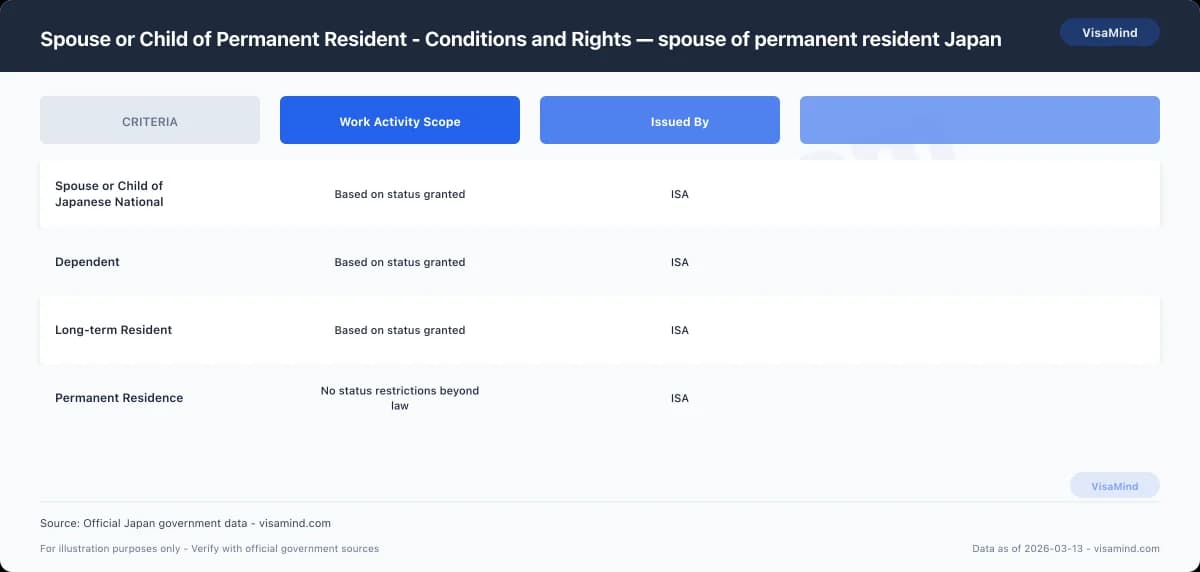
| Status of Residence | Work Activity Scope | Issued By |
|---|---|---|
| Spouse or Child of Japanese National | Based on status granted | ISA |
| Dependent | Based on status granted | ISA |
| Long-term Resident | Based on status granted | ISA |
| Permanent Residence | No status restrictions beyond law | ISA |
Always rely on the written decision from the ISA, not informal advice.
Entry and residency conditions
You must maintain a valid residence status at all times.
The period of stay granted by the ISA determines how long you may remain in Japan.
Your residence card will state:
- Status of residence
- Period of stay
- Date of expiration
You must apply for an extension before your period of stay expires.
If your marital relationship ends, your eligibility under that status may change, and you must notify the ISA as required.
If you later qualify for Permanent Residence, you may apply separately through the ISA.
Approval depends on meeting the legal requirements in place at the time of application.
Failure to comply with the conditions of your status can affect future applications, including changes to Long-term Resident or Permanent Residence.
Renewal and Extension
#You must plan early when you extend a stay tied to a spouse status in Japan.
Long-term categories require advance coordination with your sponsor and the Immigration Services Agency of Japan (ISA).
Timing for long-term stays
If you hold or plan to continue under a long-term status such as Spouse or Child of Japanese National, Long-term Resident, or another residence category that allows extended stay, your sponsor in Japan must secure a Certificate of Eligibility (CoE) before you submit your Form Visa Application.
ISA processes the CoE before you proceed with the next step.
This stage alone can take 1–3 months, so you should begin preparations well before your current period of stay ends.
Use this timeline as a planning guide:
| Step | Action | Authority | Estimated Time |
|---|---|---|---|
| 1 | Sponsor applies for Certificate of Eligibility | ISA | 1–3 months |
| 2 | You submit Visa Application based on CoE | ISA | Check ISA for current processing times |
Do not wait until the last weeks of your status.
Delays at the CoE stage affect everything that follows, including transitions from categories such as Dependent or other temporary statuses.
Sponsor obligations for extensions
Your sponsor plays a central role in any extension tied to a marital relationship.
For long-term stays, your sponsor must:
- Apply for the Certificate of Eligibility with ISA
- Provide required supporting documentation to ISA
- Complete the process before you submit your Visa Application
ISA will not move forward without a properly issued CoE for long-term residence purposes.
This requirement applies regardless of whether you seek to continue under a spouse-based category or shift from another status such as Working Holiday Visa or Dependent to a longer-term residence category.
If you later pursue Permanent Residence, review the current requirements directly with ISA before filing.
Required Documents
#You must submit specific identity documents, correctly completed forms, and compliant photographs.
Incomplete forms or incorrect photos often cause delays with the Immigration Services Agency of Japan (ISA).
Core identity documents
You need a valid passport when filing your Form Visa Application. The passport confirms both your identity and nationality, and it must be valid at the time you submit your application.
Depending on your nationality, different numbers of forms and photos are needed:
| Applicant Category | Visa Application Forms Required | Photographs Required |
|---|---|---|
| Most nationalities | 1 | 1 |
| Russia, CIS countries, or Georgia | 2 | 2 |
Every required section of the form must be completed. Don’t leave mandatory fields blank.
You must also sign the form before submission. An unsigned application simply won’t proceed.
If you’re applying as a Spouse or Child of Japanese National, Dependent, Long-term Resident, or for Permanent Residence, make sure you use the form that matches your requested status. Using the wrong visa category can slow things down.
The ISA (出入国在留管理庁) reviews your identity documents alongside your application details. Any inconsistency between your passport and the form will likely delay the review.
Photos and form requirements
Your photograph must meet specific requirements. Many applications get stuck because the photo doesn’t comply.
Photos must meet all of the following:
- Size: 4.5 cm × 4.5 cm
- Background: Plain white
- Taken within: Last 6 months
- No hats or sunglasses
Applicants from Russia, CIS countries, or Georgia need to submit two identical photos.
Don’t use edited images, photos with shadows, or colored backgrounds. Even small deviations in size can cause rejection.
Attach the photo in the designated space on the form. The image should be clear and undamaged.
Every section of the Visa Application form must be completed accurately. If something doesn’t apply, follow the form’s instructions instead of leaving it blank.
Supporting evidence to submit
You need to submit all required evidence along with your passport, form, and photograph. ISA won’t process incomplete files.
Supporting documents must match your visa category. For example:
- Spouse or Child of Japanese National
- Dependent
- Long-term Resident
- Permanent Residence
The evidence you provide must align with the status you’re requesting. Submitting the wrong documents for your category can cause delays.
Check that all required documents are included before you file. Missing documents often result in processing delays or requests for more information.
Path to Permanent Residence
#Moving from a spouse-based status to Permanent Residence is possible if you keep meeting ISA requirements and maintain lawful residence. Your current status, stability in Japan, and compliance with immigration rules all play a role in the timing.
Common next steps
If you hold Spouse or Child of Japanese National, Dependent, or Long-term Resident status, you may apply for Permanent Residence through the Immigration Services Agency (ISA).
A formal Form Visa Application for change of status or permanent residence must be filed with the ISA. The agency checks your residence history, activities, and legal compliance.
Common pathways include:
| Current Status | Typical Direction Toward PR |
|---|---|
| Spouse or Child of Japanese National | Direct application for Permanent Residence if eligibility is met |
| Long-term Resident | Application for Permanent Residence after continued lawful stay |
| Dependent | Change to a more independent status before seeking Permanent Residence |
| Working Holiday Visa | Change to an eligible mid- to long-term status before pursuing Permanent Residence |
You must keep your status valid at all times. Overstays or unauthorized work can affect your eligibility.
Timing toward PR
Your timeline depends on your current residence status and how long you’ve lived in Japan under that status.
ISA looks at several factors:
- Length and continuity of your stay
- Stability of your marital relationship, if applying as a spouse
- Compliance with immigration laws
- Financial and residential stability
If you entered on a Working Holiday Visa, you must first change to a qualifying mid- to long-term status, such as Spouse or Child of Japanese National or Long-term Resident, before applying for Permanent Residence.
Submit your application to the Immigration Services Agency when you meet the residence and status requirements. processing times and document requirements can change, so check the latest standards with ISA before applying.
Application Process
#Apply under the correct status category and follow the instructions from the Immigration Services Agency of Japan (ISA). Mistakes in category selection or form preparation can delay or prevent approval.
Review instructions and download forms
Start by identifying your exact status of residence. Spouses of Japanese nationals usually apply under Spouse or Child of Japanese National. Spouses of Permanent Residence holders may apply as a Dependent or sometimes as a Long-term Resident.
Each category has its own requirements and forms. Review the instructions issued by the Immigration Services Agency of Japan (ISA) before completing your Form Visa Application.
Follow this sequence:
-
Confirm your eligibility category.
-
Download the correct forms for that status.
-
Review document checklists in the official instructions.
-
Prepare your application exactly as required.
This table helps clarify distinctions:
| Status Category | Typical Applicant | Key Purpose |
|---|---|---|
| Spouse or Child of Japanese National | Married to a Japanese citizen | Residence based on marriage |
| Dependent | Spouse of a foreign national with valid status (e.g., Permanent Residence, work status) | Residence tied to sponsor’s status |
| Long-term Resident | Special family or humanitarian cases | Discretionary residence status |
If you’re changing status from within Japan, check whether your current status (for example, Working Holiday Visa) allows a status change under ISA rules. Always use the official ISA guidance for the most current forms and filing details.
Short-stay alternatives (eVISA)
If you plan a temporary visit before applying for a long-term status, see if you qualify for the Japan eVISA system for short-stay tourism.
The eVISA is available to certain nationalities for short-term visits. It doesn’t grant residence as a spouse, Dependent, Long-term Resident, or Permanent Residence holder.
Before going to an embassy or consulate, confirm:
- If your nationality qualifies for eVISA
- That your travel purpose fits short-stay tourism
- That you don’t intend to reside long term under that entry
Use eVISA only for temporary stays. If you plan to live in Japan with your spouse, apply for the appropriate long-term status through the Immigration Services Agency (ISA) under the right residence category.
Eligibility Requirements
#You need formal immigration approval before submitting your Form Visa Application. Eligibility depends on getting a Certificate of Eligibility and meeting the correct sponsor and residence category rules under the Immigration Services Agency of Japan (ISA).
Certificate of Eligibility requirement
You must obtain a Certificate of Eligibility (COE) before applying for a Japan spouse visa linked to Permanent Residence. A regional office of the Immigration Services Agency of Japan (ISA) issues this certificate.
The COE confirms you meet requirements for your residence status. ISA reviews your application under the correct category, such as:
- Spouse or Child of Japanese National
- Spouse or Child of Permanent Resident
- Dependent
- Long-term Resident
Apply under the category that matches your legal relationship and your sponsor’s status. Review the criteria for your exact status before you file.
Submitting the wrong COE category can lead to refusal. The COE isn’t a visa; it’s proof that you qualify for the status you’re requesting.
| Requirement | Key Point |
|---|---|
| Issuing authority | Immigration Services Agency of Japan (ISA) |
| Purpose | Confirms eligibility for a specific residence status |
| Required for | Visa Application under spouse-related categories |
Sponsor and category rules
Your sponsor’s immigration status sets the residence category you can use. You can’t choose a category that doesn’t match your sponsor’s legal position in Japan.
For a Japan spouse of PR visa, your sponsor must hold Permanent Residence. In that case, you apply under Spouse or Child of Permanent Resident.
If your spouse holds another status, such as a Working Holiday Visa, you do not qualify under the Permanent Resident spouse category. You may need to apply as a Dependent instead, if eligible.
ISA checks:
- The sponsor’s current residence status
- The legal validity of your marriage
- Whether your category matches the sponsor’s status
Submitting under the wrong category leads to refusal or delays. Always confirm your sponsor’s exact status before filing your COE and Visa Application.
Relationship Scrutiny Red Flags
#The Immigration Services Agency of Japan (ISA) checks your Form Visa Application for accuracy and completeness. Small inconsistencies or missing mandatory documents can lead to refusal, even if your marriage is genuine.
Incomplete or inconsistent information
ISA compares every detail across your forms and supporting documents. If your passport number, name spelling, dates, or address history don’t match exactly, officers may question your application.
Common problem areas:
- Different spellings of your name across forms
- Mismatched passport numbers or expiration dates
- Conflicting dates for marriage or cohabitation
- Inconsistent answers between a prior status (such as Working Holiday Visa or Dependent) and your current application
Use the exact information from your passport and official records.
If you previously held a status such as Spouse or Child of Japanese National, Long-term Resident, or another residence status before applying for Permanent Residence, make sure all past status details match ISA records.
| Risk Area | What ISA Checks | What You Should Do |
|---|---|---|
| Identity details | Passport number, full legal name | Copy directly from passport |
| Status history | Prior residence status | Match prior approvals exactly |
| Personal history | Dates and addresses | Review for consistency |
Review every page before submission. Even minor errors can create doubt.
Missing mandatory certificates
ISA requires a Certificate of Eligibility (CoE) for long-term residence categories. If you apply without it where required, ISA may refuse your application.
You typically need a CoE when applying for:
- Work-related statuses
- Student status
- Dependent status
- Other long-term residence categories
The CoE must be issued by the Immigration Services Agency before you submit your Visa Application abroad. Marriage alone doesn’t remove this requirement.
If you’re changing status inside Japan, check if a CoE is required for your category before filing. Always verify document requirements with ISA to avoid preventable rejection.
Fees
#| Component | Amount |
|---|---|
| Application feeExtracted from guide content — verify against official source | ¥4,000 (approx $27 USD) |
Fees change; always verify on ISA.