
Overview — Japan permanent residence
#
Japan permanent residence gives you an open-ended status with no activity restrictions and no need to renew your period of stay.
The Immigration Services Agency of Japan (ISA) reviews and decides all permanent residence (Form PR Application) cases.
What the status allows
Permanent residence removes the limitations tied to work-based or family-based statuses.
You’re not required to match your activities to a specific category such as Engineer/Specialist in Humanities/International Services, Highly Skilled Professional, or Specified Skilled Worker (i).
With permanent residence, you can:
- Work in any field without changing your status
- Change employers freely
- Engage in multiple activities (employment, business, study)
- Remain in Japan indefinitely, subject to re-entry rules
- Sponsor certain family members under applicable statuses
Your residence card will list your status as permanent resident, not a time-limited category.
You still need to comply with Japanese law, maintain proper registration, and follow ISA procedures for re-entry and address changes.
Permanent residence isn’t the same as statuses such as Long-term Resident or Spouse or Child of Permanent Resident, which require renewal and have specific eligibility conditions.
| Feature | Permanent Resident | Work or Family Status |
|---|---|---|
| Period of stay | Indefinite | Fixed term |
| Activity restrictions | None | Limited to status scope |
| Renewal required | No | Yes |
| ISA approval needed for job change | No | Often yes |
Typical pathways
You qualify for permanent residence only if you already hold a valid residence status.
ISA evaluates your current status, length and stability of stay, conduct, and compliance history.
Common starting points include:
- Highly Skilled Professional
- Engineer/Specialist in Humanities/International Services
- Specified Skilled Worker (i)
- Long-term Resident
- Spouse or Child of Permanent Resident
Your pathway affects how you structure your PR Application.
Applicants under Highly Skilled Professional status often rely on documented professional qualifications and employment records.
Spouses focus on family registration and proof of relationship.
You submit your PR Application to ISA with supporting documents that show:
- Continuous lawful residence
- Financial stability
- Tax and social insurance compliance
- Good conduct
ISA makes the final determination based on your full record, not just your current visa category.
Application Process
#You must file the official “Permanent Residence” application with the Immigration Services Agency of Japan (ISA).
Prepare the correct form, secure a qualified guarantor, and maintain valid status during the 6–12 month review period.
Preparing the form and instructions
Always use the latest version.
Review the instructions that match your current status of residence.
This includes categories such as:
- Long-term Resident
- Spouse or Child of Permanent Resident
- Highly Skilled Professional
- Engineer/Specialist in Humanities/International Services
- Specified Skilled Worker (i)
Complete every required section accurately.
Sign the form where indicated and attach all required evidence.
If your stay relates to work or another long-term purpose, you may first obtain a Certificate of Eligibility through the regional office of the ISA before applying for a visa.
Follow the instructions that apply to your situation.
Filing a Form PR Application does not guarantee approval.
You must meet the eligibility requirements for your current status category.
| Step | What You Must Do | Key Point |
|---|---|---|
| 1 | Download current form | Use official ISA version |
| 2 | Check category instructions | Match your status type |
| 3 | Complete and sign | Do not leave blanks |
| 4 | Attach required evidence | Follow ISA checklist |
Guarantor and supporting evidence
You must appoint a Japanese guarantor (身元保証人).
Without a guarantor, ISA will not process your application.
Your guarantor is often:
- Your employer
- Your Japanese spouse
- Another qualified individual residing in Japan
The guarantor submits:
- A letter of guarantee
- Tax certificates
- Proof of income
You must also submit the supporting documents listed in the official instructions for your status category.
Missing documents delay processing or result in rejection.
A common reason for refusal is expired or soon‑to‑expire status.
Your current residence status—whether Highly Skilled Professional, Engineer/Specialist in Humanities/International Services, Specified Skilled Worker (i), or another category—must remain valid during processing.
If your period of stay will expire, apply for an extension before it lapses.
Submission, checks and outcome
Submit your completed PR Application and supporting documents to the appropriate ISA office as directed in the official instructions.
Confirm the correct submission method before filing.
Processing typically takes 6 to 12 months or longer.
During this period:
- You may continue working and living in Japan.
- Your current residence status must remain valid at all times.
- You must comply with the conditions of your existing status.
ISA reviews your application and supporting evidence.
If ISA requires additional documents, respond promptly and completely.
Delays in responding can extend processing times.
Always verify current procedures and updates directly with the Immigration Services Agency of Japan (出入国在留管理庁) before submission.

Fees and Processing Times
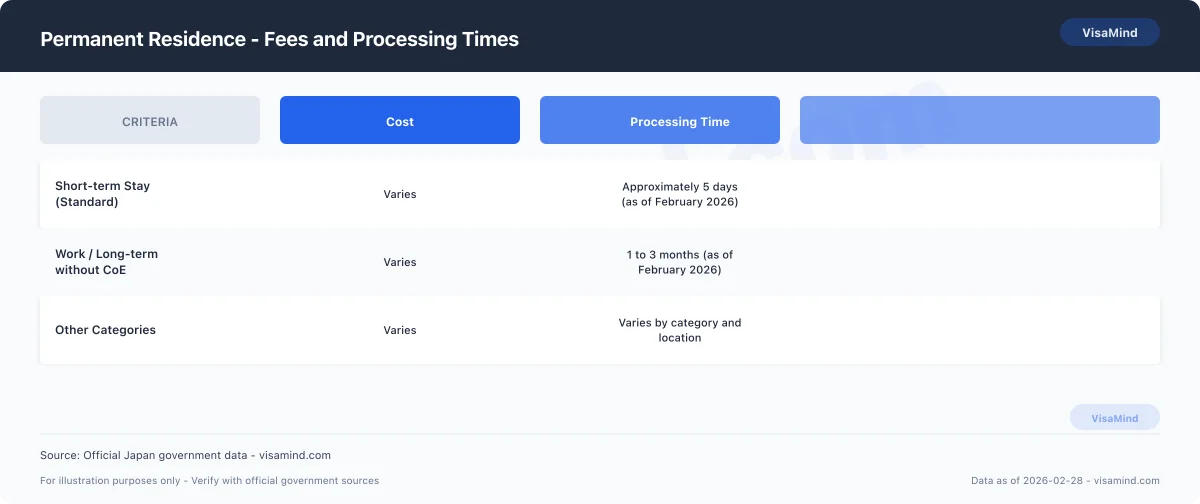
#You pay a government fee when your permanent residence is approved, and you should expect several months of processing.
The exact timeline depends on your status category and the Immigration Services Agency of Japan (ISA) office handling your Form PR Application.
Application fee
You must pay a ¥10,000 fee for your permanent residence application once the Immigration Services Agency (ISA) approves it.
This fee applies regardless of your current status, including:
- Highly Skilled Professional
- Engineer/Specialist in Humanities/International Services
- Specified Skilled Worker (i)
- Long-term Resident
- Spouse or Child of Permanent Resident
You do not pay the ¥10,000 at the time of initial filing.
You pay after approval, following instructions from ISA.
| Item | Amount (JPY) | When You Pay |
|---|---|---|
| Permanent Residence Application Fee | ¥10,000 | After approval |
Fees can change.
Confirm the current amount with the Immigration Services Agency (ISA) before you prepare your payment.
Processing time ranges
Under the standard route, permanent residence applications take 6 to 12 months to process as of March 2026.
Your actual timeline depends on:
- Your current residence status (for example, Highly Skilled Professional or Spouse or Child of Permanent Resident)
- The complexity of your case
- The ISA office reviewing your PR Application
Applications filed under categories such as Engineer/Specialist in Humanities/International Services or Specified Skilled Worker (i) may experience different processing times depending on workload and documentation.
| Application Type | Typical Processing Time |
|---|---|
| Standard Permanent Residence | 6–12 months |
ISA processes all permanent residence applications.
You should verify current processing times directly with the Immigration Services Agency before filing, as timeframes vary by location and case volume.
Your Rights as a Permanent Resident
#Permanent residence gives you stability in Japan, but it also requires strict compliance with tax and legal duties.
You gain broad freedom in daily activities while remaining accountable to the Immigration Services Agency of Japan (ISA) for ongoing eligibility.
Work, study and daily life
As a permanent resident, you live in Japan without being tied to a specific status such as Engineer/Specialist in Humanities/International Services, Highly Skilled Professional, or Specified Skilled Worker (i).
You no longer need to maintain the conditions attached to those categories.
You may work, change jobs, study, or manage your daily life without applying for a new work‑based status.
This flexibility also applies if you previously held Long-term Resident or Spouse or Child of Permanent Resident status.
Your status remains valid unless revoked.
ISA expects you to maintain good standing, including compliance with public obligations that were reviewed during your Form PR Application.
Keep clear records of your residence history and financial activity.
These documents matter if you later sponsor a family member or interact with ISA for any status-related procedure.
Legal and tax obligations
Tax compliance is not optional.
ISA closely reviews your municipal and national payment history, and any unpaid amounts can lead to serious consequences, including denial of a PR application or problems maintaining status.
You should maintain:
- Municipal tax certificates (課税証明書)
- Municipal tax payment certificates (納税証明書)
- National pension payment records
- 3–5 years of consistent payment history where applicable
| Record Type | Issued By | Why It Matters |
|---|---|---|
| Municipal tax certificate (課税証明書) | Local municipality | Confirms assessed income and tax amount |
| Municipal tax payment certificate (納税証明書) | Local municipality | Confirms taxes were paid |
| National pension record | Pension authority | Shows required contributions were made |
Delinquent taxes or unpaid pension contributions can result in denial or adverse action.
You must keep payments current and resolve any arrears immediately.
ISA handles immigration status matters.
You remain responsible for meeting Japanese legal and financial obligations at all times.
Maintaining PR Status
#You must preserve continuous residence and keep a qualified guarantor on record to avoid problems with your status.
Most rejections and delays stem from gaps in residence history or issues with the guarantor’s qualifications.
Continuous residence requirements
You must meet the 10-year continuous residence requirement unless you qualify for a fast-track as a Highly Skilled Professional.
If you applied under a category such as Engineer/Specialist in Humanities/International Services, Long-term Resident, Spouse or Child of Permanent Resident, or Specified Skilled Worker (i), your prior stay counts toward this requirement only if it was continuous.
Temporary trips outside Japan are acceptable.
Extended stays abroad can interrupt continuity and lead to rejection of your Form PR Application.
| Scenario | Effect on Continuity |
|---|---|
| Short, temporary absence | Generally acceptable |
| Extended stay abroad | May break continuous residence |
| 10 years in Japan | Meets standard requirement |
| HSP fast-track | May qualify with shorter period |
If you’re unsure whether your travel history affects eligibility, confirm directly with the Immigration Services Agency of Japan (ISA) before filing.
Guarantor and status validity
You must secure a guarantor who is either a Japanese national or a permanent resident.
The guarantor must have stable income.
Delays often occur when applicants submit incomplete or unqualified guarantor documents.
Prepare the following in advance:
- Proof of the guarantor’s status (Japanese national or permanent resident)
- Evidence of stable income
- Relevant tax documentation
An unqualified guarantor can delay or undermine your PR Application.
Review the ISA requirements carefully and confirm that your guarantor’s financial records are complete and current before submission.
Renewing Your PR Card
#Permanent residence does not expire, but your residence card must remain valid and your status can be lost in specific situations.
You must manage travel carefully and maintain truthful records with the Immigration Services Agency of Japan (ISA).
Re-entry and long absences
If you stay outside Japan for more than one continuous year without a valid re-entry permit, ISA can cancel your permanent resident status.
This rule applies regardless of how you qualified for PR.
It does not matter whether you previously held a status such as:
- Highly Skilled Professional
- Engineer/Specialist in Humanities/International Services
- Specified Skilled Worker (i)
- Long-term Resident
- Spouse or Child of Permanent Resident
Once you become a permanent resident, the key issue is how long you remain outside Japan and whether you secured proper re-entry authorization before departure.
If you plan extended travel, confirm your re-entry status with ISA before leaving Japan.
Do not assume that prior visa history or a pending Form PR Application protects you.
| Situation | Risk to PR Status |
|---|---|
| Outside Japan over 1 year without re-entry permit | Revocation possible |
| Outside Japan under 1 year with proper permission | No issue stated |
Keep travel records and confirm entry and exit dates.
ISA evaluates continuous absence, not your intent.
When status can be revoked
ISA may revoke permanent residence if you provided false or misleading information in your PR Application.
This covers inaccurate statements about your identity, immigration history, or background information.
The issue isn't limited to your current status. Even if you transitioned from Highly Skilled Professional or Spouse or Child of Permanent Resident, prior misrepresentation can affect your permanent residence.
ISA has authority to review the accuracy of your application materials. If they determine approval relied on false information, they can cancel your status.
| Grounds for Revocation | Authority |
|---|---|
| False information in PR Application | Immigration Services Agency of Japan (ISA) |
| Continuous absence over 1 year without re-entry permit | ISA |
Submit complete and accurate information at every stage of your immigration history.
Permanent residence remains secure only if you maintain compliance with ISA requirements.
When to Get Help
#Certain issues lead to automatic denial if you handle them incorrectly.
Criminal records and undisclosed immigration violations require careful disclosure and documentation before you submit your Form PR Application to the Immigration Services Agency of Japan (ISA).
Criminal or disclosure issues
If you have any criminal record, even minor, you should seek legal guidance before filing.
ISA reviews background information closely. If you fail to disclose a past conviction or immigration violation and ISA discovers it during review, your application will be denied automatically.
You must disclose:
- Any criminal conviction in Japan or abroad
- Any past overstay
- Any unauthorized work
- Any prior status violations
This applies regardless of your current status, including:
| Current Status | Disclosure Required? |
|---|---|
| Long-term Resident | Yes |
| Spouse or Child of Permanent Resident | Yes |
| Highly Skilled Professional | Yes |
| Engineer/Specialist in Humanities/International Services | Yes |
| Specified Skilled Worker (i) | Yes |
An attorney can help you assess the seriousness of the issue and prepare a written explanation.
They'll help organize supporting documents and present full and accurate disclosure.
Do not omit information. ISA treats nondisclosure more severely than the violation itself.
Complicated immigration histories
Get help if your immigration record includes multiple status changes or prior compliance problems.
Examples include:
- Several changes of residence status
- A past denial of extension or change of status
- A previous withdrawal of an application
- Periods where your status was close to expiration
If you moved between categories such as Highly Skilled Professional, Engineer/Specialist in Humanities/International Services, or Specified Skilled Worker (i), your timeline must remain consistent and lawful.
ISA reviews your full stay history when assessing your PR Application.
Any gaps, inconsistencies, or missing records raise concerns.
A professional can reconstruct your status timeline and identify potential red flags.
They'll ensure all prior issues are fully disclosed and align your documents with ISA expectations.
When your history isn't straightforward, precise documentation determines the outcome.
Path to Citizenship
#Permanent residence gives you indefinite stay in Japan, but it doesn't grant nationality.
If you want a Japanese passport, you must apply for naturalization through the Immigration Services Agency (ISA) and meet separate legal requirements.
Naturalization as a next step
Naturalization is a separate legal process from a Form PR Application.
You apply to the Immigration Services Agency of Japan (ISA), which reviews your eligibility and supporting documents.
You must generally show:
- Continuous residence in Japan for a required period
- Stable income or financial support
- Good conduct and compliance with tax and social insurance obligations
- Proper residence status history (for example, Engineer/Specialist in Humanities/International Services, Highly Skilled Professional, Long-term Resident, or Spouse or Child of Permanent Resident)
- No serious immigration violations
Your current status matters.
Time spent under Highly Skilled Professional or work categories such as Engineer/Specialist in Humanities/International Services may support a stable residence record.
Time under Specified Skilled Worker (i) may be treated differently depending on your circumstances, and you must confirm details directly with ISA.
You submit your application to ISA and attend interviews if requested.
ISA makes the final decision on approval.
Common timelines
There is no single processing time that applies to every case.
ISA evaluates naturalization applications individually based on your residence history, tax records, employment, and family situation.
Your timeline depends on factors such as:
- Length and continuity of residence
- Changes in status (for example, from Specified Skilled Worker (i) to a work visa, then to permanent resident)
- Marriage to a Japanese national or status as Spouse or Child of Permanent Resident
- Gaps in pension, tax, or social insurance payments
Many applicants first secure permanent residence, then apply for naturalization after building a longer record of stable living in Japan.
Others move directly from a work status, such as Highly Skilled Professional, if they meet the legal residence threshold.
For current eligibility criteria and procedural details, review the official guidance published by the Immigration Services Agency of Japan (ISA).
Who Qualifies — Japan PR
#You qualify for Permanent Residence based on how long you've lived in Japan and the status you hold.
Most applicants qualify through long-term residence, while Highly Skilled Professionals can apply much sooner if they meet a strict points threshold.
Standard residence periods
Most applicants must show more than 10 years of continuous residence in Japan.
Within those 10+ years, you must have spent at least 5 years under a work or family-based status, such as:
- Engineer/Specialist in Humanities/International Services
- Specified Skilled Worker (i)
- Long-term Resident
- Spouse or Child of Permanent Resident
“Continuous residence” means you have maintained valid status without gaps.
Your stay must be lawful and properly documented with the Immigration Services Agency of Japan (ISA).
Use this as a baseline:
| Requirement | Standard Route |
|---|---|
| Total residence in Japan | 10+ years |
| Time on work or family status | 5+ years |
| Acceptable statuses | Work or family-based categories |
You apply for PR directly with the ISA once you meet these residence benchmarks.
If your status history doesn't clearly meet the 10-year and 5-year thresholds, you should wait until it does before filing your Form PR Application.
Highly Skilled Professional fast-track
If you hold Highly Skilled Professional (HSP) status, you may qualify much faster.
Applicants who score 80 points or more under Japan’s Highly Skilled Professional points system can apply for Permanent Residence after just 1 year of residence.
| Requirement | HSP Fast-Track |
|---|---|
| Status | Highly Skilled Professional |
| Points threshold | 80+ points |
| Minimum residence | 1 year |
This route shortens the timeline compared to the standard 10-year path.
You must maintain HSP status and meet the required points level at the time you apply.
If you qualify under this fast-track, you file your PR Application with the ISA once you complete the one-year residence period and confirm your 80+ point score.
Why PR Applications Fail
#Most refusals stem from missing financial records or preventable filing errors.
You can avoid many problems by preparing documents early and confirming your payment history before you submit your Form PR Application to the Immigration Services Agency of Japan (ISA).
Common refusal reasons
The most frequent reason for refusal is an incomplete tax or national pension payment history.
ISA expects you to show consistent payment records for the required period.
If you cannot produce official certificates or your records show unpaid amounts, ISA may deny your PR Application.
Typical issues include:
- Missing 3–5 years of tax certificates
- Gaps in national pension payments
- Unpaid or late payments at the time of filing
- Submitting estimates instead of official proof
These problems affect applicants across statuses, including:
| Current Status | Risk Factor |
|---|---|
| Highly Skilled Professional | Incomplete multi‑year tax record |
| Engineer/Specialist in Humanities/International Services | Pension payment gaps |
| Long-term Resident | Missing local tax certificates |
| Spouse or Child of Permanent Resident | Unpaid national pension |
| Specified Skilled Worker (i) | Short or inconsistent payment history |
ISA reviews your actual payment record, not your intent to pay.
How to avoid delays and rejections
Start preparing several months before you file.
First, obtain official tax certificates covering the required 3–5 years.
Request national pension payment records for the same period and check for gaps.
If you find unpaid amounts, pay them before submitting your PR Application.
Keep proof of payment.
Follow this sequence:
-
Request tax certificates from your local municipality.
-
Obtain your national pension payment record.
-
Confirm there are no unpaid or late entries.
-
Resolve any outstanding balances.
-
Submit complete, official documentation with your application.
Do not assume ISA will overlook small gaps.
Even applicants under stable categories such as Highly Skilled Professional or Spouse or Child of Permanent Resident face refusal if their financial record is incomplete.
Accuracy and complete documentation protect your application.
Fees
#| Component | Amount |
|---|---|
| Application feePermanent residence (expected to increase in FY2026) | ¥10,000 (approx $67 USD) |
Fees change; always verify on ISA.