
What the Specified Skilled Worker (ii) Covers — Japan Specified Skilled Worker ii
#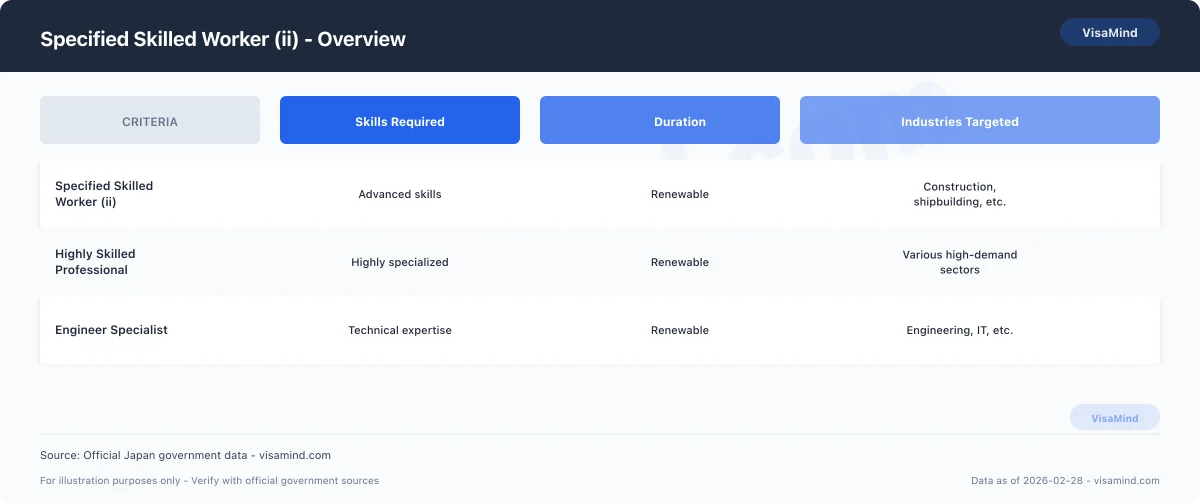
Specified Skilled Worker (ii) is for experienced foreign workers who have advanced skills in designated industries. It builds on Specified Skilled Worker (i) and offers broader stay options and more stability for you and, in some cases, your family.
Who the status is for
Specified Skilled Worker (ii) is meant for foreign nationals who have gone beyond the entry-level stage of Specified Skilled Worker (i) and can show higher technical ability in an eligible field.
You typically qualify if you:
- Hold or previously held Specified Skilled Worker (i) status in the same field, or
- Pass the required advanced skill exam for a designated industry, and
- Meet Japanese language requirements set for that field, and
- Secure a contract with a Japanese employer.
The Immigration Services Agency of Japan (ISA) reviews your eligibility during your Certificate of Eligibility (CoE) Application or change of status application.
This status is separate from categories like:
- Engineer/Specialist in Humanities/International Services (professional or academic roles)
- Technical Intern Training (training-based, limited scope)
- Highly Skilled Professional (points-based system)
- Long-term Resident (based on personal or family circumstances)
You’re limited to working within the authorized industry and role approved by ISA.
Designated industries and skills testing
Specified Skilled Worker status is organized around designated industries rather than a single occupation. The government sets which fields accept skilled workers, and each field carries its own skill standard.
Designated industries under the Specified Skilled Worker program include fields such as construction, manufacture of industrial products, automobile repair and maintenance, shipbuilding and ship machinery, fishery and aquaculture, agriculture, food and beverage manufacture, and food service; however, within the manufacture of industrial products field, only the machining/metal processing (機械金属加工), electrical/electronic assembly (電気電子機器組立て), and metal surface treatment (金属表面処理) business categories are eligible under Specified Skilled Worker (ii). Automobile repair and maintenance is its own designated field, not a sub-category of manufacturing. The exact fields eligible for Specified Skilled Worker (ii) are set by regulation, so confirm the current designated industry list with the Immigration Services Agency of Japan (ISA) before you apply. See Work in Japan for how this route compares with the other ways to take up employment in Japan.
Specified Skilled Worker (ii) sits at the top of that structure. Where Specified Skilled Worker (i) admits skilled workers who can carry out assigned tasks, the (ii) level is built for workers who direct the work of others, and each designated industry measures that through its own advanced skills proficiency standard.
To qualify, most applicants pass a skills proficiency exam for their designated industry and, where the field requires it, show Japanese language proficiency through a recognized language exam. Passing the higher-level skills exam is the main way to demonstrate the advanced ability that separates Specified Skilled Worker (ii) from Specified Skilled Worker (i). Immigration screening then checks that your exam results, experience, and job offer all match the field you name in your application.
Key characteristics
Specified Skilled Worker (ii) provides greater stability than Specified Skilled Worker (i). It’s designed for workers who can operate with a high level of independence and responsibility.
Key features include:
- Employment in an approved designated industry
- Ability to renew your period of stay without the fixed maximum applied to Specified Skilled Worker (i)
- Eligibility, where permitted, to bring qualifying family members
- Continued employer sponsorship and compliance obligations
Your employer must maintain proper labor conditions and follow reporting rules required by ISA.
Below is a practical comparison:
| Feature | Specified Skilled Worker (i) | Specified Skilled Worker (ii) |
|---|---|---|
| Skill level | Basic operational skills | Advanced, experienced level |
| Stay renewals | Limited cumulative period | Renewable without the same fixed cap |
| Family members | Generally not permitted | Permitted if requirements are met |
| Career stage | Entry to mid-level | Experienced worker |
You must still complete a Form CoE Application (if applying from abroad) and a Form Visa Application at a Japanese embassy or consulate, or apply for a change of status if you’re already in Japan.
ISA makes the final decision on your status grant and period of stay.
Quick timeline note
Japan introduced Specified Skilled Worker (ii) after launching Specified Skilled Worker (i) to address long-term labor needs in certain industries.
The government later expanded the scope of industries eligible for Specified Skilled Worker (ii). The exact industries and current requirements are determined by regulation and administered by ISA.
You should confirm the current designated fields and testing standards through ISA materials before you begin your CoE Application or Visa Application. Policies can change, and eligibility depends on the rules in effect at the time you apply.
Official sources: https://www.moj.go.jp/isa/applications/status/specifiedskilledworker.html
Skills Proficiency Exams and Japanese Language Requirements
#Specified Skilled Worker (ii) is an exam-led status. You prove advanced ability through a skills proficiency exam tied to one designated industry, not through a general qualification that carries across fields.
The advanced skills proficiency exam
Each designated industry publishes its own skills proficiency standard, and the ministry that oversees that field runs the exam. For Specified Skilled Worker (ii), the test sits above the entry-level exam used for Specified Skilled Worker (i): it asks whether you can plan work, supervise other skilled workers, and carry responsibility for quality and safety.
Taking the designated fields listed earlier in this guide, the table below sets out what the advanced exam generally adds on top of the entry-level test in each one. Treat it as orientation rather than a syllabus: exam content is set field by field by the ministry that runs the test, and the authoritative field list is published by the Immigration Services Agency and the Ministry of Foreign Affairs.
| Designated field | What the advanced exam typically adds |
|---|---|
| Construction | Site supervision, process management, safety control |
| Manufacture of industrial products | Production line management, quality control, defect analysis |
| Automobile repair and maintenance | Advanced diagnosis, inspection work, workshop supervision |
| Shipbuilding and ship machinery | Welding and fitting to specification, work planning |
| Fishery and aquaculture | Operation planning, stock and equipment management |
| Food and beverage manufacture | Hygiene management, process and staff oversight |
Not every field open to Specified Skilled Worker (i) is open at the (ii) level, and within the manufacture of industrial products field, only the machining/metal processing (機械金属加工), electrical/electronic assembly (電気電子機器組立て), and metal surface treatment (金属表面処理) business categories are covered under Specified Skilled Worker (ii). Nursing care, for example, sits outside the Specified Skilled Worker (ii) scope and is handled under separate arrangements. The designated field list and the exams attached to it are set by regulation and have been revised as the program expanded, so confirm the current fields and the exam schedule for yours with ISA before you commit to a route.
Practical experience alongside the exam
Passing the exam is not always the whole test. Several fields also expect documented practical experience in a supervisory or lead role — time recorded as a site foreman in construction, for instance — and your employer has to be able to evidence it.
You'll generally need to show:
- A pass certificate from the advanced skills proficiency exam for your designated field
- An employment contract for work inside that same field
- Records of your practical experience, issued by the employer who supervised it
- Where the field requires it, evidence of Japanese language ability
ISA reads these together. An exam pass that doesn't line up with the job your sponsor describes is a common source of follow-up questions.
Japanese language proficiency at the (ii) level
Entry into the Specified Skilled Worker system normally involves a Japanese language test — commonly the JFT-Basic (Japan Foundation Test for Basic Japanese) or the Japanese Language Proficiency Test (JLPT) — or completion of Technical Intern Training, which can remove the need to re-test.
At the Specified Skilled Worker (ii) level the emphasis shifts. Because you have usually already cleared the language bar to reach Specified Skilled Worker (i), many fields do not impose a further separate language exam for (ii), and screening concentrates on the advanced skills test instead. Language expectations are still set field by field, so treat Japanese language proficiency as something to confirm rather than assume.
Practical proficiency matters either way. Supervisory work in a designated industry means giving instructions, reading procedures, and handling safety paperwork in Japanese, and employers screen for that even where no certificate is demanded.
Sponsor Requirements
#Your employer in Japan leads the Certificate of Eligibility (CoE) process. You cannot file the Form CoE Application yourself from abroad, and sponsor errors often cause delays.
Who files the Certificate of Eligibility (CoE)
For a Japan Specified Skilled Worker (ii) application, the sponsor in Japan files the CoE Application with ISA.
You, as the foreign national, can’t submit the CoE directly if you’re outside Japan.
The sponsor is usually:
- A Japanese employer
- In some statuses, a school or family member (not typical for Specified Skilled Worker (ii))
For work statuses such as Specified Skilled Worker (i), Engineer/Specialist in Humanities/International Services, Technical Intern Training, Highly Skilled Professional, or Long-term Resident, the same principle applies: the accepting organization in Japan submits the CoE request to ISA.
Once ISA issues the CoE, you use it to apply for your Form Visa Application at a Japanese embassy or consulate abroad.
If the sponsor fails to prepare a complete application, ISA will delay processing or request more documents.
Employer documentation to include
ISA reviews both the company’s credibility and your qualifications. Missing documents are the most common reason for delays.
Your sponsor should include:
- Company registration certificate (登記事項証明書)
- Most recent financial statements
- A clear business overview document
- Evidence of your qualifications (diplomas, work history)
Use this checklist to reduce risk:
| Category | Required Evidence |
|---|---|
| Company legal status | Registration certificate |
| Company stability | Latest financial statements |
| Business activity | Written company overview |
| Your qualifications | Diplomas and employment history |
ISA checks if the company is properly established and financially viable.
ISA also looks at whether your background matches the role described in the application. If your education or work history doesn’t fit the position, ISA may question eligibility.
Incomplete submissions almost always result in additional document requests.
Regional filing and jurisdiction
The CoE Application must be filed at the ISA regional office with jurisdiction over the applicant's planned residence address when the applicant files directly, or over the accepting organization's location when a representative or accepting organization files on the applicant's behalf.
Jurisdiction depends on where the company is located, not:
- Your nationality
- Your current residence abroad
- Your intended place of residence in Japan
Filing at the wrong regional office causes delays because ISA will redirect or return the application.
Before submission, your employer should confirm:
-
The correct regional ISA office.
-
That the company address on file matches the filing jurisdiction.
-
That all supporting documents reflect the same registered address.
ISA processes applications through its regional offices, and each office handles sponsors within its geographic authority. Filing correctly the first time prevents unnecessary setbacks.
Official sources: https://www.moj.go.jp/isa/applications/procedures/16-1.html?hl=en
Family Members
#If your status permits you to bring family members, each person must complete a separate immigration process. Long‑term stays require advance approval from ISA and careful coordination with the Japanese consulate.
Who can accompany the worker
Your ability to bring family depends on the specific residence status you hold.
ISA determines eligibility based on your approved status, such as Specified Skilled Worker (i), Specified Skilled Worker (ii), Engineer/Specialist in Humanities/International Services, Highly Skilled Professional, or Long-term Resident. Each category has different rules, and you must confirm your eligibility directly with ISA guidance before starting any application.
If your status allows dependents, each family member must qualify individually for a dependent or other appropriate residence status. They cannot enter Japan long term based solely on your visa sticker.
Prior participation in Technical Intern Training or another status does not automatically permit family sponsorship. ISA reviews the current approved status, not your immigration history.
| Worker Status | Family Eligibility Determined By | Separate Application Required |
|---|---|---|
| Specified Skilled Worker (i) | ISA rules for that status | Yes |
| Specified Skilled Worker (ii) | ISA rules for that status | Yes |
| Engineer/Specialist in Humanities/International Services | ISA rules for that status | Yes |
| Highly Skilled Professional | ISA rules for that status | Yes |
Always verify current criteria with the Immigration Services Agency (出入国在留管理庁).
Long-term visa requirements for dependents
Family members who plan to stay in Japan long term must first obtain a Certificate of Eligibility (CoE).
This step is mandatory for work, study, and dependent residence statuses. Skipping the CoE often leads to refusal at the visa stage.
The process typically follows these steps:
-
Submit a Form CoE Application to ISA in Japan.
-
Wait for ISA to issue the Certificate of Eligibility.
-
File a Form Visa Application at the Japanese Embassy or Consulate in your country of residence.
A visa alone does not guarantee entry. Immigration officers at the airport or seaport make the final decision.
Your family members should carry:
- Return or onward travel details
- Accommodation information in Japan
- Proof of sufficient financial support
Officers may request these documents at inspection.
Consular timing for family applicants
Apply at the Japanese Embassy or Consulate in your country of residence at least 2–3 weeks before your planned travel date.
Standard processing is usually about 5 business days, but delays occur during peak seasons. Plan conservatively if your family intends to travel during busy periods.
Each dependent must submit a separate Visa Application after receiving their CoE. Consulates will not issue long‑term visas without a valid Certificate of Eligibility issued by ISA.
Coordinate travel carefully. Even with an approved visa, entry remains subject to inspection at the port of arrival. Prepare complete documentation and avoid last‑minute travel plans that leave no margin for processing delays.
Extending Your Work Visa — SSW 2 Japan
#You must manage your Certificate of Eligibility (CoE) carefully when extending your Specified Skilled Worker (ii) status. The CoE has a strict validity period, and timing errors can force your sponsor to start over with a new application through ISA.
CoE validity and timing
Your Certificate of Eligibility (CoE) is valid for 3 months from the date of issuance. This deadline is strict.
You must complete your Form Visa Application at the Japanese embassy or consulate within that three‑month window. If you delay beyond that period, the CoE loses its effect and you can’t use it.
| Item | Key Rule | Who Is Responsible |
|---|---|---|
| CoE validity | 3 months from issuance | You and your sponsor |
| Visa application | Must occur within 3 months | You |
| Issuing authority | Immigration Services Agency (ISA) | ISA |
Do not confuse this process with changing to another status such as Engineer/Specialist in Humanities/International Services, Highly Skilled Professional, Long‑term Resident, or moving from Technical Intern Training. Each status requires its own proper application and approval through ISA.
For SSW2, timing is the critical factor. Once ISA issues the CoE, act immediately.
What to do if the CoE expires
If your CoE expires before you apply for the visa, you cannot revive it. The document becomes unusable.
Your sponsor must submit a new Form CoE Application to ISA. You cannot simply explain the delay at the embassy to proceed.
Take these steps:
-
Confirm the expiration date printed on the CoE.
-
Inform your sponsoring employer immediately.
-
Have the sponsor re‑file a new CoE Application with ISA.
-
Wait for issuance before booking a new visa appointment.
ISA handles the review and issuance of CoEs. The embassy will not override an expired certificate.
Prior approval under Specified Skilled Worker (i) or another status does not help you bypass this rule. Each CoE stands on its own validity period.
When to start re-filing
You should monitor your timeline from the day ISA issues the CoE. Don’t wait until the final weeks to act.
Start preparing your visa application as soon as you receive the certificate. Early scheduling reduces the risk of expiration.
If you realize you can’t attend your visa appointment within the three‑month validity period, instruct your sponsor to prepare for a new CoE filing immediately. Waiting until after expiration will delay your employment start date.
ISA controls the CoE issuance process, and your embassy processes the Visa Application. You must coordinate both steps carefully to maintain your SSW2 status without interruption.
From Work Visa to PR
#You can move from a temporary work status to permanent residence if you maintain lawful stay and meet ISA requirements. Most applicants first hold another work status before qualifying for Specified Skilled Worker (ii) and then permanent residence.
Typical preceding status
You often reach Specified Skilled Worker (ii) after holding one of these:
- Specified Skilled Worker (i)
- Technical Intern Training
- Engineer/Specialist in Humanities/International Services
- Highly Skilled Professional
- Long-term Resident
Many workers begin under Specified Skilled Worker (i) and later qualify for (ii) after meeting skill and experience requirements set by the Immigration Services Agency of Japan (ISA).
Others change from Technical Intern Training if they meet the criteria for a skilled role in an eligible field.
If you hold Engineer/Specialist in Humanities/International Services, you may switch statuses when your job aligns with an approved Specified Skilled Worker field.
The same applies if you currently hold Highly Skilled Professional or Long-term Resident, provided you satisfy the category requirements.
To change status inside Japan, you file a status change application with the ISA.
If you apply from abroad, your employer first obtains a Certificate of Eligibility (CoE), then you submit your Form Visa Application at a Japanese embassy or consulate.
| Current Status | Typical Action | Authority |
|---|---|---|
| Specified Skilled Worker (i) | Apply for change to (ii) | ISA |
| Technical Intern Training | Apply for change if eligible | ISA |
| Engineer/Specialist in Humanities/International Services | Change status if job qualifies | ISA |
| Highly Skilled Professional | Change status if moving fields | ISA |
Common next steps
After obtaining Specified Skilled Worker (ii), you can work without the renewal limits that apply to (i).
This long-term stability often positions you to pursue permanent residence (PR).
You apply for PR directly with the Immigration Services Agency (ISA) while residing in Japan under a valid status.
You must maintain lawful residence and comply with the conditions of your current status at the time of filing.
The process typically involves:
-
Preparing required supporting documents.
-
Filing a permanent residence application with the ISA.
-
Waiting for review while maintaining your valid status.
If you later change employers, you may need to update your status details with the ISA.
If you leave Japan and re-enter, ensure your residence status remains valid.
| Stage | What You File | Where |
|---|---|---|
| Change to Specified Skilled Worker (ii) | Status change or Form CoE Application | ISA |
| Entry from abroad | Visa Application (after CoE) | Japanese embassy/consulate |
| Permanent Residence | PR application | ISA |
Fees and Processing Times
#You pay a fixed government fee for visa issuance.
Expect several weeks to a few months for processing under standard handling.
Processing speed depends on your category and the regional office of the Immigration Services Agency of Japan (ISA).
Visa issuance fee
You must pay a ¥6,000 visa issuance fee for the Specified Skilled Worker (ii) visa as of February 2026.
This fee applies to a multiple-entry visa.
You pay the fee at the time of visa issuance after your Certificate of Eligibility (CoE) Application is approved and you submit your Form Visa Application to the Japanese embassy or consulate.
The fee does not cover document preparation, translations, or professional assistance.
| Item | Amount (JPY) | Notes |
|---|---|---|
| Visa issuance fee | ¥6,000 | Multiple-entry visa |
If you change status inside Japan from Specified Skilled Worker (i), Technical Intern Training, Engineer/Specialist in Humanities/International Services, Long-term Resident, or another status, confirm with the ISA whether additional procedural fees apply.
Check the ISA for the most current fee schedule before you apply.
Standard processing range
Under standard processing, Specified Skilled Worker (ii) applications typically take 1 to 3 months as of March 2026.
This timeframe generally covers review of your Form CoE Application by the ISA.
After the ISA issues the CoE, you submit your Visa Application abroad, and the embassy or consulate completes visa issuance.
Processing times vary based on workload and document completeness.
You can reduce delays by:
- Submitting complete and consistent documents
- Matching your job duties to the approved SSW (ii) category
- Avoiding discrepancies between your CoE Application and Visa Application
Priority handling may apply in certain categories.
For example, Highly Skilled Professional CoE applications often move faster due to preferential treatment, but this does not automatically apply to Specified Skilled Worker (ii).
Variation by category and location
The processing time depends on both your industry category and the ISA regional office handling your case.
Workload differs by location.
A regional office with a high volume of Specified Skilled Worker (i) and (ii) filings may take longer than a less congested office.
The complexity of your employment history or transition from another status also affects review time.
| Factor | Impact on Timeline |
|---|---|
| ISA regional office workload | Heavier workload may extend processing |
| Category complexity | Detailed job review may increase scrutiny |
| Change from another status (e.g., Technical Intern Training) | Additional background review may apply |
| Priority categories (e.g., Highly Skilled Professional) | Often processed faster |
If you switch from Specified Skilled Worker (i) to (ii), the ISA will review whether you meet the higher requirements for long-term employment.
That review can influence timing.
Because timelines change, verify current processing estimates with the Immigration Services Agency (出入国在留管理庁) before submitting your CoE Application or scheduling relocation.
Conditions and Portability
#Your status of residence controls what you can do in Japan and whether you can stay if your job changes.
You must separate three issues: your legal status granted by the Immigration Services Agency (ISA), your admissibility at entry, and the consulate’s independent visa decision.
Visa vs entry control
A visa and a status of residence are not the same.
The visa is issued by a Japanese consulate abroad.
The status of residence, such as Specified Skilled Worker (i) or Specified Skilled Worker (ii), is granted by the Immigration Services Agency (ISA) when you land in Japan or when you change status inside Japan.
| Document | Who issues it | What it does |
|---|---|---|
| Visa | Japanese consulate | Allows you to travel to Japan and request entry |
| Status of Residence | ISA | Defines your activities and period of stay in Japan |
Under Specified Skilled Worker (ii), you hold a work-based status.
It differs from categories such as Engineer/Specialist in Humanities/International Services, Technical Intern Training, Long-term Resident, or Highly Skilled Professional.
Each status limits the type of activities you can perform.
If you change employers, your status must still match your actual work.
ISA evaluates whether your activities remain within the scope of Specified Skilled Worker (ii).
Your visa sticker alone does not control your right to stay.
Moving employers within your designated industry
Specified Skilled Worker (ii) is tied to a designated industry, not to a single company. Skilled workers in this status can generally change employers, provided the new job sits inside the same designated field your status was granted for and the new employer takes on the sponsor obligations ISA sets.
Two things have to stay true when you move:
- Your duties remain within the approved designated industry and match the skills proficiency you tested in
- Your new employer accepts the support and reporting obligations that apply to Specified Skilled Worker employment
You also have to notify ISA when your contracted organization changes. That notification is a separate step from renewing your period of stay, and missing it is treated as a compliance failure rather than a paperwork slip.
Moving outside your designated field is a different matter. It means sitting the exam for the new field, or changing to another status of residence such as Engineer/Specialist in Humanities/International Services, with its own eligibility test.
When admissibility issues matter
You must remain admissible at every stage: visa issuance, landing, and status changes.
Admissibility concerns become critical if you have:
- A criminal record
- Prior overstays or status violations in Japan
- Previous deportation or departure orders
Even if ISA approves your Certificate of Eligibility (CoE) Application, problems in your history can still affect the outcome later.
A CoE reflects ISA’s assessment of your eligibility for a specific status, not a final clearance of all entry risks.
If you previously held Technical Intern Training or Specified Skilled Worker (i) status and violated conditions, that history can affect future screening.
You must disclose prior issues accurately.
Inconsistent or incomplete information can lead to denial.
Consular decision vs CoE
A Certificate of Eligibility is not a visa.
ISA issues the CoE in Japan after reviewing your sponsor and eligibility for Specified Skilled Worker (ii).
You then submit a Form Visa Application at a Japanese consulate abroad using that CoE.
The consulate makes its own decision.
| Stage | Authority | Key Function |
|---|---|---|
| CoE review | ISA | Confirms eligibility for the requested status |
| Visa review | Japanese consulate | Determines whether to issue a visa |
| Landing inspection | ISA | Grants or refuses landing permission |
A valid CoE does not obligate the consulate to issue a visa.
The consular officer assesses your background and admissibility independently.
If the consulate refuses your visa due to criminal history or past immigration violations, the CoE does not override that refusal.
You must resolve the underlying issue before reapplying.
Application Process
#You must secure a Certificate of Eligibility (CoE) before applying for the Specified Skilled Worker (ii) visa.
Your sponsor in Japan files the CoE with the Immigration Services Agency (出入国在留管理庁) (ISA), and you then apply for the visa at the correct Japanese embassy or consulate.
Form: where to get it and who files
Download the official “Specified Skilled Worker (ii)” form and instructions from the Immigration Services Agency (ISA) website.
Use only the current version.
For long-term work statuses such as Specified Skilled Worker (ii), your sponsor in Japan must first obtain a Certificate of Eligibility (CoE) from ISA.
CoE processing typically takes 1–3 months, so start early.
After ISA issues the CoE, you file your Form Visa Application at the Japanese embassy or consulate with jurisdiction over your place of residence.
Filing at the wrong post leads to refusal.
Some applicants must submit extra visa forms:
| Nationality | Additional Requirement |
|---|---|
| Russia, CIS countries, Georgia | Two visa application forms + photographs |
| China | Family Register copy + Temporary Residence Permit or Residence Certificate |
The JAPAN eVISA system applies to short-term tourism only.
It does not replace the process for Specified Skilled Worker (ii).
Completing and signing the form
Complete every required field on the Specified Skilled Worker (ii) form exactly as shown in your passport and CoE.
Do not leave mandatory sections blank.
Review your immigration history carefully.
If you previously held Specified Skilled Worker (i), Engineer/Specialist in Humanities/International Services, Technical Intern Training, Long-term Resident, or Highly Skilled Professional, ensure the details match your ISA records.
Sign the form where required.
Unsigned forms are rejected.
Before filing, confirm:
- Your passport remains valid for your intended stay
- Your passport has blank pages for visa placement
- You apply at the correct embassy or consulate
If any information conflicts with your CoE, resolve it before submission.
ISA relies on consistency between your CoE and Visa Application.
Supporting evidence and photo rules
Submit the documents listed in the official instructions along with your CoE and completed Visa Application.
Provide any nationality-specific documents noted above.
Photo requirements are strict.
Many delays result from non-compliant photos.
Photo specifications:
- Size: 4.5 cm x 4.5 cm
- Taken within the last 6 months
- Plain white background
- No hats or sunglasses
Photos that do not meet these standards cause processing delays.
Use the checklist below before filing:
- CoE issued by ISA
- Completed and signed Specified Skilled Worker (ii) form
- Required number of visa application forms (if applicable)
- Correct photographs
- Passport meeting validity and space requirements
- Nationality-specific civil documents (if required)
If you need updated document lists or procedural changes, verify them directly with the Immigration Services Agency (ISA) or the Japanese embassy or consulate handling your case.
Eligibility Requirements
#You must qualify under a defined pathway and follow the rules that apply to that category.
The Immigration Services Agency of Japan (出入国在留管理庁) (ISA) reviews your status, prior residence history, and supporting documents before approving a Certificate of Eligibility (Form CoE Application) and subsequent Form Visa Application.
Check specific eligibility categories
Japan grants Specified Skilled Worker (ii) status only if you fit within an approved framework.
You must confirm which pathway applies to you before you prepare any forms.
Common status backgrounds that affect eligibility include:
- Specified Skilled Worker (i)
- Technical Intern Training
- Engineer/Specialist in Humanities/International Services
- Highly Skilled Professional
- Long-term Resident
Your current or previous residence status determines what evidence ISA expects.
You cannot assume that eligibility rules transfer automatically from one status to another.
Use this comparison to organize your review:
| Current or Prior Status | What You Must Verify |
|---|---|
| Specified Skilled Worker (i) | Whether you meet the qualification rules required to move to (ii) |
| Technical Intern Training | Whether your training history aligns with qualification standards |
| Engineer/Specialist in Humanities/International Services | Whether your professional scope matches the permitted activities |
| Highly Skilled Professional | Whether a status change fits your employment conditions |
| Long-term Resident | Whether your residence history affects eligibility requirements |
ISA evaluates your case based on the category you select in your CoE Application or change-of-status filing.
Review the official instructions for your specific category before you submit anything.
Documents tied to qualification rules
ISA asks for documents that directly support the qualification standards for your chosen category. You’ll need to submit evidence that matches the specific rules tied to your status.
Prepare documents such as:
- Proof of your current residence status in Japan
- Records connected to your prior status (if changing from Specified Skilled Worker (i), Technical Intern Training, or another status)
- Employer-issued documents supporting your job role
- Materials required for the CoE Application
- Documents required for the Visa Application, if applying from outside Japan
Your documents must fit the exact qualification pathway you’re claiming. If you’re relying on prior status history, include records that show continuity and compliance.
ISA reviews your file for completeness and consistency. Missing documents or mismatched categories can delay or block approval, regardless of eligibility.
When Self-Preparation Isn't Enough
#You can handle a lot of Specified Skilled Worker (ii) paperwork yourself, but some situations bring legal and procedural risks. If company records are incomplete, qualifications don’t line up, or you’ve had prior immigration issues, you’ll want a structured review before submitting a Form CoE Application or Form Visa Application to the Immigration Services Agency of Japan (ISA).
Situations that commonly need professional help
Careful review is needed when your sponsoring company’s paperwork isn’t fully organized or up to date. ISA expects consistent corporate records.
Common problem areas include:
- Missing company registration certificate (登記事項証明書)
- Outdated or incomplete financial statements
- No clear business overview document
- Inconsistent information across submitted materials
Even a small omission can slow down your CoE Application. ISA doesn’t fill in missing documents for you.
You also need to make sure your qualifications match the status of residence you’re applying for. For example:
| Status of Residence | Key Qualification Standard |
|---|---|
| Engineer/Specialist in Humanities/International Services | Relevant university degree or 10+ years of professional experience |
| Specified Skilled Worker (i) | Must meet category-specific requirements |
| Specified Skilled Worker (ii) | Must meet the requirements tied to your approved field |
If your background doesn’t clearly match the legal criteria, ISA may reject the application. A professional review can help you avoid category mismatches before filing.
Prior denials and complex cases
If ISA has denied you before, don’t resubmit without addressing the specific reason. Sending in the same documents won’t change the outcome.
Common complexity triggers include:
- Prior refusal under Specified Skilled Worker (i)
- A rejected Engineer/Specialist in Humanities/International Services application due to insufficient qualifications
- Gaps between your work history and the visa category requested
- Transitions from Technical Intern Training, Long-term Resident, or Highly Skilled Professional status with unclear eligibility alignment
You’ll need to figure out if the denial was due to incomplete employer documentation or a qualification mismatch. Each problem needs a different fix.
A structured review helps ensure your new CoE Application actually resolves the legal deficiency ISA noted.
Changing employers mid-process
Switching employers while your CoE Application or Visa Application is pending increases procedural risk. ISA evaluates the sponsoring company as part of your eligibility.
If you change employers:
-
Your new company must submit full corporate documentation.
-
Your job duties must still match the approved visa category.
-
Your qualifications must independently satisfy the status requirements.
A mismatch between your background and the new role can trigger rejection, even if your previous employer met all standards.
When moving from Specified Skilled Worker (i) to Specified Skilled Worker (ii), or between categories like Engineer/Specialist in Humanities/International Services, confirm that your credentials remain valid for the new position.
Prior approval doesn’t guarantee future approval. ISA evaluates each sponsor and role on its own.
Common Petition Challenges
#Most rejections come from mismatched information and missing documents. The Immigration Services Agency of Japan (ISA) checks your Certificate of Eligibility (CoE) application and Form Visa Application side by side. Even small discrepancies can cause refusal.
Inconsistent application information
ISA compares your Form CoE Application with your later Visa Application. If names, dates, salary, or job details differ, the case can be seen as unreliable.
You’ll need to make sure the following details match exactly across all filings:
- Full name (spelling, order, and format as shown in your passport)
- Date and place of birth
- Passport number
- Employer name and work location
- Job title and employment terms
- Salary amount and payment structure
- Contract start date
Even small differences—like abbreviating your employer’s name in one form but not the other—can raise concerns.
This crops up often when applicants previously held Specified Skilled Worker (i), Technical Intern Training, Engineer/Specialist in Humanities/International Services, Long-term Resident, or Highly Skilled Professional status and reuse older information without checking current terms. Always make sure your current employment contract matches what’s in your CoE record before submitting the Visa Application.
| Item Compared by ISA | Must Match Between CoE and Visa Application |
|---|---|
| Personal details | Exact passport data |
| Employment terms | Same position, salary, dates |
| Employer information | Identical legal name and address |
Check both applications side by side before submitting.
Incomplete evidence and documentation gaps
ISA may refuse your application if forms have missing answers or inconsistent entries. Blank fields, unexplained gaps in employment history, or mismatched dates hurt credibility.
Use your passport and official documents when filling out every field. Don’t rely on memory.
Focus on:
- Providing complete employment details
- Using exact passport information
- Ensuring all dates follow a consistent timeline
- Checking that attached documents back up every claim in the form
If you’ve previously changed status—from Technical Intern Training or Specified Skilled Worker (i) to Specified Skilled Worker (ii)—make sure the transition details show up clearly in your paperwork.
Before filing:
-
Review each page for unanswered questions.
-
Confirm consistency across all forms.
-
Verify that supporting documents match the written information.
ISA looks at the entire record as a single file, not as separate documents.
Photo, embassy, and passport errors
Technical mistakes can slow or derail your Visa Application even after CoE approval. Incorrect photos, outdated passports, or picking the wrong embassy or consulate create avoidable problems.
Check the following before submitting:
- Your passport is valid and matches the number on all forms.
- Your photo meets current application standards.
- You apply at the correct Japanese embassy or consulate for your residence.
If you renew your passport after CoE issuance, make sure the new passport details align with your Visa Application. Discrepancies between the CoE record and your updated passport can cause confusion if not handled properly.
Document accuracy matters as much as eligibility. Administrative errors frequently result in rejection, even when you otherwise qualify for Specified Skilled Worker (ii).
Fees
#| Component | Amount |
|---|---|
| Visa issuance feeVisa issuance fee: ¥6,000 (approx $40 USD) (as of 2026-02). Verify the current fee on the official schedule before filing. | ¥6,000 (approx $40 USD) |
Fees change; always verify on ISA.