Japan Technical Intern Training: Overview
#
Japan Technical Intern Training places you with an approved host organization so you can gain practical skills in Japan under a structured training plan.
You apply through a supervising organization, and the Immigration Services Agency of Japan (出入国在留管理庁) (ISA) grants and manages your residence status.
The program connects training, immigration status, and employer oversight.
You must follow the approved plan and maintain compliance with ISA rules at every stage.
The status of residence is Technical Intern Training (技能実習), which applicants and recruiters usually call the technical intern visa.
The Technical Intern Training Program (TITP) is Japan's framework for accepting foreign technical interns into structured training programs, and it sits alongside the Specified Skilled Worker route as one of the main ways to work in Japan as a lower- or mid-skilled worker.
Commentators often describe TITP as a de facto guest worker channel, because host industries facing labor shortages rely on it to fill roles while trainees build skills that can later support a move into skilled worker status.
See Work in Japan for how this status compares with other work pathways.
How those training programs are supervised, and how technical interns progress between stages, is set out in the next section.
Program purpose and duration
Japan Technical Intern Training lets you enter Japan as a technical intern trainee to acquire technical skills through on-the-job training with an authorized host company.
The focus is skill transfer under a formal training framework, not general employment.
Your period of stay depends on the training stage approved by ISA and the details of your plan.
ISA determines the authorized length of stay when it issues your residence status and any extensions.
You cannot treat this status as interchangeable with other work categories.
It differs from:
| Status | Primary Purpose | Change of Status Possible |
|---|---|---|
| Technical Intern Training (技能実習) | Structured skill training | Subject to ISA approval |
| Specified Skilled Worker (i) | Work in designated sectors | Requires eligibility and ISA approval |
| Specified Skilled Worker (ii) | Advanced sector-based work | Requires eligibility and ISA approval |
| Engineer/Specialist in Humanities/International Services | Professional services work | Separate criteria |
| Intra-company Transferee | Transfer within a multinational company | Separate criteria |
If you plan to move to Specified Skilled Worker (i) or another status, you must qualify independently and file a change of status application with ISA.
Who this is for
Japan Technical Intern Training is for individuals who:
- Have a confirmed placement with an approved supervising organization and host company
- Intend to receive structured technical training in Japan
- Can meet the residence and compliance requirements set by ISA
You apply as a trainee under a defined occupation and training plan.
Your host organization must support your Form CoE Application (Certificate of Eligibility application) before you submit your Form Visa Application at a Japanese embassy or consulate.
This program doesn’t suit those aiming for professional employment under categories such as Engineer/Specialist in Humanities/International Services or transfer under Intra-company Transferee.
Those categories follow different eligibility standards and documentation requirements.
Key timeline notes
Your process generally follows these steps:
-
Host organization prepares and submits the CoE Application to ISA.
-
ISA reviews the application and issues a Certificate of Eligibility if approved.
-
You file your Visa Application at a Japanese embassy or consulate using the CoE.
-
You enter Japan and begin training under the approved plan.
ISA controls processing and final decisions.
You must maintain your training activities and comply with reporting and residence rules throughout your stay.
Failure to follow the approved plan can affect your current status and any future change to Specified Skilled Worker (i) or other residence categories.
How the Technical Intern Training Program (TITP) Works
#The Technical Intern Training Program (TITP) is the framework that governs how Japan accepts technical interns, and knowing its structure tells you who is accountable for your placement.
Two Japanese entities stand behind every trainee, and a separate oversight body monitors both.
You should know which organization does what before you sign anything.
Supervising and implementing organizations
Most technical interns enter Japan under the supervised route rather than through a direct company transfer.
A supervising organization (監理団体, kanri dantai) — usually a business or industry cooperative — works with a sending organization in your home country and takes responsibility for your training plan.
An implementing organization — the host company where you actually work — delivers the day-to-day on-the-job training.
| Role | Who it is | What it is responsible for |
|---|---|---|
| Supervising organization | Japanese cooperative or industry body | Recruitment, the training plan, monitoring the host company |
| Implementing organization | Host company | On-the-job training under the approved plan |
| Organization for Technical Intern Training (OTIT) | Statutory oversight body | Accrediting training plans, inspecting hosts, trainee consultation |
| Immigration Services Agency of Japan (ISA) | Immigration authority | Status of residence, the Certificate of Eligibility, extensions |
The Organization for Technical Intern Training (OTIT) is the statutory body set up under Japan's technical intern training law to accredit training plans, inspect host companies, and run a consultation channel for technical interns who run into problems at the host company.
If your working conditions do not match the approved plan, the supervising organization and OTIT are usually your first points of contact, though the Immigration Services Agency of Japan remains the authority for anything touching your status of residence.
Training stages and the move into skilled worker status
Technical Intern Training (i) covers the first stage after you arrive.
Moving on to Technical Intern Training (ii) and then (iii) depends on passing the required skills evaluation and on ISA approving a change of your status of residence.
Not every occupation is approved for every stage, so confirm with your supervising organization which stages your training programs support before you plan around them.
Many technical interns use this ladder as a route toward Specified Skilled Worker (i) status, which is the more employment-focused way to work in Japan.
That transition is not automatic.
You must qualify for the target status on its own terms and file a change of status application with ISA.
Sectors, criticism, and the reform of technical intern training
TITP placements concentrate in sectors with persistent labor shortages, such as agriculture, food manufacturing, construction, machinery, and caregiving.
That concentration is why researchers and journalists often describe the program as a guest worker channel rather than a pure training scheme, and why it has drawn sustained criticism over trainee working conditions and debt owed to sending organizations.
Japan has legislated a successor framework — Employment for Skill Development (育成就労, ikusei shūrō) — intended to replace technical intern training with an employment-based system designed to feed more directly into Specified Skilled Worker (i) status and to permit supervised transfers between employers.
Because that transition is still being implemented, confirm with the Immigration Services Agency of Japan which rules apply to your intake before you commit to a placement.
Pay, working conditions, and worker protections
Technical intern training is paid work rather than an unpaid internship: once on-the-job training starts at the implementing organization you are an employee, and Japanese labor law — the Labor Standards Act, the Minimum Wage Act, and workplace health and safety rules — applies to technical interns on the same terms as to Japanese staff.
In practice that means wages set at or above the prefectural minimum wage covering your workplace, enrollment in the applicable social and employment insurance schemes, and income and resident tax withheld from your pay.
Japan's technical intern training law also prohibits sending organizations, supervising organizations, and host companies from collecting deposits or writing penalty clauses that charge you for leaving a placement, so treat any such demand as a warning sign before you sign.
If your actual pay, hours, or duties do not match the approved training plan, raise it with your supervising organization or with the Organization for Technical Intern Training (OTIT), which runs a native-language consultation channel for technical interns.
Because entitlements depend on your contract and on the sector your training programs fall under, confirm them with the Immigration Services Agency of Japan and with the Labor Standards Inspection Office that covers your workplace.

Sponsor Requirements (technical intern Japan)
#Your sponsoring organization in Japan controls the Certificate of Eligibility (CoE) process and must meet strict documentation standards.
The Immigration Services Agency of Japan (ISA) reviews the sponsor’s credibility, financial stability, and filing accuracy before you can proceed to the Form Visa Application stage.
Who files the CoE
Your host company or supervising organization in Japan files the Form CoE Application with the Immigration Services Agency (ISA).
You, as the technical intern trainee, cannot submit it yourself from abroad.
A supervising organization that runs several training programs at once is assessed on its record across all of them, so its compliance history matters to you beyond the CoE stage.
The sponsor files at the regional ISA office that has authority over the company’s registered address.
Filing based on your intended residence in Japan is incorrect and can delay review.
The basic sequence works as follows:
-
Sponsor prepares and submits the CoE Application to ISA.
-
ISA reviews the sponsor and trainee documentation.
-
Once issued, you use the CoE to apply for your visa at a Japanese embassy or consulate.
This filing structure also applies in principle to other work statuses such as Specified Skilled Worker (i), Specified Skilled Worker (ii), Engineer/Specialist in Humanities/International Services, and Intra-company Transferee, where a Japan-based entity acts as sponsor.
Company documentation
ISA evaluates whether the sponsoring company operates lawfully and has the financial capacity to host a trainee.
Incomplete corporate evidence is the most common cause of delays.
Your sponsor should include:
- Company registration certificate (登記事項証明書)
- Most recent financial statements
- Business overview document explaining operations and activities
- Your qualifications, such as diplomas and work history
Use the checklist below to reduce delays:
| Document Category | Examples |
|---|---|
| Legal status | Company registration certificate |
| Financial proof | Latest financial statements |
| Business activity | Written business overview |
| Technical intern trainee profile | Diplomas, employment history |
ISA compares the company profile with the planned training activities.
If the documentation does not clearly support the training plan, ISA may request additional materials.
Your sponsor must ensure that all documents are complete and internally consistent before submission.
Filing jurisdiction and common sponsor mistakes
ISA requires the CoE Application to be filed with the office that has jurisdiction over the sponsor’s location in Japan.
Filing in the wrong region can lead to reassignment or processing delays.
Two frequent sponsor errors cause avoidable setbacks:
- Submitting incomplete company documentation
- Filing with the wrong regional ISA office
You can reduce risk by confirming:
- The sponsor’s registered address
- The correct ISA regional office
- That all corporate and trainee documents are attached
Errors at the CoE stage delay your Visa Application and travel timeline.
Your sponsor must treat the CoE filing as a formal legal submission.
Fees and Processing Times
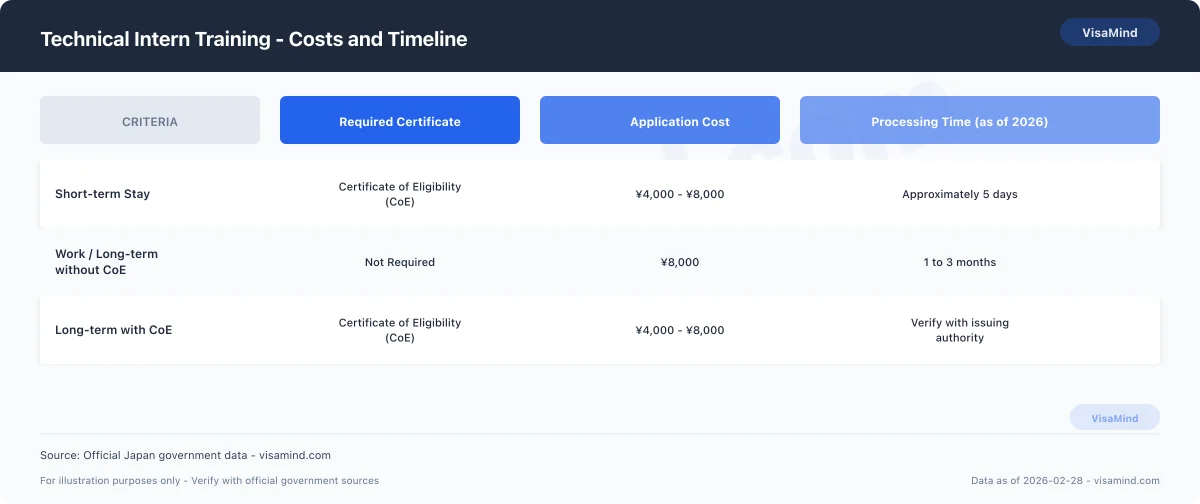
#You must budget for government fees and allow several months for approval.
Processing times depend on whether you submit a Certificate of Eligibility (CoE) and on the workload at the Immigration Services Agency (ISA) and the issuing post.
Visa and residence card fees
You pay government fees when the visa is issued and when your residence card is issued.
| Item | Fee (JPY) | When You Pay |
|---|---|---|
| Form Visa Application fee | ¥8,000 | Upon visa issuance |
| Residence card (Zairyū card) | ¥4,000 | Upon issuance |
The visa fee applies to Technical Intern Training applicants.
The residence card fee applies after you receive permission to land and your status is granted.
ISA manages residence status in Japan.
If you later change status to Specified Skilled Worker (i), Specified Skilled Worker (ii), Engineer/Specialist in Humanities/International Services, or Intra-company Transferee, separate fees may apply.
Check ISA guidance for the exact amount before you submit any status change application.
CoE and visa processing timelines
Most Technical Intern Training cases follow a two-step process:
-
Your supervising organization files a Form CoE Application with ISA.
-
You submit your Visa Application after the CoE is issued.
Under standard processing, Technical Intern Training cases typically take 2 to 4 months as of March 2026.
Actual timing depends on the category and the regional office handling the case.
Processing may take 1 to 3 months depending on visa category and office workload.
Priority categories such as Highly Skilled Professional often move faster, but Technical Intern Training does not receive the same priority treatment.
If you do not submit a CoE with your visa application, visa issuance can take one to three months.
Submitting the CoE usually shortens embassy or consulate review time.
Variations by category and location
The processing times vary by:
- Technical Intern category (e.g., stage or occupation)
- Regional ISA office handling the CoE
- Embassy or consulate processing the visa
- Overall application volume
ISA handles the CoE review inside Japan.
Each regional office manages its own caseload, which affects timing.
Other statuses such as Specified Skilled Worker (i), Specified Skilled Worker (ii), Engineer/Specialist in Humanities/International Services, and Intra-company Transferee follow different review tracks.
Some categories may process faster or slower depending on complexity and documentation.
The processing times change based on staffing levels and application volume, and published ranges reflect typical—not guaranteed—timeframes.

How to Renew
#You must track your Certificate of Eligibility (CoE) validity and file on time to avoid restarting the process.
The Immigration Services Agency of Japan (ISA) controls CoE issuance and long-term status approvals, including transitions to other work categories.
CoE validity and timing
Your Certificate of Eligibility (CoE) remains valid for 3 months from the date of issuance.
You must submit your Form Visa Application at the Japanese embassy or consulate within that 3‑month window.
If you wait beyond that period, the document loses validity.
Follow this sequence:
-
Your sponsor files the Form CoE Application with the Immigration Services Agency (ISA).
-
ISA issues the CoE.
-
You apply for your visa at the embassy or consulate within 3 months.
| Step | Responsible Party | Key Deadline |
|---|---|---|
| CoE Application | Accepting organization / sponsor | No fixed validity limit once issued |
| Visa Application | You (the technical intern trainee) | Within 3 months of CoE issuance |
Plan your embassy appointment as soon as you receive the CoE.
Delays commonly cause expiration.
This timing rule applies to Technical Intern Trainees and to other long‑term work statuses such as Specified Skilled Worker (i), Specified Skilled Worker (ii), Engineer/Specialist in Humanities/International Services, and Intra-company Transferee, because each requires a valid CoE before visa issuance.
What happens if a CoE expires
An expired CoE cannot support a visa application.
The embassy or consulate will not issue your visa based on an outdated document.
If your CoE expires before you apply:
- Your sponsor must submit a new CoE Application to ISA.
- ISA must review and issue a new certificate.
- You must restart the visa application process using the new CoE.
ISA does not extend expired certificates.
You cannot “reactivate” the same document.
This mistake often delays start dates and training schedules.
Monitor the issuance date carefully and coordinate with your supervising organization to prevent gaps.
Requirements for long-term visa renewals
Any long-term status in Japan requires a valid Certificate of Eligibility at the application stage.
If you apply for a work-based status and fail to obtain a CoE from ISA first, the application will not proceed.
You must secure a CoE for categories such as:
- Technical Intern Training
- Specified Skilled Worker (i)
- Specified Skilled Worker (ii)
- Engineer/Specialist in Humanities/International Services
- Intra-company Transferee
| Application Type | CoE Required Before Visa Application |
|---|---|
| Work visas | Yes |
| Study visas | Yes |
| Dependent visas | Yes |
ISA reviews and issues CoEs for these statuses.
Before filing any long-term Visa Application, confirm that your sponsor has obtained the correct and valid CoE.
If you need detailed procedural updates or document lists, confirm the current CoE validity window against official guidance from the Immigration Services Agency of Japan (ISA).
Path to Permanent Residence
#A Certificate of Eligibility (CoE) and a visa allow you to travel to Japan, but neither guarantees long‑term stay.
You must understand what each document does, who makes the final decisions, and how entry differs from long‑term residence planning.
What a CoE/visa does and doesn't promise
The Immigration Services Agency of Japan (ISA) reviews your Form CoE Application in Japan.
If approved, the CoE confirms that your planned activities—such as working as a Technical Intern Trainee (技能実習), transitioning to Specified Skilled Worker (i) or (ii), or changing to Engineer/Specialist in Humanities/International Services—match a recognized status.
A CoE does not guarantee visa issuance.
The Japanese consulate or embassy makes its own decision during your Form Visa Application process.
If you have a criminal record or past visa violations, the consulate may refuse your visa even with a valid CoE.
| Document | Issued By | What It Confirms | What It Does Not Guarantee |
|---|---|---|---|
| Certificate of Eligibility (CoE) | ISA (Japan) | Your planned activities fit a residence status | Visa approval |
| Visa | Japanese consulate/embassy | You may travel to Japan for that status | Entry at the airport |
Each step is a separate review.
Entry vs. long-term status considerations
A visa lets you travel to Japan.
Immigration officers at the airport make the final entry decision and can refuse entry even if your visa is valid.
You should carry:
- Your return ticket (if applicable)
- Accommodation details
- Proof of sufficient funds
Officers may inspect these documents before granting landing permission.
Entry permission and long‑term residence are different matters.
Entry gives you permission to stay under the status granted at the airport.
Long‑term planning—such as moving from Technical Intern Training to Specified Skilled Worker (i), then possibly to Specified Skilled Worker (ii), or another work category like Intra-company Transferee—requires separate applications reviewed by the ISA.
Each stage involves a new assessment.
You must maintain compliance at every step if you plan to build toward permanent residence eligibility in the future.
Technical interns who intend to work in Japan long term normally move into a skilled worker status first, because the ISA assesses residence history by status and technical intern training is not equivalent to a long-term work status.
Confirm with the ISA how your period of stay will be counted before you plan around it.

The Dual-Track Application
#You complete two coordinated steps: file the proper form with the Immigration Services Agency of Japan (ISA) and apply for your visa at a Japanese Embassy or Consulate.
Accuracy, correct category selection, and timely submission determine whether you can travel as scheduled.
Download and prepare the official form
Start by downloading the official “Technical Intern Training” form from the Immigration Services Agency of Japan (出入国在留管理庁, ISA).
Use only the current version.
Before you write anything, review the instructions carefully.
The form applies to applicants seeking Technical Intern Training status, and you must follow the guidance that matches your situation as a technical intern trainee.
Prepare all required details in advance, including:
- Personal identification information
- Your intended training details
- Supporting documentation required by ISA
If you later change status to Specified Skilled Worker (i), Specified Skilled Worker (ii), Engineer/Specialist in Humanities/International Services, or Intra-company Transferee, you will use a different process.
Do not use the Technical Intern Training form for those categories.
Use the checklist below before completing the form:
| Item | Action Required |
|---|---|
| Correct form | Download from ISA website |
| Eligibility review | Confirm you qualify as a Technical Intern Trainee |
| Instructions | Read category-specific guidance |
| Supporting evidence | Gather documents before signing |
Complete the form clearly and consistently with your supporting documents.
Follow instructions by eligibility category
ISA evaluates your application based on the specific status of residence you request.
You must select and follow the correct eligibility category from the start.
For Technical Intern Training, you apply as a technical intern trainee under that program.
Do not confuse this with:
- Specified Skilled Worker (i)
- Specified Skilled Worker (ii)
- Engineer/Specialist in Humanities/International Services
- Intra-company Transferee
Each category has separate requirements and documentation standards.
Filing under the wrong category can delay or disrupt your case.
If you require a Certificate of Eligibility (CoE) Application) as part of your process, ensure that the information in that filing matches your later Form Visa Application at the embassy or consulate.
Inconsistent details between filings create avoidable complications.
When uncertain about documentation or eligibility rules, verify requirements directly through the Immigration Services Agency (ISA).
Do not rely on outdated versions of the form or unofficial summaries.
Complete, sign and submit with evidence
Fill out every required section of the Technical Intern Training form.
Do not leave mandatory fields blank.
After completing the form:
-
Review all entries for accuracy.
-
Attach the required supporting documents.
-
Sign where indicated.
Unsigned forms are not valid.
Submit your Visa Application at the Japanese Embassy or Consulate in your country of residence.
Apply at least 2–3 weeks before your intended travel date.
Processing typically takes about 5 business days, but it can take longer during peak periods.
For clarity:
| Step | Where It Happens | Key Timing |
|---|---|---|
| Form preparation | You + ISA requirements | Before embassy visit |
| Visa Application | Japanese Embassy/Consulate | Apply 2–3 weeks before travel |
| Standard processing | Embassy/Consulate | ~5 business days (may vary) |
The JAPAN eVISA system is available only for short-stay tourism for eligible nationalities.
Technical Intern Training applicants must follow the proper work-related visa process instead.
Submit a complete, signed application with all required evidence to avoid delays.
Confirm the current embassy timings against MOFA visa processing information before you book travel.
Conditions and Portability
#Your Certificate of Eligibility (CoE) supports your Form Visa Application, but it does not secure visa issuance.
You must meet passport, consular, and inspection requirements at each stage, and the Immigration Services Agency of Japan (ISA) retains final authority on status decisions.
Limits on guarantees and entry
A Certificate of Eligibility (CoE) confirms that the ISA reviewed your planned activities in Japan under the Technical Intern Training status.
It does not guarantee that a Japanese embassy or consulate will issue your visa.
You must still complete a separate Visa Application and satisfy all documentary requirements at the consular stage.
If the consulate identifies deficiencies, it may refuse the visa even if you hold a valid CoE.
Common risk points include:
- Passport validity that does not cover your intended stay
- No blank page available for visa attachment
- Filing at a consulate that lacks jurisdiction over your residence
These limits apply to a technical intern trainee and also to applicants for other statuses such as Specified Skilled Worker (i), Specified Skilled Worker (ii), Engineer/Specialist in Humanities/International Services, or Intra-company Transferee.
Each status requires its own compliant visa issuance process.
| Document | What It Does | What It Does Not Do |
|---|---|---|
| Certificate of Eligibility | Shows ISA pre-approval of planned activities | Does not guarantee visa issuance |
| Visa | Allows entry at a port of entry | Does not override passport defects |
Passport and consular jurisdiction rules
Your passport must remain valid for the full duration of your intended stay.
It must also contain at least one blank page for visa placement.
If your passport expires too soon or lacks space, the consulate may refuse your application.
Renew your passport before submitting your Visa Application if needed.
You must apply only at the Japanese embassy or consulate that has jurisdiction over your current place of residence.
Applying at the wrong location can lead to rejection.
Before filing, confirm:
- Your residential address matches the consulate’s jurisdiction
- Your passport validity covers your planned entry and stay
- Your passport contains unused visa pages
These checks apply equally whether you seek Technical Intern Training or another work status.
What immigration officers may check
At the visa stage and at entry, officers may verify that your documents match your approved CoE details.
They review identity information, passport validity, and proper visa placement.
If your passport validity falls short or lacks space, entry may be denied even if you hold a visa.
You remain responsible for maintaining compliant travel documents.
Officers may also confirm that you applied through the correct consular jurisdiction.
Inconsistencies between your residence and issuing post can raise issues.
You should carry:
- Your valid passport
- Your issued visa
- Your CoE documentation
The ISA controls status decisions inside Japan.
You must comply with document and entry rules at every step of the process.
Changing employers as a technical intern
Technical Intern Training status ties you to the implementing organization named in your approved training plan.
Unlike open work statuses, technical interns cannot move freely between employers, and a transfer has to go through your supervising organization and be reflected in a revised plan.
If the host company stops operating, or if conditions on the ground breach the plan, the supervising organization and the Organization for Technical Intern Training (OTIT) handle placement with a new host company.
This limited portability is one of the main practical differences between TITP and the Specified Skilled Worker (i) route, where movement between employers inside the same designated sector is possible.
Confirm the current transfer rules with the Immigration Services Agency of Japan before you assume that a move is permitted.
Bringing Your Spouse and Children
#You must prepare formal immigration documents for each family member before they can join you in Japan.
The Immigration Services Agency of Japan (ISA) reviews both the Certificate of Eligibility (CoE) application and the subsequent Form Visa Application.
Your spouse and children cannot rely on your Technical Intern Training (技能実習) status documents alone.
Each person files and receives their own immigration documentation.
Basic documents family members need
Each dependent must submit a complete and separate visa application.
You prepare the documents for every applicant individually.
Required documents for each family member:
- A valid passport
- One visa application form
- One photograph
- A valid Certificate of Eligibility
| Document | Who Must Submit | Purpose |
|---|---|---|
| Passport | Spouse and each child | Confirms identity and nationality |
| Visa Application Form | Spouse and each child | Formal request for visa issuance |
| Photograph | Spouse and each child | Identity verification |
| Certificate of Eligibility | Spouse and each child | Confirms eligibility for status |
You submit these documents when applying for the visa after the CoE is issued.
If you later change status to Specified Skilled Worker (i), Specified Skilled Worker (ii), Engineer/Specialist in Humanities/International Services, or Intra-company Transferee, each dependent still requires their own complete set of documents.
Certificate of Eligibility for dependents
Before your spouse or children apply for a visa, you must secure a Certificate of Eligibility (CoE) for each of them.
The Form CoE Application is filed with the Immigration Services Agency (ISA).
ISA examines eligibility and issues the certificate if the application meets requirements.
You cannot skip this step.
The visa application requires the approved CoE.
The process follows this sequence:
-
Submit a CoE Application to ISA for each dependent.
-
Receive the issued Certificate of Eligibility.
-
Submit the Visa Application with the passport, application form, photograph, and CoE.
Each family member receives a separate CoE.
Keep the documents consistent with your current residence status as a Technical Intern Training participant or other authorized status in Japan.
Eligibility Requirements
#You must meet specific qualification, identity, and passport standards before the Immigration Services Agency of Japan (ISA) will approve your status.
Errors in these areas often lead to rejection at the Certificate of Eligibility (Form CoE Application) or Form Visa Application stage.
Qualification and experience checks
ISA reviews whether your background matches the Japan Technical Intern Training status.
Your education and work history must align with the training plan submitted in your CoE Application.
A common reason for refusal is applying under the wrong status of residence.
This happens when your qualifications better fit categories such as Engineer/Specialist in Humanities/International Services, Intra-company Transferee, or Specified Skilled Worker (i) or (ii).
You should confirm:
- Your education level
- Your years of work experience
- The relevance of that experience to the training role
- That the training content matches your background
For comparison:
| Status of Residence | Key Qualification Focus |
|---|---|
| Technical Intern Training | Skills development aligned with approved training plan |
| Engineer/Specialist in Humanities/International Services | Relevant university degree or 10+ years of related experience |
| Specified Skilled Worker (i) | Skills tied to designated industry field |
| Specified Skilled Worker (ii) | Advanced, field-specific experience |
If your qualifications do not match the selected status, ISA may deny your CoE Application.
Always verify eligibility before submission.
Photo and identity document standards
ISA applies strict photo rules.
Non-compliant photos often delay processing or cause resubmission requests.
Your photo must:
- Measure 4.5 cm × 4.5 cm
- Be taken within the last 6 months
- Have a plain white background
- Show your full face clearly
- Exclude hats and sunglasses
Submit clear copies of your identity documents exactly as required in the Visa Application and CoE Application forms.
Do not alter or digitally edit your photo.
Even minor background shadows or incorrect sizing can result in rejection.
Passport validity and visa space
Your passport must remain valid for the entire intended stay in Japan.
ISA will not issue a status if your passport expires during the approved period.
You must also have sufficient blank pages for visa attachment.
Before filing your Visa Application, confirm:
- Your passport expiration date extends beyond your stay
- At least one blank visa page is available
- The passport is undamaged and legible
If your passport lacks validity or space, renew it before applying.
Submitting an application with an inadequate passport often results in refusal or processing delays.
When Self-Preparation Isn't Enough
#Small errors can lead to rejection or long delays, especially when your documents do not align or fail to meet technical requirements.
You must pay close attention to consistency and formatting at every stage.
Complex or high-risk cases
You face higher risk when your Certificate of Eligibility (CoE) Application and Form Visa Application contain mismatched information.
The Immigration Services Agency of Japan (ISA) reviews these details closely.
Even minor differences can trigger rejection.
| Key Item | Must Match Exactly Between CoE and Visa Application |
|---|---|
| Personal details | Name spelling, date of birth, nationality |
| Employment terms | Job title, duties, contract conditions |
| Salary | Stated compensation amount |
| Dates | Contract start date and duration |
If you apply as a technical intern trainee under the Japan Technical Intern Training program but later present different employment terms, ISA may question credibility.
Photograph errors also cause delays.
Your photo must meet all technical requirements:
- Size: 4.5 cm × 4.5 cm
- Background: plain white
- Taken within the last 6 months
- No hats or accessories
Applicants changing status later to Specified Skilled Worker (i), Specified Skilled Worker (ii), Engineer/Specialist in Humanities/International Services, or Intra-company Transferee must maintain the same level of document consistency.
When to consider professional help
Seek professional guidance if you struggle to align your Form CoE Application and Visa Application details.
This becomes important if:
- Your employment terms changed after the CoE submission
- Your employer revised salary or contract dates
- You previously received a rejection or delay
- You plan to transition from Technical Intern to another status
A professional can review both applications side by side before submission.
They can also verify that your supporting documents, including photographs, meet ISA standards.
Careful pre-submission review reduces the risk of preventable rejection and protects your training timeline.
Check the current photograph and document specifications on MOFA guidance for the technical intern visa before you submit.
Common Petition Challenges
#Most rejections in Japan Technical Intern Training cases stem from inconsistent answers or missing paperwork.
You must align every detail across your Certificate of Eligibility (CoE) Application and Form Visa Application and submit complete supporting documents to the Immigration Services Agency of Japan (ISA).
Inconsistent or incomplete information
ISA reviews your Form CoE Application and Visa Application side by side.
Any mismatch can lead to refusal.
You must ensure that your name, date of birth, passport number, and nationality appear exactly the same on every form.
Even small differences in spelling, spacing, or number order can trigger scrutiny.
Common problem areas include:
- Different spellings of your name between your passport and forms
- Incorrect passport number or expiration date
- Inconsistent employment details for the Technical Intern Trainee (技能実習) position
- Conflicting statements about prior status, such as Specified Skilled Worker (i), Specified Skilled Worker (ii), Engineer/Specialist in Humanities/International Services, or Intra-company Transferee
Use the exact information shown in your passport and official documents.
Do not abbreviate or shorten names unless the passport does so.
Before submission:
-
Compare all answers across every page of the CoE Application.
-
Cross-check the same details in your Visa Application.
-
Confirm that your sponsoring organization’s information matches in all forms.
ISA decides cases based on written records.
If your forms conflict, officers may question credibility and deny the petition.
Documentation gaps that cause delays
ISA expects a complete file at the time of submission.
Missing documents often result in processing delays or refusal.
Your CoE Application must include all required supporting materials from both you and the supervising organization.
If any document is absent or unclear, ISA may stop processing until the issue is resolved.
Typical documentation issues include:
- Missing passport copy
- Incomplete application pages
- Unsigned forms
- Supporting documents that do not match the details listed in the application
| Issue | Likely Outcome |
|---|---|
| Missing required document | Processing delay or rejection |
| Information in document does not match form | Request for clarification or refusal |
| Illegible copy | Additional document request |
Check that every document supports the specific Technical Intern Trainee role described in your application.
If you previously held another status, ensure the paperwork clearly reflects your current category.
Submit a complete and internally consistent file the first time.
ISA evaluates what you provide, not what you intended to submit.
Fees
#| Component | Amount |
|---|---|
| Application feeExtracted from guide content — verify against official source | ¥8,000 (approx $54 USD) |
| Residence card feeZairyū card issuance — verify against MOFA | ¥4,000 (approx $27 USD) |
Fees change; always verify on ISA.