
What You Need to Show Financially
#For a Spanish Schengen visa, financial-means rules are applied by the Spanish consulate handling the application under the Ministry of Foreign Affairs (MAEC), rather than by Spain’s migration-policy secretariat. Amounts and acceptable evidence can change, so verify the current MAEC or consular instructions for the place where you will file.
To obtain a visa for Spain, applicants must demonstrate that they meet specific financial requirements to ensure they can support themselves during their stay. For instance, for the Schengen Tourist Visa, applicants must show a minimum of €100 per day, with a minimum total amount of €900 as of early 2026 — always verify current amounts with the official authority. These financial thresholds are set by the Spanish consulate handling the application under the Ministry of Foreign Affairs (MAEC) and vary depending on the type of visa you are applying for.
How to Demonstrate Financial Means
To prove you meet these financial requirements, you'll typically need to provide several forms of documentation. This can include bank statements, proof of regular income, or other assets that show you have the necessary funds. For example, if you're applying for a National Work Visa, you might need to show evidence of a job offer and salary, while a Non-Lucrative Residence Visa requires proof of sufficient financial resources to live in Spain without working.
Key Financial Documents
The types of documents you may need include:
- Bank Statements: Recent statements showing consistent income or sufficient savings.
- Investment Portfolios: Documents that verify holdings in stocks, bonds, or other securities.
- Employment Contracts: If applicable, these show proof of income from Spanish or foreign employers.
- Pension Statements: For retirees, evidence of pension income can be crucial.
These documents must be up-to-date and clearly demonstrate the financial stability required for your intended stay in Spain.
Considerations for Different Visa Types
Different visa categories have varying financial thresholds. For example, the former Golden Visa route (closed to new applications on 3 April 2025) requires a significant investment in Spanish real estate or businesses, whereas the National Student Visa demands proof of tuition payment and living expenses coverage. Similarly, if you're applying for the Digital Nomad Visa, you'll need to provide evidence of remote work income that meets or exceeds stipulated minimums.
Important: Always verify the current financial requirements with the official Spanish consulate handling the application under the Ministry of Foreign Affairs (MAEC) website, as these can change and may differ based on your specific circumstances or visa type.
Why Financial Requirements Matter
The Spanish government requires proof of financial means to ensure that all visa applicants can support themselves and avoid becoming a financial burden on the state. This measure is in place to protect both the applicant and the country’s resources, ensuring a mutually beneficial arrangement for those wishing to live, work, or study in Spain. By preparing the necessary financial documentation thoroughly and accurately, you increase your chances of a successful visa application.
How Much You Need by Visa Type
#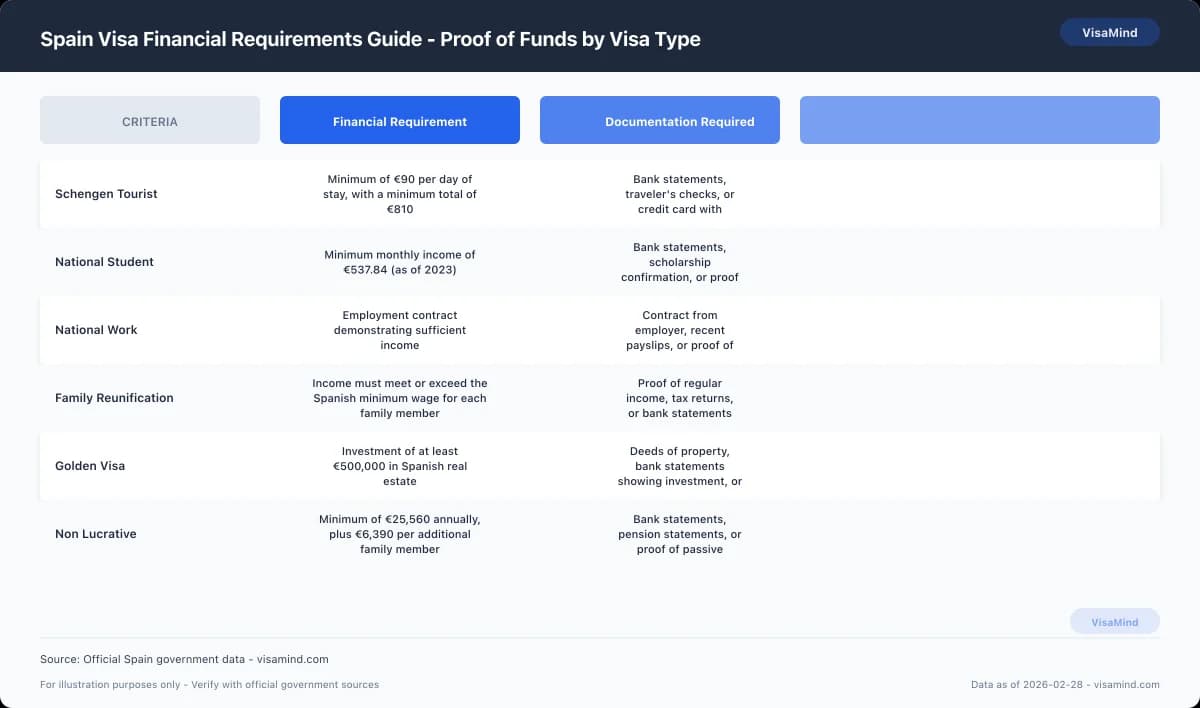
Understanding the financial requirements is crucial. The amount you need to show varies significantly depending on the type of visa you are applying for. Here's a detailed breakdown of the financial requirements, as managed by the Spanish consulate handling the application under the Ministry of Foreign Affairs (MAEC), for different visa categories.
Financial Requirements by Visa Type
| Visa Type | Minimum Financial Requirement | Evidence Required |
|---|---|---|
| Schengen Tourist Visa | Approximately €100 per day for the duration of the stay | Bank statements, traveler's cheques, or certified checks |
| National Student Visa | Approximately €600 per month | Proof of scholarship, bank statements, or financial guarantee from a sponsor |
| National Work Visa | No specific minimum, but proof of employment and salary is required | Employment contract and recent pay slips |
| Family Reunification Visa | 150% of the IPREM (Public Income Index) for the first family member and 50% for each additional member | Bank statements, employment contracts, or tax returns |
| Permanent Residence (PR) Visa | Proof of stable and sufficient income, typically through employment or pension | Employment contract, pension documents, or consistent passive income records |
Visitor Visas
For those applying for a Schengen Tourist Visa, the financial requirement is approximately €100 per day of your intended stay. This amount can be evidenced through recent bank statements, traveler's cheques, or certified checks. It's important that these documents clearly show your financial ability to support yourself during your visit to Spain.
Student Visas
The National Student Visa requires you to demonstrate you have at least €600 per month to cover your living expenses. This can be proven through various means, including a scholarship offer, personal bank statements, or a financial guarantee from a family member or sponsor. For more details on the student visa process, refer to the National Student Visa page.
Work Visas
For those seeking a National Work Visa, while there is no specific financial threshold, you must provide proof of employment and salary. This typically involves submitting your employment contract and recent pay slips. Learn more about the work visa process on the National Work Visa page.
Family and Permanent Visas
The Family Reunification Visa requires you to show income equivalent to 150% of the IPREM for the first family member and 50% for each additional family member. This can be shown through bank statements, employment contracts, or tax returns. For those applying for a Long Term Residence, evidence of a stable and sufficient income source is essential, which can include employment, pension, or consistent passive income.
Important: Ensure that all financial documents are recent and clearly show your financial capacity. Incomplete or outdated documentation can lead to delays or rejections.
These requirements are subject to change, so it's advisable to verify the most current information on the official website of the Spanish consulate handling the application under MAEC before lodging your application. Understanding these financial obligations will help you prepare adequately for your application process.
Reading Between the Lines of Bank Statements
#Financial requirements play a crucial role in the approval process. Understanding how to present your financial situation through bank statements is essential for meeting the expectations set by the Spanish consulate handling the application under the Ministry of Foreign Affairs (MAEC). Here’s what you need to consider regarding the bank statements you provide as part of your application.
How Many Months of Bank Statements Are Required?
- Generally, three to six months of bank statements are required. This duration helps the Spanish consulate handling the application under the Ministry of Foreign Affairs (MAEC) assess your financial stability over a reasonable period.
- For certain visa types like the Non-Lucrative Residence Visa or former Golden Visa route (closed to new applications on 3 April 2025), the requirement may vary, so always check the specific visa guidelines.
Minimum Balance vs. Average Balance
- Minimum Balance: It’s important to maintain a minimum balance that meets the threshold specified for your visa type. This ensures you have enough funds to cover your stay in Spain without working.
- Average Balance: A consistent average balance is often more telling of financial stability than a fluctuating minimum balance. Ensure your average monthly balance reflects sufficient financial means.
Which Accounts Count?
- Personal Bank Accounts: Only accounts that are in your name are typically considered. Ensure these accounts reflect regular income or savings.
- Savings vs. Checking Accounts: Both types can be used, but savings accounts often provide a clearer picture of financial health due to less fluctuation in transactions.
- Currency: While accounts in euros are ideal, foreign currency accounts are acceptable, but be prepared to provide currency conversion evidence.
Are Joint Accounts Accepted?
- Joint Accounts: These are often accepted if you are a primary account holder. However, you may need to provide additional documentation proving your right to access and use the funds.
- Spousal Accounts: If applying for a family reunification visa, spousal or joint accounts with a spouse may be applicable, but ensure you provide proof of relationship and joint financial responsibility.
Important: Always verify the specific financial requirements for your visa type on the official Documents Checklist. This ensures you meet the the consulate's criteria and avoid potential delays or refusals.
For more detailed guidelines on Spain's visa financial requirements, consult the Visa Refusal Reasons to understand common pitfalls applicants encounter. Remember, thorough preparation and understanding of your financial presentation can significantly enhance your visa application success.
Accepted and Rejected Evidence
#Demonstrating financial capability is a critical requirement. The Spanish consulate handling the application under the Ministry of Foreign Affairs (MAEC) mandates specific types of financial evidence that applicants must provide to support their applications. Below is a detailed breakdown of acceptable and unacceptable forms of financial evidence.
Accepted Evidence
When demonstrating your financial stability, the following forms of evidence are generally accepted:
-
Cash Savings
- Bank statements showing sufficient cash balance in personal accounts. Ensure these statements are recent, typically from the past three to six months.
-
Investments
- Documents proving ownership of stocks, bonds, or mutual funds. These should include account statements highlighting the current value of investments.
-
Property Ownership
- Title deeds or property ownership documents that can be translated into financial value. These should be accompanied by a recent property valuation report.
-
Scholarships and Grants
- Official letters confirming scholarships or grants awarded, including details of the amount and duration.
-
Pension Statements
- Official pension statements indicating regular income, which may be particularly relevant for those applying for visas like the Non-Lucrative Residence Visa.
Rejected Evidence
Not all financial documents are considered valid for proving financial stability. The following are typically rejected:
-
Loans
- Any funds acquired through loans or borrowed money are not accepted as proof of financial stability, as they represent liabilities rather than assets.
-
Unverified Income Sources
- Income claims that cannot be substantiated with official documentation, such as unregistered cash income.
-
Cryptocurrency Holdings
- While increasingly popular, cryptocurrency holdings are often rejected due to their volatile nature and lack of regulatory oversight.
Important: Ensure all documents are translated into Spanish by a certified translator if they are originally in another language.
What Does Not Count?
Certain types of financial evidence are not regarded as adequate proof of financial stability for visa applications:
-
Promissory Notes
- Future promises of payment or financial support that lack immediate liquidity.
-
Informal Agreements
- Any informal financial agreements or arrangements that are not legally binding or officially documented.
For those applying for specific visas, such as the Digital Nomad Visa or former Golden Visa route (closed to new applications on 3 April 2025), it is important to verify specific financial requirements as they may vary. You can find more details on the respective visa pages.
Tip: For a comprehensive list of documents required, refer to the Documents Checklist to ensure you're fully prepared before lodging your application.
Financial Evidence Pitfalls
#Meeting financial requirements is a critical step. However, there are several pitfalls that can lead to issues if not addressed properly. Here's what you need to watch out for:
Last-Minute Deposits
- Sudden Large Deposits: Depositing a significant amount of money into your account shortly before your application may raise red flags. The Spanish consulate handling the application under the Ministry of Foreign Affairs (MAEC) may question the source of these funds.
- Lack of Explanation: If you have made large deposits, provide a clear explanation and documentation of their origins. This could include sale receipts, bonus letters, or gift confirmations.
Insufficient Financial History
- Short Account History: Presenting bank statements with only a few months of history can be problematic. Aim to provide at least six months of statements to demonstrate consistent financial stability.
- Irregular Transactions: Frequent cash withdrawals or deposits can create suspicion. Ensure your transactions reflect a stable and transparent financial situation.
Wrong Currency
- Non-Euro Balances: As Spain operates within the Eurozone, presenting financial evidence in a non-euro currency may cause complications. Convert your financial documents to euros and provide exchange rate information at the time of conversion.
Important: When converting currency, use a reliable source and clearly indicate the exchange rate applied. This helps the Spanish consulate handling the application under the Ministry of Foreign Affairs (MAEC) understand your financial standing in euros.
Missing Explanations
- Unexplained Income Sources: If your account shows income from various sources, provide explanations and supporting documents. For example, if you have rental income, include lease agreements or rental receipts.
- Lack of Supporting Documents: Always accompany your bank statements with documents that substantiate claims of regular income or financial support, especially if you are applying for visas like the Digital Nomad Visa or National Student Visa.
Tip: Cross-reference your financial evidence with the Documents Checklist to ensure completeness before submission.
By understanding and avoiding these common pitfalls, you can strengthen your financial evidence and improve your chances of a successful visa application. For more detailed guidance, consider reviewing the Visa Refusal Reasons to ensure your application is as robust as possible.
Third-Party Financial Proof
#Understanding the requirements for financial proof is vital. This section will help clarify what is needed when someone else is providing the necessary financial backing for your application.
What Financial Proof Can a Sponsor Provide?
If a sponsor is providing financial proof on your behalf, there are several key documents they should present to demonstrate their ability to support you during your stay in Spain. These documents typically include:
-
Proof of Income: This can be in the form of recent pay stubs, an employment contract showing annual salary, or a letter from the employer verifying income.
-
Affidavit of Support: A legal document where the sponsor formally declares their intention and ability to support you financially. This document should be notarized to ensure its legitimacy.
-
Tax Returns: Copies of the sponsor's most recent tax returns. This helps in verifying the sponsor's financial capacity over the past few years.
How to Structure the Financial Proof?
When submitting financial proof from a sponsor, it's essential to ensure all documents are well-organized and present a clear picture of the sponsor's financial stability. Here’s a suggested order:
-
Affidavit of Support: Start with the notarized affidavit to officially declare the sponsor's commitment.
-
Proof of Income: Follow with income documentation, such as pay stubs or salary letters, to substantiate the sponsor's earnings.
-
Tax Returns: Include the most recent tax returns to provide a historical view of the sponsor's financial situation.
Tip: Ensure all documents are translated into Spanish if they are originally in another language and attach certified translations along with the originals.
Common Scenarios for Third-Party Financial Support
Third-party financial support is common in various visa applications, such as for the National Work Visa or National Student Visa. In these cases, the applicant might not have sufficient funds or income themselves and thus rely on a family member or close associate to fulfill the financial requirements.
-
Students: Often rely on parents or guardians to provide proof of financial support.
-
Employees: May have employers acting as sponsors, especially for skilled positions requiring relocation to Spain.
-
Family Reunification: Family members already residing in Spain might sponsor relatives applying for reunification.
Important: Ensure that the sponsor meets the financial threshold set by the Spanish consulate handling the application under MAEC. As these thresholds may change, always verify the latest requirements on the official Spanish consulate website.
Having a clear understanding of these requirements and ensuring all documentation is in order can significantly aid in the visa application process when a third-party sponsor is involved. Remember to check specific visa types, such as the Schengen Business Visa or Family Reunification Visa, for any additional criteria.
Tips for Preparing Financial Evidence
#Tip: Begin gathering your financial documents well in advance, as compiling thorough evidence can be time-consuming.
Start Early
- Document Collection: Begin collecting bank statements, employment contracts, and tax returns at least three months before you plan to lodge your application. Consistent financial documentation is key.
- Financial Planning: Ensure you have sufficient funds in your account several months beforehand to demonstrate financial stability, especially for visas like the Non-Lucrative Residence Visa.
Maintain Consistent Records
- Bank Statements: Keep at least six months of consecutive bank statements. Ensure all transactions are clear and avoid unexplained large deposits or withdrawals.
- Income Verification: Regular pay slips or pension statements can help verify your income. Ensure they match with the deposits shown on your bank statements.
Address Unusual Patterns
- Cover Letters: If there are irregularities, such as large one-time deposits, include a cover letter explaining these. This can prevent misunderstandings about your financial situation.
- Supporting Documents: Attach additional evidence like sale contracts or gift letters if large sums are involved. This helps clarify your financial history for the Spanish consulate handling the application under MAEC.
Review and Prepare
- Cross-Check Documents: Double-check that all financial documents match the details in your application. Inconsistencies can lead to delays or rejections.
- Professional Assistance: Consider consulting with a financial advisor familiar with Spanish immigration requirements to ensure your financial evidence meets all criteria.
For more insights on the application process, you might find the How To Apply and Visa Refusal Reasons guides helpful. Preparing your financial evidence carefully can increase your chances of success when applying for a visa to Spain.