
Spain student visa: Overview
#Spain grants a student stay authorization (estancia por estudios) for non‑EU/EEA nationals planning to study for over 90 days. SEM sets the rules, consulates issue visas, and the National Police handle your NIE/TIE once you’re in Spain.
Who this visa is for
You’ll need this visa if you’re studying in Spain for over 90 days at an authorized institution. That covers university programs, recognized exchange programs, language courses, and some research or training activities.
You might qualify if you’re doing research not covered by the Research Visa, or completing practical training tied directly to your studies. Shorter programs—under 90 days—usually require a short-stay visa.
This visa isn’t for those whose main goal is employment or permanent settlement. In those situations, you’d look at options like the Non-Lucrative Residence Visa, Research Visa, or other residence permits.
If your family wants to join you, they’ll need to apply separately through the right dependent authorization. That’s a different process from the Family Reunification Visa used by long‑term residents.
What it allows you to do
This authorization lets you live in Spain for the approved study period. The visa in your passport gets you into Spain, and if you’ll be there longer than six months, you must get a Foreigner Identity Card (TIE) from the National Police.
You can:
- Reside in Spain for your study period
- Enroll and attend classes at your approved institution
- Apply for renewal if you keep meeting the requirements
- Request authorization for internships or traineeships tied to your program, if eligible
In some cases, you can modify your status in Spain using forms like EX‑01, EX‑02, EX‑03, or EX‑05, depending on what you’re applying for. SEM decides if you qualify for these changes.
Time spent as a student doesn’t count the same way as other residence types if you later apply for Long-Term Residence. Check those details before planning future steps.
Basic eligibility snapshot
You’ll need to meet legal and documentary requirements. Spanish consulates review your visa application abroad, while SEM sets the framework.
Generally, you must show:
- Admission to an authorized Spanish educational institution
- Proof of enough financial means for your stay
- Valid health insurance covering you in Spain
- No prohibition on entering Spain
- A passport valid for your entire stay
If your studies last more than six months, you’ll also need to:
- Apply for a TIE after arrival
- Stay enrolled and make academic progress
The main authorities:
| Authority | Role in your process |
|---|---|
| State Secretariat for Migration (SEM) | Sets immigration policy and regulations |
| Spanish Consulate | Issues your student visa abroad |
| National Police | Issues your NIE and TIE in Spain |
For forms and procedural details, refer to official guidance from SEM and your assigned Spanish consulate.
Student Visa Document Checklist
#You must submit a complete application, the right form, and all required documents at once. Missing forms or signatures can cause rejection or delays by SEM or the Spanish consulate.
Complete the form
Fill out every section of the official application form that matches your situation. Don’t leave required fields blank.
If you’re applying from within Spain, use the correct immigration form. These are common:
| Purpose | Form Code |
|---|---|
| Initial authorization | Form EX-01 |
| Modification of status | Form EX-03 |
| Specific temporary residence cases | Form EX-05 |
| Other residence-related procedures | Form EX-02 |
Confirm the form with SEM before submitting.
If applying from abroad, the consulate issues the visa, but SEM controls the underlying authorization. Double-check that your personal information matches your passport.
Review every page before you file. Sign and date where required. Unsigned forms won’t be accepted.
If you previously held a Non-Lucrative Residence Visa, Research Visa, Trainee/Internship Visa, or another residence category and are changing status, indicate that on the form.
Supporting evidence to submit
All supporting documents must be submitted with your main application. Don’t send documents separately unless SEM asks for them.
Your evidence needs to show:
- Your identity
- The purpose of your stay
- Your current immigration status (if applying from Spain)
- Any previous authorizations from SEM
If you’re switching from another residence type—like a Research Visa or Trainee/Internship Visa—include proof of that.
If your family is applying with you or joining you later, the process may use the Family Reunification Visa framework. Include documentation linking each family member to your file.
Organize your documents logically and label them. Incomplete submissions can lead to denial without further notice.
Filing supplements and signatures
All required supplementary forms must be filed with your main petition. Late supplements can cause rejection.
Common supplements:
- Additional residence declarations
- Status modification requests (like EX-03)
- Long-Term Residence–related filings, if needed
If you’re seeking Long-Term Residence after student status, confirm the right procedural form with SEM.
Every required signature must appear on:
- The main application
- Any supplementary forms
- Declarations or sworn statements
Make sure all dates are consistent. Mismatches between signatures, dates, and supporting documents often trigger requests for correction.
Spanish consulates issue visas abroad, SEM controls residence authorization, and the National Police issue your NIE or TIE after approval. Details on your application must match what you’ll use for identification later.
Fees and Wait Times
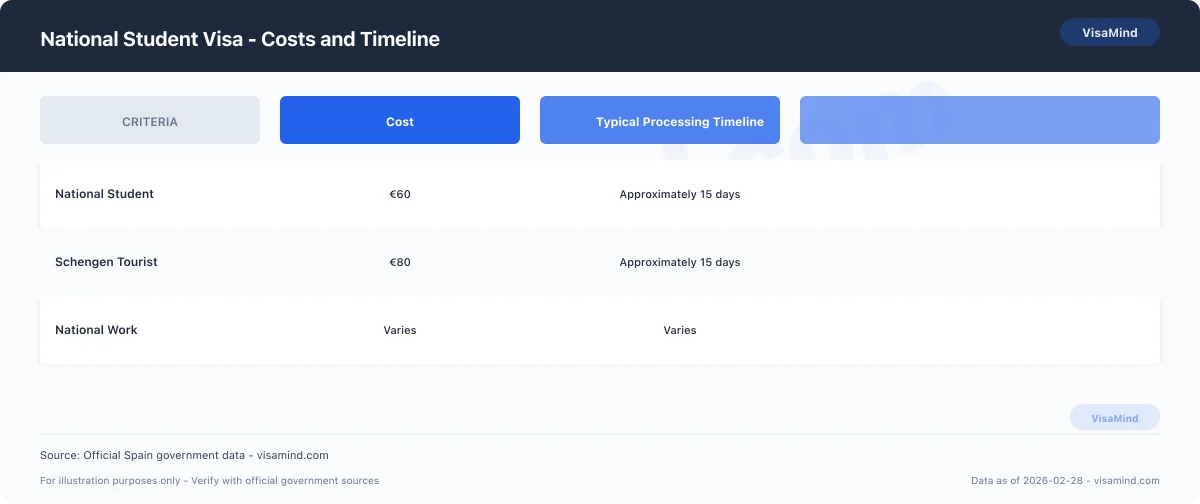
#Budget for both a visa application fee and a residence authorization fee. processing times depend on your visa category and where you apply, but standard student cases usually take one to two months.
Application and residence fees
You’ll pay two separate government charges for a Spain student visa.
| Fee type | Amount (EUR) | When you pay |
|---|---|---|
| Visa application fee | €150 | When you submit your visa application at the Spanish consulate |
| Residence authorization fee | €60 | For the residence authorization linked to your stay |
The €150 covers consular processing of your visa. The €60 is for the residence authorization for your studies.
If you later apply for a different status—like a Non-Lucrative Residence Visa, Research Visa, Trainee/Internship Visa, Family Reunification Visa, or Long-Term Residence—the forms and fees may change. Confirm the correct form and fee with SEM or the consulate handling your case.
Check current fees directly with the consulate or SEM before paying.
Standard processing time
For a national student visa, expect a decision in 1 to 2 months.
This applies to typical applications processed through Spanish consulates abroad. It doesn’t guarantee approval, and it doesn’t include the time you’ll need to gather documents or attend appointments.
After entering Spain, you must complete local formalities, like obtaining your foreigner identity card from the National Police. That step has its own timeline and doesn’t shorten the initial 1–2 month visa processing period.
Apply well in advance of your course start date. Consulates won’t speed up your case just because your program is starting soon.
Variations by category and location
The processing times can differ based on:
- The visa category
- The consulate where you apply
- Whether your case needs extra review
A Research Visa or Trainee/Internship Visa might require different documents and more internal review than a standard student visa. Applications linked to Family Reunification or Long-Term Residence follow additional procedures under SEM oversight.
If you apply from abroad, the consulate issues the visa. If you change your status inside Spain using forms like Form EX-01, Form EX-02, Form EX-03, or Form EX-05, SEM manages the process.
Timelines vary by category and location. Confirm current processing estimates with the consulate or SEM before planning travel or enrollment.
What Comes After Your Degree
#
Finishing your studies doesn’t extend your legal stay. You’ll need to apply for a new authorization that matches your next activity and meet requirements set by the State Secretariat for Migration (Secretaría de Estado de Migraciones, SEM).
Approval is not automatic
Submitting a national application after graduation doesn’t guarantee approval. SEM reviews each file individually and expects a complete application that follows instructions exactly.
Choose the correct pathway based on your plans. Here are common options:
| Pathway | Typical Form | Purpose |
|---|---|---|
| Non-Lucrative Residence Visa | Form EX-01 | Residence without work activity |
| Modification of stay to residence/work | Form EX-02 | Change from student stay to another status |
| Research authorization | Form EX-03 | Research-related activity |
| Internship authorization | Form EX-05 | Trainee or internship activity |
| Family Reunification Visa | EX-01 (varies by case) | Bring eligible family members |
| Long-Term Residence | EX-11 (where applicable) | Extended residence status |
Confirm the form and document list through SEM’s official instructions. Consulates issue visas abroad, and the National Police handle your NIE or TIE after approval.
Incomplete applications, missing documents, or using the wrong form can get your request refused.
Expert tips for next steps
Start by clarifying your objective: work, research, internship, non-lucrative residence, or family reunification. Your chosen category determines which form and documents you’ll need.
Follow these steps:
-
Review SEM instructions for your selected form (EX-01, EX-02, EX-03, or EX-05).
-
Prepare every required document as listed.
-
Verify whether you must apply in Spain or through a consulate.
-
Keep copies of everything you file.
Student status doesn’t convert automatically. Each new authorization requires a formal application and supporting evidence.
If you’re planning to stay long term, check whether your next permit can eventually support Long-Term Residence. Choose your path with that in mind.
Can You Work?
#Your right to work depends on the authorization linked to your residence status in Spain. You must follow the rules set by SEM and the conditions printed on your approval documents.
Work while studying — overview
A student visa doesn’t automatically grant you the right to work without restriction. You need to check the instructions tied to your permit and confirm what SEM allows in your case.
Different residence categories have different rules. For example, a Non-Lucrative Residence Visa doesn’t permit employment, while a Research Visa or Trainee/Internship Visa may allow activity directly related to your program.
Your rights change if you later move to another status, such as Long-Term Residence or a permit through Family Reunification Visa sponsorship.
| Status Type | Primary Purpose | Work Activity Tied to Program? | Authority Involved |
|---|---|---|---|
| Student Visa | Study | Check official resolution | SEM |
| Research Visa | Research activity | As authorized in approval | SEM |
| Trainee/Internship Visa | Structured training | As authorized in approval | SEM |
| Non-Lucrative Residence Visa | Residence without work | No employment permitted | SEM |
If you change your status using forms like Form EX-01, Form EX-02, Form EX-03, or Form EX-05, review the instructions for that procedure before accepting any employment.
Practical tips
You must confirm your authorization before starting any paid or unpaid activity. Don’t rely on informal advice from schools or employers.
Follow these steps:
-
Review the official instructions for your visa or residence authorization.
-
Check the conditions listed in your approval resolution.
-
Confirm whether you must submit an additional application (such as EX-01, EX-02, EX-03, or EX-05).
-
Keep copies of all filings and approvals.
Always include every required document when submitting a modification or related request. Incomplete filings delay decisions and can affect your legal stay.
If your situation changes—like switching from student status to a research or internship pathway—verify the new conditions directly with SEM. Spanish consulates issue visas abroad, but SEM determines immigration policy and conditions inside Spain.
When to Get Help
#Start by confirming your exact eligibility category and the correct application form. Many problems come up when applicants choose the wrong visa type or submit the wrong form to the State Secretariat for Migration (Secretaría de Estado de Migraciones) (SEM).
Check eligibility categories first
You must match your purpose of stay to the correct visa and form before you apply. Filing the wrong application with SEM can delay or derail your case.
Use this table to see where you fit:
| Your Situation | Visa Type | Common Form |
|---|---|---|
| Full-time studies | Student authorization | Form EX-03 |
| Unpaid or structured training | Trainee/Internship Visa | EX-03 or Form EX-05 (depending on case) |
| Academic research project | Research Visa | Form EX-01 or Form EX-02 |
| Living in Spain without work | Non-Lucrative Residence Visa | EX-01 |
| Joining a family member in Spain | Family Reunification Visa | EX-02 |
| Long-term status change | Long-Term Residence | EX-11 (as applicable) |
Before filing, review:
- Your admission or hosting documents
- Whether you will conduct research, intern, or only study
- Whether you plan to bring family members
- Whether you intend to change status later
If your situation overlaps categories—for example, study plus paid research—seek clarification before submitting any EX form to SEM.
When to consult an adviser
You should consult an immigration adviser if your case involves more than a straightforward student stay.
Get professional guidance if:
- You are switching from a Student authorization to Long-Term Residence
- You previously held a Non-Lucrative Residence Visa and want to study
- You plan to bring dependents under the Family Reunification Visa
- Your internship arrangement resembles employment
- You are unsure whether to file EX-01, EX-02, EX-03, or EX-05
Complex cases often require coordination between SEM, a Spanish consulate abroad, and later the National Police for your NIE or TIE.
An adviser helps you confirm eligibility, choose the correct form, and avoid filing under the wrong category.
Extending Your Student Visa
#You must apply for an extension before your current authorization expires. processing times depend on your visa category and where you submit your application.
Processing time differences
The processing times for student visa extensions are not uniform. They vary based on:
- The specific authorization you hold (such as Research Visa, Trainee/Internship Visa, or standard national student authorization)
- The office handling your file
- Whether your case involves related statuses such as Family Reunification Visa, Non-Lucrative Residence Visa, or future eligibility for Long-Term Residence
You should confirm current timelines directly with the State Secretariat for Migration (Secretaría de Estado de Migraciones, SEM) or the authority processing your application.
| Factor | Why It Matters |
|---|---|
| Visa category | Different residence authorizations follow different review procedures |
| Processing location | Workload and internal routing affect timelines |
| Change of status | Moving between categories (e.g., student to research) may alter review steps |
If you submit forms such as Form EX-01, Form EX-02, Form EX-03, or Form EX-05, verify the expected processing timeframe for that specific form. Past timelines don’t always predict current ones.
Where to get the latest forms
You must use the current official version of your application form. Outdated forms can delay processing.
Download all national student extension forms and official instructions from the State Secretariat for Migration (SEM). This includes forms such as:
- EX-01
- EX-02
- EX-03
- EX-05
Always review the instructions published with the form. Requirements can differ depending on whether you extend a standard student stay, a Research Visa, or a Trainee/Internship Visa.
Use only forms issued by SEM. Avoid third-party websites or saved copies from prior applications.
How to Apply
#You must file your application with the correct authority and include every required document listed in the official instructions. Incomplete forms or missing paperwork cause delays and rejections.
Step-by-step filing tips
Follow a structured process to avoid errors:
-
Confirm your visa type (Student Visa, Research Visa, Trainee/Internship Visa, Non-Lucrative Residence Visa if applicable to your situation).
-
Review the official instructions issued by the State Secretariat for Migration (Secretaría de Estado de Migraciones) (SEM).
-
Complete the correct application form and check every field before submission.
-
Submit your application through the appropriate authority. Spanish consulates issue visas abroad.
-
Complete post-arrival steps with the National Police for your NIE or TIE, if required.
Use the correct form for your residence authorization:
| Form | Common Use |
|---|---|
| Form EX-01 | Initial residence authorization |
| Form EX-02 | Family Reunification Visa applications |
| Form EX-03 | Work-related authorizations |
| Form EX-05 | Long-Term Residence applications |
If you are unsure which form applies, confirm through SEM’s official guidance before filing.
Common filing best practices
Submit a complete and accurate application the first time. Missing documents or incorrect information often delay processing.
Use this checklist before filing:
- All required forms fully completed
- No blank fields unless officially permitted
- Every required supporting document included
- Information consistent across all documents
- Correct visa category selected
If you apply for related categories such as a Research Visa, Trainee/Internship Visa, or Family Reunification Visa, verify that the form number matches your purpose. Don’t assume forms are interchangeable.
Check the SEM’s official instructions for current fees in EUR (€) and processing updates. Requirements can change, and you remain responsible for submitting a complete file.
Student Visa Requirements
#You must follow the official instructions exactly and submit documents that match your personal and civil records. Most refusals and delays happen because applicants omit required evidence or provide inconsistent information.
Review official instructions
Start with the guidance issued by the State Secretariat for Migration (Secretaría de Estado de Migraciones) (SEM) and the Spanish consulate where you will apply. SEM sets immigration policy, while consulates issue visas abroad and the National Police handle NIE/TIE matters in Spain.
Check the correct category before you prepare anything. Spain offers several residence options, and requirements differ:
| Visa or Authorization | Typical Purpose | Common Form Codes* |
|---|---|---|
| Student Visa | Study at an authorized institution | Form EX-01, Form EX-02 |
| Research Visa | Academic research activities | Form EX-03 |
| Trainee/Internship Visa | Structured training placement | Form EX-05 |
| Non-Lucrative Residence Visa | Residence without work | EX-01 |
| Family Reunification Visa | Join eligible family in Spain | EX-02 |
| Long-Term Residence | Extended legal stay | EX-11 (if applicable) |
*Always confirm the correct form code in the official instructions.
If you apply under the wrong category or use the wrong form, the consulate may refuse or delay your case. Read every field carefully and confirm you understand what evidence each section requires before you submit.
Prepare documents to match requirements
You must submit every required document listed in the official instructions. Missing proof—especially proof of family relationship when relevant—often leads to refusal.
Focus on consistency. Your name, dates, and civil status must match across:
- Passport
- Civil certificates
- Application forms (such as EX-01, EX-02, EX-03, or EX-05, if applicable)
- Supporting letters or institutional documents
Review your file against this checklist before submission:
-
Confirm you selected the correct visa category.
-
Complete every field on the application form.
-
Attach all required civil and supporting documents.
-
Ensure all information matches your official records exactly.
Incomplete forms or inconsistent details commonly cause processing delays. Cross-check each document against the official instructions and verify that nothing is missing before you file.
What Goes Wrong
#Most problems with a Spain student visa trace back to errors in your own application. Delays and refusals often result from missing documents, inconsistent information, or incorrect forms submitted to the Spanish consulate or later to the State Secretariat for Migration (Secretaría de Estado de Migraciones) (SEM).
Common delays
Delays usually happen when you submit incomplete or inaccurate information.
You must complete every field on the correct form and include all required supporting documents. This applies whether you apply for a standard student visa or a related status such as a Research Visa, Trainee/Internship Visa, or Family Reunification Visa.
Common delay triggers include:
- Leaving blank fields on forms such as Form EX-01, Form EX-02, Form EX-03, or Form EX-05
- Submitting documents with inconsistent personal details
- Forgetting required supporting documents listed in the consulate instructions
- Providing incorrect information that requires clarification
Even small discrepancies can slow review by the Spanish consulate or SEM. If your case later involves modification to Long-Term Residence or another category, earlier inconsistencies can resurface and create further processing issues.
Before filing, review:
| Area to Check | What to Confirm |
|---|---|
| Personal data | Names, passport number, dates match all documents |
| Forms | Correct form version (EX-01, EX-02, EX-03, EX-05 as applicable) |
| Supporting documents | Every required item included per official checklist |
| Signatures | All required signatures present |
Common causes of rejection
Rejections often stem from the same core issue: incorrect or incomplete submissions, but with more serious consequences.
If you provide inaccurate information or omit required documentation, the authority may refuse the application rather than request corrections. This risk applies across categories, including the Non-Lucrative Residence Visa, Research Visa, and Trainee/Internship Visa.
You increase your rejection risk if you:
- Submit forms with conflicting answers
- Fail to include mandatory documents
- Provide information that does not match official records
- Use the wrong immigration form for your situation
SEM evaluates applications based on the documents you submit. Officers do not correct or complete your file for you.
Treat every form and attachment as final. Review your full package carefully before submission to avoid preventable refusal.
Fees
#| Component | Amount |
|---|---|
| Application feeExtracted from guide content — verify against official source | €150 (approx $162 USD) |
| Additional residence authorization feeExtracted from guide content — verify against official source | €60 (approx $65 USD) |
Fees change; always verify on SEM.