On this page
- Is This Program for You?
- Eligibility Criteria
- Step-by-Step Application
- Supporting Documents Checklist
- Timeline and Processing
- Where Applicants Go Wrong
- How It Compares to Alternatives
- Fees and Financial Requirements
- What You Can and Cannot Do
- Real-World Examples
- Visa options for this goal
- Guides for Spain
- Other goals for Spain
Is This Program for You?
#The State Secretariat for Migration (SEM) offers various pathways to regularize your immigration status in Spain, each tailored to specific circumstances. If you're considering making Spain your home, understanding which pathway aligns with your situation is crucial. Here's who should consider the available programs:
Who Qualifies?
-
Non-Lucrative Residency Visa (Form EX-01): Ideal for individuals with sufficient economic means who wish to reside in Spain without engaging in any professional activities. This option is particularly suited for retirees or those on extended sabbaticals. Proof of financial capability is essential.
-
Family Reunification Visa (Form EX-02): This pathway is designed for those looking to join family members who are already legally residing in Spain. It enables spouses, children, and dependent relatives to live together. Ensure you have documentation proving familial ties.
-
Residence and Work Authorization (Form EX-03): If you have secured employment with a Spanish company, this authorization allows you to live and work in Spain. A valid employment contract is a prerequisite. For more on work visas, explore the National Work visa.
-
EU Blue Card (Form EX-05): This is tailored for highly skilled workers from outside the EU. It offers an attractive route for professionals in fields like technology and engineering. The EU Blue Card requires evidence of qualifications and a job offer that meets salary thresholds.
-
Exceptional Circumstances (Form EX-10): This option is available for those who qualify under special conditions such as arraigo (social, labor, or family ties). It provides a pathway for individuals who have established significant roots in Spain. Learn more about these options in our Arraigo Guide.
Is This Program Right for You?
Choosing the right pathway depends on your individual circumstances and future plans in Spain. Here are some factors to consider:
-
Economic Means: Ensure you have the financial resources to support yourself, especially for non-lucrative visas.
-
Employment Opportunities: If you have a job offer, the residence and work authorization is crucial.
-
Family Ties: If reuniting with family is a priority, the family reunification visa is appropriate.
-
Special Circumstances: For those with established ties to Spain, the exceptional circumstances route might be the best fit.
Important: Ensure that you gather all necessary documents and verify specific requirements with the SEM before proceeding. Incomplete submissions can delay or jeopardize your application.
For further details on specific visa types and what they entail, explore our Documents Checklist and Processing Times. By aligning your application with these guidelines, you can better navigate the Spanish immigration system.
Eligibility Criteria
#To regularize your status in Spain, understanding the eligibility criteria for various visas and residence permits is crucial. The State Secretariat for Migration (SEM) oversees these processes, and each visa type has specific requirements. Below, we break down the eligibility criteria for some common permits and visas.
Non-Lucrative Residency Visa
This visa is ideal for those who wish to live in Spain without engaging in any professional or lucrative activities.
- Financial Requirements: You must demonstrate sufficient economic means to support yourself without working. This often involves showing bank statements or proof of passive income.
- Health Insurance: Private health insurance coverage is mandatory, as public healthcare is not available for this visa type.
- No Criminal Record: A clean criminal record certificate from your home country is required.
- Residence Proof: You must provide proof of residence in Spain, such as a rental contract.
For more in-depth information, visit the Non Lucrative Visa page.
Family Reunification Visa
If you plan to bring family members to Spain, the family reunification visa is necessary.
- Legal Residency: The sponsor must have legal residence in Spain with a valid residence permit.
- Financial Stability: Demonstrating financial capacity to support family members is crucial, with thresholds based on family size.
- Accommodation: Adequate housing must be available for the family members intending to join you.
Explore the Family Reunification visa for detailed criteria.
Work and Residence Authorization
For those seeking employment with a Spanish company, obtaining work and residence authorization is essential.
- Employment Contract: A valid job offer or contract from a Spanish employer is required.
- Professional Qualifications: Depending on the job, you may need to verify qualifications or professional experience.
- Language Skills: Proficiency in Spanish or the language required for the job can be beneficial but is not always mandatory.
Consider checking the National Work Visa for further insights into work-related permits.
EU Blue Card
The EU Blue Card is for highly qualified individuals seeking employment in Spain.
- High Qualification: A higher education qualification or substantial professional experience is necessary.
- Job Offer: You must have a job offer with a salary that meets the national threshold for Blue Card holders.
- Professional Experience: At least five years of professional experience in the relevant field may be required.
Learn more about eligibility on the EU Blue Card page.
Important: Ensure that all documentation is current and aligns with the specific requirements for the visa type you are applying for. Missing documents or inaccuracies can lead to delays or rejections.
Understanding these eligibility criteria will help you navigate the process of regularizing your status in Spain with confidence. For additional guidance, refer to the Documents Checklist and Processing Times to plan effectively.
Step-by-Step Application
#Determine Your Eligibility
Before you begin the process to regularize your status in Spain, it's crucial to identify the specific visa or residence permit that applies to your situation. Different forms correspond to different types of visas or permits. For instance, if you are applying for a non-lucrative residency visa, you will need Form EX-01. If you are seeking family reunification, you should use Form EX-02. Each category has distinct eligibility requirements, so ensure you understand what is necessary for your particular situation. You can explore more about the Non Lucrative and Family Reunification visas to see which best fits your needs.
Gather Required Documents
Once you've identified the appropriate visa or permit type, gather all required documents. This generally includes the completed application form, proof of economic funds, and any supporting documents specific to your application type, such as an employment contract for work authorizations. Detailed information about the required documents can be found in the Documents Checklist. Ensuring you have everything in order will help prevent delays or rejections.
Lodge Your Application
With all documents ready, you need to lodge your application with the appropriate office. For visas, this typically involves submitting your documents to a Spanish consulate if you are outside Spain. If you are already in Spain, you should submit your application to the relevant immigration office. Be sure to review any specific instructions for your visa category to ensure all procedures are followed correctly.
Tip: Consider submitting your application online through the official platform of the Secretaría de Estado de Migraciones to receive a confirmation receipt immediately.
Pay Applicable Fees
Each application requires a fee, which varies depending on the type of visa or permit. Ensure you check the current fee schedule on the official website, as these can change. Payment is often required at the time of submission, and proof of payment should be included with your application.
Track Your Application
After submission, it's essential to track the status of your application. Processing times can vary based on the visa type and current workload of the immigration offices. You can find more information about expected timelines in the Processing Times guide. Stay informed to respond promptly to any requests for additional information or documentation.
By following these steps, you can effectively navigate the process of regularizing your status in Spain. Always refer to the latest guidelines from the State Secretariat for Migration (SEM) to ensure compliance with current regulations.
Supporting Documents Checklist
#When seeking to regularize your immigration status in Spain, it's vital to prepare a comprehensive set of supporting documents. These documents must be submitted to the Secretaría de Estado de Migraciones (SEM) as part of your application process. Below is a checklist of the essential documents you will need, categorized for clarity.
General Documentation
- Valid Passport: Ensure your passport is valid for at least six months beyond your intended stay in Spain.
- Passport-sized Photographs: Recent photos that meet Spanish visa requirements.
- Completed Application Form: This will be specific to the type of visa or permit you are applying for, such as Form EX-01 for non-lucrative residency or Form EX-02 for family reunification.
Economic and Employment Evidence
- Proof of Economic Resources: For non-lucrative residency, you need to demonstrate sufficient financial means. This can include bank statements or proof of income.
- Employment Contract: Required for work authorizations, such as those applied for with Form EX-03. The contract must be with a Spanish employer.
Residency and Family Ties
- Proof of Accommodation: Lease agreement or property deed showing your place of residence in Spain.
- Family Documents: If applying for family reunification, you'll need marriage or birth certificates to prove relationships.
Health and Insurance
- Medical Insurance: Private or public health insurance that covers you for the duration of your stay.
- Health Certificate: Sometimes required to prove you are free from diseases that could pose a public health risk.
Tip: Verify all documents are translated into Spanish by a certified translator if they are originally in another language. This is crucial for documents like birth certificates and marriage licenses.
Special Circumstances
- Arraigo Documentation: If applying under exceptional circumstances like arraigo, you will need proof of your ties to Spain. This can include evidence of social or employment ties, depending on whether you are applying for Arraigo Social or Arraigo Laboral.
Final Steps
After gathering all necessary documents, ensure they are organized and complete before submission. Missing documents can delay the process or result in denial. For detailed guidance on the application process, refer to the How To Apply guide.
Important: Always check the official SEM website to confirm the latest document requirements, as they can change.
Timeline and Processing
#The processing time for regularizing your status in Spain can vary significantly depending on the type of visa or residence permit you are applying for. The State Secretariat for Migration (Secretaría de Estado de Migraciones, SEM) is responsible for managing these applications. On average, you can expect the process to take anywhere from one to three months. However, certain factors can either expedite or delay your application.
Factors Affecting Processing Speed
Several elements can impact how quickly your application is processed:
- Completeness of Application: Ensuring that you have included all required documents and information can prevent unnecessary delays.
- Type of Permit or Visa: Some applications, such as the Arraigo Social or Non Lucrative visas, may have more streamlined processes compared to others.
- Application Volume: High demand periods may result in longer processing times due to increased workloads at immigration offices.
Expedited Processing Options
While there are no official expedited processing options directly through SEM, some strategies may help speed up the process:
- Online Submission: If applicable, submitting your application online can help avoid postal delays and provide you with immediate confirmation and a receipt number.
- Correct Form Selection: Using the correct form for your specific situation, such as EX-01 for a non-lucrative residency visa, is crucial to avoid processing setbacks.
Tip: File online to avoid mail delays and get a receipt number immediately.
Typical Processing Timeline
The following table provides a general overview of expected processing times for different types of regularization applications:
| Visa/Permit Type | Typical Processing Time |
|---|---|
| Non Lucrative Residency | 2-3 months |
| Family Reunification | 1-2 months |
| EU Blue Card | 1-3 months |
| Arraigo Social | 2-3 months |
For more detailed information on processing times, consult the Processing Times Guide.
Important: Missing documentation or incorrect forms can lead to significant delays. Ensure you have a comprehensive Documents Checklist before submitting your application.
In summary, while regularizing your status in Spain generally takes one to three months, the exact timeframe can vary based on several factors. Always verify the latest information on the official SEM website and ensure your application is complete to avoid unnecessary delays.
Where Applicants Go Wrong
#Important: Carefully verifying each step and requirement can significantly reduce the risk of application refusal. Missteps in the process may lead to delays or rejections.
Common Mistakes in Application Submission
-
Incomplete Applications: One of the most frequent mistakes is submitting an incomplete application. Ensure that every section of the application is completed and all necessary documents are gathered. Missing even one piece of required information can lead to a rejection.
-
Incorrect Form Usage: Using the wrong form for your specific visa type can cause immediate refusal. For instance, using Form EX-01 when you need Form EX-03 for work authorization with a Spanish company is a common pitfall. Double-check that you are using the correct form for your intended visa or permit type.
-
Missing Documentation: Failing to provide essential documents, such as proof of economic funds for a Non Lucrative visa or an employment contract for a work visa, can lead to denial. Always consult the Documents Checklist to ensure you have everything needed.
Failing to Meet Financial and Employment Requirements
-
Insufficient Economic Proof: For non-lucrative residency applications, demonstrating financial independence is crucial. Failure to provide adequate proof of sufficient economic resources can result in a denial. Review the Financial Requirements to understand the thresholds you must meet.
-
Invalid Employment Contracts: If applying for a work authorization, a valid and compliant employment contract is mandatory. Submitting a contract that does not meet Spanish legal standards is a common error. Ensure your contract details align with the requirements for a National Work visa.
Overlooking Specific Visa Conditions
-
Ignoring Visa-Specific Conditions: Each visa type, such as the EU Blue Card, has unique conditions that must be met. Overlooking these can lead to refusal. It's essential to understand the specific conditions associated with your visa category by reviewing relevant guides, such as How To Apply.
-
Failure to Demonstrate Ties for Arraigo: For those applying under the Arraigo Social or Arraigo Laboral programs, proving sufficient ties to Spain is critical. Insufficient evidence of social or employment ties can result in application denial.
Tip: Consider consulting with a legal expert or immigration advisor familiar with Spain's immigration laws to avoid common pitfalls and ensure a successful application process.
How It Compares to Alternatives
#
Tip: Regularizing your status in Spain provides a pathway to apply for various types of visas or residence permits through the Secretaría de Estado de Migraciones.
How It Compares to Alternatives
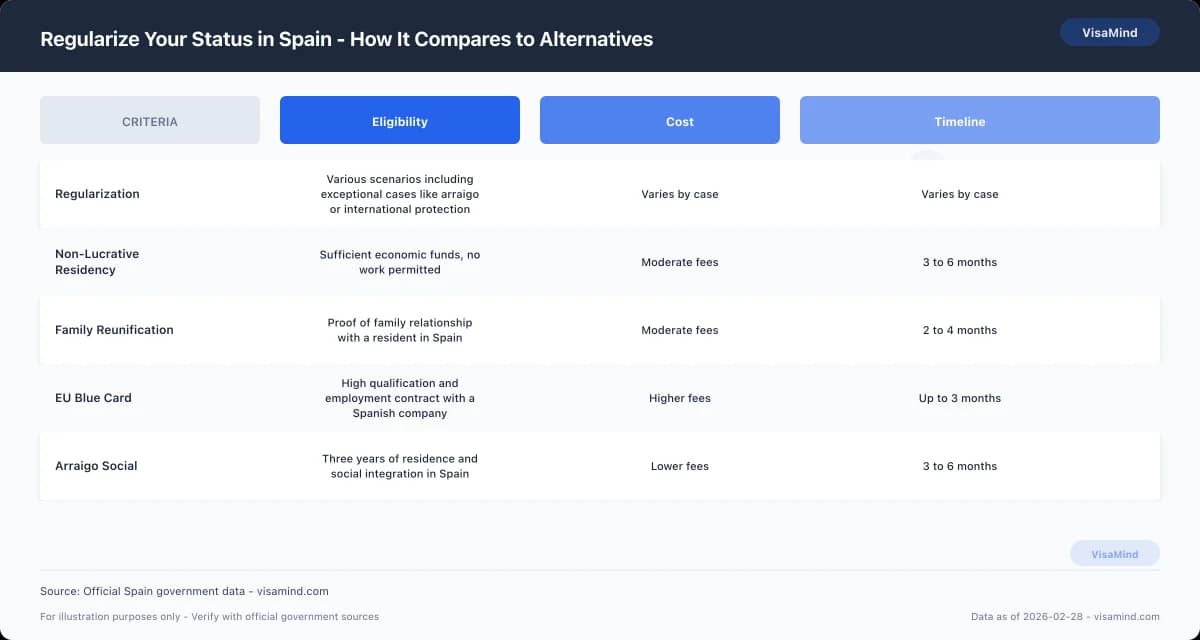
When considering how to regularize your status in Spain, it's important to understand how this pathway compares to other immigration options. Below is a comparison of the regularization process with some alternative programs in Spain.
| Pathway | Eligibility | Cost | Timeline |
|---|---|---|---|
| Regularize Your Status | Individuals already in Spain without proper documentation | Typically involves legal fees; verify on the official website | Varies; generally longer due to case reviews |
| Arraigo Social | Lived in Spain for 3 years, have social ties | Similar fees to regularization | Around 3 months |
| Arraigo Laboral | Worked in Spain for 6 months, lived for 2 years | Similar fees to regularization | Approximately 3 months |
| Family Reunification | Family members of legal residents | Varies; legal and application fees apply | Typically 2-5 months |
| Non Lucrative Residency | Sufficient economic funds, no work allowed | Approx. €60-€80 as of 2023; verify on the official website | 1-3 months, depending on consulate |
Key Differences
Eligibility Criteria
The primary difference in eligibility lies in the requirements for time spent in Spain and specific circumstances. For example, Arraigo Social requires proof of social ties and a longer duration of stay in Spain, whereas Family Reunification is based on familial connections to a legal resident.
Economic Requirements
Most pathways, including the Non Lucrative Residency, require proof of economic stability, either through savings or income. However, the regularization process often focuses more on establishing ties and circumstances rather than strictly financial proof.
Processing Time
Regularizing your status can be a longer process due to the complexities involved, including the need to demonstrate significant ties to the community or employment history. In contrast, processes like Family Reunification and Arraigo Social have more streamlined timelines, typically ranging from 2 to 5 months.
Important: Ensure you gather all necessary documentation and meet the specific criteria for your chosen pathway to avoid delays.
Conclusion
Understanding the differences between these pathways helps in making an informed decision about the best option for regularizing your status in Spain. Each has its unique requirements and advantages, so consider your personal circumstances and future plans carefully. For more detailed guidance, explore specific guides such as the Arraigo Guide or How To Apply.
Fees and Financial Requirements
#Understanding the fees and financial requirements is crucial. The costs and economic criteria vary depending on the type of visa or residence permit you are applying for through the State Secretariat for Migration (SEM).
Comparison of Fees and Financial Requirements
| Visa Type | Eligibility | Cost | Financial Requirements |
|---|---|---|---|
| Non-Lucrative Residency | Form EX-01 | €60 (as of 2023) | Proof of an annual income of at least €25,560, plus €6,390 per additional family member |
| Family Reunification | Form EX-02 | €76 | Proof of sufficient financial resources to support family members |
| Residence and Work Authorization | Form EX-03 | €190 | Valid employment contract with a Spanish company |
| EU Blue Card | Form EX-05 | €385 | Annual gross salary must be at least 1.5 times the average salary in Spain |
| Arraigo Social | Form EX-10 | €38 | Proof of integration and economic resources, including a job offer or self-employment plan |
Important: Verify the current fees and financial requirements on the official SEM website as these can change.
Financial Proof Requirements
When applying for regularization, you need to provide evidence of your financial stability. This can include:
- Bank Statements: Demonstrating sufficient funds for your stay.
- Employment Contracts: If applying for a work-based permit, you must present a valid contract with a Spanish employer.
- Income Statements: Required for non-lucrative residency to prove sustained income.
- Investment Proof: Necessary for the Golden Visa, which requires a significant investment in Spanish real estate or businesses.
Application Tips
Gather all necessary financial documents before starting your application. Incomplete submissions can lead to delays or rejections. For more guidance, consult our Financial Requirements Guide.
Tip: Consider consulting with an immigration lawyer or advisor familiar with Spanish regulations to ensure your financial documentation meets the standards required by SEM.
By adhering to these guidelines and preparing thoroughly, you can enhance your chances of successfully regularizing your status in Spain.
What You Can and Cannot Do
#Once your status is regularized in Spain, your work rights depend on the type of permit or visa you hold. For instance, if you've secured a residence and work authorization through a Spanish company using Form EX-03, you're allowed to work in Spain under the terms outlined in your employment contract. Alternatively, if you're in Spain on a non-lucrative residency visa (Form EX-01), you are not permitted to engage in any work or professional activities.
Important: Engaging in work activities not authorized by your visa type could lead to penalties or the revocation of your residency status.
Travel and Mobility
With a valid residence permit, you can generally travel freely within the Schengen Area. However, it is crucial to remember that extended absences from Spain may impact your ability to renew your permit or apply for long-term residency.
- Short Trips: Traveling within the Schengen Area is typically permitted for up to 90 days within a 180-day period.
- Extended Absences: Staying outside Spain for more than six months in a year could affect your residency renewal or eligibility for long-term residency.
Family Members and Reunification
If you wish to bring family members to Spain, you will need to apply for a family reunification visa using Form EX-02. This allows spouses, dependent children, and other eligible family members to join you in Spain, provided you can support them financially.
- Eligible Family Members:
- Spouse or registered partner
- Children under 18
- Dependent parents
Tip: Ensure you have the necessary financial means and accommodation to support your family members, as these are key criteria for family reunification.
Limitations and Obligations
Regularizing your status in Spain comes with certain obligations. You must comply with Spanish laws and ensure that all documentation remains current, including your NIE/TIE card. Failure to comply can result in fines, deportation, or other legal consequences.
- Document Renewal: Keep track of the expiration dates for all permits and renew them in a timely manner.
- Legal Compliance: Abide by all Spanish laws, including tax obligations and any specific conditions tied to your residency status.
Understanding these aspects of your rights and limitations ensures a smoother experience while living in Spain. For more detailed guidance on specific visa types, explore options like the Digital Nomad or Golden Visa.
Real-World Examples
#Maria, a Spanish citizen residing in Barcelona, wanted to bring her husband, Javier, from Argentina to live with her in Spain. Maria was concerned about ensuring that all necessary documents were in order to avoid any delays. To address this, she consulted the Secretaría de Estado de Migraciones (SEM) website to make sure she understood the requirements for the Family Reunification Visa. Maria gathered all the required documents, including proof of her income and their marriage certificate, and Javier submitted the EX-02 form along with these documents to the Spanish consulate in Buenos Aires. Within three months, Javier received his visa approval, allowing him to join Maria in Spain.
Scenario: Transitioning from Study to Work
Carlos, a Brazilian student in Madrid, was finishing his master's degree and wanted to stay in Spain to work. He found a job offer with a local tech company that was willing to sponsor his work permit. Carlos needed to transition from his student residence permit to a work authorization. He used the EX-03 form to apply for a residence and work authorization, ensuring he included the employment contract as a supporting document. Carlos also consulted the Documents Checklist to ensure he had all necessary paperwork. After submitting his application to the local immigration office, he received approval within two months, allowing him to begin his new role.
Scenario: Establishing Residence Through Arraigo
Lucia, originally from Peru, had been living in Spain for several years without legal residency. To regularize her status, she applied for a residence permit through the Arraigo Social process. Lucia gathered evidence of her social integration, including a job offer and proof of her continuous stay in Spain. She used the EX-10 form and submitted her application to the SEM. During the processing, Lucia stayed informed through the Arraigo Guide to understand each step. Within six months, Lucia received her residence permit, enabling her to live and work legally in Spain.
FAQs
Is it possible to switch from a non-lucrative residency to a work authorization in Spain?
How long does the SEM take to process a social ties regularization application in Spain?
Can I combine family reunification and work authorization when regularizing my status in Spain?
What is the cost of applying for a non-lucrative residency visa to regularize your status in Spain?
What is the processing timeline for a family reunification visa in Spain?
Can I regularize my status in Spain if I have an internship opportunity?
Are there financial requirements for regularizing status in Spain through the non-lucrative residency visa?
VisaMind provides informational guidance only and is not a government agency. This is not legal advice. Requirements can change and eligibility depends on your specific facts. If your case is complex or high-stakes, consult a licensed immigration attorney.
Next steps
Requirements vary by nationality, purpose, timeline, and case details. Use Find My Visa to get a personalized checklist for Spain with official sources and deadlines.
Find my visa