
What This Work Visa Offers — Spain ICT visa
#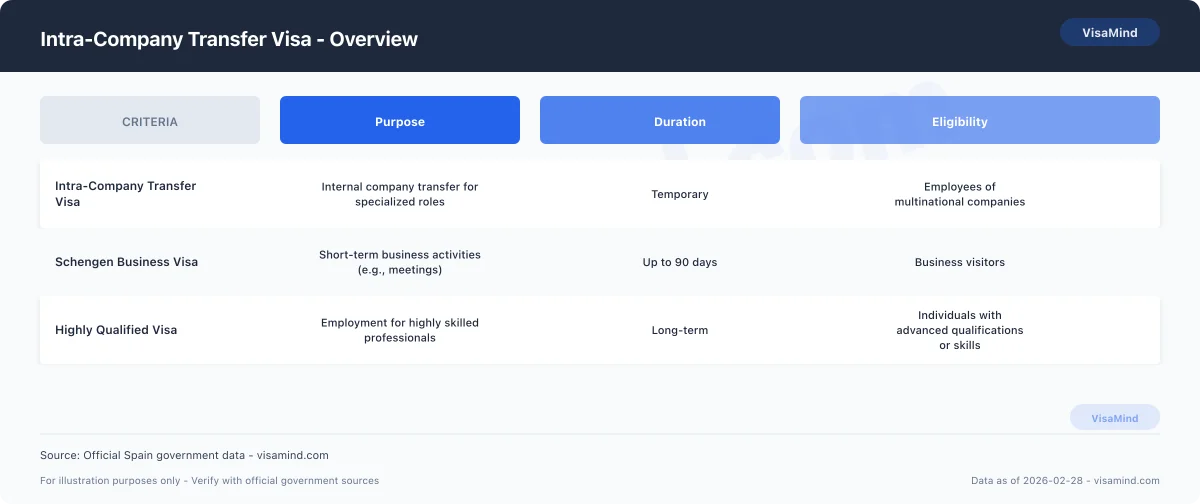
The Spain ICT visa lets your employer transfer you within a multinational group for a temporary assignment in Spain.
It applies to defined employee categories and requires a specific form filed with the State Secretariat for Migration (SEM).
Who uses this visa
You use this visa when your current employer transfers you to a Spanish entity within the same corporate group.
The assignment must be temporary and based on your existing employment relationship.
This route fits multinational companies moving key personnel into Spain for internal projects, restructuring, training, or specialized work.
It’s not for open-market hiring in Spain.
You do not use this visa if you plan to:
- Work for an unrelated Spanish employer.
- Start your own business under the Self-Employment Visa (Autónomo).
- Apply independently under the EU Blue Card or Highly Qualified Professional Visa.
- Enter solely for training under a standalone Trainee/Internship Visa outside a corporate transfer.
If you’re not sure whether your situation qualifies as an intra-company transfer, check the official guidance from the State Secretariat for Migration.
Covered employee categories
The ICT visa covers three groups within a multinational company:
| Category | Who qualifies | Purpose of transfer |
|---|---|---|
| Managers | Senior staff directing departments or the organization | Lead operations or oversee strategy in Spain |
| Specialists | Employees with advanced, company-specific expertise | Provide technical or proprietary knowledge |
| Trainees | Employees in structured corporate training | Complete professional development within the group |
Your role must fit one of these categories.
General employees without managerial authority, specialized expertise, or formal trainee status don’t qualify under this route.
The transfer must remain internal to the corporate group.
If your employer plans to hire you directly into Spain without an existing group relationship, you’ll probably need a National Work Visa or another residence authorization.
Governing form and authority
You apply using the official “Intra-Company Transfer Visa” (ICT) form issued by the State Secretariat for Migration (SEM).
SEM sets immigration policy and processes this authorization.
Spanish consulates issue the visa abroad after SEM approves the authorization.
After arrival in Spain, the National Police handle your foreigner identity documentation (NIE/TIE).
Don’t confuse the ICT form with other Spanish immigration forms:
| Form | Typical Use |
|---|---|
| Form EX-01 | Initial residence authorization |
| Form EX-02 | Residence renewal |
| Form EX-03 | Modification of residence status |
| Form EX-05 | EU long-term residence |
The ICT form is only for intra-company transfers.
Always use the latest version and instructions from the State Secretariat for Migration.
Fees and Processing Times
#You’ll need to budget for a government filing fee and expect a processing period that can last several months.
Both cost and timeline depend on where and how you apply, and which ICT category applies to your transfer.
Application fee
The standard government fee for a Spain ICT visa application is €60.
This amount applies as of March 2026.
You pay the fee when you submit your application to the competent authority, either in Spain or through a Spanish consulate abroad.
| Item | Amount (EUR) | Notes |
|---|---|---|
| ICT visa application fee | €60 | Per application |
If you file related authorization forms in Spain, such as Form EX-01, Form EX-02, Form EX-03, or Form EX-05, check with the State Secretariat for Migration (SEM) about any extra administrative fees for your situation.
Fee structures can differ from those used for a National Work Visa, EU Blue Card, Highly Qualified Professional Visa, Self-Employment Visa (Autónomo), or Trainee/Internship Visa.
Authorities can update fees without notice.
Standard processing time
ICT applications take 1 to 3 months to process under the standard procedure.
This timeframe applies as of March 2026.
The clock usually starts once you submit a complete application with all required documents.
processing times depend on:
- The specific ICT category
- Whether you apply from Spain or abroad
- The workload of the deciding authority
If you apply from outside Spain, the Spanish consulate issues the visa after approval.
If you apply in Spain, SEM handles the immigration authorization, and the National Police issue your residence card (TIE) after arrival.
Delays often happen due to incomplete forms, errors on forms like EX-01, EX-02, EX-03, or EX-05, or missing documents.
Submitting a complete file helps you stay within the 1–3 month window.
Check local variations
Timelines can vary depending on the authority handling your case.
Responsibility is divided as follows:
| Authority | Role |
|---|---|
| SEM | Immigration policy and authorization decisions |
| Spanish consulates | Visa issuance abroad |
| National Police | NIE/TIE issuance in Spain |
Processing speed can differ by province in Spain and by consulate abroad.
The 1–3 month standard may move faster or slower depending on local caseload.
Timelines for other permits, such as the EU Blue Card or Highly Qualified Professional Visa, don’t apply here.
Before you file, check current processing estimates with SEM or the consulate responsible for your application.
When to Get Professional Help
#An ICT application can fail even with employer support.
Careful document review and correct filing with all required supplements often determine whether SEM accepts your case.
Employer-handled cases vs complex cases
Many ICT applications move forward smoothly when your employer’s HR team prepares a complete file and follows official SEM instructions.
You may not need outside help if your case is straightforward and your employer has recent experience with ICT transfers.
Professional review makes sense if your situation overlaps with other categories, such as:
- Highly Qualified Professional Visa
- EU Blue Card
- National Work Visa
- Self-Employment Visa (Autónomo)
- Trainee/Internship Visa
Confusion between categories often leads to filing the wrong form, like Form EX-01, Form EX-02, Form EX-03, or Form EX-05, or submitting documents meant for a different permit.
| Scenario | Risk Level | Why Professional Review Helps |
|---|---|---|
| Standard ICT transfer with experienced employer | Lower | Employer likely familiar with SEM procedures |
| Mixed eligibility (e.g., ICT vs EU Blue Card) | Higher | Incorrect category can lead to rejection |
| Change of status inside Spain | Higher | Incorrect form selection (EX forms) can delay approval |
If your employer treats the ICT as interchangeable with other permits, confirm the strategy before filing.
When expert review helps
Expert review is useful when documentation is incomplete, inconsistent, or prepared without checking the latest SEM instructions.
SEM expects every required document in the correct format, submitted together with the main filing.
Professional review is especially important if:
- You previously held another Spanish residence status.
- You’re unsure which EX form applies.
- Your employer plans to file required supplements separately.
- Your consular visa application follows SEM authorization.
Spanish consulates issue the visa abroad, and the National Police issue your NIE/TIE after arrival.
Errors at the SEM stage can block all later steps.
An expert checks that your file aligns with ICT requirements, not another work category.
How experts prevent common errors
Most ICT refusals result from preventable filing mistakes.
You avoid common errors when a professional:
-
Reviews the official SEM instructions line by line.
-
Confirms all required documents appear in the initial submission.
-
Ensures required supplements are filed together with the main petition.
Submitting documents separately when they must be filed together can result in rejection.
An expert also compares your ICT case against similar categories, such as the Highly Qualified Professional Visa or EU Blue Card, to confirm you’re not using the wrong legal pathway.
Careful preparation reduces delays and prevents the need to restart the process.
From Work Visa to PR
#Moving from a Spain ICT visa to long-term residence takes planning, correct filings, and consistent legal stay.
You must align your next permit type with your work situation and keep your immigration record clean with SEM and the National Police.
Long-term options overview
Your Spain ICT authorization doesn’t automatically convert into permanent residence.
You must apply under a category that matches your employment or business activity at the time of renewal.
Common transition pathways include:
| Situation | Possible Authorization | Typical Form |
|---|---|---|
| Continued employment with Spanish employer | National Work Visa | Form EX-03 |
| Senior or specialized role | Highly Qualified Professional Visa | Form EX-05 |
| EU-level skilled employment | EU Blue Card | EX-05 |
| Starting your own business | Self-Employment Visa (Autónomo) | Form EX-01 |
| Structured training role | Trainee/Internship Visa | Form EX-02 |
Applications go to the State Secretariat for Migration (SEM).
If you apply from abroad, Spanish consulates issue the visa.
After approval, you complete your NIE/TIE process with the National Police.
Each category has its own eligibility rules.
Check the official instructions for your specific permit type before filing.
Check eligibility early
Start reviewing your long-term options before your ICT authorization expires.
SEM evaluates each application under the rules of the new category, not under your previous ICT status.
Confirm you meet the core criteria for the category you choose.
This usually includes:
- A qualifying job offer or business plan
- Compliance with the conditions of your current stay
- Proper submission of the correct EX form
- No gaps in lawful residence
If you qualify for the Highly Qualified Professional Visa or EU Blue Card, make sure your role and contract match that category’s requirements before switching.
If you plan to become self-employed, prepare your Autónomo application carefully and use the correct form (EX-01).
You’re responsible for ensuring the correct filing, not your employer.
Document continuity
Continuous lawful residence is essential when moving toward long-term status.
Gaps in authorization can interrupt your immigration record and affect future applications.
Keep documentation of:
- All prior residence authorizations
- Renewal approvals
- Employment contracts or activity records
- TIE issuance and renewals
Keep copies of every EX form submitted (EX-01, EX-02, EX-03, EX-05) and all SEM decisions.
When renewing or changing status, file before your current authorization expires.
Late filings create legal risk and may require extra justification.
Track expiration dates carefully.
You build eligibility for long-term residence through documented, uninterrupted compliance with Spain’s immigration rules.
Extending Your Work Visa
#You must file a complete and accurate extension request to keep your legal status in Spain.
Start early, update your documents, and submit the correct form to the State Secretariat for Migration (SEM).
When to start extension filings
Begin preparing your extension as soon as you confirm your assignment in Spain will continue.
Don’t wait until your current authorization is close to expiring.
Review the official instructions from the State Secretariat for Migration (SEM) for your permit type.
Different categories—like the National Work Visa, Highly Qualified Professional Visa, EU Blue Card, Self-Employment Visa (Autónomo), and Trainee/Internship Visa—may require different application forms.
Common extension forms include:
| Visa Category | Common Form |
|---|---|
| Standard employment authorization | Form EX-03 |
| Self-employment (Autónomo) | Form EX-01 |
| Modifications or specific work/residence changes | Form EX-02 / Form EX-05 |
Always confirm the correct form in the official instructions before filing.
Submit your application to SEM while your current authorization remains valid.
If you’re abroad, a Spanish consulate handles visa issuance.
If you’re in Spain, you’ll deal with SEM and then the National Police for your updated TIE.
Documents to refresh
You’ll need to provide updated documents that reflect your current employment status. Outdated contracts or expired certificates won’t work.
Prepare a checklist and confirm you:
- Complete all required sections of the right EX form
- Sign the application in all designated places
- Include all required supporting documents from the official instructions
- Provide updated employer documentation, if your situation requires it
- Submit proof that your employment or assignment is ongoing
If you hold an EU Blue Card or Highly Qualified Professional Visa, make sure the employer documentation matches your current job and conditions.
Those extending a Self-Employment Visa (Autónomo) should confirm that their business activity documentation reflects ongoing operations.
Missing signatures or incomplete sections are a common reason for processing delays. Review every page before you submit.
Timing and signatures
Every required section of the application form must be signed. SEM won’t process unsigned or partially completed forms.
Follow these steps:
-
Download the correct and latest version of the applicable EX form.
-
Complete every required field.
-
Sign where indicated.
-
Attach all required supporting documents.
-
Submit following the filing instructions.
If your employer needs to sign certain sections—often the case for employment-based permits—get their signature before filing.
Once approved, you’ll coordinate with the National Police to renew or update your TIE card. If applying from abroad, the Spanish consulate issues the visa after SEM approves the authorization.
The Dual-Track Application
#The Spain ICT visa requires coordinated action by both you and your employer. Both parts must align, include the right official forms, and contain all required supporting documents to avoid rejection by the State Secretariat for Migration (Secretaría de Estado de Migraciones) (SEM).
Employer petition vs worker application
Your employer starts the process before SEM. You complete your own application steps and later appear before the Spanish consulate if you’re applying from abroad.
The employer’s role typically includes:
- Preparing the main petition
- Completing the appropriate EX form (Form EX-01, Form EX-02, Form EX-03, or Form EX-05, depending on the authorization type)
- Signing all required sections
- Filing the petition with all mandatory supporting documents
You’re responsible for:
- Reviewing the official instructions carefully
- Completing your corresponding visa application
- Ensuring your personal documents match the employer’s submission
If either side omits required supplements, SEM can reject the filing. Confirm all documentation is submitted as one complete package.
| Stage | Employer | You (Worker) |
|---|---|---|
| Initial authorization | Files petition with SEM | Provides personal documents |
| Official forms | Completes and signs relevant EX form | Completes visa application forms |
| Supporting evidence | Submits corporate and assignment documents | Submits identity and civil documents |
| Consular stage | — | Applies at Spanish consulate abroad (if required) |
Don’t confuse this process with the National Work Visa, Highly Qualified Professional Visa, EU Blue Card, Self-Employment Visa (Autónomo), or Trainee/Internship Visa. Each uses different criteria and forms.
Filling out the official form
Every required field on the applicable EX form must be completed. Incomplete sections or missing signatures will usually lead to rejection.
Focus on:
- Accurate personal details
- Correct employer information
- Proper identification of the immigration category
- Required signatures in all designated areas
Review the official SEM instructions before submission. Don’t rely on templates from other visa types.
Consistency matters. Your name, passport details, and employment information need to match across all documents.
If you’re applying under a different category—like EX-01 or EX-05—double-check that the selected form matches your exact immigration route. Using the wrong form delays or invalidates your application.
Before you file, confirm:
- All mandatory sections are completed
- The form is signed where required
- No pages are missing
- All referenced attachments are included
Submitting evidence and supplements
All required evidence must be filed with the main petition. SEM may reject applications missing supporting documents.
Typical structure:
-
Completed and signed EX form
-
Required supporting documentation
-
Any mandatory supplementary forms
Don’t send the main petition first and plan to submit supplements later unless SEM’s official instructions specifically allow it.
If you’re applying from outside Spain, the Spanish consulate handles visa issuance after SEM grants authorization. The National Police will issue your NIE/TIE once you enter Spain.
Check that:
- Every required document is on your checklist
- Copies are clear and complete
- All referenced supplements are attached
- The submission follows the format described in SEM’s official instructions
A complete, properly signed, and fully documented filing gives SEM what it needs to assess your ICT authorization without extra delay.
Bringing Your Spouse and Children — intra-company transfer Spain
#Your spouse and children can apply to join you under the intra-company transfer Spain framework. Approval depends on clear civil documentation and complete filings.
Most refusals in family applications are due to missing proof of relationship or incomplete supporting documents submitted to the State Secretariat for Migration (Secretaría de Estado de Migraciones, SEM).
Who qualifies as a dependent
Your family member must qualify based on a legally recognized relationship, proven with official civil records.
SEM checks whether the relationship is formally documented and consistent across all submitted forms. This applies whether you hold authorization under the ICT route or another pathway such as the Highly Qualified Professional Visa, EU Blue Card, Trainee/Internship Visa, or related permits processed through forms like Form EX-01, Form EX-02, Form EX-03, or Form EX-05.
Confirm that:
- The relationship appears in official civil registry records.
- Personal details match your immigration file.
- The dependent’s application aligns with your authorized stay.
Spanish consulates issue visas abroad. SEM oversees immigration authorization in Spain, and the National Police manages the NIE/TIE issuance.
If you previously held a National Work Visa or Self-Employment Visa (Autónomo) and changed status, make sure your current authorization matches the basis of your family’s application.
Proof of relationship
Submit formal civil documents that clearly establish your relationship.
These documents must:
- Identify both parties by full legal name
- Match the spelling, dates, and identification details used in your ICT application
- Show a legally recognized family link
Inconsistent data between your forms and civil records often leads to rejection.
| Document Element | What SEM Checks | Risk if Missing or Inconsistent |
|---|---|---|
| Full legal names | Exact match with application forms | Request for correction or denial |
| Dates (birth/marriage) | Consistency across all filings | Delays or refusal |
| Official civil registration | Legal validity of the relationship | Immediate rejection |
Review every entry before submission. Even small discrepancies trigger additional review.
Common documentary issues for dependents
Most denials stem from incomplete documentation or missing required evidence.
Common problems include:
- Omitting civil documents that prove the relationship
- Submitting documents that do not match your ICT file information
- Failing to follow SEM document instructions for the specific form used (such as EX-01, EX-02, EX-03, or EX-05)
Follow the official instructions issued by SEM and the relevant Spanish consulate handling the visa application. Each authority reviews documentation independently.
Cross-check:
-
Your approved ICT authorization details
-
Each dependent’s civil records
-
All required supporting documents listed in the official application instructions
Accuracy and completeness drive outcomes. Missing relationship evidence is the most frequent and avoidable reason for refusal.
Eligibility Requirements
#You must qualify under a specific intra-company transfer category and follow the correct procedure from the outset. Spain processes applications through the State Secretariat for Migration (Secretaría de Estado de Migraciones, SEM). Spanish consulates issue visas abroad and the National Police issues your NIE or TIE in Spain.
Check the specific eligibility category
Identify the exact category for your transfer before preparing documents. The Spain ICT visa is distinct from other work routes such as the National Work Visa, Highly Qualified Professional Visa, EU Blue Card, Self-Employment Visa (Autónomo), and Trainee/Internship Visa.
Each category has its own legal basis, required forms, and procedural steps. Using the wrong form—like Form EX-01, Form EX-02, Form EX-03, or Form EX-05—can delay or invalidate your application.
Compare your situation:
| Permit Type | Purpose | Typical Applicant Profile | Authority Involved |
|---|---|---|---|
| ICT Visa | Intra-company transfer | Employee transferred within same corporate group | SEM |
| National Work Visa | Standard employment in Spain | Locally hired foreign worker | SEM |
| EU Blue Card | Highly qualified employment | Degree-holder with qualifying job offer | SEM |
| Self-Employment Visa (Autónomo) | Independent business activity | Self-employed professional | SEM |
| Trainee/Internship Visa | Training placement | Intern or trainee | SEM |
Always check the correct category in SEM instructions before submitting anything.
Manager, specialist, or trainee roles
You must fit within an accepted intra-company transfer role. The ICT framework covers employees transferred to Spain in a defined capacity within the same company or corporate group.
Roles typically fall into one of these categories:
- Manager – Directs a department or function and supervises other employees
- Specialist – Has advanced knowledge essential to the company’s activities, services, or research
- Trainee – Participates in structured professional development or training
This route isn’t for self-employment or local hiring. For independent work, the Self-Employment Visa (Autónomo) applies.
Your employer must structure your transfer to match one of these roles. The job title alone doesn’t determine eligibility. SEM evaluates actual duties and the purpose of the transfer.
Start with official instructions
Begin with the official SEM guidance for your selected category. Application steps, documentation, and required forms vary.
Follow this sequence:
-
Confirm your eligibility category
-
Review the corresponding SEM instructions
-
Complete the correct application form (such as EX-01, EX-02, EX-03, or EX-05, if applicable)
-
Submit through the proper authority
If you’re applying from outside Spain, the Spanish consulate issues your visa after authorization. After arrival, you complete registration and obtain your TIE from the National Police.
Requirements from other visa types won’t apply. Each route operates under its own rules administered by SEM.
What Your Employer Must Do
#Your employer handles the core filing for the Spain ICT visa. They must follow the instructions issued by the State Secretariat for Migration (Secretaría de Estado de Migraciones) (SEM) and submit every required document in the correct format.
Accuracy and completeness are key to moving the application forward.
Employer documentation responsibilities
Your employer must prepare and submit the full application package as required by SEM. Missing documents or incomplete forms can lead to rejection or requests for correction.
At a minimum, your employer should:
- Review the official SEM instructions for the ICT category
- Complete the correct EX form (such as EX‑01, EX‑02, EX‑03, or EX‑05, as applicable)
- Include all supporting corporate and assignment documentation required by the instructions
- Ensure consistency across all forms and attachments
If your case overlaps with other categories—like the Highly Qualified Professional Visa, EU Blue Card, National Work Visa, Self-Employment Visa (Autónomo), or Trainee/Internship Visa—your employer must confirm that the ICT route is the right classification before filing.
| Responsibility | Who Handles It |
|---|---|
| Review official requirements | Employer |
| Prepare and sign forms (e.g., EX forms) | Employer |
| Compile supporting documents | Employer |
| Submit application to SEM | Employer |
Spanish consulates issue visas abroad. The National Police issues the NIE/TIE after approval. Your employer’s role centers on the authorization stage.
Filing supplements and compliance
Your employer must ensure every required supplement is filed with the main application. SEM checks completeness at intake, so partial filings create delays.
Employers should:
-
Cross-check each document against the official checklist
-
Confirm all forms are properly signed
-
Verify that supporting documents match the information on the EX form
-
Keep copies of everything submitted
If SEM requests more documentation, your employer must respond within the stated timeframe. Missing the deadline can mean denial.
Compliance also includes filing under the correct category. An incorrect selection—such as choosing a National Work Visa route instead of ICT—may require refiling under the proper classification.
Review official instructions
Your employer should use the most current instructions from SEM. Requirements change, and outdated guidance leads to preventable errors.
Direct your employer to:
- Consult official SEM guidance before preparing the file
- Confirm the correct EX form version
- Follow document formatting and submission rules as written
Requirements for other work categories like the EU Blue Card or Highly Qualified Professional Visa don’t always match. Each route has its own documentation structure.
When uncertain, your employer should follow the official SEM instructions. Accuracy at the preparation stage protects your timeline and lowers the risk of rejection.
Common Petition Challenges
#Most delays in a Spain ICT visa case stem from preventable filing errors. You can avoid many of these by submitting complete forms and every required supporting document exactly as instructed by the State Secretariat for Migration (Secretaría de Estado de Migraciones) (SEM).
Incomplete or incorrect information
Every field on the relevant application forms—Form EX-01, Form EX-02, Form EX-03, or Form EX-05—must be filled in as instructed for your category. Missing answers, inconsistent data, or unchecked boxes often trigger requests for correction.
Even minor discrepancies can create larger problems. For example, if your employer lists one job title and the form lists another, SEM may question the accuracy of the filing.
The visa category must match your purpose. Confusing an ICT application with a National Work Visa, Highly Qualified Professional Visa, EU Blue Card, Self-Employment Visa (Autónomo), or Trainee/Internship Visa can lead to rejection if the form and supporting documents don’t align.
Before you submit, check:
- All biographical details for consistency
- Employer information across every form
- Signatures and dates in required sections
- The correct form version for your visa type
Missing required evidence
You need to include every document listed in the official instructions for your specific permit. Omitting even one required item can halt processing.
SEM reviews only the documents you submit. If you fail to provide a required attachment, the authority cannot assume eligibility.
Common issues:
- Forgetting to attach a required supporting document
- Submitting a form without the corresponding evidence
- Providing partial documentation instead of the full set requested
The responsibility to provide a complete file rests with you and your sponsoring employer. Spanish consulates will also review documentation before issuing the visa abroad. Missing items at that stage can halt issuance.
How missing items delay or reject cases
When SEM finds incomplete information or missing evidence, it may pause processing or issue a request for correction. Each correction cycle extends your timeline.
In more serious cases, SEM may reject the application outright if required documentation isn’t provided. You would then need to refile, which restarts the review process.
The impact of filing errors typically follows this pattern:
| Issue | Immediate Effect | Likely Outcome |
|---|---|---|
| Incomplete form | File flagged for review | Request for correction |
| Incorrect information | Inconsistency noted | Additional scrutiny or delay |
| Missing required document | File considered incomplete | Processing pause or rejection |
Fees
#| Component | Amount |
|---|---|
| Application feeExtracted from guide content — verify against official source | €60 (approx $65 USD) |
Fees change; always verify on SEM.