
On this page
- About Citizenship Acquisition — Spanish citizenship application
- Language and Integration Requirements — Spanish nationality requirements (Spain nationality)
- Fees and Processing Times
- Application Process
- Prepare Your Documents
- Eligibility Requirements
- Oath and Ceremony
- Why Citizenship Applications Get Denied
- Fees
- Required forms
- Related visa types
- Related guides
- Related goals
- Next steps
About Citizenship Acquisition — Spanish citizenship application
#Spanish citizenship formalizes your legal status and lets you obtain a Spanish national identity card and passport. You apply through legal pathways based on family ties, residence, or exceptional circumstances, submitting the required form and supporting documents to the competent Spanish authorities.
Who this covers
You may apply for Spanish citizenship if you qualify under one of the legally recognized routes. The form applies to individuals seeking nationality through:
- Family connections
- Lawful residence in Spain
- Extraordinary circumstances
This includes those who previously held residence authorization such as:
- Non-Lucrative Residence Visa holders
- Family Reunification Visa holders
- Individuals with Long-Term Residence
- Applicants regularized under Arraigo Familiar (Family Ties Regularization)
Your immigration history matters. You must hold or have held a valid status issued under Spain’s immigration framework overseen by the State Secretariat for Migration (Secretaría de Estado de Migraciones – SEM).
If you applied for your residence from abroad, a Spanish consulate handled your visa. If you obtained a foreigner identity number (NIE) or residence card (TIE), the National Police issued it.
| Applicant Profile | Basis for Citizenship Application |
|---|---|
| Family member of a Spanish national | Family connection |
| Legal resident in Spain | Residency period |
| Person with exceptional circumstances | Special legal grounds |
What you gain
Once approved, you become a Spanish national with full legal recognition under Spanish law.
You gain the right to:
- Apply for a Spanish passport
- Obtain a Spanish national identity card (DNI)
- Be recognized as a citizen rather than a foreign resident
Citizenship changes your legal position. You no longer rely on residence permits such as Long-Term Residence or visas like the Non-Lucrative Residence Visa.
Your status shifts from immigration-based authorization to nationality. This removes the need to renew residence documentation tied to foreign national status.
| Before Approval | After Approval |
|---|---|
| Residence permit holder | Spanish citizen |
| TIE as foreigner | DNI as citizen |
| Foreign passport | Spanish passport |
You must still complete the formal citizenship procedure and pay the applicable administrative fee using Modelo 790 (Code 062). For the current fee amount, refer to the Spanish government’s published figures.
Main application routes
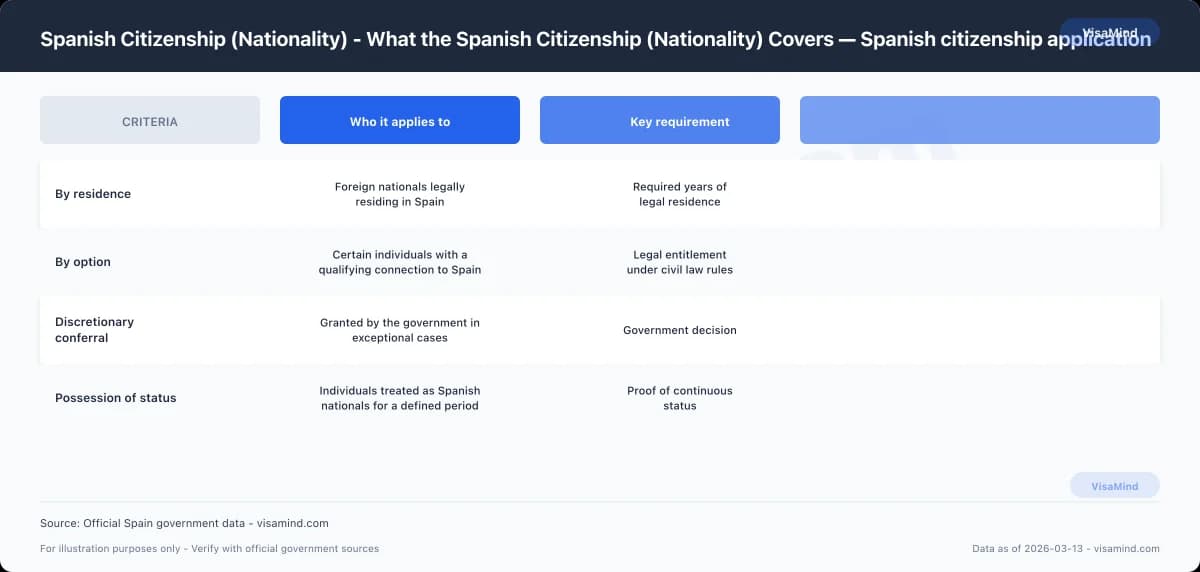
Spanish citizenship applications generally fall into three categories:
-
Citizenship by family connection
-
Citizenship by residence
-
Citizenship under extraordinary circumstances
Family-based applications apply when you have qualifying ties to a Spanish national. This route often connects to prior immigration status obtained through family sponsorship or Arraigo Familiar.
Residence-based applications apply if you have legally lived in Spain under an authorized status. Your residence history must be lawful and properly documented under SEM oversight.
Extraordinary circumstances apply in limited cases defined by law. You must demonstrate eligibility under the specific provision that applies to your situation.
Each route requires:
- A completed Spanish citizenship application form
- Supporting civil and identity documents
- Proof of your legal basis (family, residence, or special circumstance)
- Payment through Modelo 790 (Code 062)
You submit your application through the competent Spanish authority according to your place of residence.
Language and Integration Requirements — Spanish nationality requirements (Spain nationality)
#Spain requires you to prove basic Spanish language ability and knowledge of the country’s constitutional and social framework. Most applicants complete two exams administered by Instituto Cervantes and pay the corresponding fees during registration.
Language test (DELE A2)
You must pass the DELE A2 exam to show basic Spanish proficiency, unless you qualify for an exemption. This level confirms you can understand and use everyday expressions and handle routine situations in Spanish.
Instituto Cervantes administers the exam through approved test centers in Spain and abroad. You register directly with the test provider and pay the required fee.
| Requirement | Details |
|---|---|
| Exam name | DELE A2 |
| Purpose | Prove basic Spanish language proficiency |
| Administered by | Instituto Cervantes |
| Fee | €150 (as of 2026-02) |
You’ll need the DELE A2 certificate when you submit your nationality application file to the Ministry of Justice. Keep your exam confirmation and results for your records.
This requirement applies whether you previously held a Non-Lucrative Residence Visa, Family Reunification Visa, Long-Term Residence, or obtained status through Arraigo Familiar (Family Ties Regularization). Prior residence status doesn’t provide an automatic waiver for the language test.
Civic knowledge (CCSE)
You must also pass the CCSE (Conocimientos Constitucionales y Socioculturales de España) exam in most cases. This test measures your knowledge of Spain’s Constitution, government structure, and social and cultural norms.
Instituto Cervantes organizes and scores the CCSE exam. You register online through the official platform and select your exam session and location.
| Requirement | Details |
|---|---|
| Exam name | CCSE |
| Purpose | Test knowledge of constitutional and sociocultural topics |
| Administered by | Instituto Cervantes |
| Fee | €100 (as of 2026-02) |
You submit proof of passing the CCSE with your nationality application. The Ministry of Justice reviews your results as part of the integration assessment.
Passing the CCSE does not replace other administrative steps, such as paying the nationality application fee using Modelo 790 (Code 062) or complying with procedures overseen by the State Secretariat for Migration (Secretaría de Estado de Migraciones) (SEM) in related residence matters.
Exemptions
Some applicants do not need to take one or both exams. Exemptions depend on your personal circumstances and supporting documentation.
You may qualify for an exemption if:
- You meet criteria recognized by the Ministry of Justice for language or civic knowledge waivers.
- You fall within a category specifically exempted under current nationality regulations.
The authority reviewing your nationality file decides whether to grant the exemption. You must submit official documents that clearly support your request.
If you believe you qualify, confirm the exact exemption rules and documentary requirements with the Ministry of Justice before filing. Holding Long-Term Residence, status through Arraigo Familiar (Family Ties Regularization), or a past Family Reunification Visa does not automatically exempt you from the DELE A2 or CCSE.
Fees and Processing Times
#You must budget for government filing fees and prepare for a multi‑year review period. Costs are fixed by regulation, while timelines depend on your category, location, and file verification by the authorities.
Application & exam fees
You pay a €200 government application fee when you submit your Spanish citizenship file using Modelo 790 (Code 062).
| Fee Type | Amount | Notes |
|---|---|---|
| Citizenship application | €200 | Paid with Modelo 790 (Code 062) |
You must also pay any required examination fees. The amount depends on the testing body and is not included in the €200 government filing fee. Confirm current exam costs with the official examination provider before registering.
If you hold residence through a Non-Lucrative Residence Visa, Long-Term Residence, Family Reunification Visa, or Arraigo Familiar (Family Ties Regularization), your prior immigration fees do not reduce the citizenship filing fee. Citizenship is a separate procedure administered under the authority of the State Secretariat for Migration (Secretaría de Estado de Migraciones) (SEM).
Spanish consulates collect visa fees abroad, while the National Police issue your NIE or TIE. Those payments are separate from your citizenship application.
Processing time estimates
Under the standard procedure, citizenship applications take 12 to 36 months to process.
| Procedure Type | Estimated Processing Time |
|---|---|
| Standard route | 12–36 months |
Expect a timeframe of 1 to 3 years from submission to final decision. The clock starts once you properly file your complete application and pay the required fee.
Processing includes background checks, review of your legal residence history, and confirmation that you meet the applicable legal category. Delays occur if your file is incomplete or if authorities request additional documentation.
Always verify current processing estimates with the issuing authority before you apply.
Variable timelines & verification
processing times vary based on:
- Your citizenship category
- Your place of submission
- The workload of the reviewing office
- The need for additional verification
Applicants with complex residence histories—such as time under different permits like Non-Lucrative Residence, Family Reunification, or Arraigo Familiar—may face longer review periods if authorities must reconcile records.
The State Secretariat for Migration (SEM) oversees immigration policy, but different offices handle different stages of review. Administrative workload directly affects timing.
You must monitor your application status through the official government channel and respond quickly to any request for documents. Failure to respond on time can extend your timeline significantly.
Application Process
#You file your application with the correct authority, complete the required nationality form accurately, and pay the correct government fee. Errors in the form or payment validation commonly cause delays, so you must follow each step carefully.
Where to file
You submit your Spanish citizenship application to the State Secretariat for Migration (Secretaría de Estado de Migraciones, SEM) when your case falls under its authority.
This typically applies if your residence in Spain was granted through immigration categories such as:
- Non-Lucrative Residence Visa
- Long-Term Residence
- Arraigo Familiar (Family Ties Regularization)
- Family Reunification Visa
If you are applying from abroad, a Spanish consulate handles visa issuance, not SEM. However, citizenship nationality filings referenced here are submitted according to SEM procedures.
Before filing, download the current nationality application form and official instructions from the SEM website. Always review the instructions specific to your eligibility category. Requirements differ depending on how you obtained legal residence.
Use the table below to confirm the authority involved:
| Procedure Type | Responsible Authority |
|---|---|
| Immigration policy & nationality filings | State Secretariat for Migration (SEM) |
| Visa issuance abroad | Spanish Consulates |
| NIE/TIE issuance | National Police |
File only with the authority listed in the official instructions for your case.
Filling & submitting the form
Download the most recent Spanish citizenship application form directly from the SEM website. Do not reuse an older saved version.
Complete every required section. Incomplete forms often result in processing delays.
Follow these steps:
-
Read the instructions for your eligibility category.
-
Fill in all mandatory fields exactly as requested.
-
Sign the form where required.
-
Attach all required supporting evidence.
Ensure your personal details match your residence records. If your status was granted under Long-Term Residence, Non-Lucrative Residence, or Arraigo Familiar, your information must be consistent with those records.
Before submitting, confirm:
- Your name appears exactly as on your residence documents.
- All required documents are included.
- The correct fee code is selected (see below).
Submit the completed form according to the instructions provided by SEM. Keep copies of everything you file.
Payment, receipts & validation
You must pay the nationality application fee using Modelo 790 (Code 062). This specific code applies to nationality procedures.
Selecting the wrong 790 code is a common error and causes delays.
| Form | Correct Code | Purpose |
|---|---|---|
| Modelo 790 | Code 062 | Spanish nationality application |
Do not use other 790 codes. They apply to different immigration procedures.
After payment, verify that your receipt is properly validated. If you pay online, confirm that the receipt displays the full validation code. An incomplete or unclear validation can delay your application.
If the online validation code is unclear, pay at a bank and obtain a physically stamped receipt. A stamped bank receipt provides clear proof of payment.
Always keep a copy of the validated receipt and include it with your application submission.
Prepare Your Documents
#You must prove your relationship, your lawful residence in Spain, or the exceptional grounds that support your application. Spanish authorities will not fill gaps in your file, so you need clear, complete documentary evidence from the start.
Proof of family ties
If you're applying for nationality by option or through a Spanish family member, you'll need to show documents proving your relationship to the Spanish citizen.
Gather:
- Birth certificates that demonstrate parent–child relationships
- Marriage certificates if you're applying as a spouse
- Any civil registry records linking you to the Spanish national
- Evidence that your Spanish relative is actually a Spanish citizen
For those applying under Arraigo Familiar (Family Ties Regularization), include proof of the qualifying family connection. If you previously had a Family Reunification Visa, add copies of the visa and related approvals to show the relationship is ongoing.
Authorities expect all names, dates, and registry details to match across your documents.
| Situation | Required Evidence |
|---|---|
| Nationality by option | Civil registry documents proving relationship to Spanish citizen |
| Arraigo Familiar | Proof of qualifying family link |
| Spouse of Spanish citizen | Marriage certificate + proof of spouse’s citizenship |
Submit official copies issued by the relevant civil registry.
Proof of residency & status
For nationality by residency, you have to show you've legally lived in Spain for the required time.
Collect:
- Residence authorizations under programs like the Non-Lucrative Residence Visa
- Evidence of Long-Term Residence status, if you have it
- Copies of your residence cards (TIE) from the National Police
- Official records confirming your immigration status from the State Secretariat for Migration (Secretaría de Estado de Migraciones, SEM)
Your documents should clearly show how long you've been allowed to stay. Gaps or expired permits can cause delays or even lead to denial.
You also need to show proof of payment for the administrative fee using Modelo 790 (Code 062). The exact amount is published by the competent authority.
Exceptional circumstances & special connections
Applicants using discretionary conferral need to document the exceptional circumstances supporting their request.
Provide:
- Official documents explaining your extraordinary situation
- Certifications from government or institutions backing your claim
If you're claiming Sephardic origin, submit proof of:
- Sephardic ancestry
- A current, demonstrable special connection to Spain
Authorities look for concrete, verifiable evidence of both historical roots and present-day ties.
If you're relying on a particular legal route, organize your file so each document clearly supports that ground.
Eligibility Requirements
#You must meet certain age, residence, and legal status requirements before applying for Spanish nationality. The specific path depends on factors like your time in Spain and whether you have close family ties to Spanish citizens.
Age & legal capacity
Your age and legal capacity matter in Spanish nationality applications.
You can apply by yourself if you're over 14 years old and legally capable.
If you're under 18, your legal representative submits the application for you. Usually, that's a parent or guardian with legal authority.
Key points:
- 14–17 years old: You may apply, but a legal representative might need to be involved.
- Under 18: A parent or legal guardian files the application.
- 18 or older: You apply on your own.
You also need valid legal residence status in Spain when applying through residence. The State Secretariat for Migration (Secretaría de Estado de Migraciones, SEM) manages immigration policy, while nationality procedures are handled by other authorities.
Residence duration rules
Most people qualify by having legal residence in Spain for a minimum period.
The general rule is:
- 10 years of continuous legal residence
Some applicants qualify with less time:
| Situation | Required Legal Residence |
|---|---|
| Nationals of Latin American countries | 2 years |
| Nationals of the Philippines | 2 years |
| Nationals of Equatorial Guinea | 2 years |
| Nationals of Andorra | 2 years |
| Nationals of Portugal | 2 years |
| Married to a Spanish citizen | 1 year |
| Born in Spain | 1 year |
Your residence must be lawful and on record. This can include status from a Non-Lucrative Residence Visa, Family Reunification Visa, or Long-Term Residence.
Any time spent in Spain without valid authorization doesn't count.
Other qualifying routes
You might qualify for Spanish nationality without the standard 10-year rule if you have specific family ties or special circumstances.
Recognized routes:
- Family ties to Spanish citizens
- Marriage to a Spanish citizen (1 year of legal residence)
- Birth in Spain (1 year of legal residence)
- Discretionary conferral for exceptional circumstances
If you regularized your status through Arraigo Familiar (Family Ties Regularization) based on a Spanish family member, that lawful residence might count toward the reduced residence requirement, depending on your case.
Each route needs proof of your legal status and the qualifying condition. Submit the right application and pay the administrative fee using Modelo 790 (Code 062), with the current fee published by the competent authority.
Oath and Ceremony
#
Once your nationality application is approved, there are two final steps: taking the oath and registering your nationality in the Civil Register. Only after this registration can you get Spanish identity documents.
Oath of allegiance
You must personally declare loyalty to the King and promise to follow the Spanish Constitution.
This isn't optional—it's a legal step to finalize your Spanish nationality.
The oath happens at the Civil Register. You have to appear in person.
During the appointment, you:
- Swear or promise loyalty to the King
- Swear or promise to obey the Spanish Constitution
- Confirm your intention to become a Spanish national
If you held a residence status—like a Non-Lucrative Residence Visa, Long-Term Residence, Arraigo Familiar, or status from a Family Reunification Visa—that status becomes secondary once you acquire nationality. From then on, you're recognized as a Spanish national, not as a foreign resident under SEM.
Civil register entry and certificate
You're not fully recognized as a Spanish citizen until the Civil Register records your nationality.
The Civil Register creates an official entry showing your acquisition of Spanish nationality. This record is the legal basis for all future identity documents.
The process:
-
Take the oath
-
Complete the Civil Register entry
-
Receive a Spanish birth certificate reflecting your nationality
This certificate is essential; you'll need it to apply for your national identity card and passport.
| Step | Authority Involved | Result |
|---|---|---|
| Oath declaration | Civil Register | Legal confirmation of allegiance |
| Nationality registration | Civil Register | Official nationality record |
| Certificate issuance | Civil Register | Proof of Spanish nationality |
The State Secretariat for Migration (Secretaría de Estado de Migraciones) (SEM) manages immigration policy, but nationality registration is handled by the Civil Register.
Receiving ID and passport
Once your nationality is recorded in the Civil Register, you can apply for Spanish identity documents.
Apply in person for:
- DNI (Documento Nacional de Identidad)
- Spanish passport
The National Police issue both.
Bring your Civil Register certificate. Without it, you can't get your DNI or passport.
After you receive them, you no longer use your foreigner identification number (NIE) or residence card. Your Spanish DNI is your main ID in Spain, and your passport confirms your Spanish nationality for travel.
Why Citizenship Applications Get Denied
#Spanish citizenship is not automatic. Authorities look at your legal residence history, whether you met all formal requirements, and your final oath before granting nationality.
Common documentation gaps
You must prove you legally lived in Spain for the required period if applying through nationality by residence. Without valid residence authorization, your application may be denied.
This often affects people who had:
- Non-Lucrative Residence Visa
- Family Reunification Visa
- Long-Term Residence
- Arraigo Familiar (Family Ties Regularization)
If your records with the State Secretariat for Migration (Secretaría de Estado de Migraciones, SEM) don't clearly show lawful residence, your file may not support approval.
Typical issues:
- Missing proof of valid residence authorization
- Inconsistent residence records
- Gaps in documentation for certain periods
You also have to submit Modelo 790 (Code 062) properly. Errors or missing documents can delay your file or lead to refusal.
| Issue | Why It Matters |
|---|---|
| No legal proof of residency | You cannot qualify through nationality by residence |
| Incomplete residence history | Authorities cannot verify eligibility |
| Incorrect or missing required forms | File may be considered incomplete |
You have to prove your eligibility. Authorities won't fix missing evidence for you.
Failure to meet conditions
Approval means more than just submitting documents. You need to satisfy all legal conditions tied to your application path.
If you get approval, you still have to formally swear the oath of allegiance. Not completing this step means you won't acquire Spanish nationality.
You must:
-
Receive approval
-
Complete the oath of allegiance
-
Finalize the registration steps required by the competent authority
If you miss any of these steps, nationality won't take effect.
Application not guaranteed
Submitting a Spanish citizenship application doesn't guarantee approval. Each case is reviewed individually.
Even with valid residence—like Long-Term Residence or Arraigo Familiar—approval depends on whether your file clearly meets all legal requirements.
Applications are denied when:
- Required proof is insufficient
- Legal residence can't be verified
- Mandatory post-approval steps aren't completed
Treat your application as a legal process, not just paperwork. The review is discretionary within the legal framework, and only complete files that meet all requirements are approved.
Fees
#| Component | Amount |
|---|---|
| Application feeExtracted from guide content — verify against official source | €200 (approx $216 USD) |
| DELE exam feeLanguage proficiency exam (A2) — required unless exempt; amount varies by test center | €150 (approx $162 USD) |
| CCSE exam feeCivic knowledge exam — required for most applicants; Instituto Cervantes | €100 (approx $108 USD) |
Fees change; always verify on SEM.
Next steps
#Use Find My Visa to build a sequenced plan with official sources and deadlines.
FAQs
What is Modelo 790 (Code 062)?
Modelo 790 (Code 062) is a government fee form used for immigration procedures.
You must complete and submit it for your specific process. The current fee amount is published by the competent authority.
Where do you submit your visa if applying from abroad?
You submit your visa application at the Spanish consulate in your country of residence.
SEM sets policy. Consulates handle visa issuance.
What application routes are available for Spanish nationality?
The spanish-citizenship form is used to apply through various routes such as family connections, residency, or discretionary conferral (exceptional circumstances).
How long does a Spanish citizenship application usually take to process?
Standard processing is reported as 12 to 36 months (1–3 years); processing times vary by applicant category and processing location, so verify current times with the issuing authority.
What fees will I need to pay?
The application fee is €200. Language and civic exams carry additional fees (DELE approx. €150 for A2; CCSE approx. €100).
Who is eligible to apply?
Persons over the age of 14 and persons under 18 with a legal representative may apply. Eligibility routes include family ties to Spanish citizens, discretionary conferral for exceptional circumstances, and residency (with specified duration requirements).
What documents prove a relationship to a Spanish citizen?
Applicants must provide documentary evidence of their relationship to the Spanish citizen; evidence requirements apply specifically for nationality by option and related categories.
Are language or civic knowledge tests required?
A language proficiency exam (DELE A2) is required unless exempt, and a civic knowledge exam (CCSE) is required for most applicants; both have associated fees.
Where do I file the Spanish citizenship form and where can I get it?
Applicants file with the Secretaría de Estado de Migraciones. You can download the current spanish-citizenship form and instructions from the official Secretaría de Estado de Migraciones website.
What happens after my nationality is approved?
Upon acquiring nationality, you complete the Civil Register entry and must swear an oath of allegiance to the King and obedience to the Spanish Constitution; the process facilitates rights to a Spanish identity card and passport.
What are common reasons an application may be refused or delayed?
Applications can be refused or delayed for reasons such as failing to provide legal proof of residency for a residency-based application, not swearing the required oath upon acquiring nationality, and because filing does not guarantee approval.
Official sources referenced
Last reviewed: 2026-03-13
VisaMind provides informational guidance only and is not a government agency. This is not legal advice. Requirements can change and eligibility depends on your specific facts. If your case is complex or high-stakes, consult a licensed immigration attorney.
Next steps
Every Spain visa case depends on your nationality, purpose, and timeline. Get a personalized plan with official sources and deadlines.
Get my Spanish Citizenship (Nationality) plan