
Overview — Thailand SMART visa
#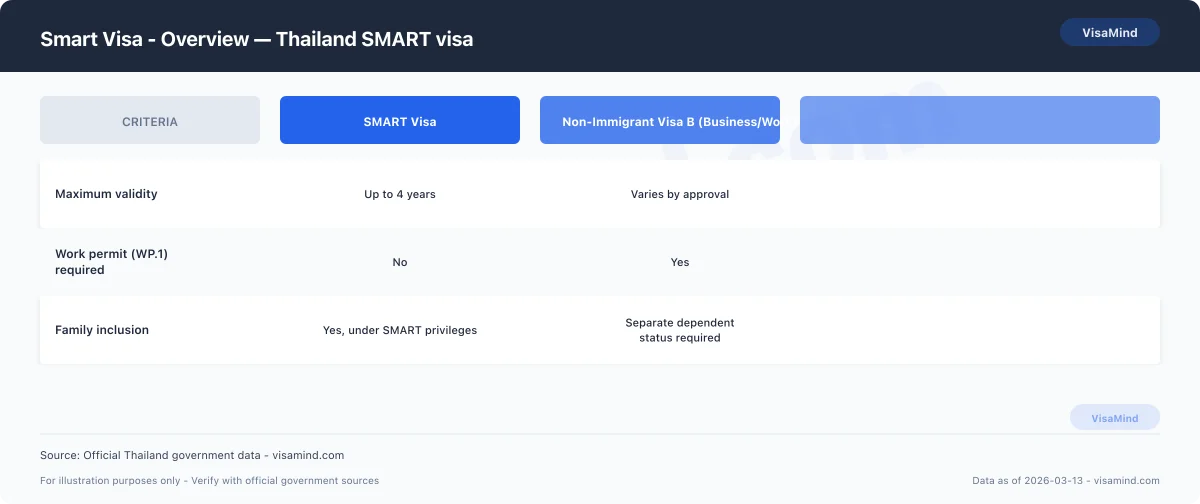
The Thailand SMART visa gives qualified professionals and investors long-term permission to stay and work in Thailand. It replaces the need for a separate work permit and allows certain family members to stay with you.
What it is
The Thailand SMART visa is a 4-year visa for highly skilled individuals working in specific target industries. You can live and work in Thailand without applying for a separate work permit through the Immigration Bureau.
Unlike the Non-Immigrant Visa B (Business/Work), you don’t need to file a work permit application like Form WP.1. The SMART visa combines stay and work authorization into a single immigration status.
This visa is distinct from other long-stay categories:
| Visa Type | Primary Purpose | Work Permit Required |
|---|---|---|
| SMART Visa | High-skill work/investment in target industries | No |
| Non-Immigrant Visa B (Business/Work) | Employment in Thailand | Yes (WP.1) |
| Non-Immigrant Visa B (Business Meetings) | Short business visits | Not designed for employment |
| Non-Immigrant Visa ED (Education) | Study | Not for employment |
| Non-Immigrant Visa O | Family or other purposes | Depends on activity |
| Non-Immigrant Visa O-A (Retirement) | Retirement | No employment permitted |
The Immigration Bureau (สำนักงานตรวจคนเข้าเมือง) oversees your stay once the visa is issued.
Who it's for
The SMART visa targets individuals who meet specific professional or investment criteria in designated industries. You must qualify as a highly skilled professional or investor under the program’s standards.
You may be eligible if you fall into one of these categories:
- Highly skilled professionals working in approved target industries
- Investors participating in qualifying sectors
- Other qualified individuals under the SMART framework
This visa suits you if you want to work in Thailand long term without managing a separate work permit process. It also benefits you if you plan to relocate with your immediate family.
If your purpose is general employment outside the approved framework, you would typically apply for a Non-Immigrant Visa B (Business/Work) instead. For study, retirement, or family reasons, other visa categories like Non-Immigrant Visa ED, Non-Immigrant Visa O, or Non-Immigrant Visa O-A (Retirement) may be more appropriate.
Key features
The SMART visa offers structural advantages compared to traditional work-based visas.
Core features include:
- Validity of up to 4 years
- No separate work permit required
- Authorization to work in approved target industries
- Inclusion of eligible family members
Because you don’t need a separate work permit, you avoid filing Form WP.1 and aren’t tied to the standard work authorization process.
Family inclusion allows your spouse and qualifying dependents to stay in Thailand under related permissions. This is useful if you’re planning a long-term relocation.
For current application procedures, required documents, and any applicable fees in THB (฿), consult the Immigration Bureau. Requirements can shift depending on your qualification category.
Sponsor Requirements
#Your sponsor or filing entity must submit documents to the Immigration Bureau of Thailand and follow the correct appointment or electronic process. You must also ensure that all required forms and supporting records reach the proper authority in the correct format.
What sponsors/filers submit
Your sponsor files the required form directly with the Immigration Bureau when you apply for SMART Visa issuance inside Thailand.
At a minimum, the filing package includes:
- The official application form used by the Immigration Bureau
- Supporting documents required for your specific SMART Visa category
- Copies of your current immigration status documents, if you already hold a Thai visa (such as Non-Immigrant Visa B (Business/Work), Non-Immigrant Visa B (Business Meetings), Non-Immigrant Visa ED (Education), Non-Immigrant Visa O, or Non-Immigrant Visa O-A (Retirement))
If you are transitioning from another visa type, your sponsor must ensure your existing status remains valid at the time of submission.
The Immigration Bureau reviews filings submitted for SMART Visa issuance in Thailand. For document lists specific to your category, check the Immigration Bureau of Thailand (สำนักงานตรวจคนเข้าเมือง).
| Filing Scenario | Who Submits | Where Reviewed |
|---|---|---|
| Applying inside Thailand | Sponsor/Filer | Immigration Bureau |
| Applying through E-Visa system | Applicant uploads; sponsor coordinates | Relevant Thai authority processing E-Visa |
Appointments and submission routes
You must schedule an appointment for SMART Visa issuance with the Immigration Bureau if you apply in Thailand. Walk-in service isn’t guaranteed.
You may also apply through the E-Visa system, depending on your location at the time of application. In that case, you complete the online Form Visa Application process and follow the electronic instructions provided.
Follow these steps:
-
Confirm your eligibility and visa category.
-
Prepare required documents.
-
Book an appointment with the Immigration Bureau or submit through the E-Visa system.
-
Attend your appointment or complete the digital submission process.
If you previously held a work-related status, confirm whether separate work authorization forms, such as Form WP.1, apply to your situation through the relevant Thai authority.
Appointment procedures can change, so verify details directly with the Immigration Bureau before appearing in person.
Where to send e-documents
If you apply through the E-Visa system and later enter Thailand, you must send your electronic visa document and your Thai arrival stamp to:
smartvisa@boi.go.th
Send clear, complete copies. Include your full name and passport details in the email so officers can match your records.
Do not send incomplete files. Missing pages or unclear stamps cause delays.
The Immigration Bureau processes in-country issuance, while electronic documents submitted after entry support SMART Visa verification. Always keep copies of everything you send for your records.
Conditions and Portability
#Your Thailand SMART Visa remains valid only if you follow ongoing compliance rules set by the Immigration Bureau of Thailand (สำนักงานตรวจคนเข้าเมือง). The most important obligation is maintaining proper residence reporting and keeping your immigration record accurate.
Reporting and residence rules
If required, you must report your current residential address to the Immigration Bureau every 90 days.
Failing to make a required 90‑day report of your current residence places you out of compliance. This issue can affect how the Immigration Bureau reviews your stay and any future Form Visa Application you submit.
You should track your reporting cycle carefully. Holding a SMART Visa doesn’t remove this obligation.
Key compliance point
| Requirement | Authority | Risk if Ignored |
|---|---|---|
| 90‑day residence report (when required) | Immigration Bureau of Thailand | Non-compliance with visa conditions |
Other Thai visa categories—such as the Non-Immigrant Visa B (Business/Work), Non-Immigrant Visa B (Business Meetings), Non-Immigrant Visa ED (Education), Non-Immigrant Visa O, and Non-Immigrant Visa O-A (Retirement)—also require holders to follow Immigration Bureau reporting rules. Your SMART Visa doesn’t exempt you from residence compliance if reporting applies to you.
Visa record checks
The Immigration Bureau maintains records tied to your passport and visa category. Officers review your compliance history when you interact with immigration authorities.
Your record reflects whether you completed required 90‑day residence reports. Any missed report becomes part of your immigration file.
You should confirm that your reporting history is complete before:
- Submitting a new Visa Application
- Requesting changes related to your stay
- Responding to immigration inquiries
Accurate records protect your status. You control this by meeting all reporting obligations on time.
Dependents
#Your spouse and children can apply for a dedicated SMART visa category tied to your approved status. Thailand issues a specific SMART O (Other) visa for legal dependents of the main SMART visa holder, and the Immigration Bureau (สำนักงานตรวจคนเข้าเมือง) manages the process.
Who qualifies as a dependent
Thailand limits SMART visa dependents to your legal spouse and your children. Other relatives do not qualify under this category.
You must show that the relationship is legally recognized. The Immigration Bureau reviews your documentation as part of the Form Visa Application process.
Eligible dependents include:
- Spouse legally married to the SMART visa holder
- Children of the SMART visa holder
If your family member doesn’t meet these criteria, they must consider a different visa type, such as a Non-Immigrant Visa O, Non-Immigrant Visa ED (Education), or another appropriate category.
The SMART O status exists specifically for family members of a SMART visa holder. It doesn’t replace other visa options like the Non-Immigrant Visa B (Business/Work), Non-Immigrant Visa B (Business Meetings), or Non-Immigrant Visa O-A (Retirement) when those categories better match the applicant’s purpose of stay.
Dependent visa categories
Thailand issues SMART O (Other) visas to qualifying dependents of approved SMART visa holders. This category links directly to the principal applicant’s SMART status.
| Applicant Type | Visa Category | Basis of Eligibility |
|---|---|---|
| Legal spouse | SMART O | Marriage to SMART visa holder |
| Child | SMART O | Parent holds SMART visa |
You apply through the SMART visa application process, and the Immigration Bureau reviews each dependent application individually.
The dependent visa remains connected to the main applicant’s status. If the principal visa changes or ends, the dependent’s SMART O status may also require review.
For current procedural steps and document requirements, consult the Immigration Bureau’s official guidance before submitting your visa application.
When to Get Professional Help
#SMART Visa approval isn’t automatic, and mistakes in your Form Visa Application can lead to refusal. Seek legal guidance when your eligibility depends on financial proof or when you’re changing status from another Thai visa category.
When to consult a lawyer
Consult a lawyer before filing if your application relies on financial evidence, especially under the Smart S category. Applications often fail when applicants don’t provide adequate proof of required deposits.
A lawyer can review:
- Your bank deposit documentation
- The consistency of your financial records
- Whether your documents meet Immigration Bureau standards
If you currently hold another visa—such as:
- Non-Immigrant Visa B (Business/Work)
- Non-Immigrant Visa B (Business Meetings)
- Non-Immigrant Visa ED (Education)
- Non-Immigrant Visa O
- Non-Immigrant Visa O-A (Retirement)
—you should also seek advice before changing status. Errors during a status transition can affect your lawful stay.
If the Immigration Bureau questions your supporting documents or asks for clarification, legal representation becomes even more important.
| Situation | Risk Without Legal Review |
|---|---|
| Smart S financial qualification | Refusal due to insufficient deposit evidence |
| Change from Non-Immigrant Visa B | Status complications |
| Prior incomplete filing | Rejection or delay |
Common complex scenarios
Certain fact patterns increase the likelihood of refusal or delay.
Smart S applicants face issues when deposit evidence doesn’t clearly demonstrate compliance. If your funds are recent, transferred between accounts, or inconsistently documented, you shouldn’t file without review.
You should also seek help if:
-
You previously applied and were not approved.
-
Your current visa category differs significantly from your intended SMART Visa purpose.
-
The Immigration Bureau raises concerns about documentation.
Holding a Non-Immigrant Visa B (Business/Work) or another long-term visa doesn’t guarantee approval. SMART Visa approval depends on meeting its specific criteria.
Filing without complete and consistent documentation increases the risk of refusal. If you’re uncertain whether your evidence meets the standard, consult a qualified immigration lawyer before submission.
Fees and Processing Times
#You must pay a fixed government fee and plan for a processing period that can extend up to three months. Processing length depends on your SMART Visa category and where you submit your application.
Application fees
The SMART Form Visa Application fee is ฿10,000 per applicant (as of February 2026).
You pay this fee as part of your Visa Application through the authorized channel handling your case.
The amount applies specifically to the SMART Visa and is different from fees for other visa types such as the Non-Immigrant Visa B (Business/Work), Non-Immigrant Visa B (Business Meetings), Non-Immigrant Visa ED (Education), Non-Immigrant Visa O, or Non-Immigrant Visa O-A (Retirement).
| Item | Amount (THB) | Notes |
|---|---|---|
| SMART Visa application fee | ฿10,000 | Per applicant |
The fee structure for other visa categories is separate.
If you’re comparing the SMART Visa with a Non-Immigrant Visa B or need to file a work authorization form like Form WP.1, confirm those fees directly with the Immigration Bureau of Thailand (สำนักงานตรวจคนเข้าเมือง).
Government fees can change.
Standard processing time
The standard processing time for a SMART Visa is 1 to 3 months (as of March 2026).
This range applies under normal conditions after you submit a complete application through the designated process.
| Processing Type | Timeframe |
|---|---|
| Standard SMART Visa processing | 1–3 months |
You shouldn’t expect approval within a fixed number of days.
Plan for a possible three-month review period when setting your relocation, employment start, or business activity dates.
If you previously held a Non-Immigrant Visa B, Non-Immigrant Visa O, or another category and want to transition, factor this timeframe into your planning.
Timing variations
processing times can shift due to:
- Your specific SMART Visa category
- The location where you submit your application
- The reviewing authority assigned to your case
Some applications move faster within the 1–3 month window, while others edge toward the longer end due to category-specific review.
If you apply from within Thailand, the Immigration Bureau may handle parts of the process.
Submitting through an overseas channel can mean different timelines depending on that location’s workflow.
How to Apply
You must use the official Smart Visa application form and follow Immigration Bureau procedures exactly.
Download the correct documents, complete every section, and submit your evidence at the designated counter or via the Thai E‑Visa system.
Download forms and instructions
Use only the latest version.
Forms from other visa categories—like Non-Immigrant Visa B (Business/Work), Non-Immigrant Visa B (Business Meetings), Non-Immigrant Visa ED (Education), Non-Immigrant Visa O, or Non-Immigrant Visa O-A (Retirement)—aren’t interchangeable.
The Smart Visa form asks for:
- Your purpose for staying in Thailand
- Your professional activity in a targeted industry
- Your personal identification information
If you plan to use the Thai E‑Visa system, confirm you’re following the right process before you proceed.
Prepare and sign your application
Complete all required sections of the Smart Visa form.
Don’t leave mandatory fields blank.
Describe your intended activity in Thailand clearly and make sure it aligns with your chosen SMART Visa category.
Inconsistent or incomplete information can slow down your evaluation.
Prepare supporting evidence as listed in the official instructions.
While requirements vary by applicant, you’ll generally need:
- Completed Smart Visa form
- Supporting documents required by the instructions
- Any additional evidence requested for evaluation
Sign the application where indicated.
Unsigned forms won’t move forward.
If your stay involves work authorization elements similar to a WP.1 or other work-related filings, keep your information consistent across all submissions.
Submit at appointment or online
Submit your completed application and supporting documents at the designated B.I.D. counter of the Immigration Bureau.
Bring all required documents in an organized format.
Officers will check your submission for completeness before evaluation.
If you use the Thai E‑Visa system, follow that system’s process and contact the system immediately if you hit technical or document-upload issues.
Use this checklist before submission:
| Item | Completed |
|---|---|
| Latest Smart Visa form downloaded | ☐ |
| All required sections completed | ☐ |
| Form signed | ☐ |
| Purpose and activity clearly described | ☐ |
| Supporting documents attached | ☐ |
| Submission method confirmed (B.I.D. counter or Thai E‑Visa) | ☐ |
Submit only complete applications to avoid delays with the Immigration Bureau.
Path to Permanent Residence
#The SMART Visa gives you long-term stay and work authorization.
Permanent residence, though, requires a separate process with the Immigration Bureau.
You’ll need to plan ahead, keep lawful status, and document your income and activities carefully.
Typical next steps
You can’t convert a SMART Visa directly into permanent residence unless you meet the Immigration Bureau’s residence criteria.
You must hold valid long-term status and comply with all reporting and tax obligations before applying.
Most applicants first:
-
Maintain continuous lawful stay under the SMART Visa.
-
Document income and tax payments in Thailand.
-
Keep employment or investment activity consistent with SMART Visa conditions.
-
Monitor annual announcements from the Immigration Bureau regarding permanent residence applications.
If your SMART Visa status changes, you might need to transition to another Non-Immigrant category before applying, such as:
| Visa Type | Typical Purpose | When It May Be Relevant |
|---|---|---|
| Non-Immigrant Visa B (Business/Work) | Employment in Thailand | If you move into a standard employer-sponsored role |
| Non-Immigrant Visa B (Business Meetings) | Short-term business activity | Not suitable for long-term residence planning |
| Non-Immigrant Visa O | Family-based stay | If married to a Thai national or supporting Thai dependents |
| Non-Immigrant Visa O-A (Retirement) | Retirement | If you later qualify based on age and financial criteria |
| Non-Immigrant Visa ED (Education) | Study | Not typically aligned with residence planning |
You must file your permanent residence application directly with the Immigration Bureau during the annual application window.
Check announcements from the Immigration Bureau for eligibility details and required documentation.
Long-term planning
Treat permanent residence as a structured, multi-year goal.
Keep records of your work authorization, income, tax filings, and address registrations.
If you’re working in Thailand, maintain proper authorization.
For roles outside SMART Visa privileges, this might include a work permit application (Form WP.1) under the Non-Immigrant Visa B (Business/Work) category.
Focus on:
- Continuous legal stay without overstays
- Consistent tax compliance in Thailand
- Clear proof of income and professional activity
- Accurate 90-day reporting and address registration
If your employment ends, your company structure changes, or you shift to retirement or family-based status, reassess whether a Non-Immigrant Visa O or Non-Immigrant Visa O-A (Retirement) better supports your permanent residence plan.
Before submitting any Form Visa Application for permanent residence, confirm current criteria and document requirements directly with the Immigration Bureau.
Rules and annual quotas change, and you must meet the standards in effect when you apply.
Who Can Apply — SMART visa Thailand
#You must qualify under a specific SMART visa category and meet that category’s defined criteria.
The Immigration Bureau (สำนักงานตรวจคนเข้าเมือง) reviews your eligibility strictly based on the category you select and the documents you provide.
SMART visas aren’t the same as standard visas such as the Non-Immigrant Visa B (Business/Work), Non-Immigrant Visa B (Business Meetings), Non-Immigrant Visa ED (Education), Non-Immigrant Visa O, and Non-Immigrant Visa O-A (Retirement).
You must apply under the SMART framework, not by converting from one of these visas unless you meet SMART requirements.
Category-specific rules
Each SMART visa category has its own eligibility rules.
Review the official instructions for your exact category before starting your Form Visa Application.
For example, the SMART S (Startup) category applies to technology-based startup entrepreneurs in targeted industries.
Key points for SMART S:
- You must be a startup entrepreneur in a qualifying technology-based business.
- Your business must fall within targeted industries.
- You must meet financial and insurance requirements specific to this category.
The table below highlights the core category requirement:
| SMART Category | Intended Applicant | Core Condition Mentioned |
|---|---|---|
| SMART S (Startup) | Technology-based startup entrepreneur | Must meet deposit and insurance requirements |
If you previously held a Non-Immigrant Visa B (Business/Work) or filed a work permit application such as Form WP.1, you still need to satisfy SMART-specific rules.
Holding another visa category doesn’t automatically qualify you.
The Immigration Bureau assesses your eligibility strictly under SMART criteria, not under general business or education visa standards.
Financial and insurance requirements
Certain categories require proof of financial stability and insurance coverage.
For SMART S (Startup), you must:
- Maintain a deposit of at least ฿600,000
- Hold that deposit for at least 3 months
- Provide proof of health insurance
You must document the deposit and show the funds stayed in place for the required period.
Temporary transfers or short-term balances usually won’t satisfy this condition.
Health insurance proof must be submitted with your application.
The Immigration Bureau won’t approve your status without evidence that you meet this requirement.
If you currently hold a Non-Immigrant Visa O-A (Retirement) or another category with insurance obligations, don’t assume that coverage automatically meets SMART standards.
You must follow the SMART-specific instructions.
For procedural guidance, consult the Immigration Bureau.
Preparing category documentation
Prepare documentation that matches your selected SMART category.
Incomplete or mismatched documentation delays review.
For SMART S applicants, focus on:
- Evidence that your business is technology-based
- Confirmation that your industry qualifies as targeted
- Proof of the required ฿600,000 deposit held for at least 3 months
- Valid health insurance documentation
Organize your documents in a logical order.
Present financial records clearly so the reviewing officer can confirm compliance without back-and-forth.
If you previously entered Thailand on a Non-Immigrant Visa B (Business Meetings) or Non-Immigrant Visa ED (Education), include documentation that explains your current purpose under SMART rules.
Don’t rely on prior visa status to establish eligibility.
Submit your complete Visa Application according to Immigration Bureau instructions.
Inaccurate category selection or missing financial proof can result in refusal.
Renewal and Extension
#You must file specific forms and attend an in-person appointment with the Immigration Bureau (สำนักงานตรวจคนเข้าเมือง).
Prepare signed forms, acknowledgment documents, and original identification before you arrive.
Forms and appointment documents
Complete and sign the required renewal paperwork before your appointment.
The Immigration Bureau won’t process an incomplete file.
Key forms include:
- TM.90 (extension or renewal request form)
- STM.6 acknowledgment form
- Any additional forms listed in your SMART visa notification letter
Sign each form in ink.
Details must match your passport exactly, including full name and passport number.
If you previously held another status such as Non-Immigrant Visa B (Business/Work), Non-Immigrant Visa ED (Education), or Non-Immigrant Visa O, you still submit the SMART visa renewal forms required by the Immigration Bureau.
| Document | Required for Appointment | Signature Required |
|---|---|---|
| TM.90 | Yes | Yes |
| STM.6 acknowledgment | Yes | Yes |
| SMART visa notification letter | Yes | No signature required unless specified |
Confirm any updated document requirements with the Immigration Bureau before your visit.
Acknowledgements and evidence
Include the official SMART visa notification letter issued in support of your status.
This letter confirms your eligibility to continue under the SMART visa category.
The STM.6 acknowledgment form confirms that you understand and accept the conditions of your stay.
Sign this form before submission.
Make sure all documents are consistent with your current passport details.
If you previously changed visa categories—such as from Non-Immigrant Visa B (Business Meetings) or Non-Immigrant Visa O-A (Retirement)—your renewal must reflect your current SMART visa classification.
Keep copies of every document you submit.
The Immigration Bureau may retain copies for its records.
What to bring to the appointment
Bring original documents and signed forms to your in-person appointment at the Immigration Bureau.
You’ll need:
- Your original passport
- Completed and signed TM.90
- Signed STM.6 acknowledgment form
- Your SMART visa notification letter
- Any additional required forms listed in your appointment notice
Organize your documents in the order listed above.
Present originals when requested.
If you previously applied for a work permit using Form WP.1 under another visa category such as Non-Immigrant Visa B (Business/Work), bring documentation only if your notification letter instructs you to do so.
Arrive on time with a complete file.
The Immigration Bureau won’t proceed without all required documents.
Common Petition Challenges
#Most SMART visa problems stem from preventable filing errors and mismatched visa selections.
Even minor inconsistencies in your application or entry records can delay or jeopardize approval by the Immigration Bureau (สำนักงานตรวจคนเข้าเมือง).
Frequent filing mistakes
Review every form before submitting it. Missing signatures are one of the most common reasons applications stall.
Unsigned forms stop processing in its tracks. The Immigration Bureau won’t move your case forward if required fields or signatures are incomplete.
Another frequent issue involves selecting the wrong visa category in the online Form Visa Application. Applicants sometimes pick Non-Immigrant Visa B (Business/Work), Non-Immigrant Visa B (Business Meetings), Non-Immigrant Visa ED (Education), Non-Immigrant Visa O, or Non-Immigrant Visa O-A (Retirement) instead of the SMART visa category listed in their official notification letter.
Your E-Visa category must match your approval notice exactly. Even a small mismatch can trigger confusion or outright rejection.
Use this checklist before submission:
- Confirm all required signatures appear on every form
- Verify the visa category matches your SMART visa notification letter
- Ensure your personal details are consistent across all documents
- Review uploaded documents for completeness and legibility
| Issue | What Happens | How to Prevent It |
|---|---|---|
| Missing signature | Processing delay or refusal | Review each signature block before submission |
| Wrong visa type selected | Application inconsistency | Match category to notification letter exactly |
| Inconsistent personal data | Verification delays | Cross-check all entries before final submission |
Evidence pitfalls
All information in your application must align with your SMART visa notification letter. Inconsistencies between documents cause issues during review.
Selecting a visa category that doesn’t match your approval letter creates a documentary conflict. The Immigration Bureau expects everything to line up.
Check that references to prior visa types like Non-Immigrant Visa B (Business/Work) or Non-Immigrant Visa O don’t appear by mistake on your current SMART visa submission.
Even small data mismatches can slow adjudication. Consistency across your Visa Application and supporting records matters.
How mistakes affect approval
Errors can delay issuance or require corrective steps with the Immigration Bureau. You might need to resubmit documents or fix your visa category.
After receiving your SMART visa, check all details printed on the visa and your arrival stamp. Confirm your name, visa type, and permitted stay period.
If you miss an error at this stage, complications may arise later. Corrections become much harder if you continue your stay under incorrect information.
Protect your approval by reviewing every document at each stage:
-
Before submitting your Visa Application
-
When receiving your SMART visa
-
Upon entry, by checking your arrival stamp
Fees
#| Component | Amount |
|---|---|
| Application feeApplication fee: ฿10,000 (approx $290 USD) (as of 2026-02). Verify the current fee on the official schedule before filing. | ฿10,000 (approx $290 USD) |
Fees change; always verify on Immigration Bureau.