What the Tourist Visa (TR) Covers — Thailand tourist visa
#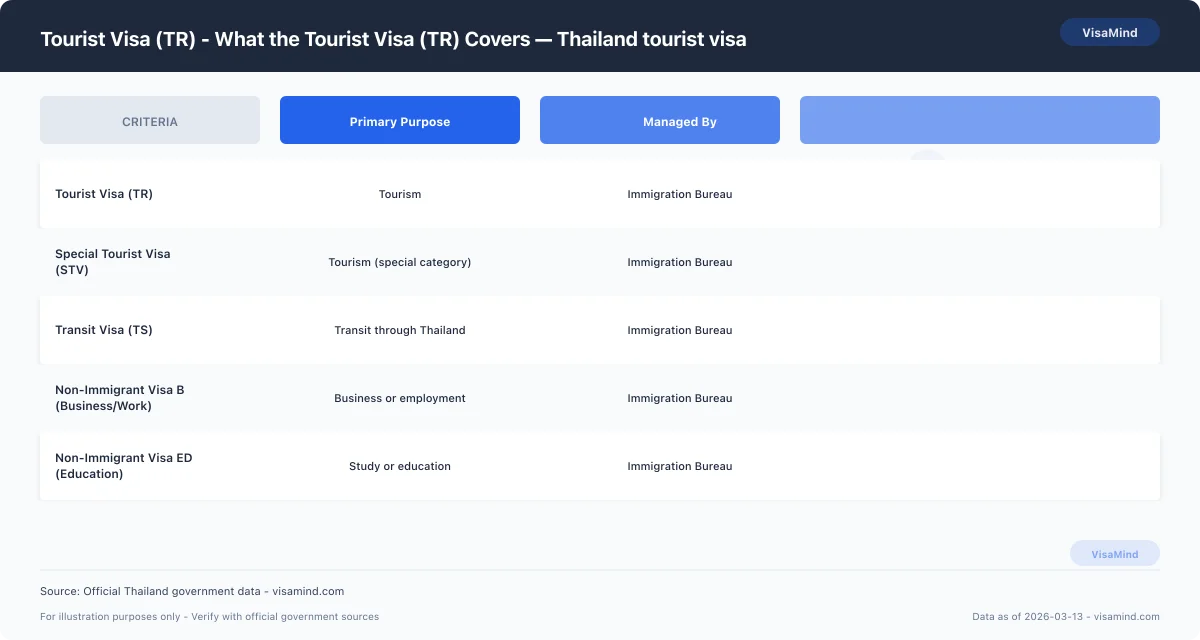
The Tourist Visa (TR) allows entry for tourism, medical treatment, and some MICE-related travel. Employment, long-term study, or business work are not permitted.
Permitted activities depend on what you state in your Form Visa Application and are monitored by the Immigration Bureau (สำนักงานตรวจคนเข้าเมือง).
Permitted activities
With a Tourist Visa (TR), you may stay in Thailand for leisure and travel. This includes sightseeing, visiting attractions, and spending time as a visitor.
You can enter under this visa if your purpose aligns with approved short-term travel activities and does not involve employment or formal study.
The Tourist Visa does not allow:
- Paid or unpaid employment
- Business work activities covered under the Non-Immigrant Visa B (Business/Work)
- Formal education programs covered under the Non-Immigrant Visa ED (Education)
If your purpose falls outside tourism, you need the correct visa category instead.
Here’s a table for comparison:
| Visa Type | Main Purpose | Employment Allowed |
|---|---|---|
| Tourist Visa (TR) | Tourism and approved short-term visits | No |
| Non-Immigrant Visa B (Business/Work) | Business or employment | Yes |
| Non-Immigrant Visa ED (Education) | Study or academic programs | No employment under this category |
| Transit Visa (TS) | Transit through Thailand | No |
If you qualify for a Visa Exemption, you might not need a Tourist Visa for short visits. For longer or specialized tourism stays, the Special Tourist Visa (STV) may be an option.
Medical and MICE travel
You can use the Tourist Visa for travel to Thailand for medical treatment. This applies if you enter specifically to receive healthcare.
Your stay must be limited to treatment and recovery. The visa does not convert into a work or long-term residence permit based on medical grounds.
The Tourist Visa also covers certain MICE activities—Meetings, Incentives, Conventions, and Exhibitions—when you attend as a participant or visitor, not as an employee working in Thailand.
Your activities must remain consistent with visitor status. If you intend to conduct business operations, manage a company, or work at an event, you must apply for the appropriate Non-Immigrant category.
At entry, you must comply with Immigration Bureau procedures. This may include submitting required arrival documentation such as the Form TM.6 form, depending on current practice. Your declared purpose should match your actual activities during your stay.
Application Process
#You must complete every required section of the Form Visa Application form, sign it, and submit it with supporting evidence. Accuracy and proper documentation decide whether the Immigration Bureau will accept your application for review.
Filling the form
Complete all required sections of the Visa Application form. Don’t leave mandatory fields blank.
Provide information that matches your passport and supporting documents. Inconsistent details can delay review or result in refusal.
When selecting your visa type, choose carefully. Common categories include:
| Visa Type | Purpose |
|---|---|
| Tourist Visa | Tourism and short-term visits |
| Special Tourist Visa (STV) | Extended tourism stay |
| Transit Visa (TS) | Transit through Thailand |
| Non-Immigrant Visa B (Business/Work) | Business or employment activities |
| Non-Immigrant Visa ED (Education) | Study or educational programs |
| Visa Exemption | Eligible short visits without a visa |
Sign where required. An unsigned application is incomplete and will not proceed.
Review your answers before submission. Errors in passport numbers, names, or dates can create problems.
Submitting your application
Submit your completed and signed form with all required supporting evidence. The Immigration Bureau won’t process incomplete submissions.
Include documents supporting your visa category. The exact evidence depends on whether you apply for a Tourist Visa, Special Tourist Visa (STV), Transit Visa (TS), or a Non-Immigrant category such as Non-Immigrant Visa B (Business/Work) or Non-Immigrant Visa ED (Education).
Checklist before submission:
- Completed Visa Application form
- Signature in all required fields
- Supporting evidence for your visa type
- Valid passport
Submit your application to the appropriate Thai authority handling visa processing. If you’re unsure where to apply, confirm with the Immigration Bureau (สำนักงานตรวจคนเข้าเมือง).
What happens after submission
After submission, the Immigration Bureau reviews your application and supporting documents. Officers assess whether you meet the requirements for the visa category you selected.
If your documents are incomplete or unclear, authorities may request additional evidence. Respond quickly and provide exactly what’s requested.
If approved, you receive the visa corresponding to your application type. Upon arrival in Thailand, you may need to complete arrival formalities, including the Form TM.6 form if required.
Keep copies of your submitted documents and approval. You might need them for entry inspection or future applications.
Tips and Common Mistakes
#Many tourist visa problems arise from using the wrong category or submitting missing documents. Following the correct instructions for your visa type and checking your file before submission helps you avoid delays.
Read the instructions first
Confirm you are applying under the correct category before starting your Form Visa Application.
Thailand offers several entry options, each with different requirements:
| Purpose of Travel | Correct Category |
|---|---|
| Short tourism stay | Tourist Visa |
| Visa-free short visit (eligible nationals) | Visa Exemption |
| Long-stay tourism program | Special Tourist Visa (STV) |
| Passing through Thailand | Transit Visa (TS) |
| Business or employment | Non-Immigrant Visa B (Business/Work) |
| Study or training | Non-Immigrant Visa ED (Education) |
A Tourist Visa does not cover business meetings, study, or transit. If your activities don’t match your visa type, the Immigration Bureau can deny entry.
Review the official instructions issued by the Immigration Bureau (สำนักงานตรวจคนเข้าเมือง) for your specific category. Each visa type has its own eligibility criteria and document standards.
If you previously entered under Visa Exemption, don’t assume the same rules apply to a Tourist Visa or STV. Requirements differ, so prepare documents accordingly.
Avoid incomplete submissions
Incomplete applications cause delays, requests for more documents, or refusal.
Before submitting your Visa Application, confirm you have:
- A fully completed application form
- Supporting documents for your visa category
- Accurate personal details matching your passport
- Required arrival or departure documentation, if applicable
- Any required immigration forms, such as Form TM.6, if issued
Check that names, passport numbers, and travel dates are consistent across all documents. Even small inconsistencies can trigger review by the Immigration Bureau.
If you apply for a Transit Visa (TS), Special Tourist Visa (STV), or another specific category, make sure your supporting documents clearly match that purpose. Submitting documents meant for a Non-Immigrant Visa B (Business/Work) or Non-Immigrant Visa ED (Education) under a Tourist Visa category can cause confusion and lead to refusal.
Review your entire file before submission. A complete and consistent application moves faster and avoids unnecessary problems.
Required Documents
#You must submit your passport and all required originals in person at the Royal Thai Embassy or Consulate-General. Incomplete or inconsistent documents can delay your Form Visa Application or lead to refusal by the Immigration Bureau (สำนักงานตรวจคนเข้าเมือง).
Passport and originals
Present your original passport when lodging your Visa Application. The passport must be the same document you’ll use to enter Thailand.
Bring only genuine, unaltered documents. The embassy or consulate will review originals before forwarding the application for consideration under the appropriate category, such as:
| Visa Category | Purpose of Travel |
|---|---|
| Visa Exemption | Short-term tourism without prior visa |
| Special Tourist Visa (STV) | Extended tourism stay |
| Transit Visa (TS) | Transit through Thailand |
| Non-Immigrant Visa B (Business/Work) | Business or employment |
| Non-Immigrant Visa ED (Education) | Study or training |
If you’ve previously received a Form TM.6 arrival/departure card, keep it with your travel records for reference when dealing with the Immigration Bureau.
Do not submit photocopies in place of required originals unless the embassy specifically allows copies in addition to originals.
Supporting evidence to include
Provide supporting documents that match your stated purpose of travel. The evidence must fit the visa category you select.
Common supporting evidence may include:
- Documents confirming the purpose of your visit (tourism, business, study, or transit)
- Records that correspond to your selected visa type (e.g., STV, Transit Visa (TS), Non-Immigrant Visa B, Non-Immigrant Visa ED)
- Any prior Thai immigration documentation relevant to your status
All documents should be consistent with the details in your Visa Application. Names, passport numbers, and travel details must match exactly.
Submit all required originals in person at the Royal Thai Embassy or Consulate-General. The Immigration Bureau reviews applications based on the documents provided, so accuracy and completeness matter.
Eligibility Requirements
#Your nationality and the travel document you hold determine whether you must apply for a Thailand tourist visa. You also need to confirm that a tourist visa fits your purpose of travel rather than another visa category managed by the Immigration Bureau (สำนักงานตรวจคนเข้าเมือง).
Nationality rules
Thailand assesses visa requirements based on your nationality and the country or territory that issued your passport or travel document.
If your nationality is different from the country or territory that issued your travel document, you may have to apply for a tourist visa in advance.
Consider these scenarios:
- You hold a passport from one country and are a national of that same country.
- You hold a travel document issued by a country where you are not a national.
- You hold a refugee or other substitute travel document.
The Immigration Bureau evaluates visa requirements based on these distinctions.
| Situation | Tourist Visa Likely Required? |
|---|---|
| Nationality matches passport-issuing country | Depends on nationality rules |
| Nationality differs from passport-issuing country | May be required |
| Travel document is not a standard national passport | May be required |
If you’re unsure, confirm your status directly with the Immigration Bureau before submitting a Form Visa Application.
Confirm your eligibility category
You must ensure a Tourist Visa matches your travel purpose.
A tourist visa applies only to temporary visits for tourism. If your purpose differs, you may need a different category.
Alternatives include:
- Visa Exemption (if you qualify under nationality rules)
- Special Tourist Visa (STV)
- Transit Visa (TS)
- Non-Immigrant Visa B (Business/Work)
- Non-Immigrant Visa ED (Education)
| Purpose of Travel | Appropriate Category |
|---|---|
| Tourism only | Tourist Visa or Visa Exemption |
| Short stopover | Transit Visa (TS) |
| Work or business | Non-Immigrant Visa B |
| Study | Non-Immigrant Visa ED |
| Extended tourism under special program | Special Tourist Visa (STV) |
If you enter Thailand, you may need to complete arrival documentation such as the Form TM.6 form, depending on current Immigration Bureau procedures.
Select the correct category before applying. Submitting the wrong visa type can delay or prevent approval.
Conditions of Stay
#Your tourist visa controls how long you may remain in Thailand and how many times you may enter during its validity. You must follow the exact terms printed on your visa sticker and comply with the Immigration Bureau of Thailand (สำนักงานตรวจคนเข้าเมือง).
Overstaying or using a tourist visa for the wrong purpose can lead to fines, cancellation, or future entry restrictions.
Length and entry type
The permitted length of stay is stamped in your passport by the Immigration Bureau when you arrive. This period may not match the visa’s overall validity.
Your stay depends on:
- The visa category issued through your Form Visa Application
- The number of entries granted
- The purpose of travel listed in your application
A tourist visa doesn’t allow work or study. If you want to work, you’ll need a Non-Immigrant Visa B (Business/Work).
If your plan is to study, you’ll need a Non-Immigrant Visa ED (Education). Entering on a tourist visa for work or study goes against your permitted conditions.
Other categories follow their own rules:
| Visa Type | Purpose | Stay Conditions |
|---|---|---|
| Tourist Visa | Tourism and leisure | Temporary stay only; no work |
| Special Tourist Visa (STV) | Long-stay tourism | Subject to specific approval conditions |
| Transit Visa (TS) | Short transit | Limited stay tied to onward travel |
| Visa Exemption | Tourism without prior visa | Stay length determined at entry |
You’re expected to leave Thailand on or before the date stamped in your passport unless the Immigration Bureau grants you an extension.
Single-entry vs multiple-entry overview
Your visa specifies single-entry or multiple-entry status. This controls how many times you can enter Thailand during your visa’s validity.
A single-entry tourist visa permits:
- One entry into Thailand
- One permitted stay period
- Automatic cancellation after you exit Thailand
A multiple-entry tourist visa allows:
- More than one entry within the visa’s validity
- A new permitted stay period each time you enter
- Continued use until the visa expires
Each arrival, the Immigration Bureau stamps your stay based on your visa type. The visa’s validity sets when you can enter; the entry stamp sets how long you can remain.
If you leave Thailand and don’t have a valid multiple-entry visa, you’ll need to submit a new Visa Application before returning. Always check your visa label and entry stamp, and keep any required arrival paperwork, including the Form TM.6 form if issued.
Know When to Get Help
#Get reliable information from the correct authority before submitting any Thailand tourist Form Visa Application. Official sources and qualified professionals help prevent errors that can disrupt your travel.
When to consult an expert
Consult an immigration professional if your situation doesn’t fit standard tourist travel.
This covers cases where you’re unsure if you qualify for Visa Exemption, a Special Tourist Visa (STV), or a Transit Visa (TS). The same goes if your activities might require a Non-Immigrant Visa B (Business/Work) or Non-Immigrant Visa ED (Education).
Seek guidance if:
- You previously overstayed in Thailand
- You’re changing visa types (for example, from tourist status to Non-Immigrant Visa B)
- You’re unclear about required documents for your Visa Application
- You have questions about entry or departure records, such as the Form TM.6
An expert can check your purpose of travel and confirm if a tourist visa fits. This helps avoid mistakes in your application.
Who manages online and official guidance
Use only official Thai government sources for forms and instructions.
The Ministry of Foreign Affairs of Thailand runs the official Thai E-Visa platform. Use that system if you’re applying online for a tourist visa and you’re eligible.
The Immigration Bureau of Thailand (สำนักงานตรวจคนเข้าเมือง) is responsible for immigration control and publishes official forms and instructions.
Use the right authority for your needs:
| Authority | What It Manages |
|---|---|
| Ministry of Foreign Affairs | Official Thai E-Visa website and online visa processing |
| Immigration Bureau of Thailand | Immigration rules, forms, and official instructions |
Download current tourist visa forms and instructions directly from the Immigration Bureau’s official website.
If you’re unsure about information from third-party sites, double-check with these two government authorities before applying.
What It Costs and How Long — visit Thailand
#You’ll pay government fees for a standard Tourist Visa, and most applications are processed within a short, defined window. Costs and timelines differ by visa type and where you apply, so confirm details with the Immigration Bureau or the e‑Visa system before submitting your Form Visa Application.
Application and processing fees
For a standard Tourist Visa, the government charges:
| Fee Type | Amount (THB) | Notes |
|---|---|---|
| Application fee | ฿50 | Payable at time of submission |
| Processing fee | ฿30 | Covers administrative handling |
These fees apply as of February 2026. Confirm the latest figures through the Thai e‑Visa system or Immigration Bureau before paying.
Other categories have their own fees:
- Visa Exemption (no visa application fee, but eligibility rules apply)
- Special Tourist Visa (STV)
- Transit Visa (TS)
- Non‑Immigrant Visa B (Business/Work)
- Non‑Immigrant Visa ED (Education)
You’ll need to review the exact visa type that matches your travel purpose.
Typical processing windows
For a Tourist Visa under standard processing, expect a decision in 3 to 5 business days as of March 2026.
The processing time depends on:
- The visa category you choose
- Where you submit your Visa Application
- Whether you apply through the e‑Visa system or another channel
Other visas, like the Special Tourist Visa (STV), Transit Visa (TS), or Non‑Immigrant categories (B or ED), may have different timelines. The Immigration Bureau sets and updates these periods.
Apply early and verify current timelines directly with the issuing authority.
How Your Application Is Assessed
#The Immigration Bureau reviews your visa category, your stated purpose of travel, and your immigration history in Thailand. Approval depends on whether your documents and intentions match the visa you request.
What the officer reviews
An officer checks the type of visa you apply for and whether it matches your planned activities.
For example:
| Visa Category | Intended Purpose |
|---|---|
| Tourist Visa | Tourism and short-term leisure |
| Special Tourist Visa (STV) | Extended tourism stay |
| Transit Visa (TS) | Passing through Thailand |
| Non-Immigrant Visa B (Business/Work) | Business or employment |
| Non-Immigrant Visa ED (Education) | Study or training |
If your activities suggest work or study, a Tourist Visa won’t be appropriate. In such cases, the officer may expect a Non-Immigrant Visa B (Business/Work) or ED (Education).
The officer reviews your Form Visa Application form for accuracy and consistency. Incomplete forms or conflicting details can damage credibility.
Your prior entries, compliance with stay limits, and use of Visa Exemption matter as well. Prior overstays or frequent Visa Exemption entries can lead the officer to question if you’re a genuine tourist.
At the border, arrival records like the Form TM.6 form may be checked against your visa and travel history.
Reasons applications can be refused
Submitting a Visa Application doesn’t guarantee approval. The Immigration Bureau can refuse your application if it doesn’t meet requirements.
Common reasons for refusal:
- Applying for the wrong visa category
- Inconsistent information in your application
- Prior overstays or immigration violations
- Indications you plan to work or study on a Tourist Visa
- Misuse of Visa Exemption for long-term stays
If you apply for a Tourist Visa but your documents show business activity, the officer may expect you to apply for a Non-Immigrant Visa B (Business/Work) instead. The same goes for full-time study that requires a Non-Immigrant Visa ED (Education).
Frequent back-to-back tourist stays, including under the Special Tourist Visa (STV), can raise questions about your purpose of travel.
Officers look at consistency, travel history, and whether your stated purpose matches the visa category. Any mismatch can lead to refusal.
Fees
#| Component | Amount |
|---|---|
| Application feeExtracted from guide content — verify against official source | ฿50 (approx $1 USD) |
| Processing feee-Visa service — verify against thaievisa.go.th | ฿30 (approx $0.87 USD) |
Fees change; always verify on Immigration Bureau.