Overview — Thailand visa free
#
Thailand’s visa exemption allows certain travelers to enter without applying in advance for a Tourist Visa (TR), Special Tourist Visa (STV), or Transit Visa (TS). You must still comply with entry conditions set by the Immigration Bureau, and you’re subject to inspection at the border.
Visa-free entry isn’t the same as holding a visa. You get permission to stay under specific limits and conditions based on your nationality and the purpose of your visit.
What the exemption allows
Visa exemption permits entry for tourism or short-term purposes without submitting a visa application before travel. You present your passport to an Immigration Bureau officer at an approved checkpoint and request entry under the exemption scheme.
The entry requirements set by the Immigration Bureau may include:
- Validity of your passport
- Purpose of travel
- Evidence you intend to leave Thailand
- Compliance with prior Thai immigration rules
Visa exemption doesn’t convert into a Tourist Visa (TR), Special Tourist Visa (STV), or Transit Visa (TS). If your purpose doesn’t match exemption conditions, apply for the appropriate visa before travel.
If required, you may need to complete arrival documentation such as the Form TM.6 form, as directed by immigration officers.
| Entry Type | Apply in Advance | Purpose | Issued By |
|---|---|---|---|
| Visa Exemption | No | Tourism / short stay | Immigration Bureau at entry |
| Tourist Visa (TR) | Yes | Tourism | Thai embassy or consulate |
| Special Tourist Visa (STV) | Yes | Extended tourism | Thai embassy or consulate |
| Transit Visa (TS) | Yes | Transit or short stop | Thai embassy or consulate |
Typical stay lengths
Your permitted stay depends on your nationality and the current policy announced by the Immigration Bureau. Thailand doesn’t apply a single duration for all travelers under visa exemption.
An immigration officer stamps your passport with the authorized length of stay when you arrive. You need to leave Thailand on or before that date unless you get lawful permission to remain.
If you need a longer stay than the exemption allows, apply in advance for a Tourist Visa (TR) or another suitable visa. Don’t assume you can extend your stay without formal approval from the Immigration Bureau.
Overstaying can result in penalties and affect future travel. You should check the exact duration allowed for your nationality through official Immigration Bureau announcements.
Who this applies to
Visa exemption applies only to nationals of countries designated by Thailand for visa-free entry. Eligibility depends strictly on your passport nationality, not your residence in another country.
You qualify if:
- Your country appears on Thailand’s visa exemption list
- Your travel purpose fits exemption conditions
- You meet entry screening by the Immigration Bureau
If your nationality isn’t included in the exemption scheme, you must apply for a Tourist Visa (TR), Special Tourist Visa (STV), or Transit Visa (TS) before traveling.
The Immigration Bureau maintains the official and current list of eligible nationalities. Confirm your status directly with the Immigration Bureau before booking travel.
What Applicants Get Wrong
#Most issues come from using outdated documents, leaving forms unfinished, or skipping required proof. Following the Immigration Bureau’s current instructions for your travel category helps you avoid delays.
Not using the current form or instructions
Download the latest visa-exemption form and instructions directly from the Immigration Bureau of Thailand (สำนักงานตรวจคนเข้าเมือง) before you start your paperwork.
Applicants sometimes reuse an old file or rely on advice meant for another category, like the Tourist Visa (TR), Special Tourist Visa (STV), or Transit Visa (TS). Each category has its own requirements.
Use this checklist before you begin:
- Check you’re reading instructions for your eligibility category
- Make sure the document version is the most recent from the Immigration Bureau
- Review all instructions before completing any section
Visa-exemption entry isn’t automatic approval. You must meet the stated conditions and follow the correct process.
Incomplete or unsigned forms
Complete every required field on the form. Blank sections, unanswered questions, or inconsistent details can cause problems.
Common mistakes include:
- Leaving sections empty, thinking they don’t apply
- Providing only partial travel details
- Forgetting to sign where required
Your signature confirms your information is accurate. An unsigned form is incomplete.
If you previously held a Tourist Visa (TR), Special Tourist Visa (STV), or Transit Visa (TS), make sure your information matches your prior records. Inconsistent details may trigger extra review.
When you arrive in Thailand, you may also need to complete arrival documentation such as the TM.
- Errors on arrival documents can create discrepancies in your immigration record.
Review your form line by line before submission. Small omissions can lead to delays.
Failing to submit required evidence
Submitting just the form isn’t enough. You need to include all supporting evidence listed in the official instructions for your eligibility category.
Some applicants think visa-exemption means no documentation is needed. That isn’t correct.
Before you submit, confirm:
- Every document listed in the instructions is attached
- The documents match your form details
- Nothing is missing from the required evidence list
If you previously applied for a Tourist Visa (TR), Special Tourist Visa (STV), or Transit Visa (TS), don’t assume those prior documents meet current requirements. Each entry or application is reviewed on its own terms.
Check the Immigration Bureau guidance for the evidence required. Incomplete documentation can result in refusal or delay.
Fees and Processing Times
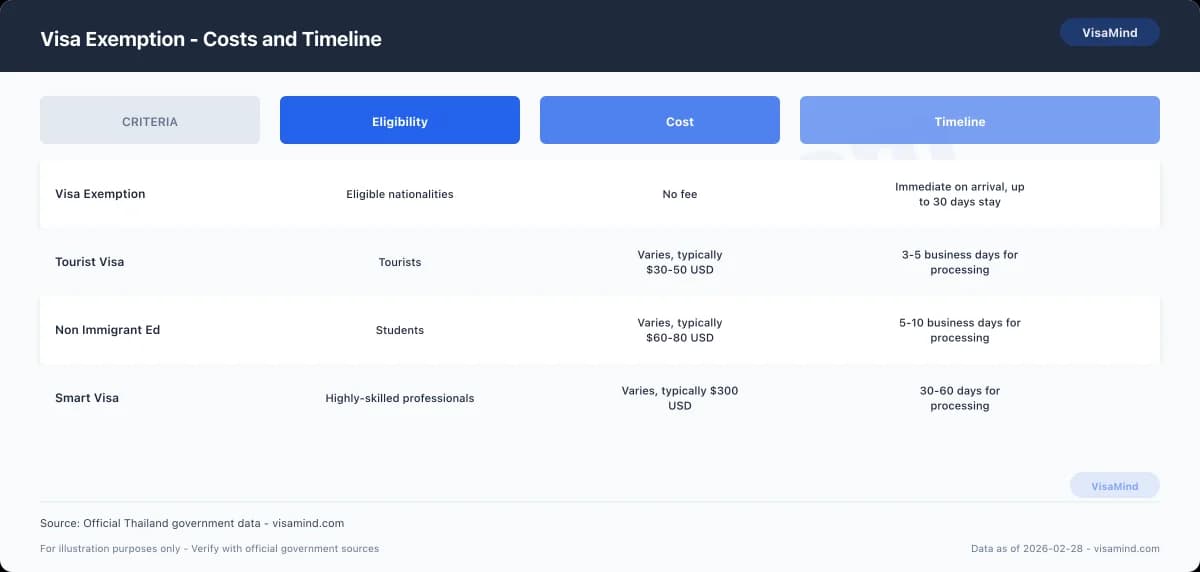
#There’s no application fee for Thailand visa-exempt entry, and approval happens on arrival. If you later apply for a visa such as the Tourist Visa (TR), Special Tourist Visa (STV), or Transit Visa (TS), fees and timelines differ. Extensions through the Immigration Bureau have separate charges.
Application fee
If you enter Thailand under a visa-exemption scheme, you don’t pay an application fee in advance. Permission to enter is granted at the port of entry.
If you apply for a visa before travel, the fee depends on the visa type. The Tourist Visa (TR), Special Tourist Visa (STV), and Transit Visa (TS) each have their own fee structure set by Thai authorities. Confirm the exact amount with the Immigration Bureau or the Thai embassy or consulate where you apply.
For reference, the following fee applies to certain visa categories as of February 2026:
| Visa Category | Government Fee (THB) |
|---|---|
| Applicable visa category | ฿5,000 |
Verify the current fee directly with the Immigration Bureau before submitting your application. Fees are charged in Thai Baht (฿).
Processing time
Visa-exempt entry has a processing time of 0 days. You get your entry stamp at immigration control upon arrival, if you meet entry requirements.
There’s no pre-approval stage for visa-exempt travelers. The immigration officer decides at the airport, land border, or seaport.
If you apply in advance for a Tourist Visa (TR), Special Tourist Visa (STV), or Transit Visa (TS), processing times vary by location. You need to check directly with the Immigration Bureau or the Thai embassy or consulate handling your application.
Keep copies of your passport bio page and entry stamp. You may also receive or complete a Form TM.6 arrival/departure card, depending on current entry procedures.
Extension fee (see Conditions)
If you want to stay longer than your visa-exempt period allows, apply for an extension at a local office of the Immigration Bureau (สำนักงานตรวจคนเข้าเมือง) before your permitted stay expires.
Extension fees are separate from the original visa or entry permission. The exact amount depends on your status and the type of permission you hold, such as:
- Visa-exempt entry
- Tourist Visa (TR)
- Special Tourist Visa (STV)
- Transit Visa (TS)
Confirm the current extension fee directly with the Immigration Bureau. Officers won’t process your request without full payment of the required government fee in Thai Baht (฿).
Document Checklist — Thailand visa exemption
#Use the official Visa Exemption form issued by the Immigration Bureau of Thailand when filing under the visa-exempt category. This section explains the form, who must use it, and where to get it before submission.
Official form (Visa Exemption)
The required document is the official “Visa Exemption” form issued by the Immigration Bureau (สำนักงานตรวจคนเข้าเมือง).
Complete this form when you apply or file directly with the Immigration Bureau under visa-exempt status.
Use the form exactly as issued. Don’t substitute it with forms used for other visa types such as:
| Visa Category | Official Name |
|---|---|
| Tourist visa | Tourist Visa (TR) |
| Long-stay tourist program | Special Tourist Visa (STV) |
| Transit visa | Transit Visa (TS) |
Each category has its own requirements and documentation. The Visa Exemption form is for applicants under visa-exempt entry rules only.
Prepare the form carefully. Incomplete or incorrect submissions may delay processing with the Immigration Bureau.
Who uses the form
Use the Visa Exemption form if you’re filing with the Immigration Bureau under Thailand’s visa-exempt entry framework.
This form isn’t for:
- Tourist Visa (TR) applicants
- Special Tourist Visa (STV) applicants
- Transit Visa (TS) applicants
Those categories have separate procedures and documentation.
Arrival documentation, such as the Form TM.6, isn’t replaced by this form. The TM.6 serves a different function. The Visa Exemption form is for filings made with the Immigration Bureau under visa-exempt status.
If you’re unsure whether your stay falls under visa exemption or a formal visa category, confirm your status directly with the Immigration Bureau before submitting paperwork.
Where to get the form
Get the official Visa Exemption form directly from the Immigration Bureau of Thailand.
Don’t rely on unofficial templates or third-party versions. The Immigration Bureau controls the format and content of the form.
Use the most current version available when you file. Outdated editions can result in rejection or requests for correction.
For the latest version and filing instructions, consult the Immigration Bureau. Official instructions and form access are provided through the Immigration Bureau’s designated channels.
Make sure the form clearly states “Visa Exemption” and identifies the Immigration Bureau (สำนักงานตรวจคนเข้าเมือง) as the issuing authority before you complete and submit it.
Conditions of Stay
#You must follow the exact period and purpose granted at entry. Overstaying or using visa-free entry for activities not permitted can lead to fines or future entry restrictions.
Your conditions depend on the entry stamp issued by the Immigration Bureau of Thailand (สำนักงานตรวจคนเข้าเมือง) and the category noted in your passport.
Length of stay and extensions
The Immigration Bureau decides how long you can stay in Thailand under visa-free entry. The permitted period is stamped in your passport.
You must leave or apply for an extension before your permitted stay ends. If you need more time, you can request a 30‑day extension at a local Immigration Bureau office.
Approval isn’t guaranteed. Officers review your application and supporting documents.
Bring these when you apply:
- Your passport with entry stamp
- Completed extension application form (per Immigration Bureau requirements)
- Any supporting documents needed for your stay reason
If you switch to or already have a Tourist Visa (TR), Special Tourist Visa (STV), or Transit Visa (TS), the rules differ. Confirm your specific stay period and eligibility for an extension with the Immigration Bureau before applying.
If you received or previously completed a Form TM.6 arrival/departure record, make sure your records match your current status when you request an extension.
Extension fees and where to extend
You must apply for an extension in person at an Immigration Bureau office inside Thailand. The standard government fee for a 30‑day extension is:
| Item | Fee (THB) |
|---|---|
| 30‑day extension of stay | ฿1,000 |
Pay the fee when you submit your application. Without payment, your request won’t be processed.
Extensions aren’t available at the airport unless immigration authorities specifically instruct you otherwise. Apply before your permitted stay expires.
Overstaying, even by a single day, can lead to penalties under Thai immigration law.
Verify extension policies
Extension policies change from time to time. Always confirm current rules with the Immigration Bureau before relying on a timeline or fee.
Check these details directly:
- Your exact permitted length of stay
- Whether you’re eligible for a 30‑day extension
- Required documents for your nationality
- How your status (visa‑free, TR, STV, or TS) affects eligibility
Visa‑free entry and a Tourist Visa (TR) don’t always share the same extension conditions. Each category comes with its own set of terms.
What Consular Officers Evaluate
#Consular officers and the Immigration Bureau review your identity, travel history, and immigration records before approving visa-free entry or a visa such as the Tourist Visa (TR), Special Tourist Visa (STV), or Transit Visa (TS). They use official databases and your documents to determine if you’re admissible.
Background and records checks
Officers verify your personal data through the Immigration Bureau’s systems. They check your name, passport number, nationality, and previous entries against immigration records.
They also look at any alien residence records linked to you. This covers past residence status in Thailand and whether you complied with reporting or departure requirements.
If you previously applied through a proxy or attorney, officers can review those filings and compare them with your current application. Inconsistencies between past and present submissions raise concerns.
Expect close review if you:
- Overstayed before
- Changed visa categories frequently (for example, TR to STV)
- Entered and exited Thailand several times in a short period
- Have past cancellation or denial records
Officers match your arrival and departure history, including data from your Form TM.6 record if relevant. If your declared travel history doesn’t line up with official records, approval may be delayed or refused.
Blacklist and residence verification
The Immigration Bureau checks if your name appears on any blacklist or watchlist database. Blacklisting can result from overstays, immigration violations, or removal orders.
This review applies to all categories:
- Tourist Visa (TR)
- Special Tourist Visa (STV)
- Transit Visa (TS)
Officers also confirm your current residence status. If you claim lawful residence in another country, they’ll check if that matches your travel pattern and immigration history.
Key areas reviewed include:
| Review Area | What Officers Confirm |
|---|---|
| Blacklist status | No active ban or restriction |
| Prior violations | No unresolved immigration breaches |
| Residence data | Lawful status matches declared address |
| System alerts | No internal flags in the IT system |
If the system shows an active restriction, officers can’t override it. You’ll need to resolve the underlying issue with the Immigration Bureau before traveling.
Inconsistencies or missing information
Officers compare every piece of information in your application with immigration system records. Even minor differences—like a spelling variation or passport number issue—can trigger extra review.
Common issues:
-
Mismatched passport details
-
Undisclosed prior entries or overstays
-
Missing prior visa history
-
Incomplete personal information
If you previously entered Thailand under visa exemption and now apply for a TR, STV, or TS, your declared history must line up with recorded entry data.
Applications submitted through a representative get the same scrutiny. You’re responsible for accuracy, even if a proxy or attorney prepared your forms.
Provide complete and consistent information the first time. Officers rely on record checks, and unresolved discrepancies often result in refusal or denial of entry.
Fees
#| Component | Amount |
|---|---|
| Application feeExtracted from guide content — verify against official source | ฿5,000 (approx $145 USD) |
| Extension fee30-day extension at immigration — verify against Immigration Bureau | ฿1,000 (approx $29 USD) |
Fees change; always verify on Immigration Bureau.