What the F-2 Dependent Visa (Spouse/Child of F-1) Covers
#The F-2 visa allows certain family members of an F-1 visa Student to stay in the United States during the Student’s academic program.
It provides lawful dependent status tied directly to the F-1’s ongoing compliance with immigration rules.
Who it covers
The F-2 Dependent Visa covers immediate family members of an F-1 Student.
You may qualify if you are:
- The spouse of an F-1 Student
- The unmarried child of an F-1 Student
Your eligibility depends entirely on the F-1 Student maintaining valid status in their academic program.
| Relationship to F-1 Student | Eligible for F-2? | Key Condition |
|---|---|---|
| Spouse | Yes | F-1 must maintain status |
| Unmarried child | Yes | F-1 must maintain status |
If the F-1 Student falls out of status, your F-2 status is also affected.
Your status does not stand alone.
Purpose and scope
The F-2 visa allows you to accompany or join an F-1 Student in the United States.
It gives you lawful immigration status while the Student pursues their approved course of study.
Your stay remains linked to the F-1 Student’s enrollment in a study program and their compliance with immigration requirements.
The F-2 does not create an independent basis to remain in the United States.
It exists solely because of the F-1 Student’s status.
| Status Type | Independent Status? | Based On |
|---|---|---|
| F-1 Student | Yes | Approved academic program |
| F-2 Dependent | No | F-1 Student’s valid status |
USCIS oversees immigration benefits and status matters inside the United States.
The U.S. Department of State handles visa issuance at U.S. embassies and consulates.
Information for applicants
If you apply from outside the United States, you complete Form DS-160, the Online Nonimmigrant Visa Application.
The U.S. Department of State manages the visa interview and issuance process.
You must apply for an F-2 visa separately, even though your eligibility depends on the F-1 Student.
The basic process generally includes:
-
Completing Form DS-160
-
Attending a visa interview at a U.S. embassy or consulate
-
Receiving the visa if approved by the consular officer
After visa approval, U.S. Customs and Border Protection (CBP) determines your admission at the port of entry.
For current filing steps, documentation details, and any required fees, review official guidance from:
- U.S. Department of State (for visa processing and interviews)
- U.S. Citizenship and Immigration Services (USCIS) (for status matters inside the United States)
When to Get Help
#
You can’t handle every F-2 issue on your own.
Some steps require your designated school official (DSO), while others call for legal guidance or coordination with a pending petition.
When a DSO or school must be involved
Your designated school official (DSO) plays a required role when you plan to bring dependents in F-2 status.
You must contact your DSO before your spouse or child applies for a visa.
The DSO manages your Student record and confirms your eligibility to request dependent status.
Don’t assume you can move forward without school involvement.
Use this checklist:
- Inform your DSO that you plan to add F-2 dependents
- Confirm your Student record is active and accurate
- Follow your school’s process before the dependent completes Form Form DS-160
Filing for F-2 status does not guarantee approval.
The U.S. Department of State makes visa decisions at the consulate, and U.S. Customs and Border Protection (CBP) determines admission at the port of entry.
If your school requires documentation or internal approval steps, complete them before scheduling a visa interview.
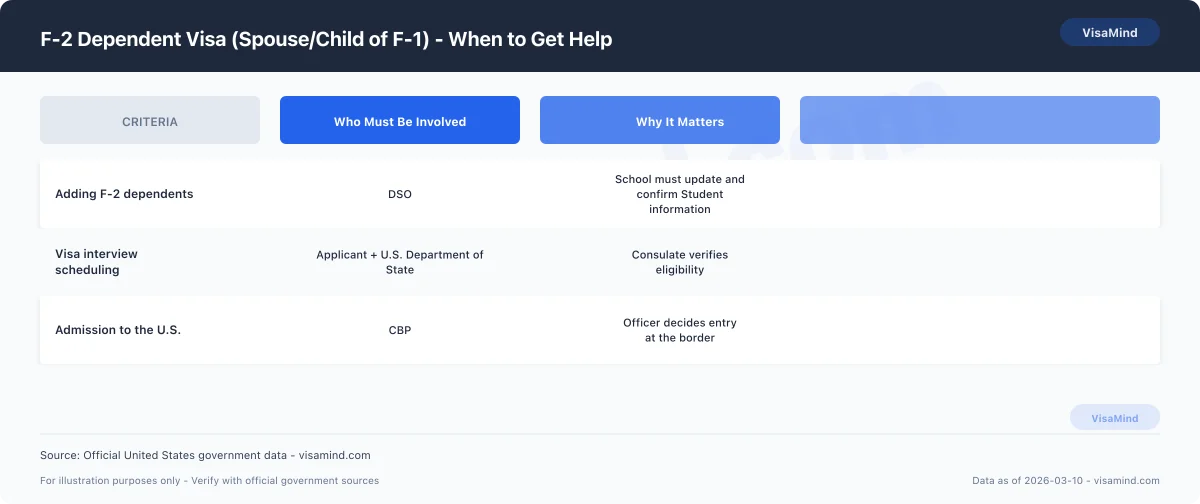
| Issue | Who Must Be Involved | Why It Matters |
|---|---|---|
| Adding F-2 dependents | DSO | School must update and confirm Student information |
| Visa interview scheduling | Applicant + U.S. Department of State | Consulate verifies eligibility |
| Admission to the U.S. | CBP | Officer decides entry at the border |
When to consult an immigration pro
Consult an immigration attorney if your situation includes petition-based status or prior filings with USCIS.
This is especially important if another visa category connects to your case.
For example, if you previously held or currently hold H-1b visa or L-1 status, make sure your Form I-129 petition is approved before completing Form DS-160.
The consulate will verify petition approval before issuing a visa.
Do not rely on assumptions about pending petitions.
Approval status directly affects visa eligibility.
You should also seek legal advice if:
- You are unsure whether your petition has been approved by USCIS
- Your immigration history includes multiple status changes
- A consular officer questions the underlying petition
An attorney can confirm petition status, review your USCIS records, and help you avoid submitting a DS-160 tied to an unapproved petition.
Complex petition-based issues
Petition-based complications require careful timing and coordination.
If your F-2 case connects to an employment-based petition, approval status controls what happens next.
Follow this sequence:
-
Confirm USCIS has approved the relevant petition (such as Form I-129).
-
Verify approval details before submitting Form DS-160.
-
Expect the consulate to confirm petition validity during visa processing.
If the petition is not approved, the visa will not move forward.
The Department of State will check petition records before issuing a visa.
Keep these points in mind:
- USCIS handles petitions and benefit approvals.
- The U.S. Department of State issues visas abroad.
- CBP decides whether to admit you at entry.
When multiple agencies are involved, small mistakes create delays.
If you do not clearly understand which agency controls your next step, get professional guidance before filing anything.
Path to Permanent Residence
#An F-2 visa does not provide a direct route to a green card.
Your options depend on maintaining valid dependent status or taking clear steps to change to a different immigration category.
Maintaining dependent status
You remain in lawful status only while the primary F-1 visa Student maintains valid F-1 status during the approved study program.
If the Student falls out of status, your F-2 status ends as well.
Focus on these core requirements:
- The F-1 Student must continue their study program.
- You must remain a dependent spouse or child.
- You cannot independently extend your stay beyond the F-1’s authorized period.
Your immigration standing is tied to the Student’s record with USCIS and the terms of the F-1 program.
| Factor | Impact on Your F-2 Status |
|---|---|
| F-1 maintains status | You remain in valid F-2 status |
| F-1 status ends | Your F-2 status ends |
| F-1 program continues | You may remain for the same period |
You cannot apply for permanent residence based solely on F-2 classification.
You must qualify under a separate immigrant category.
Studying in F-2 status
F-2 dependents are allowed to study part-time — less than a full course of study — at an SEVP-certified school without changing status. F-2 children may also attend K-12 school full-time. Only full-time post-secondary study requires a change of status.
Changing status or next steps
If you want to pursue your own academic program full-time, you must apply to change status to F-1 or M-1 visa.
You file a change of status request with USCIS, using Form I-539, while inside the United States.
Key steps include:
-
Submit the appropriate application to USCIS.
-
Wait for approval before beginning full-time study as a Student.
-
Maintain lawful status during the entire process.
If you leave the United States and apply for a new visa abroad, you complete Form DS-160 through the U.S. Department of State and attend a visa interview before returning.
Permanent residence requires a separate immigrant petition and eligibility under another category.
Review current filing procedures and eligibility rules on the USCIS website before taking action.
Fees and Processing Times
#You will pay a standard visa application fee and wait for consular processing after you submit Form DS-160.
processing times depend on the visa category and the U.S. embassy or consulate handling your case.
Visa and application fees
The F-2 visa requires payment of the Machine Readable Visa (MRV) application fee.
As of February 2026, the fee is $185 per applicant.
| Fee Type | Amount (USD) | Paid To |
|---|---|---|
| MRV application fee | $185 | U.S. Department of State |
You pay this fee when you schedule your visa interview after submitting the DS-160 online.
The U.S. Department of State collects this fee, not USCIS.
Each dependent must pay a separate $185 fee, including children.
Fees generally do not transfer to another person.
If you need confirmation of current amounts before you apply, check the U.S. Department of State fee schedule.
Typical processing windows
Processing includes two stages: completing the DS-160 and waiting for interview availability and visa issuance.
Most F-2 applicants fall under the “Student/Exchange (F, M, J)” category for scheduling purposes.
As of February 2026, reported processing ranges for that category are:
| Visa Category (for scheduling) | Reported Time Range |
|---|---|
| Student/Exchange (F, M, J) | 0.5 to 7.5 months |
Actual time depends on the specific U.S. embassy or consulate.
Some locations schedule interviews within weeks, while others take several months. The 0.5-to-7.5-month range reflects how far out interview appointments are booked at different consulates. Once you attend the interview, visa issuance itself is usually faster — often about 2 to 8 weeks to print and return your passport. These are two different stages, not conflicting estimates.
You must verify current timelines with the U.S. Department of State for your location.
How processing varies by category
Although you apply for an F-2 visa, consular posts group appointments by broader visa categories.
These groupings affect how quickly you receive an interview.
Current reported ranges by category include:
| Category | Reported Time Range |
|---|---|
| Visitor (B1/B2) | 0.5 to 23 months |
| Student/Exchange (F, M, J) | 0.5 to 7.5 months |
| Petition-based (H, L, O, P, Q) | 0.5 to 4.5 months |
| Crew and Transit (C, D, C1/D) | 0.5 to 14 months |
F-2 applicants align with the Student/Exchange grouping because your eligibility depends on the principal F-1 visa Student.
You should review processing times specifically under that category for your consulate.
USCIS does not process F-2 visa issuance abroad.
The U.S. Department of State handles interviews and visa decisions, and U.S. Customs and Border Protection (CBP) decides admission at the port of entry.
What You Can Do
#Your F-2 visa allows you to stay in the United States as the dependent of an F-1 visa Student, but it places clear limits on your activities.
You must also keep accurate and valid records at all times to avoid problems with USCIS or the U.S. Department of State.
Limitations on activities
Your stay depends entirely on the status of the F-1 Student.
If the Student falls out of status, your F-2 status ends as well.
You must follow the restrictions tied to the F-2 visa.
Review your visa application details carefully, including the Form DS-160 confirmation you submitted to the U.S. Department of State.
Key points to remember:
- Your status does not give you independent immigration benefits.
- Your ability to remain in the United States depends on the Student’s compliance with their visa terms.
- USCIS oversees immigration benefits and status-related filings inside the United States.
Before taking any action that could affect your stay—such as requesting a change through USCIS—confirm that it aligns with your current F-2 classification.
If you are unsure whether a specific activity is permitted, review official guidance on the USCIS website.
| Area | What You Must Remember |
|---|---|
| Status control | Tied directly to the F-1 Student |
| Government agency (visa issuance) | U.S. Department of State |
| Government agency (status benefits) | USCIS |
Document maintenance
Keep your immigration documents valid and accessible at all times. This includes everything issued during consular processing and any records related to your admission.
Maintain copies of:
- Your passport identity page
- Your F-2 visa issued by the U.S. Department of State
- Your DS-160 confirmation page
- Any USCIS approval notices, if applicable
Make sure your documents match the Student’s records. Mismatched or expired papers can cause issues if you apply for a benefit through USCIS or appear before a U.S. government official.
Check expiration dates regularly. If you need to file an application with USCIS, review the most current form instructions before submitting anything.
| Document Type | Why It Matters |
|---|---|
| Passport | Confirms identity and validity of stay |
| F-2 Visa | Shows classification issued by the Department of State |
| DS-160 Confirmation | Proof of visa application submission |
| USCIS Notices | Evidence of approved immigration benefits |
Store both digital and paper copies somewhere secure. You’re responsible for keeping complete and accurate records during your stay.
What to Submit
#Submit school-issued documents, required government forms, compliant photos, and supporting evidence. Accuracy and document quality affect processing and interview scheduling.
School-issued documents (I-20)
Your application starts with the Form I-20 from the Student’s school. You can’t proceed without it.
The Student must request an I-20 for each eligible F-2 dependent. Review every detail before using it. Errors in names, dates of birth, or program information can delay visa processing.
Use this checklist:
- Form I-20 issued for you as the F-2 dependent
- I-20 properly signed where required
- Information that matches your passport exactly
If something’s wrong, ask the school to correct and reissue the document before moving forward.
| Document | Who Issues It | Why It Matters |
|---|---|---|
| Form I-20 (F-2) | Student’s school | Required to apply for an F-2 visa and complete the Form DS-160 |
The I-20 supports the information you enter on the DS-160 and present at your visa interview.
Forms and instructions
There is no "F-2 form" to download from USCIS. F-2 status is obtained either by consular processing using Form DS-160 when applying from abroad, or by a change-of-status filing on Form I-539 from inside the United States. Use only official government sources and current form editions — don’t rely on outdated copies or forms from unofficial sources.
Follow the official instructions carefully. Submit all required sections and include the supporting evidence listed.
Prepare your passport-style photos before you start. Photos that don’t meet requirements often cause delays.
Photo checklist:
- Meets U.S. Department of State photo specifications
- Clear, properly sized image
- No shadows or distortions
- Taken professionally or verified with a validated photo tool
If you apply for a visa abroad, complete the DS-160 as required by the U.S. Department of State. For visa issuance and interviews, follow Department of State guidance.
If you need current filing fees or updated form editions, check with USCIS before submitting.
Completing and signing forms
Fill out every required field fully and accurately. Inconsistent answers between your Form I-20, DS-160, and other forms can trigger delays or extra scrutiny.
Steps to follow:
-
Enter information exactly as it appears on your passport.
-
Match all details to the Student’s records and I-20.
-
Review each page before signing.
-
Sign where required; unsigned forms may be rejected.
Don’t leave required fields blank.
Once you sign, assemble your forms and supporting documents in the order listed in the official instructions. Submit them as directed by USCIS or follow U.S. Department of State procedures for consular processing.
Extending Your Family Visa
#You must take formal action to extend your F-2 status. USCIS reviews your filing, and approval depends on whether you follow the required steps and qualify under the rules.
Filing forms with USCIS
If you’re already in the United States in F-2 status and need more time, file Form I-539, Application to Extend/Change Nonimmigrant Status, with USCIS — that is the form F-2 dependents use to extend or change status from inside the United States. Read the official instructions before starting.
Follow these steps:
-
Identify the correct form for your situation.
-
Review the instructions for the F-2 category.
-
Complete every section accurately and completely.
-
Submit the application as directed.
USCIS reviews only what you submit. Incomplete forms, missing signatures, or failure to follow instructions can delay processing or lead to rejection.
If you’re applying for an F-2 visa outside the United States, complete Form DS-160 and follow the process set by the U.S. Department of State. USCIS does not issue visas.
| Situation | Agency That Processes It | Form |
|---|---|---|
| Extension in the U.S. | USCIS | Form I-539 |
| Visa application abroad | U.S. Department of State | DS-160 |
Check with USCIS for current filing instructions and fees before you submit.
Follow application instructions
Review the instructions for your specific eligibility category before filing. Don’t rely on general advice or someone else’s experience.
Focus on:
- Using the correct edition of the form
- Answering every question that applies
- Signing where required
- Including all required initial evidence
If you’re the spouse or child of an F-1 visa Student, your information must match the Student’s records. Inconsistent names, dates, or status details can cause problems.
Don’t guess. If a question doesn’t apply, follow the form instructions on how to respond. USCIS evaluates your application based on the written record.
For DS-160 filings abroad, follow the U.S. Department of State’s steps exactly as listed. Each applicant submits a separate DS-160.
Approval is not guaranteed
Filing an extension request does not guarantee approval. USCIS reviews each case individually.
USCIS may deny your request if:
- You don’t meet the eligibility requirements
- You fail to follow filing instructions
- You submit incomplete or inconsistent information
A pending application doesn’t automatically give you extra time. Wait for a formal decision from USCIS.
If you apply for an F-2 visa abroad, the U.S. Department of State decides whether to issue the visa. Visa issuance and admission are separate decisions handled by different agencies.
The Two-Stage Process
#You complete the online visa application first, then attend a consular interview handled by the U.S. Department of State. Accuracy, consistent information, and complete answers determine whether your F-2 visa application moves forward without delay.
Saving and submitting electronic forms
Complete Form DS-160, Online Nonimmigrant Visa Application, through the Consular Electronic Application Center (CEAC). This form creates the official record for the consular officer to review.
Steps to follow:
-
Start the DS-160 and record your Application ID right away.
-
Try to complete the form in one session.
-
Review every page before submitting.
-
Print and save the DS-160 confirmation page after submission.
The system lets you retrieve a saved application for a limited time, but inconsistent answers across sessions often lead to delays. All entries must match your passport, your Student’s records, and any supporting documents.
Checklist before submitting:
| Item to Verify | Why It Matters |
|---|---|
| Passport name spelling | Must match passport exactly |
| Date of birth | Discrepancies can trigger delays |
| Travel information | Inconsistent dates raise concerns |
| Student’s information | Must align with the principal F-1 visa Student’s records |
Incomplete or inconsistent information can result in refusal or requests for more documentation.
Photo and identity requirements
Upload a digital photo as part of the DS-160. The photo becomes part of your visa record and must meet Department of State standards.
Identity details must match your passport exactly, including:
- Full legal name
- Passport number
- Date and place of birth
- Issuing country
Even small differences, like missing middle names or reversed name order, can slow things down. The consular officer compares your DS-160 data with your passport and supporting documents.
Bring your printed DS-160 confirmation page to the interview. If your photo isn’t compliant or your identity information doesn’t match, the consulate may require corrections before continuing.
Answering security/background questions
The DS-160 includes mandatory security and background questions. You must answer every question fully and truthfully.
These questions cover:
- Prior visa applications
- Immigration history
- Criminal history
- Security-related issues
Don’t leave any section incomplete. The system requires responses, and missing information can lead to delays or refusal.
Review all answers carefully before submitting. Inconsistencies between your DS-160 and your interview answers can undermine credibility.
If you’re unsure how to answer a question, consult the official instructions before submitting the form. Accuracy at this stage directly affects whether your application proceeds smoothly.
Who Can Apply
#Only certain family members of an F-1 visa Student qualify for F-2 classification. You must secure proper school documentation before dependents apply for a visa.
DSO responsibilities
You may request F-2 status for:
- Your spouse
- Your unmarried children under 21 years old
No other relatives qualify.
Before your dependents can apply for an F-2 visa, you must notify your designated school official (DSO) that they will accompany you or join you later. The DSO must issue a separate Form I-20, Certificate of Eligibility for Nonimmigrant Student Status, for each dependent.
| Person | Eligible for F-2? | I-20 Required? |
|---|---|---|
| Spouse | Yes | Yes |
| Unmarried child under 21 | Yes | Yes |
| Parent | No | Not eligible |
| Sibling | No | Not eligible |
You can’t substitute your own Form I-20 for your dependents. Each qualifying family member must have a document issued by the DSO.
If you need clarification about school procedures, contact your DSO. For visa issuance questions, review guidance from the U.S. Department of State.
How to obtain I-20s for dependents
Take these steps with your school to secure dependent Forms I-20.
-
Tell your DSO that your spouse or children will apply for F-2 classification.
-
Request a separate Form I-20 for each dependent.
-
Confirm each document is properly issued before your dependents complete Form DS-160.
Each dependent uses their individual Form I-20 when applying for an F-2 visa through the U.S. Department of State. They must submit Form DS-160, Online Nonimmigrant Visa Application, and attend a visa interview if required.
USCIS does not issue F-2 visas. The Department of State handles visa processing, and U.S. Customs and Border Protection (CBP) determines admission at the port of entry.
For questions about document preparation or eligibility, consult your DSO or review official guidance from the U.S. Department of State.
Why Family Visas Get Denied
#Most F-2 visa denials stem from inconsistent information, unanswered security questions, or avoidable filing errors. Align your records with the Student’s file and complete every required field accurately to reduce risk.
Common information mismatches
Inconsistent details between your application and the Student’s records trigger delays or denials. USCIS and the U.S. Department of State compare the F-2 applicant’s information with the Student’s file.
Problems arise when:
- The Student doesn’t inform the designated school official (DSO) about accompanying dependents.
- The Form DS-160 lists information that doesn’t match the Student’s school record.
- You select the wrong visa category for your purpose of travel.
Choosing the incorrect category—like a visitor visa instead of the proper dependent category—can lead to rejection at the start.
Checklist before submitting:
| Item to Confirm | What to Check |
|---|---|
| Visa category | You selected the correct nonimmigrant category based on your purpose |
| Student record | The DSO has updated the Student’s record to include you |
| DS-160 entries | Names, dates, and biographic details match the Student’s information |
Even small discrepancies can cause significant delays. Review every field before you submit.
Incomplete security/background info
Answer every security and background question on the DS-160. Leaving blanks or skipping items often results in a Request for Evidence (RFE) or refusal.
Officers expect complete responses. If a question doesn’t apply, enter “None” or “N/A” rather than leaving it blank.
Pay attention to:
- Prior travel history fields
- Security and background sections
- Any yes/no eligibility questions
Incomplete answers suggest carelessness or avoidance. Even minor omissions can delay processing because the officer can’t move forward without full disclosures.
Before submitting:
-
Review each page of the DS-160.
-
Make sure no required field is blank.
-
Double-check all yes/no answers for accuracy.
Accuracy matters more than speed.
Other application pitfalls
Treating the F-2 as an afterthought to the Student’s F-1 visa process raises your risk of denial.
Your application stands alone and must remain consistent throughout.
Common issues include:
- Failing to coordinate timing with the Student’s application
- Submitting forms before the Student updates school records
- Providing inconsistent personal details across documents
Officers compare information across systems.
If your details don’t match the Student’s file, credibility may come into question.
Here’s a quick comparison table to help avoid mistakes:
| Area | Risk | How You Avoid It |
|---|---|---|
| School notification | Record does not reflect dependents | Confirm the DSO added you before applying |
| Form completion | Missing or inconsistent data | Review every entry for accuracy |
| Visa selection | Incorrect category chosen | Verify the proper nonimmigrant classification |
Fees
#Total estimated cost: $185
| Component | Amount |
|---|---|
| Application fee (MRV)MRV fee (non-petition) | $185 |
Verify current fees — official United States fee schedule
Fees shown are as of 2026-02. Verify on the official United States government website before applying.
Required forms
#Plan your F-2 Dependent Visa (Spouse/Child of F-1) with free United States tools
#Itemized government fees for F-2 Dependent Visa (Spouse/Child of F-1) and other United States categories.
Check United States eligibility
See how your profile scores against F-2 Dependent Visa (Spouse/Child of F-1) and other United States visas.
United States processing times
Typical wait times and stage breakdowns for F-2 Dependent Visa (Spouse/Child of F-1) and related United States visas.
Practice United States interview
Common interview questions and feedback for United States visa applicants.
Verified United States directory
#Browse source-backed, publication-certified records related to this visa route.
Browse source-backed, publication-certified records related to this visa route.