
What the Investor Visa (DT Symbol) Covers — Vietnam investor visa
#The Investor Visa (DT symbol) allows you to enter Vietnam for investment purposes. It’s the legal basis for your stay as a foreign investor and can lead to a Temporary Residence Card (TRC) issued by the Immigration Dept.
Who this is for
The DT visa is for foreign investors planning to carry out investment activities in Vietnam.
You qualify if you:
- Invest in a business or project in Vietnam
- Need legal entry to manage or oversee your investment
- Intend to stay in Vietnam beyond a short-term visit
This visa is not the same as the Business Visa (DN Symbol). The DN visa supports general business activities, while the DT visa specifically covers investment status.
If you’re building a long-term presence in Vietnam through capital contribution or ownership, the DT visa is the right tool for that purpose. It establishes you as an investor, not an employee, so it’s separate from the Work Permit system.
| Visa Type | Primary Purpose | Investor Status Recognized |
|---|---|---|
| DT (Investor Visa) | Investment activities | Yes |
| DN (Business Visa) | General business activities | No specific investor status |
What the visa allows
The DT visa lets you enter Vietnam for investment-related activities.
With this visa, you may:
- Legally enter Vietnam as a foreign investor
- Stay in Vietnam for investment purposes
- Apply for a Temporary Residence Card (TRC) if eligible
The TRC lets you reside in Vietnam longer without repeated visa renewals. You apply for the TRC through the Immigration Dept (Cục Quản lý xuất nhập cảnh).
The DT visa doesn’t replace other immigration categories. It doesn’t automatically grant a Permanent Residence Card or provide visa-free entry under a Visa Exemption program.
Quick facts
You apply for the Investor Visa using designated immigration forms, including:
- Form NA1 (visa application form for foreigners)
- Form NA2 (sponsorship/guarantee request form)
- Form NA5 (visa extension or amendment form, if applicable)
The Immigration Dept reviews and processes these applications.
Key points:
- Visa symbol: DT
- Purpose: Investment in Vietnam
- Authority: Immigration Dept (Cục Quản lý xuất nhập cảnh)
- May lead to: Temporary Residence Card (TRC)
For current fees, processing times, and document requirements, refer to the official guidance issued by the Immigration Dept.
From Investor to Citizen
#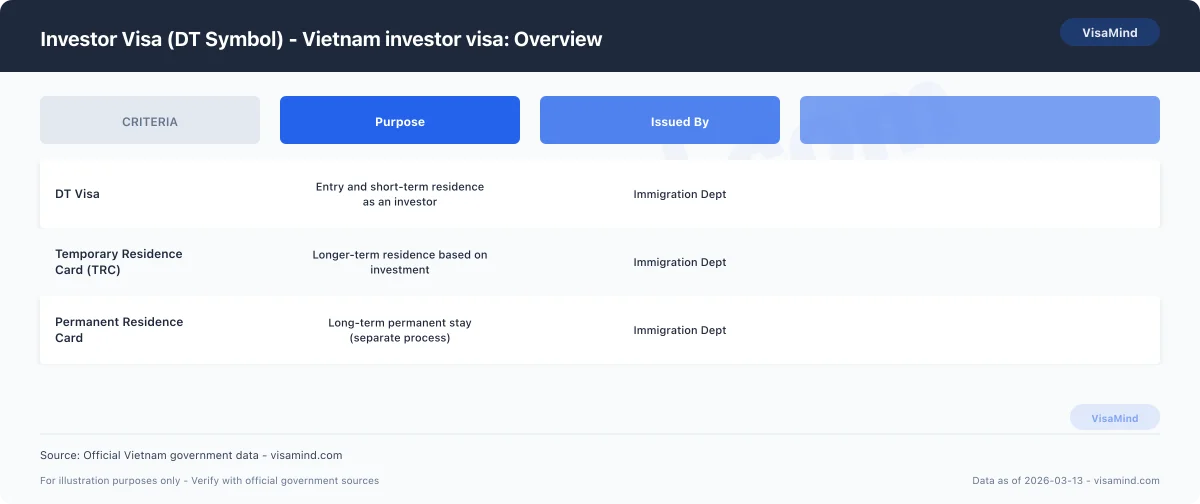
Investor status can open the door to longer-term residence, but it requires additional applications with the Immigration Department of Vietnam (Cục Quản lý xuất nhập cảnh). You must maintain a valid visa or residence document at every stage—moving from a Business Visa (DN Symbol) to a Temporary Residence Card (TRC) and, if you qualify, to permanent residence.
Common next steps
Most investors enter Vietnam on a Business Visa (DN Symbol) sponsored by their company. This visa allows you to conduct investment and business activities but doesn’t replace long-term residence status.
After entry, you typically:
-
Register your residence with local authorities.
-
Apply for a Temporary Residence Card (TRC) through the Immigration Dept.
-
Consider whether you need a Work Permit, depending on your company role.
You must submit the appropriate immigration forms, which may include:
- Form NA1 (application form for visa or stay-related matters)
- Form NA2 (request from the sponsoring organization)
- Form NA5 (application related to Visa Exemption certificate, if applicable)
If you later seek a Permanent Residence Card, you’ll need to meet stricter conditions set by the Immigration Dept. Review official guidance from the Immigration Department of Vietnam for current eligibility criteria and document requirements.
| Status | Purpose | Sponsor Required | Issued By |
|---|---|---|---|
| DN Visa | Business entry | Yes | Immigration Dept |
| TRC | Long-term stay | Yes | Immigration Dept |
| Permanent Residence Card | Indefinite residence | Yes | Immigration Dept |
Temporary Residence Card (TRC)
A Temporary Residence Card (TRC) allows you to stay in Vietnam without renewing your visa during its validity period. It saves you from repeated DN visa extensions and makes travel in and out of Vietnam easier.
You’ll apply through your sponsoring company with the Immigration Dept. The application generally includes:
- Valid passport
- Existing DN visa
- Company sponsorship documents
- Completed NA forms as required
The TRC links directly to your investment or employment status. If your company sponsorship ends, your TRC may no longer be valid.
You must keep your investment active and your registration compliant to maintain eligibility. For current fees in ₫ (VND) and processing details, consult the Immigration Department of Vietnam.
When to Hire an Attorney
#You can file many Vietnam investor visa applications yourself, but some situations increase risk, delay, or refusal. An attorney becomes valuable when your case involves legal overlap, foreign documentation, or location‑based processing issues with the Immigration Dept (Cục Quản lý xuất nhập cảnh).
Complex-case indicators
Hire an attorney if your investment structure, visa history, or residence plans don’t fit a simple profile.
You should seek legal help if you:
- Previously overstayed and now need an exit visa (often processed in 1–2 weeks, sometimes longer in complex cases)
- Intend to convert from a Business Visa (DN Symbol) to an investor category
- Plan to apply for a Temporary Residence Card (TRC) immediately after entry
- Want to pursue a Permanent Residence Card
- Face inconsistencies between corporate documents and immigration filings
An attorney reviews your corporate registration, capital contribution records, and visa status together. Mismatched information between your investment license and your Form NA1, Form NA2, or Form NA5 application can delay approval.
If your timeline depends on predictable processing, confirm current timeframes directly with the Immigration Dept before filing.
Cross-border legal issues
Cross-border documentation often creates avoidable delays.
You should hire counsel if your case involves:
- Foreign corporate ownership structures
- Documents issued outside Vietnam
- Multiple nationalities or dual passports
- A pending Work Permit tied to your investment role
Vietnamese authorities assess your immigration eligibility separately from your business compliance. An attorney coordinates both.
For example, if you enter on a Visa Exemption or Business Visa (DN Symbol) and later apply for a TRC, your legal basis for stay must align with your investment documentation. Errors in NA1, NA2, or NA5 forms can trigger additional review.
If you anticipate questions during a local investigation, legal representation helps you understand your role and your obligations before and after the review concludes.
Processing-location complications
Processing location affects both timeline and procedure.
You may file with different branches of the Immigration Dept, and internal workloads vary. Investor visa processing times differ by category and by office.
| Issue | Why Legal Help Matters |
|---|---|
| Filing in a different province from your company registration | Ensures jurisdiction is correct |
| Converting status inside Vietnam | Confirms eligibility before submission |
| Needing an exit visa before reapplying | Plans around the typical 1–2 week processing period |
| Simultaneous TRC request | Coordinates sequencing of approvals |
If you must leave Vietnam to correct status, you need a clear reentry plan before departing.
An attorney structures the order of applications so your Business Visa, investor status, TRC, and any Work Permit align with your investment records and intended length of stay.
How to Apply
#You apply through the Immigration Department of Vietnam (Cục Quản lý xuất nhập cảnh) by submitting the required forms, identity documents, and payment through the designated system. Accuracy matters—mistakes or missing information can delay approval or require you to refile.
Filing with the Immigration Department
You file your investor visa application directly with the Immigration Department of Vietnam (Immigration Dept). The filing method depends on your visa type, such as a Business Visa (DN Symbol) or an application connected to a Temporary Residence Card (TRC).
You must complete the correct form, such as:
| Form | Purpose |
|---|---|
| Form NA1 | Individual visa application |
| Form NA2 | Sponsoring organization request |
| Form NA5 | Visa extension or amendment |
Provide full personal details, passport information, and a compliant passport-style photograph. Make sure all information matches your passport exactly.
If you later apply for a Temporary Residence Card (TRC) or pursue eligibility for a Permanent Residence Card, you’ll need to submit additional documentation through the Immigration Dept under the applicable category.
Before filing, review the official instructions from the Immigration Dept to confirm document requirements and current procedures.
Online form steps
If your application is processed online, complete the electronic form carefully and upload the required documents.
Follow these steps:
-
Enter your personal and passport details exactly as shown on your passport.
-
Upload a clear image of your passport data page.
-
Upload a passport-style photograph that meets official specifications.
-
Complete every required field on the form.
-
Pay the e‑visa fee in VND (₫) through the designated payment platform.
After submission, you’ll get a registration code. Use that code, along with your registration email and date of birth, to check your status in the E‑visa search system.
When approved, print the e‑visa and present it when entering or exiting Vietnam.
Review every entry before submitting. Errors in passport numbers, names, or dates can invalidate your approval.
Submission checklist
Use this checklist to avoid delays:
- Valid passport with accurate biographical details
- Clear scan of passport data page
- Passport-style photograph
- Completed NA1, NA2, or NA5 form (as applicable)
- Payment of the required fee in VND (₫)
- Registration code for online tracking
If you apply under the Business Visa (DN Symbol) category, confirm that the sponsoring entity submits any required organizational documentation.
If you plan to obtain a Temporary Residence Card (TRC), a Work Permit, or qualify for a Visa Exemption, check that your visa type supports that next step before filing.
Always review the Immigration Dept’s official guidance for the most current document list and procedural updates.
Conditions and Compliance
#You must meet strict document standards and keep valid status at all times. The Immigration Department of Vietnam (Cục Quản lý xuất nhập cảnh) (Immigration Dept) will deny incomplete or inaccurate filings without review.
Documentation standards
Submit a passport that’s valid for at least six months at the time of filing. If your passport doesn’t meet this, the Immigration Dept will reject your application.
Your application package must be complete and accurate. Missing information, inconsistent data, or incorrect entries lead to denial.
Pay close attention to technical specifications:
- Passport data page image in the correct size
- Photo that meets required specifications
- Fully completed forms such as Form NA1, Form NA2, or Form NA5, as applicable
- Accurate visa classification (for example, Business Visa (DN Symbol) if relevant)
Use this checklist before filing:
| Requirement | Standard You Must Meet | Consequence if Incorrect |
|---|---|---|
| Passport validity | Minimum six months remaining | Application denied |
| Passport image | Correct size and clear scan | Application denied |
| Photograph | Correct format and specifications | Application rejected |
| Form completion | No missing or incorrect fields | Application rejected |
Filing under an investor category doesn’t guarantee approval. The Immigration Dept evaluates each submission independently.
If you carry currency exceeding the permitted threshold, you must declare it upon entry.
Residency and status obligations
You must maintain valid immigration status at all times. File your investor application before your current visa or status expires.
Late filings may result in denial. The Immigration Dept does not excuse overstays simply because you intend to invest.
If you hold a Business Visa (DN Symbol), confirm that your stay remains valid while your investor status is under review. If you apply for a Temporary Residence Card (TRC), ensure your underlying visa remains active until approval.
Use the correct form for your request:
-
NA1 – Individual visa application
-
NA2 – Sponsoring organization submission
-
NA5 – Visa extension or modification
If you later pursue a Permanent Residence Card, maintain full compliance during your temporary stay. Don’t assume that a pending application protects you from status violations.
Common application pitfalls
Most denials come down to avoidable mistakes. Careful review helps you steer clear of these issues.
Common mistakes include:
- Uploading passport images in the wrong size
- Submitting photos that don't meet technical requirements
Leaving blank fields on NA1, NA2, or NA5 forms is another frequent problem. Inconsistent passport details or filing after your visa has expired also lead to trouble.
Double-check every field against your passport before you submit. Even a small discrepancy can get your application rejected.
If you're moving from a Business Visa (DN Symbol) to a Temporary Residence Card (TRC), be sure your visa category matches your plans. Selecting the wrong visa type causes delays.
Procedures can shift over time. It's your responsibility to confirm requirements with the Immigration Dept before you file.
Fees and Processing Times
#Government fees come up at several stages. For an investor visa, expect a standard processing time of 1 to 3 months. Timelines depend on your visa type, where you file, and whether you need related documents like a TRC or exit visa.
Government fees
You pay fees directly to the Immigration Department of Vietnam (Cục Quản lý xuất nhập cảnh) or the Vietnamese embassy or consulate handling your case.
As of February 2026, the embassy visa stamping fee for an investor visa is the VND equivalent of USD 50, paid in Vietnamese đồng at the official exchange rate.
Other costs may apply, depending on your situation:
- Filing forms (Form NA1, Form NA2, Form NA5)
- Issuance of a Business Visa (DN Symbol) before switching to investor status
- Application for a Temporary Residence Card (TRC)
- Requests for a Permanent Residence Card
- Exit visa processing, if you need one
Fee schedules can change. Confirm current amounts with the Immigration Dept before you submit anything.
| Fee Type | Paid To | Notes |
|---|---|---|
| Investor visa stamping | Embassy/Consulate or Immigration Dept | VND equivalent of USD 50 (as of Feb 2026) |
| TRC issuance | Immigration Dept | Check current schedule |
| Exit visa (if required) | Immigration Dept | Separate processing fee |
Standard processing times
Investor visa (DT category) applications take 1 to 3 months under standard processing as of March 2026.
The exact time depends on:
- Your investor classification
- Where you file
- Whether you first enter on a Business Visa (DN symbol)
- Whether the Immigration Dept needs extra review
If you apply for a Temporary Residence Card (TRC) after your investor visa, that process is separate. Plan your travel and business activities around the full visa and residence timeline.
Exit visas, if required, usually take one to two weeks.
| Process | Standard Timeframe |
|---|---|
| Investor visa (DT) | 1–3 months |
| Required exit visa | 1–2 weeks |
Variable and expedited timelines
processing times shift by investor category and by which office handles your case. Filing inside Vietnam with the Immigration Dept can move at a different pace than embassy filings.
Delays often happen when:
- Investment documents aren't complete
- Company registration needs clarification
- You're changing from a Business Visa (DN symbol) to an investor visa
- You're applying for a Work Permit or TRC at the same time
Expedited processing isn't guaranteed. It depends on the Immigration Dept’s workload and your specific facts.
Visa Exemption allows entry without a visa, but you still need to complete investor and residence procedures to get a TRC or pursue permanent residence.
Build flexibility into your plans. Don't lock in business contracts or relocation dates until you have formal approval.
Investment Requirements — Vietnam investment visa DT
#For a Vietnam investment visa (DT), you must declare your investment plans and show your capital will go into a qualifying business activity. The Immigration Department reviews your status based on your declared investment and supporting documents.
Declaration of investment intent
You need to clearly state your intent to invest in Vietnam before the Immigration Dept will consider your DT visa application.
This declaration covers:
- Your identity as the investor
- Your commitment to invest capital
- The business sector or project you'll pursue
- Your role in the investment
You usually submit this as part of your visa application to the Immigration Dept. If you're already in Vietnam on a Business Visa (DN Symbol), you can switch to a DT visa after formalizing your investment intent.
Common immigration forms include:
| Form | General Purpose |
|---|---|
| Form NA1 | Individual visa application |
| Form NA2 | Sponsorship/organization request |
| Form NA5 | Visa extension or amendment |
Make sure your declaration matches the details in your NA1, NA2, or NA5 forms. Any inconsistency can slow things down or cause a refusal.
If approved, you may later apply for a Temporary Residence Card (TRC) as an investor. A Permanent Residence Card follows separate criteria and isn't automatic.
Qualifying investment types
Your investment must go into a legitimate business activity in Vietnam. The Immigration Dept checks that your capital contribution matches your declared investment purpose.
Qualifying investment structures generally include:
- Setting up a new company in Vietnam
- Contributing capital to an existing Vietnamese company
- Joining a business project as a registered investor
You must actually hold an investor role, not just act as an employee. If you handle operational duties beyond your investor capacity, you may need a Work Permit.
The DT visa is different from:
| Status | Purpose |
|---|---|
| Business Visa (DN symbol) | Short-term business activities without investor status |
| Visa Exemption | Entry without a visa under certain bilateral arrangements |
| DT Investor Visa | Residence tied to registered investment activity |
Once your investment status is recognized, you can apply for a Temporary Residence Card (TRC). The TRC is linked to your approved investor status and only remains valid while your qualifying investment continues.
Who Can Apply
#You can apply for a Vietnam investor visa if you can document your civil status and identity, and provide academic records where your business requires professional qualifications. The Immigration Department reviews these documents when issuing a Business Visa (DN Symbol), Temporary Residence Card (TRC), or related status.
Required civil documents
You must submit complete, consistent civil records to confirm your identity and legal status.
Key documents usually include:
- Birth certificate
- Passport with your full legal name
- Civil status records (if required for your case)
If your birth certificate has a non‑Vietnamese name, check that the spelling matches your passport and all immigration forms, including Form NA1, Form NA2, or Form NA5. Inconsistent names slow down your case.
Your documents must:
-
Show your full legal name exactly as used in your application.
-
Be clear and legible.
-
Support the visa category you request, such as a Business Visa (DN Symbol) or TRC.
If you later apply for a Permanent Residence Card or switch from a Visa Exemption status, the Immigration Dept will review these civil records again. Consistency is key across every submission.
| Document Type | Purpose in Application Review |
|---|---|
| Birth certificate | Confirms identity and legal name |
| Passport | Confirms nationality and travel status |
| Civil status record | Supports eligibility for specific functions |
Academic and identity evidence
If your investment activity involves professional or operational roles, you must provide academic qualifications that support those duties.
You should have:
- Degree certificates
- Academic transcripts, if needed
- Professional qualification records relevant to your business role
The Immigration Dept may review these documents if your investor role overlaps with activities that typically require a Work Permit. Clear academic evidence helps prevent your application from being reclassified.
Your academic documents must line up with:
- The business activities registered under your investment
- Any concurrent TRC request
- The purpose stated in your Business Visa (DN Symbol) application
Your name on all academic records must match your passport and civil documents. Any difference can delay your visa, TRC, or related status.
Investment Compliance Risks
#Small mistakes and timing errors can cause rejection, delays, or loss of status with the Immigration Dept. Forms must be accurate and filed before your current visa or card expires.
Common filing errors
Most rejections happen because of inconsistent or incomplete information on forms like Form NA1, Form NA2, or Form NA5. Even small differences between your passport and application can lead to refusal.
Match every detail to your passport and supporting documents. This includes spelling, passport number, and validity dates.
Common problems:
- Mismatched passport information
- Missing required fields on NA1, NA2, or NA5
- Skipping required supporting documents
- Inconsistent answers across related applications (for example, Business Visa (DN Symbol) and Temporary Residence Card (TRC))
| Issue | Likely Outcome | How to Prevent It |
|---|---|---|
| Incomplete form | Delay | Review every field before submission |
| Inconsistent passport details | Rejection | Copy details directly from passport |
| Missing document | Processing delay | Follow the document checklist exactly |
If you apply for a Temporary Residence Card (TRC), extend a Business Visa (DN Symbol), or file for a related status, accuracy is essential. The Immigration Dept won't fix errors for you.
Timing and status risks
You must file before your current immigration status expires. If your Business Visa (DN Symbol), Visa Exemption, or TRC lapses, the Immigration Dept may reject your extension or renewal.
Late filing brings two main risks:
-
Your application may be refused.
-
You may lose lawful stay status while waiting.
This applies to:
- TRC renewals
- Business Visa (DN Symbol) extensions
- Status changes tied to investment
- Applications that later support eligibility for a Permanent Residence Card
Track expiration dates for your visa, TRC, and passport. Processing speed won't protect your status if you file late.
If you're unsure about current filing rules or your status, contact the Immigration Dept for official guidance.
How to avoid delays and denials
Treat your filing as a compliance review. Check every document before submitting.
Use this checklist:
- Confirm passport validity and exact data entry
- Review all NA1, NA2, or NA5 fields for completeness
- Keep answers consistent across visa, TRC, and related filings
- Submit before your current status expires
- Include every document required by the Immigration Dept instructions
If your investment structure also requires a Work Permit, TRC, or Business Visa (DN Symbol), make sure information matches across all applications. Inconsistencies between filings often cause delays.
Keep copies of everything you send in. If the Immigration Dept asks for clarification, respond quickly with documents that match your original submission.
Fees
#| Component | Amount |
|---|---|
| Embassy visa feeInvestor visa (DT) — multiple-entry | $50 |
Fees change; always verify on Immigration Dept..