Who Should Consider This
#Canada welcomes over 300,000 new permanent residents each year through various immigration pathways, making it an attractive destination for individuals seeking long-term residency. Permanent residence in Canada offers many benefits, such as the ability to live, work, and study anywhere in the country, access to healthcare and social services, and a pathway to Canadian citizenship.
Who Should Consider Permanent Residence?
Permanent residence is ideal for individuals who wish to make Canada their long-term home. It is particularly suited for:
-
Skilled Workers and Professionals: Programs like Express Entry and Quebec Skilled Worker cater to individuals with specific skills and work experience.
-
Family Members: Those with family ties in Canada can explore options like Spousal Sponsorship and Parent Grandparent Sponsorship.
-
Entrepreneurs and Investors: The Start Up Visa is available for those with innovative business ideas, while other programs target investors.
-
Caregivers: Those with caregiving experience can apply through the Caregiver program.
Key Eligibility Factors
To qualify for permanent residence, you typically need to meet several criteria, including:
-
Language Proficiency: English or French skills are often required, as measured by tests like IELTS or TEF.
-
Work Experience: Relevant work experience in specific occupations can be crucial, especially for skilled worker programs.
-
Education: Higher education levels can improve eligibility and ranking in programs like Express Entry.
-
Health and Security: All applicants must pass medical and security checks to ensure they are admissible to Canada.
Special Pathways
Canada also offers unique pathways for certain groups:
-
Francophone Community Immigration: Designed for French-speaking immigrants who wish to settle outside Quebec.
-
Rural and Northern Immigration Pilot: Targets newcomers willing to work and live in smaller communities.
Tip: If you are uncertain which pathway suits you best, consider using the IRCC's online tool to explore your options.
Next Steps
If you're interested in pursuing permanent residence, it's important to research further into specific programs that match your qualifications and personal circumstances. Additional resources like the PR Pathways Overview and the Express Entry Guide can provide detailed insights on various application processes.
Do You Qualify?
#When considering applying for Permanent Residence (PR) in Canada, it's important to first determine if you meet the eligibility criteria. The qualifications vary depending on the specific program or pathway you choose. Below are some of the key factors that may influence your eligibility for Permanent Residence in Canada.
Education and Work Experience
-
Educational Credentials: Depending on the program, you might need to have your foreign educational credentials assessed. This is a requirement for many economic immigration programs, such as Express Entry and Quebec Skilled Worker.
-
Work Experience: Relevant work experience is crucial. For instance, the Federal Skilled Worker Program requires at least one year of continuous full-time or equivalent part-time paid work experience in the past ten years in a skilled occupation.
Language Proficiency
- Language Tests: You will need to prove your proficiency in English or French. Accepted tests include the IELTS, CELPIP, and TEF. The required scores depend on the immigration program, with higher scores generally increasing your chances.
Tip: Achieving a higher language proficiency score can significantly boost your Comprehensive Ranking System (CRS) points under the Express Entry system.
Points Thresholds
-
Comprehensive Ranking System (CRS) Score: For the Express Entry system, you need to meet a certain points threshold, which varies with each draw. Factors affecting your CRS score include age, education, work experience, and language skills.
-
Provincial Nominee Programs (PNP): Some provinces have their own points-based systems. Being nominated by a province can add 600 points to your CRS score, guaranteeing an invitation to apply.
Age and Income
-
Age: Age is a significant factor in the points-based systems like the CRS. Applicants aged 20-29 receive the maximum points, with points decreasing as you age beyond 30.
-
Income: While there is no direct income requirement for most PR programs, having sufficient funds is necessary to support yourself and your family upon arrival. This is especially relevant for economic immigration pathways.
Specific Program Requirements
The requirements can vary significantly depending on the specific PR program. For family sponsorship, such as Spousal Sponsorship or Parent Grandparent Sponsorship, the focus is on your relationship with the sponsor and their ability to support you financially.
Important: Ensure you review the specific requirements for your chosen pathway on the official IRCC website, as requirements and thresholds may change.
By comprehensively understanding these criteria, you can better assess your eligibility and strategically plan your application. For further guidance, consider reviewing the PR Pathways Overview to explore the different routes available for obtaining Permanent Residence in Canada.
The Application Process
#-
Determine Your Eligibility Category
Before applying for permanent residence in Canada, identify the specific immigration program that suits your circumstances. Canada's Immigration, Refugees and Citizenship Canada (IRCC) offers various pathways, such as Express Entry, Provincial Nominee Program (PNP), and Family Sponsorship. Each program has distinct eligibility criteria, so it's crucial to review the requirements for your chosen category.
-
Gather Necessary Documents
Once you've determined the appropriate category, gather all required documents. This typically includes identification documents, proof of work experience, language test results, and financial information. Depending on your category, additional documents like police certificates or medical exams might be required. Ensure you have current documents as outdated ones may delay your application.
-
Create an Online Account
To apply for permanent residence, you'll need to create an online account on the IRCC website. This account allows you to access application forms, track your application status, and receive communications from IRCC. Make sure to provide a valid email address to receive updates promptly.
-
Complete the Application Forms
Download and complete the necessary forms provided by IRCC. Ensure you have Adobe Acrobat Reader version 10 or higher to open and fill out the forms correctly. Avoid using tablets or mobile phones as they may not support the forms properly. Carefully review each form to ensure accuracy and completeness.
-
Pay the Application Fees
Application fees vary depending on the program and number of applicants included. As of 2023, fees start at CAD $1,325 for an individual application under Express Entry. Verify current fees on the official IRCC website. Payment is typically completed online through your IRCC account.
-
Submit Your Application
Once you've completed the forms and paid the fees, submit your application through your IRCC account. Include all required documents and evidence to avoid processing delays. You will receive a confirmation once your application is lodged successfully.
Tip: File online to avoid mail delays and get a receipt number immediately.
-
Biometrics and Additional Steps
After submitting your application, you may be required to provide biometrics (fingerprints and photo) at a designated collection center. IRCC will notify you if biometrics are needed, including instructions on how to proceed. Additional steps may include attending an interview or providing further documentation.
-
Track Your Application
Utilize your IRCC online account to monitor the status of your application. Processing times vary depending on the immigration program. For the most accurate timelines, refer to the Processing Times Explained guide.
By following these steps, you can navigate the permanent residence application process with greater confidence. Ensure all information is accurate and current to enhance your chances of a successful application.
Documents and Evidence
#Refugees and Citizenship Canada (IRCC). These documents help verify your identity, background, and eligibility. Below is a structured list of required documents and related items.
Personal Identification and Status Documents
- Passport: Provide a clear, valid copy of your passport, including the photo page.
- Birth Certificate: A copy of your birth certificate is required.
- Marriage Certificate: If applicable, include a copy of your marriage certificate.
- Divorce or Separation Papers: If applicable, provide evidence of divorce or separation.
- Police Certificates: You must obtain police certificates for each country you have lived in for six months or longer since the age of 18. Consult the Medicals And Police Certificates Guide for more details.
Financial Documents
- Proof of Funds: You need to demonstrate that you have adequate funds to support yourself and any dependents upon arrival in Canada. This includes bank statements and property valuations. For more information, refer to the Proof Of Funds Guide.
- Consent for an Access to Information and Personal Information Request (IMM 5744): This form is necessary if you are authorizing someone to request your personal information from Canadian government agencies.
Educational and Professional Credentials
- Educational Credentials Assessment (ECA): If required by your immigration pathway, provide an ECA to verify your foreign qualifications.
- Language Test Results: Submit valid results from recognized English or French language tests, such as IELTS or TEF.
- Employment References: Include letters from past employers, detailing your job duties and duration of employment.
Translations and Certifications
- Translations: Any documents not in English or French must be accompanied by certified translations. Ensure the translations are accurate and complete as per Canadian standards.
- Certifications: All copies of documents must be certified true copies if not submitting originals.
Important: Missing documents or incorrect submissions can delay processing times significantly. It's crucial to review your application thoroughly before lodging it with IRCC.
For further guidance on document preparation and processing times, you may consult the Processing Times Explained guide. Additionally, those transitioning from a Post-Graduation Work Permit (PGWP) may find the PGWP To PR Roadmap helpful.
How Long It Takes
#The processing time for obtaining Permanent Residence in Canada varies depending on the specific immigration program you apply through. Typically, the timeline can range from 6 months to over a year. It's important to keep up-to-date with current processing times, as they can fluctuate based on application volume and other factors. You can check the latest timelines on the IRCC website.
Factors Affecting Processing Times
Several factors can influence the speed of your Permanent Residence application:
- Completeness of Application: Ensure all required documents and information are provided. Missing information can lead to delays.
- Program Type: Some programs, like Express Entry, have faster processing times compared to others.
- Verification Process: Background checks, medical exams, and biometrics can extend processing time.
- Current Backlogs: High application volumes can lead to delays, affecting all applications in the queue.
Tip: Use the Express Entry Guide to navigate the application process efficiently and avoid common delays.
Expedited Options
While there is no guaranteed way to expedite the process, certain strategies may help:
- Express Entry System: If eligible, applying through the Express Entry system can potentially reduce processing time to as little as six months.
- Provincial Nominee Programs (PNP): Some provinces offer expedited processing for candidates who meet specific labor market needs. Check the PNP Guide for more information.
- Complete Application: Ensure your application is thorough and well-documented to prevent processing halts due to missing information.
Processing Time by Program
| Program Type | Estimated Processing Time |
|---|---|
| Express Entry | Around 6 months |
| Provincial Nominee Program | 6 - 19 months |
| Family Sponsorship | 12 - 24 months |
| Quebec Skilled Worker | 15 - 17 months |
Important: Processing times are subject to change. Always verify the latest information on the official IRCC website.
Applying for Permanent Residence requires careful preparation and understanding of the processes involved. Staying informed about potential delays and taking advantage of expedited pathways where possible can significantly affect your application timeline.
Common Mistakes
#Important: Ensuring accuracy in your Permanent Residence application is crucial, as even small mistakes can lead to processing delays or refusals.
Incomplete or Incorrect Documents
- Missing Documents: A common reason for application delays or refusals is missing documents. Ensure you gather all required documents specific to your eligibility category. Checklists like the Express Entry Document Checklist can help.
- Incorrect Information: Mismatches in personal details such as name, date of birth, or passport number can lead to complications. Double-check all entries against your official documents.
Misunderstanding Eligibility Criteria
- Eligibility Misjudgment: Many applicants misinterpret eligibility requirements. For instance, not meeting the minimum language proficiency can be a significant pitfall. It's advisable to thoroughly review the PR Pathways Overview to understand specific criteria.
- Proof of Funds: Not providing adequate proof of funds can result in refusal. Ensure you have the necessary financial documentation as outlined in the Proof Of Funds guide.
Technical Errors
- Form Access Issues: Attempting to open and fill out forms like the Consent for an Access to Information and Personal Information Request (IMM 5744) on tablets or mobile phones often leads to errors. Use a computer with Adobe Acrobat Reader version 10 or higher.
- Online Submission Mistakes: Errors during online submission, such as uploading incorrect file formats, can cause delays. Follow the specific instructions for file types and sizes.
Tip: Double-check all information entered in online forms before submission to prevent errors that could delay processing.
Miscommunication with IRCC
- Failure to Respond: Ignoring communication from IRCC or not responding in a timely manner can jeopardize your application. Always keep your contact information updated and check your email regularly.
- Incorrect Contact Information: Providing outdated or incorrect contact details can result in missed communications. Verify your contact information before finalizing your application.
By addressing these common mistakes and ensuring thorough preparation, you can improve your chances of a successful Permanent Residence application. For more detailed guidance, explore our Visa Application Steps.
This Program vs Other Options
#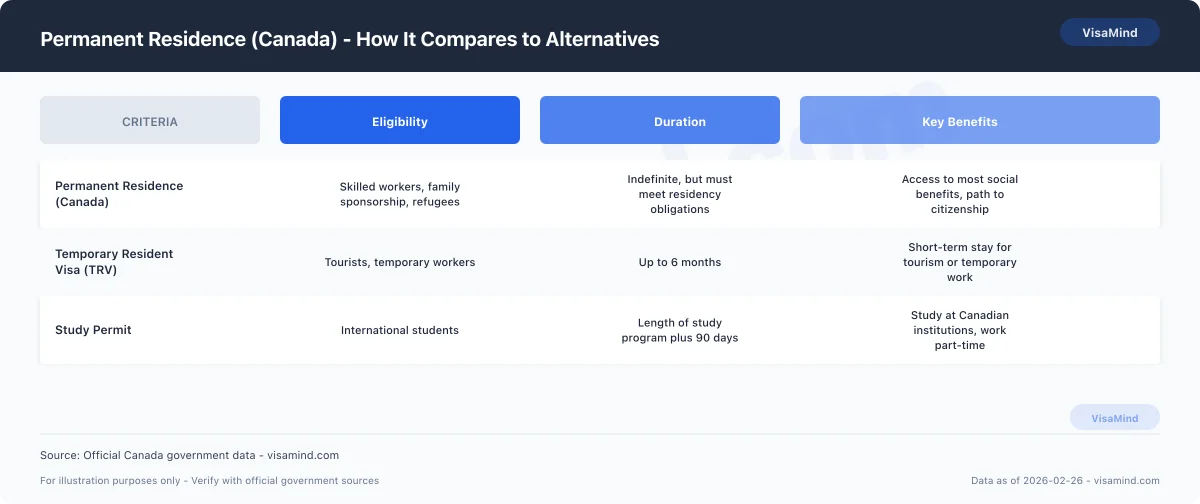
It's important to understand the distinctions between the Permanent Residence (PR) program and other options. This section highlights key differences to help you determine the best fit for your situation.
How Does Permanent Residence Differ from Other Options?
The table below compares Permanent Residence with other popular Canadian immigration programs, focusing on eligibility, costs, and timelines.
| Program | Eligibility | Cost Range (CAD) | Timeline |
|---|---|---|---|
| Permanent Residence | Skilled workers, family sponsorship | $1,325 (as of 2023) | 6-12 months |
| Temporary Resident Visa | Visitors, tourists | $100 | Up to 2 months |
| Study Permit | Students enrolled at Canadian institutions | $150 | 3-4 months |
| Work Permit | Job offer from Canadian employer | $155 | 1-2 months |
Why Choose Permanent Residence?
Permanent Residence offers several advantages over temporary visas. As a PR holder, you enjoy the ability to live, work, study, and access social benefits similar to Canadian citizens. Unlike temporary permits, PR is more stable and does not require frequent renewals.
Tip: Permanent Residence is often a step towards full citizenship, providing long-term benefits and security in Canada.
Comparing Permanent Residence to Study and Work Permits
While Study Permits and Work Permits allow for temporary stays with specific purposes, they do not provide the same level of flexibility as PR. Study Permits are limited to the duration of your program, and Work Permits are tied to employment conditions. In contrast, PR status is not linked to employment or education, allowing for greater freedom of movement and occupation within Canada.
For more detailed comparisons, consider the following guides on Study Permit Guide and Work Permits Overview.
Additional Considerations
Permanent Residence is a significant commitment and requires meeting specific criteria, including language proficiency and financial stability. It's crucial to understand these requirements thoroughly. For those considering alternative pathways, the Express Entry Guide offers insights into one of the fastest routes to obtaining PR.
Ultimately, selecting the right immigration path depends on your personal and professional goals, timelines, and immediate needs. By comparing these options, you can make an informed decision about which pathway best suits your aspirations in Canada.
Costs and Financial Thresholds
#It's important to be aware of the various costs involved. These costs can vary depending on the specific pathway you are pursuing. Here's a breakdown of some of the common expenses you can expect:
| Type of Fee | Amount (CAD) | Description |
|---|---|---|
| Application Processing Fee | $1,365 | This fee applies to principal applicants of most permanent residence programs, including Express Entry. |
| Right of Permanent Residence Fee | $515 | Required for all approved applicants, this fee is paid before becoming a permanent resident. |
| Biometrics Fee | $85 per person | Covers the cost of collecting fingerprints and a digital photo, as required for most applicants. |
| Spouse or Partner Fee | $1,365 | Additional fee for including a spouse or common-law partner in your application. |
| Dependent Child Fee | $230 per child | Fee for each dependent child included in the application. |
Tip: Check the Visa Application Steps to ensure you understand the payment process and available methods.
Financial Thresholds and Proof of Funds
For many pathways to permanent residence, demonstrating that you have sufficient financial resources to support yourself and your family upon arrival in Canada is crucial. Here's what you need to know:
-
Proof of Funds: Most economic immigration programs, such as those under the Express Entry system, require you to show proof of funds. This ensures you can support yourself and any family members once you arrive in Canada. The required amount depends on the size of your family and is updated annually. As of 2023, a single applicant needs approximately $13,757 CAD. For each additional family member, you will need to add about $3,586 CAD.
-
Investment Minimums: Some programs, like the Start Up Visa, may require proof of investment or a commitment from a designated organization. The specifics of these requirements can vary significantly based on the program.
Important: Ensure your funds are readily accessible and documented properly. Consult the Proof Of Funds guide for detailed requirements on acceptable financial proof.
Salary and Income Requirements
While most permanent residence applications through economic streams require proof of funds, specific salary or income thresholds can also apply:
-
Provincial Nominee Programs (PNP): Some provinces may have their own income requirements for nominees. It's essential to verify these directly with the relevant provincial authority and the Pnp Guide.
-
Sponsorship Obligations: If you're applying through family sponsorship, sponsors must demonstrate sufficient income to support the sponsored individual. This is particularly important for programs like Parent Grandparent Sponsorship.
Handling the financial aspects of your application can be complex, so it's advisable to stay informed about current requirements and updates, which are available on the official IRCC website.
Your Rights Under This Program
#As a permanent resident in Canada, you enjoy several rights and privileges that enhance your ability to live, work, and travel within the country. However, there are also some restrictions to be aware of.
Work Rights and Opportunities
As a permanent resident, you have the right to work for any employer in Canada and pursue any occupation. There is no need for a work permit, and you are not restricted by employment sectors or regions. This status opens up numerous opportunities for career advancement and personal growth. For more information on working in Canada, you can check the Work Permits Overview.
Travel Rights
Permanent residents can travel freely in and out of Canada. However, to return to Canada by air, you must carry a valid Permanent Resident Card or a Permanent Resident Travel Document (PRTD). If you plan to be outside Canada for an extended period, it's essential to maintain your residency obligations to avoid losing your status. Generally, you must be physically present in Canada for at least 730 days within a five-year period.
Important: If you fail to meet the residency obligation, you may lose your permanent resident status. Always verify your travel plans align with these requirements.
Family Members
Your permanent resident status allows you to sponsor eligible family members to join you in Canada. This includes your spouse, common-law partner, dependent children, and other relatives under specific conditions. Sponsoring family members is a way to reunite with loved ones and build a life together in Canada. For detailed guidance on sponsoring family members, see the Family Sponsorship Guide.
Restrictions and Responsibilities
While permanent residents enjoy many benefits, they cannot vote in federal elections or run for political office. Additionally, you must uphold Canadian laws and file taxes annually. It's crucial to maintain your residency status and fulfill your obligations to ensure you can continue to enjoy your rights as a permanent resident.
For further details about transitioning from a Post-Graduation Work Permit (PGWP) to Permanent Residence, explore the available pathways and eligibility requirements.
What Others Have Done
#A software engineer on a Bridging Open Work Permit was eager to secure Permanent Residence (Canada) to continue developing their career in Toronto. They had initially come to Canada through the Express Entry system, but after their work permit was about to expire, they faced uncertainty about their future status. To address this, they lodged an application for permanent residence through the Canadian Experience Class (CEC), leveraging their Canadian work experience as a key factor in their application. After ensuring all required documents were submitted via the IRCC portal, and carefully reviewing their eligibility details, the application was processed within six months. They successfully received their confirmation of permanent residence, allowing them to stay and work in Canada without restrictions.
Scenario: Family Sponsorship for Permanent Residence
A nurse in Vancouver wanted to sponsor her spouse, who was living overseas, for permanent residence. She applied under the Spousal Sponsorship program, ensuring she met all sponsorship requirements. Utilizing the detailed guidelines provided by IRCC, she prepared the necessary documentation, including proof of their relationship and her financial capability to support her spouse. Despite the complexity of the process, she was able to submit a complete and accurate application through the online portal. After an eight-month processing period, her spouse received approval for permanent residence and was able to join her in Canada, where they began their new life together.
Scenario: Navigating Provincial Nominee Program
An agricultural specialist working in Manitoba wanted to transition from a Temporary Resident Permit to permanent residence. They decided to apply through the Provincial Nominee Program (PNP), given their specialized skills in agriculture that aligned with Manitoba’s economic needs. The process involved submitting an expression of interest through the Manitoba Immigration Portal, followed by a nomination application with IRCC. After receiving a provincial nomination, which significantly boosted their chance of approval, they were able to apply for permanent residence. Within nine months, they received their permanent resident status, allowing them to continue contributing to the province's agricultural sector with greater stability and opportunity.
FAQs
What is the purpose of the IMM 5744 form in the Permanent Residence (Canada) process?
How can I combine a work permit and Permanent Residence (Canada) application?
What common mistakes should I avoid in my Permanent Residence (Canada) application?
What rights do I have under the Permanent Residence (Canada) program?
How does the Consent for an Access to Information and Personal Information Request (IMM 5744) form affect my Permanent Residence (Canada) application?
Can I apply for Permanent Residence (Canada) while on a student visa?
What financial thresholds must be met for Permanent Residence (Canada)?
Sources
Last reviewed: March 1, 2026
VisaMind provides informational guidance only and is not a government agency. This is not legal advice. Requirements can change and eligibility depends on your specific facts. If your case is complex or high-stakes, consult a licensed immigration attorney.
Next steps
Requirements vary by nationality, purpose, timeline, and case details. Use Find My Visa to get a personalized checklist for Canada with official sources and deadlines.
Find my visa