On this page
- Your Work Visa Options
- Employer Sponsorship Requirements
- How to Apply for a Work Visa
- What You Can and Cannot Do
- From Work Visa to PR
- What Goes Wrong
- Credential Requirements
- Salary Thresholds and Fees
- Tax Rules for Foreign Workers
- Real Scenarios
- Visa options for this goal
- Guides for Germany
- Other goals for Germany
Your Work Visa Options
#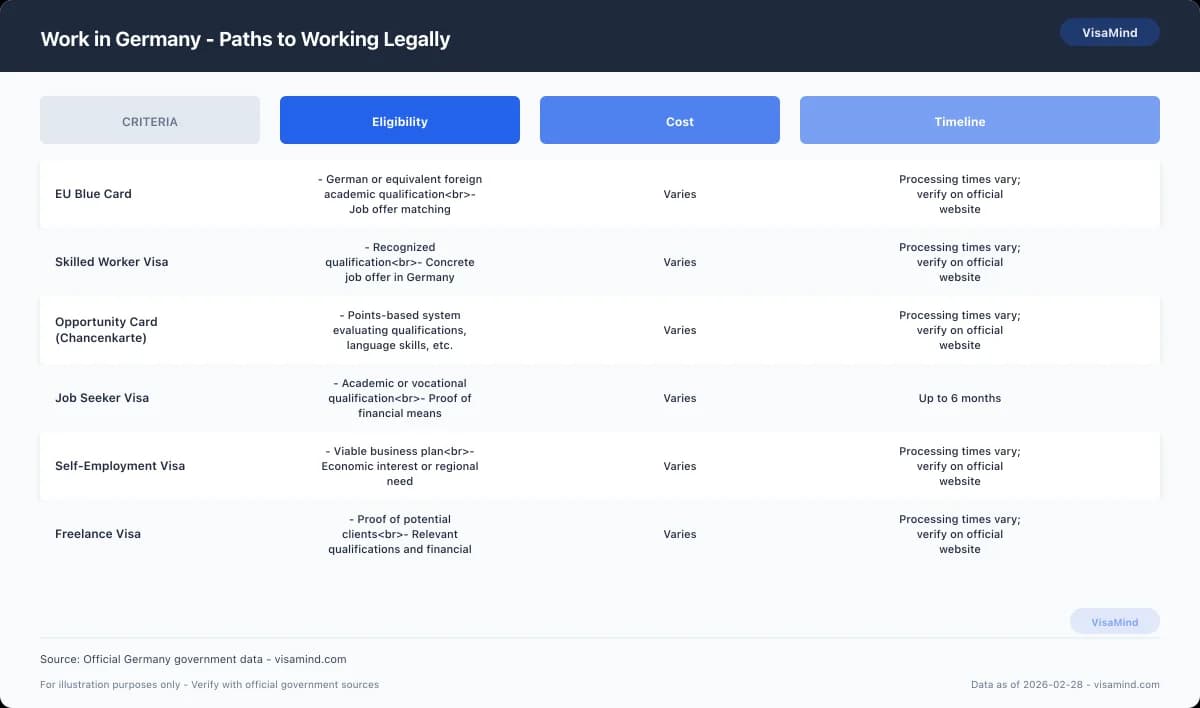
It's important to understand the various work visa options available to you. These visas allow individuals with different qualifications and employment situations to seek employment in Germany legally. Below is a comprehensive overview of the primary work visa categories available, including their eligibility criteria, costs, and timelines.
| Visa Type | Eligibility | Cost | Timeline |
|---|---|---|---|
| EU Blue Card | German or comparable foreign academic qualification, specific job offer in Germany, gross annual salary of at least €50,700 (or €45,934.20 for shortage occupations) | Approx. €100 for initial application | Up to 3 months |
| Skilled Worker Visa | Recognized vocational qualification, job offer in a relevant field, approval from the Federal Employment Agency | Approx. €75 | Up to 3 months |
| Opportunity Card (Chancenkarte) | Points-based system: qualifications, age, language skills, work experience | Approx. €100 | Varies |
| Job Seeker Visa | Academic or vocational qualification recognized in Germany, proof of financial resources | Approx. €75 | Up to 6 months |
| Self-Employment Visa | Viable business plan, economic interest or regional need, secure financing | Approx. €100 | Up to 3 months |
| Freelance Visa | Proof of freelance work offers, sufficient funds, relevant experience | Approx. €100 | Up to 3 months |
Understanding Your Eligibility
To qualify for any work visa in Germany, it's crucial to meet specific eligibility criteria. For the EU Blue Card, you need a recognized academic qualification and a job offer with a salary threshold as specified. The Skilled Worker Visa requires a vocational qualification and a related job offer. If you aim for the Opportunity Card, you'll need to qualify through a points-based system that assesses your qualifications, age, language skills, and work experience.
Tip: Ensure your foreign academic or vocational qualifications are recognized in Germany to avoid application pitfalls. You can check qualification recognition for more details.
Application Costs and Timelines
The cost for applying for work visas ranges from approximately €75 to €100, depending on the type. The Job Seeker Visa generally allows a longer processing time but provides up to six months to find employment in Germany. Other visas, such as the EU Blue Card and Skilled Worker Visa, typically have a processing time of up to three months. For precise processing times, refer to the Processing Times Guide.
Key Considerations
When planning your move, consider the specific requirements of each visa type. For example, the Self-Employment Visa requires a viable business plan that meets economic interests or regional needs. Similarly, the Freelance Visa demands proof of work offers and sufficient funds to support yourself.
Important: Failing to meet salary thresholds or not obtaining necessary approvals from the Federal Employment Agency can delay or jeopardize your application.
For more detailed information on each visa type and its specific requirements, refer to the respective visa pages: EU Blue Card, Skilled Worker Visa, and Job Seeker Visa. Understanding these options will help you choose the most suitable path for your career in Germany.
Employer Sponsorship Requirements
#To employ a foreign worker in Germany, companies must navigate specific sponsorship requirements. These include ensuring the job offer meets salary thresholds, obtaining necessary approvals, and verifying the candidate's qualifications. Here's a breakdown of what employers need to know:
Key Requirements for Sponsorship
-
Job Offer and Salary: Employers must provide a specific job offer that meets or exceeds the required salary thresholds. For most positions, the gross annual salary must be at least €50,700 as of 2026. However, for positions in shortage occupations, such as IT specialists or engineers, the threshold is lower at €45,934.20.
-
Qualification Verification: Employers must ensure that the applicant's academic qualifications are equivalent to German standards. This often involves obtaining recognition for foreign qualifications, which can be a critical step in securing a work visa like the EU Blue Card.
-
Federal Employment Agency Approval: For certain roles, especially those not covered by the EU Blue Card, employers might need approval from the Federal Employment Agency (Bundesagentur für Arbeit). This ensures that no suitable candidates are available within Germany or the EU.
Additional Considerations
-
Shortage Occupations: If the position falls within a recognized shortage occupation, the process may be more straightforward. Employers can benefit from lower salary thresholds and potentially faster processing times. The Skilled Worker Visa is another option for these roles.
-
Sector-Specific Permits: For industries with high demand, such as IT, Germany has initiatives like the "Make IT in Germany" to attract skilled workers. Employers should explore sector-specific pathways for recruiting talent.
Tip: Employers can improve their chances of successful sponsorship by consulting with the local foreigners' authority (Ausländerbehörde) early in the process to ensure all local requirements are met.
Steps to Secure Employer Sponsorship
- Evaluate the Role: Determine if the role qualifies as a shortage occupation and confirm salary meets the necessary threshold.
- Verify Qualifications: Work with the candidate to ensure all academic qualifications are recognized and equivalent to German standards.
- Seek Necessary Approvals: If needed, apply for approval from the Federal Employment Agency to demonstrate efforts to fill the position locally.
- Prepare Documentation: Gather all required documents, including the job offer and proof of qualifications, for the candidate’s visa application.
By adhering to these requirements, employers can effectively sponsor foreign workers, contributing to Germany's diverse and skilled workforce. For more detailed guidance, consider reviewing the Documents Checklist and the How To Apply guide.
How to Apply for a Work Visa
#Determine Your Eligibility
To apply for a work visa in Germany, you first need to confirm your eligibility. Generally, you must have a German academic qualification or a foreign degree equivalent to a German qualification. Additionally, you should have a specific job offer from a German employer that meets the required salary thresholds. For example, as of 2026, the gross annual salary must at least be €50,700, or €45,934.20 for shortage occupations. If you're seeking an EU Blue Card, ensure your qualifications align with the set criteria. You can learn more about the specific requirements for different work visas, such as the Skilled Worker Visa, by visiting the relevant links.
Gather Required Documents
Collecting the necessary documents is a crucial step in your application process. You will need:
- Proof of academic qualifications and their comparability to German standards.
- A copy of your specific job offer that states your position and salary.
- Evidence of adequate old-age pension provision if you are over 45 years of age.
Ensure that your documents are complete and meet the requirements outlined by the Federal Office for Migration and Refugees (BAMF). Missing or incorrect documents can lead to delays or rejection.
Submit Your Visa Application
Once you have all your documents ready, you must submit your visa application to the German mission in your country of residence. The Federal Foreign Office (Auswärtiges Amt) is responsible for handling these applications. Make sure to review the instructions specific to your eligibility category before starting the application process. You will also need to pay the applicable visa fees. Confirm the current fee structure on the official website to avoid surprises.
Tip: Consider applying online where possible to receive immediate confirmation of submission and to track your application status.
Obtain Approval and Enter Germany
Once your visa is approved, you can travel to Germany. Upon arrival, you must apply for the respective residence title at the local Foreigners Authority (Ausländerbehörde) before your entry visa expires. This step is essential to ensure your legal stay in Germany. Failure to do so may result in penalties or issues with your residency status.
Finalize Your Work Authorization
Depending on your visa type, you may need additional approvals, such as the Federal Employment Agency’s consent, particularly if your employment is in a regulated profession or requires specific certifications. Ensure all conditions are met to work legally in Germany.
For more details on processing times and document requirements, refer to our Documents Checklist and Processing Times guides.
What You Can and Cannot Do
#You have the flexibility to change employers while working in Germany under certain conditions. If you hold an EU Blue Card, you can change employers after the first two years of employment without needing approval from the Federal Employment Agency. However, if you wish to change employers within the first two years, you must obtain permission from the relevant Foreigners Authority. For other work visas, such as the Skilled Worker Visa, changing employers typically requires approval from the Foreigners Authority.
Can Family Join You?
Family reunification is possible under many German work visas. If you hold an EU Blue Card, your spouse can join you without needing to prove German language skills initially, and they can work in Germany without restrictions. For other visas, like the Family Reunion Visa, requirements may vary, such as demonstrating sufficient financial means to support family members and basic language skills for the spouse.
Can You Study?
While working in Germany on a work visa, you can also pursue educational opportunities. Many visa types, including the EU Blue Card, allow you to enroll in part-time study programs, such as language courses or professional development courses. However, if you wish to pursue full-time studies, you might need to apply for a separate Student Visa or potentially alter your residence permit to accommodate full-time education.
Tip: If you're considering long-term residence, engaging in study or training can enhance your qualifications for a Settlement Permit.
Key Considerations
- Change of Employment: Ensure compliance with any restrictions during the first two years of employment.
- Family Reunification: Verify specific requirements for your visa type and contact the local Foreigners Authority for guidance.
- Educational Opportunities: Check if your visa allows for part-time study and explore options for further education that align with your career goals.
Understanding these aspects can help you make informed decisions about your professional and personal life in Germany. Always verify the latest requirements on the official websites or consult with the Federal Office for Migration and Refugees (BAMF) for updated information.
From Work Visa to PR
#Obtaining a work visa is often the first step towards achieving permanent residency (PR) in Germany. Understanding the pathways and timelines involved is crucial for anyone considering a long-term stay in the country.
From Work Visa to Permanent Residency
If you hold a work visa, such as the EU Blue Card or a Skilled Worker Visa, you may be eligible to apply for a settlement permit, which is a form of permanent residency. The timeline and requirements for transitioning from a work visa to PR vary based on the type of visa you hold and your specific circumstances.
- EU Blue Card Holders: You can apply for a settlement permit after 33 months of employment in Germany. If you demonstrate sufficient German language skills (B1 level), you can shorten this period to 21 months.
- Skilled Workers: Typically, you can apply for PR after 48 months of employment. However, your residence and integration conditions, such as language proficiency and contributions to the social security system, can affect this timeline.
Key Requirements for Transitioning to PR
When transitioning from a work visa to a settlement permit, you must meet specific criteria:
- Stable Employment: You must have a job that's relevant to your qualifications and meets the salary thresholds set by German law.
- Financial Stability: Demonstrating financial independence, including sufficient income and contributions to the German social security system, is essential.
- Integration: Proficiency in the German language is crucial. Completing an integration course can sometimes fulfill this requirement.
- Living Conditions: Proof of adequate living arrangements and fulfillment of tax obligations is required.
Timeline Comparison for PR Eligibility
Here's a quick comparison of the timeline for PR eligibility based on different visa types:
| Visa Type | PR Eligibility Timeline |
|---|---|
| EU Blue Card | 21-33 months |
| Skilled Worker Visa | 48 months |
Important Considerations
Important: Ensure that your job's salary and duration are in line with the requirements for your specific visa type. Failing to meet these can delay your PR application.
If you are considering applying for PR, it is advisable to consult the PR Pathway Guide to understand the detailed steps and documentation required. Additionally, local foreigners' authorities (Ausländerbehörde) can provide tailored guidance based on your individual case.
Transferring from a work visa to permanent residency in Germany involves navigating various legal and administrative requirements, but with careful planning and adherence to guidelines, the process can be a smooth transition towards a stable and long-term stay in Germany.
What Goes Wrong
#Several common issues can lead to application refusal. Understanding these pitfalls can help you better prepare your application and increase your chances of success.
Academic Qualification and Job Offer
-
Incomparable Qualifications: Ensure your academic qualifications are comparable to a German degree. This often requires a formal recognition process. If your qualifications are not recognized, explore options like the Qualification Recognition process to verify comparability.
-
Mismatch Between Job and Qualifications: Your job offer must align with your academic or professional qualifications. For example, if you have a degree in engineering, your job offer should be in a related field. Mismatches can lead to application denial.
Salary and Employment Conditions
-
Insufficient Salary: The EU Blue Card and other work visas require you to meet specific salary thresholds. As of 2026, the gross annual salary must be at least €50,700, or €45,934.20 if the job is in a shortage occupation. Verify these figures on the official website to ensure compliance.
-
Lack of Federal Employment Agency Approval: For certain visa types, especially the Skilled Worker Visa, you may need approval from the Federal Employment Agency (Bundesagentur für Arbeit). This approval confirms that there are no suitable candidates within Germany or the EU for the job.
Documentation and Process Errors
-
Incomplete Documentation: Missing or incorrect documents can lead to delays or refusals. Use the Documents Checklist to ensure you have all necessary paperwork, including proof of qualifications, job offers, and financial means.
-
Expired Visa Applications: After receiving a visa from the German mission abroad, you must apply for a residence title at the local Foreigners Authority (Ausländerbehörde) before your entry visa expires. Failing to do so can result in a refusal.
Important: Always double-check the most current requirements and guidelines provided by the Federal Office for Migration and Refugees (BAMF) and the Federal Foreign Office. Policies can change, and ensuring compliance with the latest standards is crucial.
By being aware of these common pitfalls and addressing them proactively, you can significantly improve your chances of a successful application for working in Germany.
Credential Requirements
#When seeking employment in Germany, understanding the credential requirements is crucial to ensure that your qualifications are recognized and meet the necessary standards for work visas such as the Blue Card EU and the Skilled Worker Visa. Here's what you need to know about the skills assessments, qualification recognition, and degree requirements for working in Germany.
Academic Qualifications
- German or Comparable Foreign Qualification: You must have either a German academic qualification or a foreign qualification that is comparable to a German degree.
- Recognition of Foreign Qualifications: Use the anabin database to check if your foreign degree is recognized in Germany. It's essential that your degree is equivalent to a German qualification.
- Tertiary-Level Qualification: If you do not possess a traditional academic degree, you need to demonstrate a tertiary-level qualification that took at least three years to complete.
Important: Failure to provide proof of your foreign degree’s comparability to a German degree can lead to delays in your visa application process.
Job Offer and Salary Requirements
- Specific Job Offer: You must have a specific job offer from a German company that aligns with your academic qualifications or skills.
- Salary Thresholds:
- For the EU Blue Card, your job offer must include a gross annual salary of at least €50,700 (as of 2026).
- If you are employed in a shortage occupation, a lower salary threshold of €45,934.20 applies.
- For those who obtained their last degree less than three years ago, the same lower threshold of €45,934.20 applies if they have a job offer.
Additional Considerations
- Old-Age Pension Provision: If you are over 45 years old, you must provide proof of adequate old-age pension provision.
- Proof of Sufficient Funds: You need to prove that you have sufficient funds to support yourself and any projects you plan to undertake in Germany.
Tip: The Opportunity Card can be an alternative path for those who do not have a specific job offer but meet other criteria, like qualifications and language skills.
It's essential to gather all necessary documents and verify the recognition of your qualifications before lodging your visa application with the Federal Foreign Office (Auswärtiges Amt) or the local foreigners' authority (Ausländerbehörde) in Germany. For further guidance on the process, consider reviewing the How To Apply guide for detailed instructions.
Salary Thresholds and Fees
#Understanding the salary thresholds and fees involved is key to a successful application. These requirements ensure that applicants meet the financial criteria set by the German authorities for different types of work-related visas.
Salary Thresholds
The salary thresholds for work visas in Germany vary depending on the type of visa and the applicant's qualifications. Below is a comparison of these thresholds:
| Visa Type | Minimum Gross Annual Salary (as of 2026) | Additional Conditions |
|---|---|---|
| EU Blue Card | €50,700 | Must have a recognized academic qualification or equivalent |
| EU Blue Card (Shortage Occupation) | €45,934.20 | Applicable for jobs in fields with a labor shortage |
| EU Blue Card (Recent Graduates) | €45,934.20 | Degree obtained less than three years ago |
Tip: Make sure your job offer meets the salary requirements. Use the EU Blue Card link to understand more about qualifications and benefits.
Application Fees
The cost of applying for a work visa in Germany also varies by visa type and where you are applying from. Here's a general overview:
| Application Location | Fee (as of 2026) |
|---|---|
| German Embassy/Consulate | €75 for most national visas |
| Foreigner's Authority in Germany | €100 - €110 for residence permits |
Fees are typically payable in the currency of the country where the application is submitted, and it's advisable to verify the current fee structure on the official Federal Foreign Office website.
Financial Considerations
For those aged over 45, additional financial requirements may apply, such as proof of adequate old-age pension provision. It is crucial to gather all necessary financial documentation to ensure a smooth application process.
Important: Failing to meet the salary thresholds or provide necessary financial proof can lead to visa refusal. For more detailed guidance, refer to the Visa Refusal Reasons.
This information offers a comprehensive look into the financial prerequisites for working in Germany. It's advisable to stay updated with any changes in requirements by consulting official resources.
Tax Rules for Foreign Workers
#When working in Germany, understanding your tax obligations and social security contributions is crucial for compliance and financial planning. Here’s an overview of what you need to know.
Income Tax Obligations
If you work in Germany, you are generally subject to German income tax. The tax rate is progressive, starting at 14% and rising to 45% as of 2026. Your exact tax rate depends on your income level. As an employee, your employer will deduct income tax directly from your salary and transfer it to the tax authorities.
-
Tax Classes: Germany uses a tax class system (Steuerklasse) to calculate the amount of tax deducted from your salary. Your tax class is determined by your marital status and other personal circumstances.
-
Annual Tax Return: Even though taxes are deducted from your salary, you may still need to file an annual tax return, especially if you have additional income or wish to claim certain deductions.
Tip: Consider consulting a tax advisor specializing in German tax law to optimize your tax situation and ensure compliance.
Social Security Contributions
In addition to income tax, employees in Germany are required to make social security contributions. These cover health insurance, long-term care insurance, pension insurance, and unemployment insurance.
-
Employee and Employer Shares: Social security contributions are shared between you and your employer. Typically, each party pays about half of the total contributions.
-
Total Contribution Rate: As of 2026, the total rate for social security contributions is approximately 40% of your gross salary, with your share being around 20%.
Double Taxation Treaties
Germany has agreements with many countries to prevent double taxation. These treaties ensure that you are not taxed twice on the same income.
-
Residence: Your tax obligations may depend on your tax residence status. If your primary residence is in Germany, you are generally considered a tax resident and liable for taxes on your worldwide income.
-
Treaty Benefits: To benefit from a double taxation treaty, you might need to provide proof of residency or other documentation to the German tax authorities.
Important: Verify the specific terms of the double taxation treaty between Germany and your home country, as these can significantly affect your tax liabilities.
For more information on working in Germany, including visa options like the Opportunity Card or the Skilled Worker Visa, check the Federal Office for Migration and Refugees (BAMF) website and related resources.
Real Scenarios
#An IT specialist from India, equipped with a foreign academic qualification comparable to a German degree, received a job offer from a leading tech company in Berlin. The job proposal promised a gross annual salary exceeding the €50,700 threshold required for the EU Blue Card. To begin his journey, he needed to apply for the EU Blue Card through the German mission in his country of residence. Once the initial visa was granted, the specialist moved to Germany and proceeded to apply for the residence title at the local Foreigners Authority (Ausländerbehörde) before the expiry of his entry visa. His careful preparation and adherence to Germany's specific processes facilitated a smooth transition, allowing him to settle into his new role within three months of receiving the job offer.
Scenario: Engineer Pursuing a Skilled Worker Visa
A civil engineer from Brazil, possessing a valid job offer from a German construction firm, sought to relocate to Germany under the Skilled Worker Visa. Despite not having a formal university degree, her tertiary-level qualification met the three-year study requirement, aligning with Germany's recognition standards. Her employer assisted in securing the necessary approval from the Federal Employment Agency (Bundesagentur für Arbeit), which is a crucial step in the visa process. The engineer successfully lodged her application, demonstrating her qualifications and the job offer’s compliance with the salary and duration requirements. Within four months, she received her visa, allowing her to contribute her expertise to Germany's growing infrastructure projects.
Scenario: Recent Graduate Utilizing the Opportunity Card
A recent graduate from the United States, holding a degree in mechanical engineering, was eager to explore job opportunities in Germany. Without a specific job offer, she applied for the Opportunity Card to conduct a job search while residing in Germany. The application required her to pass a points-based assessment evaluating her qualifications, age, and language skills. Once she met the eligibility criteria, she submitted her application through the German mission in her home country. The process culminated in her obtaining the Opportunity Card, granting her six months to find employment in Germany. Eventually, she secured a position with a German automotive company, transitioning to a more permanent work visa through the Ausländerbehörde in her new city.
FAQs
What is the minimum salary required for a Skilled Worker Visa in Germany?
How can I apply for a Self-Employment Visa to work in Germany?
Can I combine a Freelance Visa with an Opportunity Card while working in Germany?
What are the employer sponsorship requirements for a work visa in Germany?
How do I transition from a work visa to permanent residency in Germany?
What could go wrong when applying for a work visa in Germany?
What tax rules apply to foreign workers on a work visa in Germany?
VisaMind provides informational guidance only and is not a government agency. This is not legal advice. Requirements can change and eligibility depends on your specific facts. If your case is complex or high-stakes, consult a licensed immigration attorney.
Next steps
Requirements vary by nationality, purpose, timeline, and case details. Use Find My Visa to get a personalized checklist for Germany with official sources and deadlines.
Find my visa