Who This Is For
#Is the Business Visa Right for You?
If you're looking to tap into India's vibrant market, the Business Visa could be your gateway. In 2023, India was ranked among the top 10 global destinations for business expansion, making it an attractive option for entrepreneurs and business professionals alike. But who exactly should consider applying for this visa?
Who Qualifies for the Business Visa?
The Business Visa is designed for individuals who intend to engage in commercial activities within India. Consider this visa if you fit into one of these categories:
- Entrepreneurs and Business Owners: If you're planning to establish or explore business opportunities in India, this visa is suitable for you.
- Employees of Multinational Companies: Those who need to visit India for business meetings, conferences, or project discussions.
- Investors: Individuals looking to invest in Indian companies or projects.
- Trade Fair Attendees: Participants in business fairs or exhibitions hosted in India.
For a seamless application process, it's crucial to understand your eligibility and gather the necessary documentation. You can find helpful resources and step-by-step guidance in our How To Apply and Documents Checklist sections.
What Are the Key Benefits?
Opting for a Business Visa grants you several advantages:
- Multiple Entries: Typically, the Business Visa allows for multiple entries into India, enabling you to manage ongoing business operations more effectively.
- Extended Validity: Depending on your nationality and the specifics of your application, the visa can be valid for up to five years.
- Flexibility: With this visa, you can participate in a wide range of business-related activities, including setting up industrial or business ventures, purchasing or selling industrial products, and attending meetings.
Related Visa Options
Depending on your specific needs, you might also explore other visa types such as the E Business Visa, which offers a convenient electronic application process for short-term business activities. For those attending conferences, the E Conference Visa might be more appropriate.
Making the Decision
Determining whether the Business Visa is the right fit requires careful consideration of your objectives and the nature of your visit. For detailed comparisons and further insights, our Visa Refusal Reasons guide can help you avoid common pitfalls and strengthen your application.
In summary, the Business Visa is an excellent option for individuals seeking to engage in business activities in India. By understanding your eligibility and preparing the necessary documentation, you can leverage India's dynamic business environment to your advantage.
Eligibility Criteria
#Qualifications and Experience
To be eligible for a Business Visa for India, you must meet certain qualifications and experience criteria:
- Professional Background: You should have a demonstrated history of business activity, such as owning or managing a business, or holding a senior position in an existing company.
- Industry Relevance: Your work experience should be relevant to the business activities you plan to undertake in India. For example, if you intend to enter the tech sector, prior experience in technology or IT is crucial.
- Purpose of Visit: Clearly outline the business purpose of your visit, such as attending meetings, establishing contacts, or exploring potential business ventures.
- Letter of Invitation: Obtain a letter of invitation from an Indian company or business partner detailing the nature of your visit. This letter should specify how your visit will contribute to the Indian business environment.
Income and Financial Stability
Ensuring financial stability is essential for a Business Visa:
- Proof of Funds: Provide evidence of sufficient financial resources to support yourself during your stay in India. This can include bank statements or proof of income.
- Business Investment: If you plan to invest in India, you should present a detailed investment plan and proof of available funds for investment.
- Business Turnover: If applicable, demonstrate the turnover of your current business to show financial capability and stability.
For more detailed information about financial requirements, refer to our Financial Requirements guide.
Age and Language Proficiency
While there are no strict age limits, certain guidelines can influence eligibility:
- Age Considerations: Generally, Business Visa applicants are expected to be adults (18 years and above) who can demonstrate their capacity to engage in business activities.
- Language Proficiency: While not mandatory, proficiency in English or Hindi can be beneficial for conducting business in India. Being able to communicate effectively with local business partners can enhance your business operations.
Points Thresholds and Additional Criteria
Though there is no formal points-based system for the Business Visa, certain additional criteria may improve your application's success:
- Previous Travel History: A strong travel history, especially to India, may positively influence your application.
- Business Plan: A comprehensive business plan outlining your objectives, strategies, and expected outcomes can bolster your application.
- Local Partnerships: Identifying and collaborating with local Indian businesses or partners can strengthen your case, emphasizing mutual benefits.
For more guidance on preparing your application, check our How To Apply guide and Documents Checklist.
By meeting these eligibility criteria, you can enhance your chances of successfully securing a Business Visa for India. Explore other visa options, such as the E Business Visa, if you plan to conduct business electronically or require a short-term stay.
How It Compares to Alternatives
#
How It Compares to Alternatives
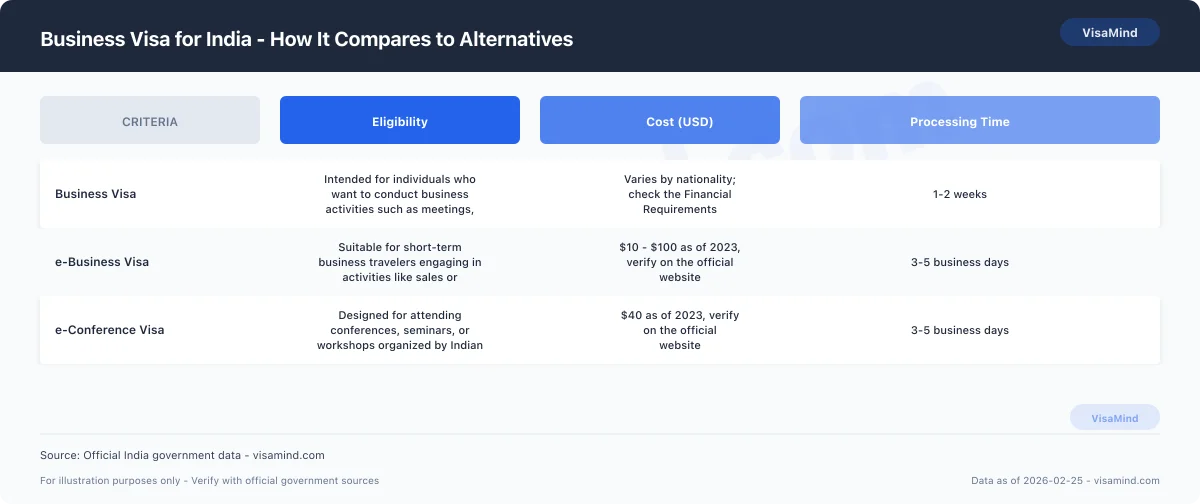
When deciding on which visa to apply for when traveling to India for business purposes, it's important to understand the key differences between available options. Below, we compare the Business Visa, e-Business Visa, and e-Conference Visa to help you determine which might be the best fit for your needs.
| Visa Type | Eligibility | Cost | Processing Time | Validity |
|---|---|---|---|---|
| Business Visa | Requires invitation from Indian business or organization | Varies by nationality | Typically 3-5 weeks | Up to 5 years, multiple entries |
| e-Business Visa | No invitation required; for short-term business activities | $10 - $25 USD as of 2023 (verify on the official website) | 3-4 business days | 1 year, multiple entries |
| e-Conference Visa | For attending conferences organized by Indian government bodies | Similar to e-Business Visa | 3-4 business days | Valid for the duration of the conference |
What Are the Key Differences?
Eligibility and Purpose
The Business Visa generally requires an invitation from an Indian company or organization and can be used for a variety of business activities, such as establishing a business venture, attending meetings, or exploring opportunities. In contrast, the e-Business Visa is designed for short-term business activities and does not require an invitation, making it a convenient option for quick trips. Meanwhile, the e-Conference Visa is specifically for attending conferences organized by Indian government bodies, like seminars or workshops.
Cost and Processing Time
The cost for a Business Visa can vary widely depending on your nationality and other factors. It typically takes longer to process, often requiring 3 to 5 weeks. The e-Business Visa, on the other hand, offers a more streamlined application process with a lower cost ranging from $10 to $25 USD as of 2023. Similarly, the e-Conference Visa shares the cost structure and processing speed with the e-Business Visa, making it an efficient choice if attending a conference.
Validity and Duration
If you need a longer-term option, the Business Visa offers validity for up to five years with multiple entries, making it suitable for those with frequent business in India. Alternatively, the e-Business Visa and e-Conference Visa are geared towards shorter visits, with the e-Business Visa allowing multiple entries over a one-year period, and the e-Conference Visa valid only for the duration of the conference.
For more information on the application process, you can refer to our How To Apply guide and ensure you have all necessary documentation ready by reviewing the Documents Checklist. Additionally, understanding the potential Visa Refusal Reasons can help you prepare a stronger application.
The Application Process
#How to Apply for a Business Visa for India
Applying for a business visa to India involves several key steps. This visa allows individuals to engage in business activities such as meetings, negotiations, or establishing contacts on behalf of a company or employer. Here is a step-by-step guide to help you navigate the application process.
Step-by-Step Process
-
Visit the Bureau of Immigration Website
Start by visiting the official Bureau of Immigration website for India. Here, you can find the "Business Visa for India" form, which is essential for your application.
-
Review Eligibility Requirements
Before you begin the application process, review the eligibility criteria for the business visa. This includes understanding the purpose of your visit, ensuring your business activities align with the visa's intent, and confirming that you have the necessary documentation.
-
Gather Required Documents
Prepare all necessary documents to support your application. Typical documents include:
- A valid passport with at least six months of validity remaining.
- Recent passport-sized photographs.
- A detailed business itinerary.
- An invitation letter from your business contact in India.
- Proof of financial means to support your stay.
Refer to the Documents Checklist for a comprehensive list.
-
Complete the Application Form
Complete the application form accurately, ensuring all required sections are filled out. Pay particular attention to details regarding your business activities and the duration of your stay in India.
-
Pay the Visa Fee
The processing of your application requires a visa fee, which varies depending on your nationality and the duration of your stay. As of 2026, the fee structure could change, so verify the current fees on the official website.
-
Submit Your Application
Submit your application along with all supporting documents either online or at the nearest Indian consulate or embassy. Ensure that all documents are correct and complete to avoid any delays.
-
Attend an Interview (If Required)
Some applicants may be required to attend an interview as part of the process. Prepare for potential questions about your business plans and objectives in India. You can refer to the Interview Prep guide for tips.
Additional Considerations
-
Processing Times: The processing time can vary, so it's advisable to apply well in advance of your intended travel dates. Check the Processing Times guide for more details.
-
Related Visa Options: If your business activities involve short-term engagements or conferences, consider the E Business Visa or E Conference Visa for potentially easier processing.
By following these steps and ensuring all your documents are in order, you can successfully apply for a business visa to India. Remember to always verify the latest information on the official Bureau of Immigration website for any updates or changes to the process.
Documents and Evidence
#What Documents Are Required for a Business Visa?
When applying for a Business Visa for India, the documentation you need to provide can significantly influence the success of your application. Here's a detailed list of documents you may be required to gather:
-
Passport:
- A valid passport with a minimum of six months validity from the date of application.
- At least two blank pages for visa stamps.
-
Photographs:
- Recent passport-sized photographs as per the specifications provided by the Indian authorities.
-
Application Form:
- The completed application form as specified by the Bureau of Immigration.
-
Business Cover Letter:
- A letter from your employer or company detailing your position, the purpose of your visit, and the duration of your stay.
-
Invitation from Indian Company:
- An invitation letter from the Indian company you intend to visit, detailing the purpose and duration of your visit.
-
Financial Statements:
- Bank statements or financial documents that demonstrate your ability to support yourself financially during your stay.
Do You Need Additional Certifications or Translations?
Depending on your situation and the country of your residence, additional certifications or translations might be necessary:
-
Translation of Documents:
- If your documents are in a language other than English, certified translations may be required.
-
Certifications:
- Some documents might need to be notarized or certified by a relevant authority to validate their authenticity.
-
Proof of Business Activities:
- Evidence of previous business activities with the Indian company or other Indian entities may strengthen your application.
What Supporting Evidence Should Be Included?
In addition to the primary documents, supporting evidence can substantiate your application:
-
Proof of Business Registration:
- Copies of your business registration or business license that validate the existence of your business.
-
Tax Returns:
- Recent tax returns that provide insight into the financial health of your business.
-
Travel Itinerary:
- A detailed itinerary of your planned activities in India, including meetings, conferences, or events you will attend.
-
Accommodation Details:
- Proof of accommodation arrangements, such as hotel bookings or letters from hosts.
Gathering comprehensive documentation is critical when applying for a Business Visa, as it demonstrates your intent and preparedness for your business activities in India. For more insights into related visas, you might explore the E Business Visa or the E Conference Visa. For further guidance on applying, check out the Visa Refusal Reasons and Financial Requirements.
Costs and Financial Thresholds
#What Are the Costs Associated with a Business Visa for India?
When applying for a Business Visa for India, understanding the financial requirements is essential. The costs can vary based on your nationality, the duration of your stay, and other factors. Below is a comparative table of typical costs and requirements associated with a Business Visa:
| Visa Type | Application Fee | Financial Proof Required | Processing Timeline |
|---|---|---|---|
| Business Visa | $100 - $250 (varies by country) | Proof of sufficient funds for stay | Typically 5-10 business days |
| e-Business Visa | $80 - $160 (varies by country) | Bank statements for the last 6 months | Usually processed within 72 hours |
| e-Conference Visa | $100 - $150 | Sponsorship letter from the conference organizer | Normally processed within 4 days |
Are There Any Financial Thresholds?
When applying for a Business Visa, you must demonstrate that you have adequate financial resources to cover your stay in India. This typically involves:
- Providing bank statements for the last six months
- Submitting proof of business activities or investments that justify your visit
- If applicable, a letter of sponsorship from an Indian company or organization
Ensure you have all the necessary documents ready to meet these financial thresholds. For more detailed guidance, visit the Financial Requirements page.
Investment Minimums for Business Activities
For those planning to invest in business ventures in India, certain investment minimums might be required depending on the nature of the business. While there is no standardized investment amount for obtaining a Business Visa, demonstrating significant investment intentions can strengthen your application. It's advisable to consult with the Foreigners Regional Registration Office (FRRO) for the most current requirements related to business investments.
How to Ensure a Smooth Application Process?
To facilitate a smooth application process, gather all necessary documentation and ensure that your financial proofs meet the required standards. You might find the Documents Checklist useful in preparing your application. Additionally, understanding the Processing Times can help you plan your travel accordingly.
By preparing thoroughly and ensuring that all financial and documentation criteria are met, you can enhance your chances of obtaining a Business Visa for India successfully.
Timeline and Processing
#What is the Processing Time for a Business Visa to India?
When applying for a Business Visa to India, the processing time can vary based on several factors, including your location and the specifics of your application. Typically, you can expect the processing to take anywhere from 5 to 15 working days after your application is lodged. However, this is a general estimate, and actual times can vary. For those applying through an Indian embassy or consulate, it's advisable to check directly with the respective office for the most current timelines.
Can Processing Be Expedited?
In certain cases, expedited processing may be available for your Business Visa application. This often depends on the specific circumstances of your visit and the policies of the visa office handling your application. If you need your visa processed more quickly, it is recommended to inquire directly with the relevant Indian embassy or consulate about the possibility and requirements for expedited service.
What Factors Affect Processing Speed?
Several factors can impact the speed at which your Business Visa is processed:
-
Completeness of Documentation: Ensuring all required documents are correctly and fully provided can significantly reduce processing delays.
-
Visa Office Workload: The current workload and staffing levels at the visa processing office can influence how quickly applications are handled.
-
Applicant’s Nationality: Processing times can sometimes vary based on the applicant's nationality due to different security or administrative requirements.
-
Type of Business Activity: The nature of your business activities in India might require additional scrutiny, which could extend processing times.
For more detailed information on processing times and to verify the latest updates, you can refer to the Processing Times Guide.
Related Visa Options
If you're exploring other visa options besides the traditional Business Visa, consider the E Business Visa or the E Conference Visa. These alternatives may offer different processing timelines and requirements.
By understanding these factors and preparing your application accordingly, you can help ensure a smoother process for obtaining your Business Visa to India.
Rights and Conditions
#What Are Your Work Rights on a Business Visa for India?
Holding a Business Visa for India allows you to engage in various business-related activities, but it does not grant you the right to full employment in India. You can attend business meetings, establish business contacts, and explore business ventures. However, you cannot take up employment or earn a salary from an Indian entity. If your intention involves working for an Indian company, consider applying for an Employment Visa.
Can You Travel Freely with a Business Visa?
A Business Visa typically allows multiple entries into India, which means you can travel in and out of the country as often as needed for your business activities. The duration of each stay is usually limited to 180 days at a time, but verify this on the official website, as conditions may vary based on your nationality and the specifics of your visa.
Are Family Members Allowed to Accompany You?
Family members may accompany you to India, but they must apply for their own visas. The most appropriate option for family members is usually the Entry Visa, which allows them to stay for the duration of your business activities. Be aware that family members on an Entry Visa are not allowed to work in India.
What Are the Restrictions and Conditions?
Holding a Business Visa comes with specific restrictions to ensure compliance with Indian immigration laws:
- Employment: You cannot engage in paid employment in India.
- Duration of Stay: While multiple entries are allowed, each stay is generally limited to 180 days.
- Activities: Permitted activities include attending meetings, business negotiations, and exploring business opportunities.
- Extension: Visa extensions are possible but not guaranteed. Refer to the Visa Extension Guide for more details.
It's crucial to adhere to these conditions to avoid any legal issues during your stay. For more information on what a Business Visa allows, consider reading about Visa Refusal Reasons to better understand the boundaries and expectations.
Common Mistakes
#Common Errors in Documentation
-
Incomplete Documentation: It's crucial that you gather all necessary documents before lodging your application. Missing documents are a common reason for refusal. You can find a comprehensive Documents Checklist that will guide you through what is needed.
-
Incorrect Visa Type: Ensure you are applying for the correct visa type. For business activities, the appropriate option is the Business Visa. If you're unsure, you can compare it with similar options, like the E Business and E Conference visas.
Eligibility Misunderstandings
-
Mismatched Purpose and Visa: Your intended activities in India must align with the Business Visa's purpose. Engaging in activities that are not permitted can lead to visa denial. Clarify your eligibility by reviewing guidelines in the Visa Refusal Reasons.
-
Inaccurate Eligibility Assessment: Double-check that you meet all eligibility criteria before applying. Misinterpretation of eligibility requirements is a frequent mistake that can be avoided by thorough research.
Application Mistakes
-
Inconsistent Information: Ensure consistency across all documents and the application itself. Discrepancies can lead to suspicion and potential refusal. Cross-reference details with the official sources to maintain accuracy.
-
Ignoring Specific Instructions: Each visa type may have unique instructions. Failing to follow these can result in delays or rejections. Always check the specific instructions for your visa category prior to submission.
Financial Documentation Errors
-
Insufficient Financial Proof: Demonstrating financial stability is essential. Make sure to provide ample evidence of funds that can support your stay and activities in India. Consult the Financial Requirements guide for more information.
-
Outdated Financial Documents: Financial documents must be current and reflective of your financial status at the time of application. Using old statements can be grounds for refusal. Always provide the most recent documents available.
By avoiding these common mistakes, you can enhance your chances of a successful Business Visa application. Be sure to review all guidelines and prepare thoroughly to prevent unnecessary setbacks.
Real Scenarios
#Real Scenarios: Applying for a Business Visa in India
Imagine you're an entrepreneur planning a trip to India to explore potential business partnerships and attend conferences. A Business Visa is your gateway to these opportunities. Once you decide to apply, it's crucial to understand the specific requirements and processes involved. Begin by consulting the Business Visa page for detailed guidance on eligibility and necessary documentation.
Consider this scenario: You're a tech company executive seeking to expand your business operations into the dynamic Indian market. In this case, you would need to prepare a comprehensive plan that outlines your business objectives, partnerships, and the nature of your meetings in India. Consulting the Documents Checklist can help ensure that you have all the required paperwork ready, such as the invitation letter from your Indian business counterparts and proof of financial stability.
If you're attending a conference in India, you might also explore the e-Conference Visa option, which could be more suitable depending on the nature of your visit. It's essential to weigh the different visa types and select the one that best aligns with your purpose of travel.
Preparing for Your Business Trip
Before embarking on your journey, it’s beneficial to familiarize yourself with the Visa Extension Guide in case you need to extend your stay for unforeseen business developments. Additionally, understanding the nuances between different visas, such as the differences highlighted in Employment Vs Project Visa, can provide further clarity if your business intentions evolve.
These insights demonstrate the practical steps and considerations for securing a Business Visa for India. Whether you’re attending meetings, conferences, or exploring market opportunities, meticulous preparation and understanding of the visa process will set the foundation for a successful business endeavor in India.
FAQs
Can I switch from a tourist visa to a business visa while in India?
What documents do I need for a business visa to India?
What happens if I overstay my business visa in India?
Can I work on a business visa in India?
Can I bring my family on a business visa to India?
How can I avoid common mistakes when applying for a business visa to India?
Is a business visa a path to permanent residency in India?
Sources
Last reviewed: February 25, 2026
VisaMind provides informational guidance only and is not a government agency. This is not legal advice. Requirements can change and eligibility depends on your specific facts. If your case is complex or high-stakes, consult a licensed immigration attorney.
Next steps
Requirements vary by nationality, purpose, timeline, and case details. VisaMind turns uncertainty into a sequenced checklist with official source citations.
Find my visa