On this page
Getting Accepted First
#Begin Your Journey: Acceptance into an Indonesian University
Embarking on the path to study in Indonesia begins not with a visa application but with securing a place in one of its esteemed universities. Here's how you can start this exciting journey:
-
Choose Your Program and University
Indonesia offers a vibrant array of academic programs across numerous fields. Whether you're interested in engineering, arts, or environmental sciences, you'll find a program that suits your aspirations. Begin by researching universities and the programs they offer. Consider factors such as accreditation, faculty expertise, and campus facilities to ensure the best fit for your educational goals.
-
Meet Academic and Language Requirements
Each university has its own set of entry requirements, which typically include academic qualifications and language proficiency. For most programs, you will need to demonstrate proficiency in Bahasa Indonesia or English, depending on the language of instruction. Be sure to check the specific criteria of your chosen program and prepare to submit any required test scores or certifications.
-
Submit Your Application
Once you've identified your preferred program and ensured you meet the entry requirements, it's time to submit your application. This process may involve providing academic transcripts, a statement of purpose, letters of recommendation, and proof of language proficiency. Pay attention to application deadlines to avoid missing out on your chosen intake.
-
Receive Your Offer and Confirmation of Enrollment (COE)
If your application is successful, the university will issue an offer, which you must formally accept. Upon acceptance, you will receive a Confirmation of Enrollment (COE), a crucial document that you will need for your visa application. The COE serves as proof of your admission and intent to study in Indonesia.
Understanding CAS/COE/CRICOS Requirements
While Indonesia does not use the Common Acceptance Scheme (CAS) or CRICOS system found in other countries, the COE plays a similar role. It confirms your enrollment and is a necessary step before you can apply for a Limited Stay Permit - Student (KITAS).
Next Steps: Preparing for Your Visa Application
With your COE in hand, you are now ready to explore visa options and begin the application process. For a comprehensive guide on what documents you'll need, refer to the Documents Checklist to ensure you have everything in order.
Remember, this initial step of getting accepted into a university is crucial in your journey to study in Indonesia. It sets the foundation for your visa application and eventual immersion into the rich academic and cultural life that awaits you.
Student Visa Requirements
#What Are the Financial Requirements for a Student Visa in Indonesia?
When planning to study in Indonesia, one of the critical requirements is demonstrating financial capability. You must show that you have sufficient funds to cover your tuition fees, living expenses, and any other costs related to your studies. As of 2023, the Indonesian Directorate General of Immigration (DGIM) requires proof of financial support, such as bank statements or a financial guarantee from a sponsor. While specific amounts may vary depending on your institution and location, it's advisable to verify the latest requirements on the official DGIM website.
Do You Need Health Insurance to Study in Indonesia?
Yes, having health insurance is a mandatory requirement for international students in Indonesia. Health insurance ensures that you have access to medical services during your stay. It is recommended to purchase a policy that covers both emergency and routine healthcare needs. Some universities may offer health insurance plans specifically for international students, but you can also opt for private insurance from recognized providers. Ensure that your health insurance plan meets the coverage standards set by your educational institution and the Indonesian government.
Is There a Language Requirement for Studying in Indonesia?
The language of instruction in Indonesian universities can be either Bahasa Indonesia or English, depending on the program. Therefore, demonstrating proficiency in the relevant language is often a requirement.
- Bahasa Indonesia: If your program is taught in Bahasa Indonesia, you may be required to pass a language proficiency test, such as the Test of Indonesian as a Foreign Language (TOIFL).
- English: For programs conducted in English, non-native speakers will need to submit evidence of their English proficiency. Tests like TOEFL or IELTS are commonly accepted. Each institution will have its specific score requirements, so check directly with your chosen university.
Summary of Requirements
Below is a quick overview of these student visa requirements:
| Requirement | Details |
|---|---|
| Financial | Proof of sufficient funds (amount varies by institution) |
| Health Insurance | Mandatory for all international students |
| Language | Proficiency in Bahasa Indonesia or English, depending on the program |
Before applying, review the Documents Checklist to ensure you have all necessary documentation. For more detailed guidance, you might also find the Kitas Student visa information helpful.
The Application Process
#How to Apply for a Study Visa in Indonesia
Embarking on a journey to study in Indonesia involves several key steps. The Directorate General of Immigration (DGIM) oversees the application process for study visas. Below, you'll find a step-by-step guide to help you navigate the application process efficiently.
Step-by-Step Application Process
-
Determine Your Eligibility Category
Before you begin, identify the specific eligibility category that applies to you. This will influence the requirements and documentation you need to prepare. Review the instructions relevant to your category, which can be found on the official DGIM website.
-
Prepare Required Documents
Gather all necessary documents to support your application. These typically include:
- A valid passport with at least six months validity
- Proof of acceptance from an Indonesian educational institution
- Financial evidence to support your stay
- Health insurance coverage
For a comprehensive list of documents, refer to the Documents Checklist.
-
Complete the Indonesia-Study Application
Once your documents are in order, proceed to complete the indonesia-study application. Ensure all sections are filled out accurately and truthfully. It's crucial to double-check your entries to avoid delays or rejections.
-
Submit Your Application to DGIM
Submit your completed application along with the gathered documents to the Directorate General of Immigration. Depending on your location, this might be done through an Indonesian embassy or consulate, or directly with the DGIM in Indonesia.
-
Await Processing and Decision
After submission, the processing time can vary. It's important to stay informed about the typical processing times, which can be found on the Processing Times guide. During this period, you might be contacted for additional information or an interview.
-
Receive Your Visa and Prepare for Departure
Once your visa is approved, you'll be notified to collect it. With your study visa in hand, you can start planning your move to Indonesia. For more information about living and studying there, consider exploring the Kitas Student visa, which is specifically designed for students.
Additional Resources
For those considering different types of visas, such as the Visa On Arrival or E Visa Tourist, it's useful to understand the differences and specific requirements of each. If you encounter any issues, the Visa Refusal Reasons guide may offer insights into common pitfalls and how to address them.
By following these steps and utilizing the available resources, you can effectively manage your application process for studying in Indonesia.
Cost of Studying
#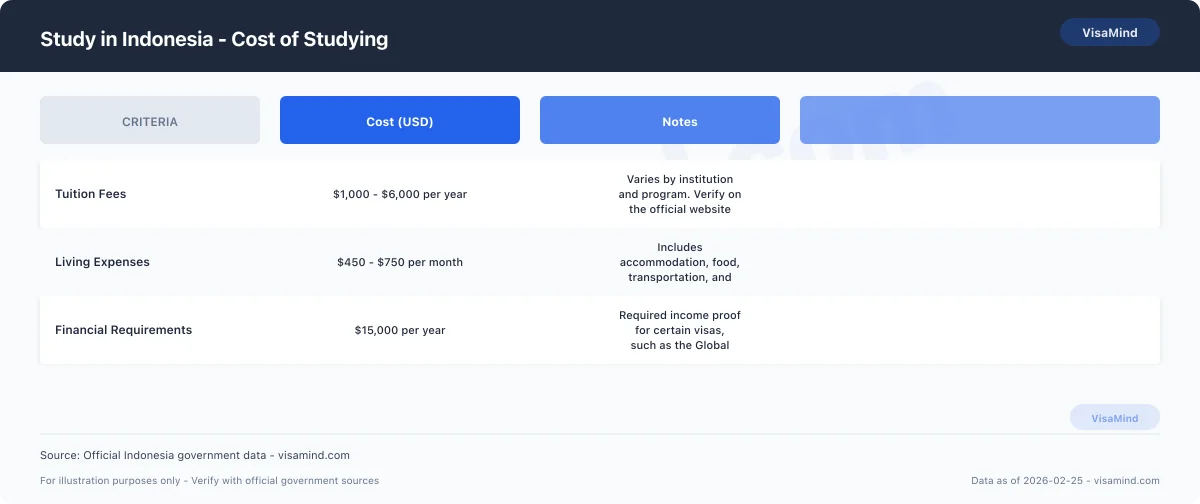
Tuition Fees
Studying in Indonesia offers a variety of educational opportunities with a range of tuition fees depending on the institution and program of study. Public universities generally have lower fees compared to private institutions. On average, you can expect to pay between $1,500 to $6,000 per year for undergraduate programs. However, more specialized courses or those at private universities can cost significantly more. It's advisable to verify the specific tuition fees for your chosen program on the university's website.
Living Costs
The cost of living in Indonesia is relatively affordable compared to many Western countries. Here's a general idea of what you might expect:
- Accommodation: Depending on location and type, monthly rent can range from $200 to $500.
- Food: Basic meals and groceries might cost around $150 to $300 per month.
- Transportation: Public transport is both convenient and affordable, with monthly costs around $20 to $40.
- Miscellaneous: Utilities, entertainment, and other personal expenses could add another $100 to $200 monthly.
Financial Requirements
To ensure you can support yourself while studying in Indonesia, you need to meet certain financial requirements. This usually involves demonstrating that you have sufficient funds to cover both tuition and living expenses for the duration of your study period. While exact figures can vary, as a guideline, having access to at least $7,000 to $10,000 per year is advisable. Check Financial Requirements for more details.
Cost Comparison Table
Below is a table summarizing the key costs you might incur while studying in Indonesia:
| Category | Estimated Cost (USD) | Notes |
|---|---|---|
| Tuition Fees | $1,500 - $6,000/year | Public universities are generally more affordable |
| Accommodation | $200 - $500/month | Cost varies by location and type of housing |
| Food | $150 - $300/month | Includes basic meals and groceries |
| Transportation | $20 - $40/month | Public transport costs |
| Miscellaneous | $100 - $200/month | Utilities, entertainment, personal expenses |
| Financial Proof | $7,000 - $10,000/year | Recommended funds to demonstrate financial capability |
These costs provide a baseline for planning your study experience in Indonesia. For more information on preparing for your stay, you can explore the How To Apply and Documents Checklist guides.
Working While Studying
#How Many Hours Can You Work While Studying?
If you're studying in Indonesia on a Limited Stay Permit - Student (KITAS), you may be wondering about the possibility of working alongside your studies. As of 2023, students holding a KITAS are permitted to work part-time, but there are restrictions on the number of hours you can work. The standard allowance is up to 20 hours per week, providing a balance between work and academic commitments. It is important to verify the current regulations on the official Directorate General of Immigration website as policies can change.
What Are the Restrictions on Student Work?
While working part-time is permitted, certain conditions apply to ensure that your primary focus remains on your studies. Here are some key restrictions you should be aware of:
- Type of Work: Employment must not interfere with your academic schedule. Typically, jobs on campus or flexible positions are preferred.
- Permission Requirement: You may need to obtain additional permissions or endorsements from your educational institution or the Indonesian immigration authorities before commencing work.
- Industry Limitation: Some sectors may be restricted for international students. It's advisable to seek opportunities within university environments or approved areas.
Where Can You Find More Information?
For detailed guidance on applying for a Limited Stay Permit - Student (KITAS) and understanding the work conditions, consider visiting the Kitas Work Vs Kitas Investor guide for a broader perspective on work permits. Additionally, the Visa Refusal Reasons guide can provide insights into common pitfalls to avoid during your application process.
By understanding these guidelines, you can effectively manage your studies and part-time work, making the most of your educational experience in Indonesia. Always remember to consult the official Directorate General of Immigration website for the most up-to-date information.
Student Life and Practical Matters
#Health Insurance
When studying in Indonesia, having adequate health insurance is essential for your well-being. Here are some key considerations:
- Mandatory Health Insurance: Students are typically required to have health insurance that covers them during their stay in Indonesia. Verify the specific requirements with your educational institution.
- Local vs. International Plans: You may choose between local Indonesian health insurance providers or international plans that offer coverage in Indonesia.
- Coverage Options: Ensure your plan covers general medical needs, emergency services, and any specific health concerns you might have. It's advisable to confirm the coverage details and limitations directly with the insurance provider.
Housing Options
Finding suitable accommodation is an important part of your student life in Indonesia. Consider the following options:
- University Housing: Many universities offer on-campus dormitories or housing. This option can provide a convenient and integrated student experience.
- Private Rentals: If you prefer more independence, look into renting an apartment or house off-campus. Websites and local real estate agents can assist in finding suitable properties.
- Homestay Programs: For a more immersive cultural experience, you might consider living with a local family through a homestay arrangement.
Banking for Students
Managing your finances effectively while studying in Indonesia is crucial. Here are some steps to help you set up your banking:
- Opening a Bank Account: Most students opt to open a local bank account to manage their finances more easily. Prepare to provide your student visa and proof of enrollment.
- Choosing a Bank: Research different banks to find one that offers student-friendly accounts with minimal fees, convenient access, and online banking options.
- Currency Exchange: If you're bringing funds from abroad, consider the exchange rates and fees for converting your money to Indonesian Rupiah (IDR).
Additional Considerations
- Transportation: Familiarize yourself with local transportation options, such as buses, trains, and ride-sharing services, to navigate the city efficiently.
- Cultural Adaptation: Engaging with local culture and customs can enhance your experience. Participating in student groups or language exchange programs can be beneficial.
For more detailed guidance on student visas, refer to the Kitas Student visa information and explore related topics on the How To Apply page. Always verify specific details on the official website to ensure accuracy.
After Graduation
#Post-Graduation Opportunities in Indonesia
Upon completing your studies in Indonesia, you might be considering staying longer to gain work experience or further your education. Here are some options and pathways you can explore for staying in Indonesia after graduation.
Post-Study Work Options
For international graduates, Indonesia provides several pathways to remain in the country and gain valuable work experience. While the specific options can vary based on your field of study and career aspirations, here are some general pathways:
-
Work Permit (KITAS Work): Graduates who secure employment with an Indonesian company can apply for a KITAS Work permit. This allows you to legally work in Indonesia and is often arranged by your employer. More details can be found in the Kitas Work section.
-
Digital Nomad Visa: If your work allows for remote flexibility, you might consider applying for a Digital Nomad visa. This is suitable for those who work online for companies outside Indonesia.
-
Business Visa: For graduates interested in entrepreneurship or starting a business in Indonesia, the E Visa Business might be a suitable option. This visa allows for business-related activities and is ideal for budding entrepreneurs.
Transitioning from Student to Work Visas
Transitioning from a student visa to a work visa involves several steps. Here’s a simplified process to help you understand what to expect:
-
Secure a Job Offer: Before you can apply for a work visa, you need a job offer from a legally registered company in Indonesia.
-
Lodge an Application: Apply for the appropriate work visa through the Directorate General of Immigration. Ensure you have gathered all necessary documents, as outlined in the Documents Checklist.
-
Await Approval: Processing times can vary, so refer to the Processing Times guide for the most current information.
Further Study Opportunities
If you wish to continue your education, you can extend your stay by enrolling in further studies. Here's what you need to know:
-
Limited Stay Permit - Student (KITAS Student): If you plan to pursue a higher degree, apply for a KITAS Student. This allows you to remain in Indonesia for the duration of your studies.
-
Research Opportunities: Indonesia offers various research programs. This can be an excellent pathway for those interested in academic or field research.
Financial Considerations
It's important to be aware of the financial requirements when transitioning from a student to a work visa. Ensure you review the Financial Requirements to avoid any surprises.
In summary, Indonesia offers a range of options for graduates looking to extend their stay, whether for work or further study. Be proactive in exploring these opportunities and ensure you follow the necessary procedures to comply with immigration regulations.
Pathway to Permanent Residence
#Pathway to Permanent Residence in Indonesia
Studying in Indonesia can be a strategic step towards obtaining permanent residency. While the primary purpose of a student visa is educational, it can open doors to longer stays and eventual permanent residency.
Transition from Student to Permanent Resident
-
Limited Stay Permit - Student (KITAS Student):
- Eligibility: Students enrolled in an Indonesian educational institution.
- Duration: Typically valid for one year, with the possibility of extension.
- Benefits: Allows you to legally reside in Indonesia while studying.
-
Pathway to Permanent Residence (KITAP):
- After several years on a KITAS, you may be eligible to apply for a Permanent Stay Permit (KITAP).
- Eligibility Criteria:
- Continuous legal residence in Indonesia.
- Meeting specific requirements set by the Directorate General of Immigration.
Steps to Transition
To move from a student visa to permanent residency, follow these general steps:
-
Maintain Your Student Status:
- Ensure you remain enrolled in your educational program and comply with all student visa conditions.
-
Consider Employment or Investment:
- After completing your studies, consider applying for relevant visas such as Kitas Work or Kitas Investor to extend your stay legally.
-
Meet Residency Requirements:
- Accumulate the required years of residency in Indonesia to apply for permanent residency. This typically involves holding a KITAS for an extended period.
-
Apply for KITAP:
- Once eligible, you can lodge an application for a KITAP, allowing you to live indefinitely in Indonesia.
- Consult the How To Apply guide for detailed steps.
Key Considerations
- Language Proficiency: Demonstrating proficiency in Bahasa Indonesia may be beneficial when applying for permanent residency.
- Cultural Integration: Engaging with local communities can enhance your residency application.
By strategically planning your educational and career path in Indonesia, you can leverage your student status towards securing long-term residency. Always verify specific requirements and procedures on the official Directorate General of Immigration website to ensure compliance with the latest regulations.
Common Mistakes
#Common Mistakes When Applying to Study in Indonesia
When applying to study in Indonesia, prospective students often encounter several pitfalls that can delay or even jeopardize their applications. Understanding these common mistakes can help you avoid them and improve your chances of a successful application.
Financial Requirements
- Insufficient Proof of Funds: One of the key requirements for a student visa is demonstrating adequate financial resources. Failing to provide sufficient evidence of financial capability can lead to application rejection. Ensure that you can show bank statements or financial guarantees that meet the Financial Requirements set by the Directorate General of Immigration.
Intent and Eligibility
-
Lack of Genuine Student Intent: Immigration authorities need to be convinced of your genuine intent to study. If your application lacks clarity or supporting documentation that illustrates your academic goals in Indonesia, it may be denied. Emphasize your academic plans and future aspirations clearly in your application.
-
Incorrect Visa Type: Applying for the wrong type of visa can lead to complications and delays. For students, the Limited Stay Permit - Student (KITAS) is typically required. Make sure to choose the correct visa category that aligns with your study purpose.
Documentation Issues
-
Incomplete Documentation: Submitting an application with missing documents is a common oversight. Before lodging your application, meticulously review the list of necessary documents. You can refer to the Documents Checklist for guidance.
-
Expired or Invalid Documents: Ensure all documents, such as passports and financial statements, are current and valid. Using expired documents can result in automatic rejection of your application.
By paying attention to these areas, you can significantly enhance your chances of a successful student visa application to Indonesia. For more detailed guidance, consider exploring resources like the Visa Refusal Reasons to understand more about potential pitfalls.
Real Scenarios
#Navigating Real-World Study Scenarios in Indonesia
Embarking on your educational journey in Indonesia involves several key steps and considerations. One of the first and most important actions is to ensure you apply correctly for the appropriate visa. For students planning to stay for an extended period, the Limited Stay Permit - Student (KITAS) is essential. You can find more about this visa on the Kitas Student page. This permit allows you to reside in Indonesia for the duration of your studies, which can be crucial for maintaining your residency status legally throughout your academic program.
What If Your Studies Extend?
If your academic program extends beyond the initial period covered by your KITAS, you will need to consider a Visa Extension. The process involves submitting a renewal application before your current permit expires. For more detailed information on timelines and requirements, refer to the Visa Extension Guide.
Balancing Study with Tourism
While focusing on your studies, you might also want to explore Indonesia’s diverse culture and landscapes. In such cases, a Visa On Arrival might be a convenient option for short-term stays, allowing you to transition easily between academic commitments and leisure activities. Learn more about this option on the Visa On Arrival page.
Handling Unforeseen Circumstances
Life can be unpredictable, and your plans might change. If you encounter issues such as needing to pause your studies or return home unexpectedly, understanding the Processing Times for various visa applications can help you navigate these changes efficiently. Always consult the Directorate General of Immigration's resources for the most current information and guidance.
FAQs
What documents are required for an Indonesia student visa?
Can I work while studying in Indonesia?
Can I switch from a tourist visa to a student visa in Indonesia?
What happens if I overstay my student visa in Indonesia?
Can my family accompany me while I study in Indonesia?
What are common mistakes when applying for a student visa in Indonesia?
Is there a pathway to permanent residence after studying in Indonesia?
Sources
Last reviewed: February 25, 2026
VisaMind provides informational guidance only and is not a government agency. This is not legal advice. Requirements can change and eligibility depends on your specific facts. If your case is complex or high-stakes, consult a licensed immigration attorney.
Next steps
Requirements vary by nationality, purpose, timeline, and case details. VisaMind turns uncertainty into a sequenced checklist with official source citations.
Find my visa