On this page
- Paths to Working Legally
- Does Your Employer Need to Do Anything?
- Skills and Qualifications
- The Application Process
- Your Rights as a Worker
- Salary and Cost Considerations
- Transitioning to Permanent Residence
- What Goes Wrong
- Real Scenarios
- Visa options for this goal
- Guides for Indonesia
- Other goals for Indonesia
Paths to Working Legally
#
Exploring Your Legal Work Options in Indonesia
Did you know that Indonesia offers a wide array of work visa categories tailored to various professional needs? Whether you are an investor, a remote worker, or a skilled employee, there are specific visas designed for your circumstances. Below, we explore these options to help you understand which might be the best fit for your situation.
Work Visa Categories
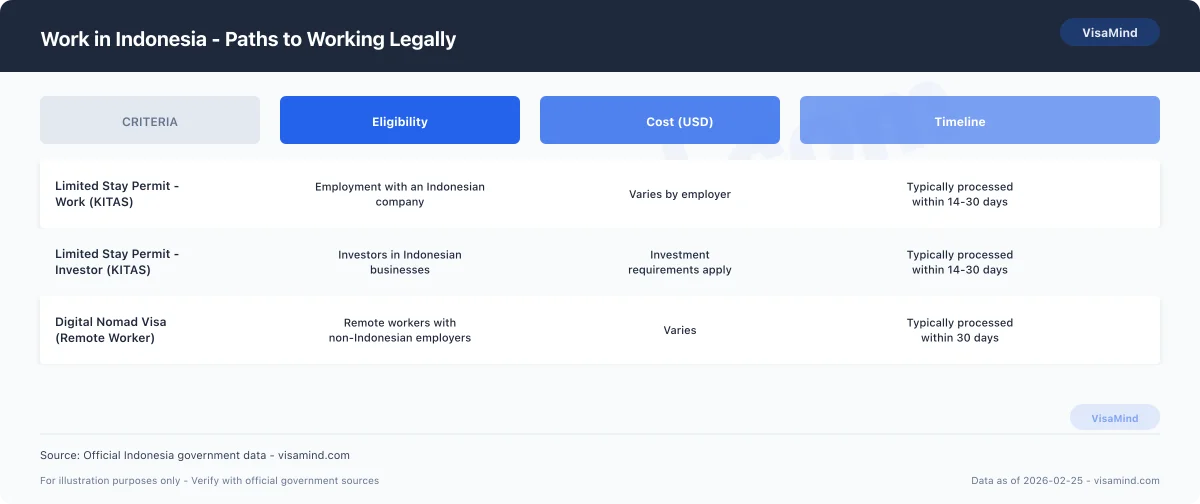
Here's a quick overview of the primary work-related visas available in Indonesia:
| Visa Type | Eligibility | Cost | Timeline |
|---|---|---|---|
| Limited Stay Permit - Work (KITAS) | Skilled professionals with a job offer from an Indonesian company | Varies by sponsor and agency fees | 1-3 months |
| Limited Stay Permit - Investor (KITAS) | Investors with a minimum capital investment in an Indonesian company | Varies depending on investment | 1-3 months |
| Digital Nomad Visa (Remote Worker) | Remote workers employed outside Indonesia with a stable income | Specific fees not detailed; verify on the official website | Approximately 2 months |
What Are the Requirements?
Regardless of the visa type, there are common requirements you'll need to meet:
- Valid Passport: Ensure your passport is valid for at least 18 months from your date of entry.
- Proof of Employment or Investment: Depending on the visa, you may need a job offer or proof of investment.
- Financial Stability: For certain visas like the Digital Nomad Visa, showing a stable income is essential.
- Health Insurance: It’s advisable to have health coverage valid in Indonesia.
How to Choose the Right Visa?
Selecting the right visa depends on your intended activities and professional status in Indonesia:
- If you have a job offer from an Indonesian company, the KITAS Work might be appropriate.
- For investors, the KITAS Investor offers a legal pathway to reside and conduct business.
- Remote workers can explore the Digital Nomad Visa, designed for those working online for companies outside Indonesia.
Final Thoughts
Indonesia's diverse work visa options cater to a variety of professional needs and situations. Whether you're planning to work on an exciting project, invest in local business opportunities, or take advantage of remote working freedoms, understanding these visa categories is your first step towards working legally in Indonesia.
For further guidance on specific processes and requirements, consider visiting our How To Apply and Documents Checklist guides. These resources can provide valuable insights to help you navigate your application journey.
Does Your Employer Need to Do Anything?
#Employer Responsibilities for Sponsoring a Work Visa
When planning to work in Indonesia, your employer plays a significant role in facilitating your work visa application. Understanding what is required from them can help you and your employer prepare effectively for the process.
What Must Your Employer Provide?
To sponsor your work visa, your employer must fulfill several requirements. These responsibilities are essential in ensuring that all necessary criteria are met for your application to be successful. Here is a list of what your employer needs to do:
-
Secure a Work Permit (IMTA): Your employer must obtain a work permit, known as IMTA, from the Ministry of Manpower. This document authorizes you to work legally in Indonesia.
-
Sponsor Declaration: A sponsor declaration from your employer is required as part of your application. This document confirms that your employer is taking responsibility for your employment in Indonesia.
-
Proof of Business Legitimacy: Your employer should provide evidence of their business legitimacy, such as a business license and registration documents. This demonstrates that they are a legally operating entity in Indonesia.
-
Job Description and Employment Contract: A detailed job description and a signed employment contract are necessary to outline your role and responsibilities.
For more detailed guidance on the specific documents needed, consider reviewing the Documents Checklist.
Are There Financial Obligations?
Employers in Indonesia may also have financial obligations when sponsoring a foreign worker. This includes covering certain fees associated with the work permit and visa application process. Additionally, employers might need to demonstrate their financial capacity to support the foreign employee.
Can You Change Employers?
If you decide to change employers while holding a work visa in Indonesia, it's important to understand the implications. A change of employer usually requires obtaining a new sponsorship and work permit. This means your new employer will need to repeat the sponsorship process, including securing a new work permit and providing all necessary documentation.
For further information on the differences between work permits, you may find our comparison guide, Kitas Work Vs Kitas Investor, helpful.
Conclusion
Your employer's role in your work visa application is crucial. From securing a work permit to providing necessary documentation, their active participation is key to a smooth application process. Make sure to discuss these requirements with your employer and ensure they are prepared to meet all necessary obligations. For any detailed inquiries, refer to the official Directorate General of Immigration website to verify current requirements and processes.
Skills and Qualifications
#Skills Assessments for Working in Indonesia
When planning to work in Indonesia, it's important to verify that your skills and qualifications align with the country's requirements. Skills assessments are often necessary to demonstrate that your expertise meets Indonesian standards.
-
Professional Certifications: Certain professions may require specific certifications. Verify whether your credentials are recognized.
-
Language Proficiency: For many positions, proficiency in Bahasa Indonesia is advantageous. Consider taking a language assessment if required by your employer.
For further guidance on how to align your skills with local expectations, review the Kitas Work Vs Kitas Investor guide.
Qualification Recognition in Indonesia
Recognizing your educational qualifications is a critical step when pursuing employment in Indonesia. Here's what you need to know about the process:
-
Degree Equivalence: Ensure your degree is equivalent to Indonesian standards. Some degrees might need to be validated or recognized by Indonesian authorities.
-
Verification Process: Engage with the relevant Indonesian authorities or professional bodies to have your qualifications assessed. This may involve submitting transcripts or diplomas for review.
-
Professional Bodies: For certain sectors, registration with an Indonesian professional body may be required to practice legally.
If you're planning a long-term stay, consider exploring the Golden Visa for additional opportunities.
Degree Requirements for Employment
Understanding degree requirements is essential for securing a position in Indonesia. Here are the key points:
-
Minimum Degree Level: Some roles may require a bachelor's degree or higher, depending on the industry and position.
-
Relevant Field of Study: Ensure your degree aligns with the job's field. Employers may prioritize candidates with specialized education relevant to the role.
-
Advanced Degrees: For higher-level positions, a master's or doctoral degree could be necessary. Verify requirements with potential employers.
For those considering a Digital Nomad arrangement, specific educational requirements might differ. Check the Digital Nomad Guide for more details.
Importance of Skills and Qualifications
Possessing the right skills and qualifications is crucial for your success in the Indonesian job market. Your ability to meet these requirements will significantly impact your employment prospects and your ability to secure a work permit, such as the Kitas Work.
By ensuring your skills and qualifications are recognized and validated, you can confidently pursue work opportunities in Indonesia. Always verify the latest requirements on the official Directorate General of Immigration website for the most accurate and up-to-date information.
The Application Process
#Understanding the Application Process
Navigating the process of obtaining a work permit in Indonesia involves several important steps. Below is a detailed, step-by-step guide on how to approach this application process with the Directorate General of Immigration (DGIM).
Steps to Apply for a Work Permit in Indonesia
-
Determine Your Eligibility
Before initiating your application, you must confirm your eligibility for a work permit in Indonesia. Different work permits, such as the Limited Stay Permit - Work (KITAS) or the Digital Nomad Visa (Remote Worker), have varying requirements. Ensure you meet the specific criteria for the permit you are applying for.
-
Gather Required Documents
Compile all necessary documents to support your application. This may include:
- A valid passport
- Proof of employment or business engagement
- Financial evidence such as proof of income, with a minimum of USD 1,500 per month or USD 15,000 per year for the Global Citizen of Indonesia (GCI) policy
- Any additional documents specific to your visa type
For a comprehensive list, refer to the Documents Checklist.
-
Review Instructions for Your Visa Category
It is crucial to thoroughly review the instructions specific to your visa category. These instructions provide detailed guidance on how to correctly complete the application. Instructions can typically be accessed through the official DGIM website.
-
Submit Your Application
Once your documents are in order, you can proceed to lodge your application. This process often involves submitting your application through an online portal or in person at an Indonesian embassy or consulate. Ensure all sections are filled accurately and all required evidence is included.
-
Pay the Applicable Fees
Be prepared to pay any associated fees. These fees can vary depending on the type of permit and your country of origin. As of 2023, ensure that you verify the exact fee structure on the official website.
-
Wait for Processing
After submission, your application will undergo processing by the DGIM. Processing times can vary, so it is advisable to check the Processing Times for estimated durations.
Financial Requirements
Understanding the financial requirements is essential for applicants, especially those applying under the GCI policy. Ensure you have documented evidence of income that meets the stated thresholds. This is a critical component of your application and can affect its outcome.
Can You Change Employers?
If you are already working in Indonesia and wish to change employers, you should verify the specific conditions under your current permit. Some permits allow changes, while others may require a new application. Checking the guidelines for your specific visa type on the DGIM website or consulting directly with them can provide clarity.
By following these steps and ensuring all requirements are met, you can effectively manage the application process for working in Indonesia. Always consult the official DGIM website for the most current information and updates related to your specific visa category.
Your Rights as a Worker
#Can You Change Employers?
In Indonesia, the ability to change employers while working on a visa such as the Limited Stay Permit - Work (KITAS) depends on the terms set by the Directorate General of Immigration. Typically, changing employers requires the approval of the immigration authorities, and you may need to lodge a new application or update your current permit. Ensure you review the specific requirements and consult with the Directorate General of Immigration if you intend to switch employers.
Can Family Join You?
If you are working in Indonesia, your family may be eligible to join you under specific conditions. The Kitas Spouse visa allows spouses to live in Indonesia, and children may also qualify for dependent visas. However, each family member's application will require documentation and evidence of relationship, such as marriage or birth certificates. It is important to consider the financial requirements as well, which may vary based on your visa type. To explore the visa types available for your family, visit our Kitas Spouse page for more detailed information.
Can You Study While Working?
While working in Indonesia, you may have the opportunity to pursue further education. However, this is subject to approval by the relevant authorities and may require you to obtain a separate permit such as the Kitas Student. If you are interested in studying while working, you should consult the Study guide to understand the necessary steps and requirements. Balancing work and study will involve careful planning, and it is essential to ensure your primary visa permits educational activities.
Summary of Your Rights
Here is a brief summary of your rights as a worker in Indonesia:
- Changing Employers: Generally requires immigration approval.
- Family Joining: Possible with appropriate visas (e.g., Kitas Spouse).
- Studying: May require additional permits.
For further details, you may want to check the How To Apply guide for a comprehensive overview of the application processes related to your specific situation.
Salary and Cost Considerations
#Salary and Cost Considerations
When considering working in Indonesia, it's important to understand the different salary and cost requirements associated with various visa types. The Directorate General of Immigration outlines specific income thresholds and application fees that you need to be aware of. Here’s a detailed comparison to help you navigate these requirements:
| Visa Type | Minimum Income Requirement | Application Fee | Estimated Processing Timeline |
|---|---|---|---|
| Global Citizen of Indonesia (GCI) | USD 1,500 per month or USD 15,000 per year | Varies, check official site | Indefinite stay, review on official site |
| Limited Stay Permit - Work (KITAS) | Employer-sponsored | Varies by nationality | 1-3 months depending on workload |
| Limited Stay Permit - Investor (KITAS) | Investment criteria apply | Varies by nationality | 1-3 months depending on workload |
| Digital Nomad Visa (Remote Worker) | Proof of remote work income | Varies, check official site | Typically 4-8 weeks |
What Are the Income Requirements?
For the Global Citizen of Indonesia (GCI) policy, you need to demonstrate a minimum income of USD 1,500 per month or USD 15,000 per year. This is crucial for proving your financial stability while residing in Indonesia. Other visa types, such as the Limited Stay Permit - Work (KITAS), generally require employer sponsorship, which involves meeting specific salary thresholds set by your employer.
Are There Application Fees?
Application fees vary based on the visa type and the applicant's nationality. The GCI, for instance, has variable fees that can be confirmed by checking the latest details on the official Directorate General of Immigration website. For the Limited Stay Permits, fees differ, so you may want to explore further details on the Kitas Work Vs Kitas Investor guide for a better understanding.
How Long Does Processing Take?
Processing times can vary, but generally, Limited Stay Permit - Work (KITAS) and Investor (KITAS) visas take about 1-3 months to process. Factors affecting the timeline include the workload of the immigration office and the completeness of your submitted documents. Always verify the latest processing times on the Processing Times guide to ensure you have the most current information.
Understanding these financial and procedural requirements will set you on the right path to successfully working in Indonesia.
Transitioning to Permanent Residence
#Transitioning from Work Visa to Permanent Residence in Indonesia
For those working in Indonesia, transitioning from a work visa to a more permanent status like the Permanent Stay Permit (KITAP) is a viable pathway. This transition allows you to enjoy more stability and long-term residence privileges in Indonesia. Here's how your work visa can lead you toward permanent residence status.
Understanding the Pathway
The path to permanent residence in Indonesia typically begins with obtaining a Limited Stay Permit (KITAS), such as a Kitas Work or Kitas Investor. Once you have held a KITAS for a specified duration, you may become eligible to apply for a KITAP.
- Initial Stage: Obtain a KITAS, which is generally valid for up to two years but can be extended.
- Transition Eligibility: After holding a KITAS for three consecutive years, you may become eligible to transition to a KITAP.
The Application Process for KITAP
To move from a KITAS to a KITAP, you'll need to follow a structured application process:
- Eligibility Check: Ensure you have fulfilled the three-year KITAS requirement.
- Document Preparation: Gather necessary documents, such as proof of continuous stay, financial stability, and employment records.
- Lodging the Application: Submit your KITAP application to the Directorate General of Immigration.
Timeline and Requirements
The timeline for transitioning from a work visa to permanent residence in Indonesia varies based on individual circumstances and the completeness of your application.
- Duration Requirement: A minimum of three years on a KITAS.
- Financial Requirement: For Global Citizen of Indonesia (GCI) policy applicants, proof of a minimum income of USD 1,500 per month or USD 15,000 per year is required.
- Review Period: Once submitted, the processing time for a KITAP can vary. It's advisable to check Processing Times for the most current information.
Benefits of Permanent Residence
Securing a KITAP offers several advantages:
- Indefinite Stay: Allows you to reside in Indonesia without the frequent need to renew your visa.
- Employment Flexibility: Greater freedom in employment opportunities within the country.
- Stability: Provides a more stable status, beneficial for long-term planning and integration into Indonesian society.
For those considering a longer-term stay in Indonesia, transitioning from a work visa to permanent residence is a strategic step. By following the outlined pathway and meeting necessary requirements, you can enjoy the benefits of living in Indonesia on a permanent basis.
What Goes Wrong
#Common Grounds for Refusal
When applying to work in Indonesia, understanding potential pitfalls can help you avoid common reasons for refusal. Here are some key areas to consider:
-
Incomplete Documentation: Ensure all necessary documents are submitted. Missing or incorrect paperwork is a frequent cause of application rejection. Refer to the Documents Checklist for detailed requirements.
-
Financial Requirements: Applicants must demonstrate a minimum income of USD 1,500 per month or USD 15,000 per year. Failure to provide sufficient proof of income can lead to refusal. You can find more details in the Financial Requirements guide.
Eligibility and Compliance Issues
Understanding and meeting eligibility criteria is crucial:
-
Eligibility Misunderstanding: Carefully review the eligibility criteria for the specific visa you are applying for. Whether you are applying for a Kitas Work or a Digital Nomad Visa, ensure that your qualifications align with visa requirements.
-
Compliance with Local Laws: Non-compliance with Indonesian laws, such as overstaying a visa or working without appropriate permits, can negatively impact future applications. It’s important to maintain legal status while in the country.
Employer and Sponsorship Challenges
Securing support from employers or sponsors is another critical component:
-
Employer Sponsorship: For work permits like the Kitas, having a reliable employer sponsor is essential. Verify that your employer is registered and authorized to hire foreign workers.
-
Sponsorship Errors: Errors in sponsorship documentation, such as incorrect company details or outdated information, can lead to application delays or denials. Ensure your sponsor provides accurate and up-to-date documentation.
By being aware of these common issues, you can better prepare your application and reduce the likelihood of encountering problems. For more insights on potential refusal reasons, explore the Visa Refusal Reasons guide.
Real Scenarios
#Navigating Work Opportunities in Indonesia
When considering working in Indonesia, understanding the Global Citizen of Indonesia (GCI) policy can be particularly advantageous. This policy, designed to foster ties between Indonesia and its diaspora, allows for indefinite stay permits. A critical requirement for GCI applicants is proving a minimum income of around USD 1,500 per month or USD 15,000 per year. This ensures that applicants have the financial means to support themselves while residing in Indonesia.
Exploring Visa Options for Work
Several visa options cater to those intending to work in Indonesia. For instance, the Limited Stay Permit - Work (KITAS) is a popular choice among expatriates. This visa allows foreigners to work and live in Indonesia for a specified period. Alternatively, for those investing in the country, the Limited Stay Permit - Investor (KITAS) is suitable. It is designed for foreign investors who wish to manage their investments in Indonesia actively.
For remote workers seeking flexibility, the Digital Nomad Visa is an exciting option. It caters to individuals whose work is not tied to a specific location, allowing them to enjoy the vibrant culture and beautiful landscapes of Indonesia while maintaining their careers.
How to Apply for the Right Visa
Before embarking on your journey to work in Indonesia, it's essential to explore the available options and understand the application process. Start by reviewing the How To Apply guide, which offers detailed insights into the steps involved. It's crucial to gather all necessary documentation, including proof of income, to support your application effectively.
Furthermore, understanding the financial requirements for each visa type is vital. The Financial Requirements guide provides comprehensive details on the monetary thresholds you need to meet. Additionally, being aware of potential Visa Refusal Reasons can help you avoid common pitfalls in your application.
By familiarizing yourself with these resources and requirements, you can ensure a smoother process in securing your work visa and beginning your professional journey in Indonesia.
FAQs
How long does it take to get a work visa in Indonesia?
What happens if I work in Indonesia without a proper visa?
Can my family accompany me on a work visa in Indonesia?
What are the requirements to apply for a Work KITAS in Indonesia?
Can I apply for permanent residence after holding a work visa in Indonesia?
What are common mistakes when applying for a work visa in Indonesia?
What rights do workers have in Indonesia with a Work KITAS?
Sources
Last reviewed: February 25, 2026
VisaMind provides informational guidance only and is not a government agency. This is not legal advice. Requirements can change and eligibility depends on your specific facts. If your case is complex or high-stakes, consult a licensed immigration attorney.
Next steps
Requirements vary by nationality, purpose, timeline, and case details. VisaMind turns uncertainty into a sequenced checklist with official source citations.
Find my visa