
On this page
- Japan Skilled Labor visa: Overview
- What Your Employer Must Do (skilled labor Japan)
- How to Renew
- Fees and Processing Times
- Path to Permanent Residence
- Family Members
- When to Get Professional Help
- Changing Employers
- Eligibility Requirements
- Application Process
- Common Petition Challenges
- Fees
- Required forms
- Related visa types
- Related guides
- Related goals
- Next steps
Japan Skilled Labor visa: Overview
#The Japan Skilled Labor visa is an official status handled by the Immigration Services Agency of Japan (ISA).
You use it to request permission to engage in specific skilled work activities recognized by Japanese immigration authorities.
Form purpose and authority
The Skilled Labor form is an official document issued and processed by the Immigration Services Agency of Japan (出入国在留管理庁, ISA).
You submit it as part of your Form Visa Application or status-related filing when you intend to perform work that falls under Japan’s recognized skilled categories.
ISA reviews your application to determine whether your planned activities match an approved work status.
The agency also decides on status changes and extensions tied to skilled employment.
This form functions within Japan’s broader work visa framework, which includes categories such as:
| Work Status Category | General Purpose |
|---|---|
| Highly Skilled Professional | Advanced professional activities |
| Engineer/Specialist in Humanities/International Services | Technical and professional services |
| Specified Skilled Worker (i) | Skilled labor in designated sectors |
| Specified Skilled Worker (ii) | Advanced skilled roles in designated sectors |
| Intra-company Transferee | Temporary transfers within a company |
Your job description must align exactly with the status you request.
ISA grants permission based on the specific activities you will perform, not just your job title.
Who uses this form
You use the Skilled Labor form if you plan to work in Japan under a status categorized as skilled labor.
This includes foreign nationals seeking initial entry, a change of status, or an extension tied to skilled employment.
Typical applicants include:
- Professionals hired by Japanese companies for specialized roles
- Workers qualifying under Specified Skilled Worker (i) or Specified Skilled Worker (ii)
- Employees transferring under Intra-company Transferee status
- Individuals applying under Engineer/Specialist in Humanities/International Services where duties involve recognized expertise
You must file the appropriate Visa Application and supporting documents required by ISA.
Your employer often supports the process, but you remain responsible for the accuracy of your submission.
If you qualify under the Highly Skilled Professional category, you follow a separate but related framework administered by ISA.
Quick overview
The Japan Skilled Labor visa framework allows you to perform authorized skilled activities in Japan under a defined immigration status.
ISA evaluates your eligibility based on the nature of your work and your compliance with immigration rules.
Key points:
- Authority: Immigration Services Agency of Japan (ISA)
- Purpose: Authorization to engage in approved skilled work
- Scope: Limited to the activities described in your application
- Application type: Visa Application, status change, or extension
Your permission to stay in Japan depends on continuing the approved activities.
If your job duties change significantly, you may need to file a new application with ISA.
What Your Employer Must Do (skilled labor Japan)
#
Your employer plays a central role in securing your status under a Skilled Labor category.
For most long-term work statuses, they must obtain approval from the Immigration Services Agency of Japan (ISA) before you submit your Form Visa Application.
Sponsor responsibilities
Your employer acts as your sponsor in Japan.
This applies to work categories such as Engineer/Specialist in Humanities/International Services, Highly Skilled Professional, Specified Skilled Worker (i), Specified Skilled Worker (ii), and Intra-company Transferee.
As your sponsor, the employer must:
- Initiate the immigration process for long-term stay
- Apply to the Immigration Services Agency (ISA) on your behalf
- Secure a Certificate of Eligibility (CoE) before you apply for the visa
- Ensure the application matches your actual job role and status category
If your employer does not obtain the CoE first, your Visa Application will likely be rejected.
This mistake commonly delays start dates and employment contracts.
You cannot bypass this step for long-term work status.
Certificate of Eligibility (CoE)
The Certificate of Eligibility (CoE) confirms that you meet the conditions for your intended work status in Japan.
Your employer must apply for this document with the Immigration Services Agency (ISA) before you submit your Visa Application at a Japanese embassy or consulate.
Processing time: 1–3 months.
Start early to avoid delays.
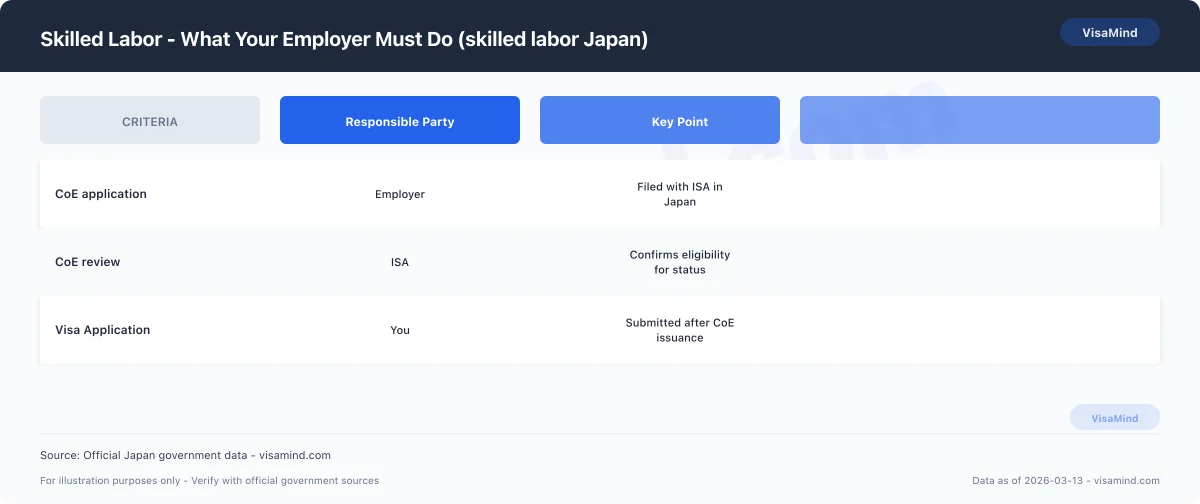
| Step | Responsible Party | Key Point |
|---|---|---|
| CoE application | Employer | Filed with ISA in Japan |
| CoE review | ISA | Confirms eligibility for status |
| Visa Application | You | Submitted after CoE issuance |
For long-term stays such as work, you must include the CoE when applying for your visa.
Missing it is a common reason for refusal.
ISA manages CoE issuance and status approvals for all work categories in Japan.
How to Renew
#You must apply for an extension of your period of stay before your current status expires.
The Immigration Services Agency of Japan (ISA) reviews each application individually, and processing typically takes 1–3 months.
When to file an extension or renewal
File your extension request while your current period of stay under your Skilled Labor–related status remains valid.
Do not wait until the last moment, because ISA processing can take 1–3 months.
This applies to statuses such as:
- Engineer/Specialist in Humanities/International Services
- Specified Skilled Worker (i)
- Specified Skilled Worker (ii)
- Highly Skilled Professional
- Intra-company Transferee
You submit a Form Visa Application for extension of period of stay to the Immigration Services Agency (出入国在留管理庁).
ISA is the authority that reviews and decides these applications in Japan.
| Item | Key Point |
|---|---|
| Where to apply | Immigration Services Agency (ISA) |
| Type of filing | Extension of period of stay (Visa Application) |
| Processing time | 1–3 months |
| Applies to | Skilled labor–related residence statuses |
Approval is not guaranteed
Submitting an extension request does not guarantee approval.
ISA examines each application on its own merits.
You must continue to meet the requirements of your current residence status.
If you hold Specified Skilled Worker (i), Specified Skilled Worker (ii), Engineer/Specialist in Humanities/International Services, Highly Skilled Professional, or Intra-company Transferee status, ISA will assess whether your activities remain consistent with that category.
ISA may:
-
Approve the extension.
-
Grant a different period of stay than requested.
-
Deny the application.
Because processing takes 1–3 months, plan ahead and ensure your application is accurate and complete before filing.
Incomplete or inconsistent information can affect the outcome of your Visa Application.
Fees and Processing Times
#You must budget for a government issuance charge and plan around category-specific processing times.
Timing depends on your visa type and where you apply, and the Immigration Services Agency of Japan (ISA) controls status decisions.
Visa fees and issuance charge
Japan charges a visa issuance fee of ¥6,000 for a multiple-entry visa (as of February 2026).
You pay this fee when the visa is issued.
| Fee Type | Amount (JPY) | Notes |
|---|---|---|
| Visa issuance fee | ¥6,000 | Multiple-entry visa; paid upon issuance |
The ¥6,000 charge applies to skilled categories such as:
- Engineer/Specialist in Humanities/International Services
- Highly Skilled Professional
- Specified Skilled Worker (i)
- Specified Skilled Worker (ii)
- Intra-company Transferee
If you apply for a change or different status, confirm current charges directly with the Immigration Services Agency of Japan (ISA).
Fee amounts can change, and you must verify the exact cost before submitting your Form Visa Application.
Typical processing ranges
Processing times for skilled labor visas under the standard track range from 1 to 3 months (as of March 2026).
This range applies to applications reviewed by immigration authorities in Japan.
When you apply at a Japanese Embassy or Consulate in your country of residence, processing typically takes about 5 business days.
This shorter timeframe reflects consular visa issuance after eligibility has been confirmed.
You should:
-
Submit your application at least 2–3 weeks before your planned travel date.
-
Expect longer timelines during peak seasons.
-
Confirm your category-specific timeframe with the issuing authority.
Categories such as Specified Skilled Worker (i) and Highly Skilled Professional may fall within the 1–3 month standard range when handled under regular processing.
Variable timing by location
Processing times vary based on where you apply and which status you request.
The Immigration Services Agency (ISA) handles in-country immigration processing and status decisions.
If you apply overseas, the Japanese Embassy or Consulate manages the Visa Application process.
Local workload and seasonal demand affect how quickly officers issue visas.
Your timeline can differ depending on:
- Visa category (for example, Engineer/Specialist in Humanities/International Services vs. Specified Skilled Worker (ii))
- Application volume at the specific consular post
- Whether your case requires additional review
Path to Permanent Residence
#You can move from a Japan Skilled Labor visa to longer-term or more stable residence by changing your status with the Immigration Services Agency of Japan (ISA).
Your options depend on your work category, qualifications, and whether you meet the criteria for other residence statuses.
Post-visa options
You may qualify to change your status if your role, salary, or qualifications evolve.
Common pathways include:
- Highly Skilled Professional
- Engineer/Specialist in Humanities/International Services
- Specified Skilled Worker (i)
- Specified Skilled Worker (ii)
- Intra-company Transferee
- Permanent Resident
ISA reviews each change of status through a formal Form Visa Application for change of residence status.
| Status | Key Feature | Long-Term Potential |
|---|---|---|
| Highly Skilled Professional | Points-based evaluation | May offer advantages for long-term stay |
| Specified Skilled Worker (i) | Sector-specific skilled work | Limited period of stay |
| Specified Skilled Worker (ii) | Advanced sector skills | Allows longer or renewable stay |
| Engineer/Specialist in Humanities/International Services | Professional or technical roles | Renewable work status |
| Permanent Resident | No work restrictions | Indefinite stay |
If you aim for permanent residence, you must meet the criteria set by ISA at the time of application.
ISA determines eligibility, documentation, and review standards.
You apply from within Japan by submitting a change or permanent residence application to ISA.
Always confirm current requirements with ISA before filing.
Common next steps
You should plan your transition well before your current period of stay expires.
Start by:
-
Reviewing your current status and expiration date.
-
Confirming whether you meet eligibility criteria for a different status.
-
Preparing required documents for a change of status or permanent residence application.
ISA requires a formal application for any status change.
You must submit supporting documents that match the specific residence category.
For example, moving from a Skilled Labor visa to Highly Skilled Professional requires proof that you meet the relevant evaluation standards.
Switching to Specified Skilled Worker (ii) requires proof of sector eligibility and qualifications.
If you apply for permanent residence, ISA evaluates your record under its permanent residence guidelines.
Check the Immigration Services Agency of Japan (出入国在留管理庁) for current criteria, required documents, and application procedures before submitting your file.
Family Members
#Your ability to bring family depends on your residence status and the specific Skilled Labor category you hold.
You must also meet strict passport and photo standards to avoid delays in your family’s Form Visa Application with the Immigration Services Agency of Japan (ISA).
Dependents and required documents
If you hold a status like Highly Skilled Professional, Engineer/Specialist in Humanities/International Services, or Intra-company Transferee, your spouse and children generally apply as dependents through a separate Visa Application.
For Specified Skilled Worker (i), check family eligibility directly with the ISA before applying. Requirements shift by status, and ISA’s guidance is the only reliable source for current rules.
Prepare these core documents for each dependent:
- Valid passport
- Completed Visa Application form
- Recent photo (see specifications below)
- Documents required by the ISA for your specific status
Photo standards are strict:
| Requirement | Specification |
|---|---|
| Size | 4.5 cm x 4.5 cm |
| Background | Plain white |
| Age of photo | Taken within the last 6 months |
| Appearance | No hats or sunglasses |
Non-compliant photos often slow down processing.
Passport and visa attachment requirements
Each family member’s passport must stay valid for the entire planned stay in Japan. The ISA may refuse or delay a Visa Application if the passport expires too soon.
Blank pages are necessary for visa attachment.
Common passport issues include:
-
Not enough remaining validity
-
No empty page for the visa sticker
-
Damage affecting identification details
Before filing, check:
- Passport expiration date
- Number of blank visa pages
- Consistency of personal details with the Visa Application
Fix these issues before submission. This step helps prevent avoidable ISA processing delays for your spouse or children.
When to Get Professional Help
#Japan work visas can be filed through your employer, but errors in forms or jurisdiction sometimes lead to refusal. Professional help becomes more valuable when your case involves multiple statuses, changes, or a complicated work history.
Employer-handled vs. lawyer-assisted filings
Many companies handle the Form Visa Application process directly with the Immigration Services Agency of Japan (ISA). This is standard for categories such as:
- Engineer/Specialist in Humanities/International Services
- Intra-company Transferee
- Specified Skilled Worker (i)
- Specified Skilled Worker (ii)
Your employer usually prepares and submits documents, coordinating with the correct Japanese Embassy or Consulate based on your place of residence.
You still need to review every form. Even minor inconsistencies between your passport and application can result in rejection. Filing at the wrong embassy or consulate can delay or invalidate your submission.
A lawyer is especially useful if your case involves a change to Highly Skilled Professional status or if you’re moving between categories, such as from Specified Skilled Worker (i) to another status. Legal review ensures your documents match across all filings and that your status lines up with your actual job duties.
| Filing Type | Typical Handling | Risk Level Without Review |
|---|---|---|
| Standard employer-sponsored category | Employer prepares and files | Moderate if forms are inconsistent |
| Status change (e.g., to Highly Skilled Professional) | Often lawyer-assisted | Higher due to category criteria |
| Overseas consular filing | Employer coordinates | Risk if filed in wrong jurisdiction |
Situations that benefit from advice
Advice is valuable when your situation goes beyond a standard employer-sponsored filing.
This includes:
- Changing from one status to another (e.g., Engineer/Specialist in Humanities/International Services to Highly Skilled Professional)
- Transitioning between Specified Skilled Worker (i) and Specified Skilled Worker (ii)
- Moving from an Intra-company Transferee role to local employment
- Correcting prior application errors or inconsistencies
If you previously submitted a form with mismatched personal details, address the issue before filing again. Repeated inconsistencies increase the chance of refusal.
Legal review also helps if you’re unsure which embassy or consulate has jurisdiction over your residence. Filing in the wrong location can result in rejection and lost time.
ISA decides applications based on the documents you submit. A professional can check that your job description, status category, and supporting documents align clearly before you apply.
Changing Employers
#When you change employers under a Japan Skilled Labor visa, you must manage both your status of residence and any travel plans carefully. Entry permission and short-term visas operate under separate rules from your work status granted by the Immigration Services Agency of Japan (ISA).
Port of entry and entry decision
A valid visa does not guarantee admission to Japan. Immigration officers at the airport or seaport make the final decision on whether you may enter.
When you re-enter Japan after changing employers under statuses such as:
- Engineer/Specialist in Humanities/International Services
- Specified Skilled Worker (i)
- Specified Skilled Worker (ii)
- Highly Skilled Professional
- Intra-company Transferee
you should carry documents that support your purpose of stay.
Prepare these for inspection:
- Your passport and valid visa
- Return or onward ticket
- Accommodation details in Japan
- Proof of sufficient funds
Officers may review these documents before granting landing permission. If they’re not satisfied, they can refuse entry even if your Form Visa Application was approved.
| Stage | Who Decides | Key Point |
|---|---|---|
| Visa issuance | Japanese overseas mission | Allows you to travel to Japan |
| Port of entry inspection | Immigration officer | Grants or denies entry |
Short-stay eVISA and nationality checks
Japan operates an online eVISA system for short-stay tourism for certain nationalities. This system applies only to temporary visits, not to work-authorized statuses like Specified Skilled Worker or Highly Skilled Professional.
Before visiting a Japanese embassy or consulate for a short stay, confirm whether your nationality qualifies for the eVISA system. Eligibility depends strictly on your passport.
- The eVISA is limited to short-term tourism.
- Work-related statuses require the appropriate work visa.
- Nationality determines eligibility for the online system.
If you plan a short trip outside Japan while changing employers, verify your visa type and nationality requirements before making travel arrangements.
Eligibility Requirements
#You must qualify under a specific work status recognized by the Immigration Services Agency of Japan (ISA). Your education, work experience, job offer, and sponsoring organization determine which category you can use.
Who qualifies
You qualify only if your activities in Japan match an authorized residence status and you have a sponsoring employer or organization when required. ISA reviews whether your background and proposed duties fit the legal definition of the status.
Common work-related categories include:
- Engineer/Specialist in Humanities/International Services
Work in engineering, IT, interpretation, design, marketing, or similar fields
-
Relevant academic background or professional experience
-
Employment contract with a Japanese entity
-
Highly Skilled Professional
Advanced academic or professional background
-
Activities fall within the designated highly skilled categories
-
Points-based assessment under ISA criteria
-
Specified Skilled Worker (i)
Employment in designated labor shortage industries
-
Meet skill level requirements set for the specific field
-
Specified Skilled Worker (ii)
Higher level of specialization in eligible industries
-
Meets expanded work scope under this status
-
Intra-company Transferee
Transfer from an overseas office to a Japanese branch
- Continuous employment with the overseas entity before transfer
You must also submit a complete Form Visa Application and supporting documents. ISA will not approve a status that doesn’t clearly match your job duties.
| Status | Key Requirement | Sponsorship Needed |
|---|---|---|
| Engineer/Specialist in Humanities/International Services | Relevant degree or experience | Yes |
| Highly Skilled Professional | Meets ISA point criteria | Yes |
| Specified Skilled Worker (i) | Industry-specific skill level | Yes |
| Specified Skilled Worker (ii) | Advanced industry skill | Yes |
| Intra-company Transferee | Prior employment with overseas entity | Yes |
Review category-specific instructions
You must review the exact criteria for your chosen status before filing. Each category has different documentary standards and activity limitations.
Focus on:
Scope of permitted activities
Your daily job duties in Japan must match the authorized activities. A mismatch leads to denial or a required status change.
Qualification evidence
Academic certificates
-
Employment verification
-
Detailed job description
-
Corporate registration documents of your sponsor
Status-specific rules
Highly Skilled Professional applicants must satisfy the ISA points framework.
-
Specified Skilled Worker (i) and (ii) applicants must meet the skill standards defined for their industry.
-
Intra-company Transferee applicants must document prior employment with the related overseas office.
ISA evaluates whether your qualifications, employer, and job duties align with the legal definition of the status. Confirm the latest documentary requirements directly with the Immigration Services Agency of Japan (ISA) before submitting your application.
Application Process
#You must use the official form issued by the Immigration Services Agency of Japan (ISA) and follow its instructions exactly. Accuracy, completeness, and proper submission determine whether ISA accepts your Form Visa Application for processing.
Download the form and instructions
Start by downloading the current Skilled Labor Visa Application form and its official instructions from the Immigration Services Agency of Japan (出入国在留管理庁, ISA). Use only the version available on the ISA website at the time you apply.
Different statuses fall under Japan’s work visa framework. Confirm that you are using the correct category before completing the form.
| Visa Category | Example Applicant Type |
|---|---|
| Engineer/Specialist in Humanities/International Services | Technical, business, or language professionals |
| Specified Skilled Worker (i) | Workers in designated labor sectors |
| Specified Skilled Worker (ii) | Advanced workers in eligible fields |
| Highly Skilled Professional | Points-based advanced professionals |
| Intra-company Transferee | Employees transferred within a company group |
Download:
- The main Visa Application form
- The official written instructions
- Any category-specific guidance listed by ISA
Read the instructions fully before you begin. ISA evaluates your application based on the category you select and the documents you submit with it.
Complete, sign, and submit
Complete every required field on the form. Don’t leave required sections blank.
Provide accurate personal details, employment information, and visa category selection. The information must match your supporting evidence exactly.
You must:
-
Fill out all mandatory sections
-
Attach all required supporting documents listed in the instructions
-
Sign the application where indicated
Unsigned or incomplete applications may not be accepted.
Organize your documents in the order listed in the ISA instructions. Clear organization reduces delays and helps the reviewing officer verify your eligibility under categories such as Specified Skilled Worker (i), Highly Skilled Professional, or Engineer/Specialist in Humanities/International Services.
ISA handles immigration applications and status changes in Japan. Stick to its document checklist.
Where to apply (embassy/consulate)
Submit your completed Visa Application to the Japanese embassy or consulate responsible for your place of residence. Don’t file at a location outside your jurisdiction unless the embassy specifically allows it.
Confirm the correct diplomatic mission before submission. Embassy and consulate jurisdictions vary by country and region.
Before you apply, check:
- The correct embassy or consulate
- Submission procedures
- Appointment requirements, if any
- Accepted payment methods (if applicable)
Each embassy or consulate processes applications in coordination with the Immigration Services Agency (ISA). Refer to the ISA or embassy for current procedural details before filing.
Common Petition Challenges
#Most delays in a Japan Skilled Labor Form Visa Application result from technical errors, not eligibility problems. You must meet strict photo and document standards and avoid preventable mistakes before the Immigration Services Agency of Japan (ISA) reviews your file.
Photograph and document compliance
ISA enforces precise photograph rules across categories such as Engineer/Specialist in Humanities/International Services, Specified Skilled Worker (i), Specified Skilled Worker (ii), Highly Skilled Professional, and Intra-company Transferee. A non-compliant photo often leads to processing delays.
You must submit a photo that meets all required specifications.
| Requirement | Standard You Must Meet |
|---|---|
| Size | 4.5 cm × 4.5 cm |
| Background | Plain white |
| Age of photo | Taken within 6 months |
| Accessories | No accessories |
Avoid submitting older photos, cropped passport images, or photos with patterned or off-white backgrounds. Don’t wear items that obscure your face.
Check that every document in your Visa Application matches your passport details exactly. Inconsistent names, birth dates, or job titles can slow review, especially if you apply under categories like Specified Skilled Worker (i) or Highly Skilled Professional.
Avoiding common rejections
Most rejections stem from avoidable technical mistakes rather than substantive ineligibility. Reviewing your file line by line before submission reduces risk.
Focus on these steps:
-
Confirm your photograph meets all listed specifications.
-
Ensure all forms are complete with no blank required fields.
-
Verify that personal details are consistent across every document.
-
Submit clear, legible copies where required.
ISA evaluates your application based on the documents you provide. If your photo fails compliance standards, the agency may delay processing while you correct it.
Treat the final review as mandatory. Small errors in a Japan Skilled Labor Visa Application can interrupt processing regardless of whether you apply under Engineer/Specialist in Humanities/International Services, Specified Skilled Worker (ii), or another eligible status.
Fees
#| Component | Amount |
|---|---|
| Visa issuance feeVisa issuance fee: ¥6,000 (approx $40 USD) (as of 2026-02). Verify the current fee on the official schedule before filing. | ¥6,000 (approx $40 USD) |
Fees change; always verify on ISA.
Required forms
#Next steps
#Use Find My Visa to build a sequenced plan with official sources and deadlines.
FAQs
Can you transfer within your company to Japan?
You may qualify under the Intra-company Transferee status.
This status requires employment with a qualifying overseas office and a transfer to a related entity in Japan.
Where do you file your Visa Application?
You follow the procedures set by the Immigration Services Agency (ISA).
ISA publishes the forms and requirements. Always refer to their latest guidance.
Where do I get the Skilled Labor form?
Download the current skilled-labor form and instructions from the official Immigration Services Agency of Japan website. The skilled-labor is an official Immigration Services Agency of Japan form used by applicants filing with that agency.
How much does the visa cost?
Japanese visa fees must be paid for issuance. The visa issuance fee is ¥6,000 (approx $40 USD) for the multiple-entry visa (as of 2026-02).
How long does processing take?
Standard processing for skilled-labor is 1 to 3 months (as of March 2026). processing times vary by category and processing location—verify current times with the issuing authority. As an expert tip, if you apply at the Japanese Embassy/Consulate in your country of residence, apply at least 2–3 weeks before travel: embassy processing typically takes 5 business days but can take longer during peak seasons.
Do I need a Certificate of Eligibility (CoE)?
For long-term stays such as work, your sponsor in Japan must obtain a Certificate of Eligibility (CoE) before you apply. Missing a CoE for long-term visas is a common cause of rejection—obtain the CoE from the Immigration Services Agency before applying.
What are the photo requirements?
Photos must be 4.5cm x 4.5cm, taken within the last 6 months, with a white background and no hats or sunglasses. Non-compliant photos are a common cause of delays or rejection.
Does filing the form guarantee approval?
No. Filing the skilled-labor form does not guarantee approval.
If I have a visa, am I guaranteed entry to Japan?
No. A visa does not guarantee entry. Immigration officers at the port of entry make the final decision—have return ticket, accommodation details, and proof of funds ready for inspection.
What are common mistakes that can cause rejection or delay?
Common problems include incomplete or inconsistent information across the form, non-compliant photographs (wrong size, background, or age), applying at the wrong embassy/consulate, and insufficient passport validity or lack of blank pages for visa attachment.
Can the Skilled Labor visa lead to permanent residence?
Yes. After this visa, common next steps can include pursuing Permanent Residence.
Official sources referenced
Last reviewed: 2026-03-13
VisaMind provides informational guidance only and is not a government agency. This is not legal advice. Requirements can change and eligibility depends on your specific facts. If your case is complex or high-stakes, consult a licensed immigration attorney.
Next steps
Every Japan visa case depends on your nationality, purpose, and timeline. Get a personalized plan with official sources and deadlines.
Get my Skilled Labor plan