Getting Accepted First
#How Do You Get Accepted to a Spanish University?
Embarking on a journey to study in Spain starts with securing admission to a recognized Spanish educational institution. This acceptance is foundational to your visa application process and requires careful planning and preparation. Here's a step-by-step guide to help you navigate this initial stage:
-
Research and Select Universities
Begin by identifying universities in Spain that offer programs aligned with your academic interests and career goals. Consider factors such as the course content, faculty reputation, campus facilities, and location. Many students find success in applying to multiple institutions to maximize their chances of acceptance.
-
Check Admission Requirements
Each university will have specific admission criteria, which may include academic transcripts, language proficiency tests (such as the DELE for Spanish or TOEFL/IELTS for English-taught programs), letters of recommendation, and a personal statement. Ensure you understand these requirements and prepare accordingly.
-
Submit Your Application
Most Spanish universities offer online application portals. Prepare and upload all necessary documents, adhering to any deadlines the institutions have set. It's advisable to keep copies of all your submissions for future reference.
-
Receive Your Acceptance Letter
Once accepted, you will receive an official letter of acceptance from the university. This document is crucial for your National Student Visa application as it verifies your enrollment in a recognized program.
What Are CAS/COE/CRICOS Requirements?
While specific terms like CAS (Confirmation of Acceptance for Studies) and CRICOS (Commonwealth Register of Institutions and Courses for Overseas Students) do not apply to Spain, the principle of having proof of enrollment remains essential.
- Proof of Enrollment: In Spain, the equivalent document is the acceptance letter from your university, which confirms your enrollment in a course. This must be presented when applying for your student visa.
Preparing for Visa Application
With your acceptance letter in hand, you're ready to move forward with your visa application. The National Student Visa is designed for international students planning to study in Spain for more than 90 days. To expedite the process, start gathering the required documentation early, including your financial evidence, health insurance, and proof of accommodation.
For more detailed guidance on the next steps, including how to apply for your student visa, refer to our How To Apply guide and the Documents Checklist.
By following these steps, you'll be well on your way to securing a place at a Spanish university and setting the stage for an enriching educational experience in Spain.
Student Visa Requirements
#What Are the Financial Requirements for a Spanish Student Visa?
To study in Spain, you must demonstrate that you have sufficient financial resources to cover your expenses while in the country. The exact amount can vary, but as a general guideline, you may need to show access to a monthly income of around €600 to €700 (as of 2023). This can be in the form of bank statements, scholarship awards, or sponsorship letters. Refer to the Financial Requirements guide for more detailed information and ensure you verify the latest amounts on the official website.
Do You Need Health Insurance for a Student Visa?
Yes, health insurance is a crucial requirement for obtaining a student visa to study in Spain. You must have private health insurance that covers you throughout your stay. The insurance should offer coverage equivalent to Spain's public health system, including emergency and routine care. It is advisable to compare different providers to find a plan that best suits your needs and budget. For more information on required documents, consult the Documents Checklist.
What Are the Language Requirements for Studying in Spain?
While language requirements can vary depending on the program and institution, many universities in Spain require proof of proficiency in the language of instruction. For courses taught in Spanish, you may need a certificate such as DELE (Diploma of Spanish as a Foreign Language). If your course is in English, you might need to provide an IELTS or TOEFL score. It is crucial to check the specific language requirements of your chosen institution.
Comparison Table of Key Student Visa Requirements
To help you better understand the key requirements for a student visa in Spain, here is a comparison table:
| Requirement | Description |
|---|---|
| Financial Proof | Show funds of approximately €600-€700/month (as of 2023). Verify on the official website. |
| Health Insurance | Obtain private insurance covering emergency and routine care throughout your stay. |
| Language Proficiency | Provide proof of language proficiency (e.g., DELE for Spanish, IELTS for English courses). |
For guidance on the application process, visit the How To Apply page. If you are interested in understanding more about the National Student Visa, be sure to check the requirements specific to your situation.
The Application Process
#How to Apply for a Student Visa in Spain
If you're planning to study in Spain, you will need to apply for a National Student Visa. This visa allows you to reside in Spain for the duration of your studies. Here are the steps you need to follow to apply:
-
Acceptance from a Spanish Institution
Before you can apply for a student visa, you must be accepted into an accredited educational institution in Spain. Ensure that you have the official acceptance letter, which will be a crucial part of your visa application.
-
Gather the Required Documents
Collect all necessary documents for your visa application. Although requirements may vary slightly depending on your nationality, typically you will need:
- A valid passport
- Proof of acceptance from a Spanish institution
- Evidence of sufficient financial means to support yourself during your studies
- Proof of health insurance
- A criminal background check
Refer to the Documents Checklist for a detailed list of required documents.
-
Submit Your Application
Lodge your visa application at the Spanish consulate or embassy in your country of residence. Be sure to check the specific requirements and processes of the consulate, as these can vary.
-
Attend a Visa Interview
In many cases, you will be required to attend a visa interview at the consulate. During this interview, you may be asked about your study plans and financial situation.
-
Pay the Visa Fee
As part of your application, you will need to pay a visa fee. The fee amount can vary, so it is advisable to verify the exact cost on the official consulate website.
What Happens After You Apply?
After submitting your application, the processing time can take several weeks. It's important to apply well in advance of your intended travel date to ensure your visa is granted in time for the start of your studies. For more details on expected timelines, consult the Processing Times guide.
Can You Extend Your Student Visa?
If you need to extend your stay in Spain beyond the initial period granted by your student visa, you may apply for an extension. This process must be initiated before your current visa expires. Check the Visa Extension Guide for more information on how to proceed with an extension application.
By following these steps, you can ensure that you have a clear understanding of the application process for studying in Spain. Always verify details with the [State Secretariat for Migration (Secretaría de Estado de Migraciones)] before proceeding, as requirements can change.
Cost of Studying
#
Tuition Fees
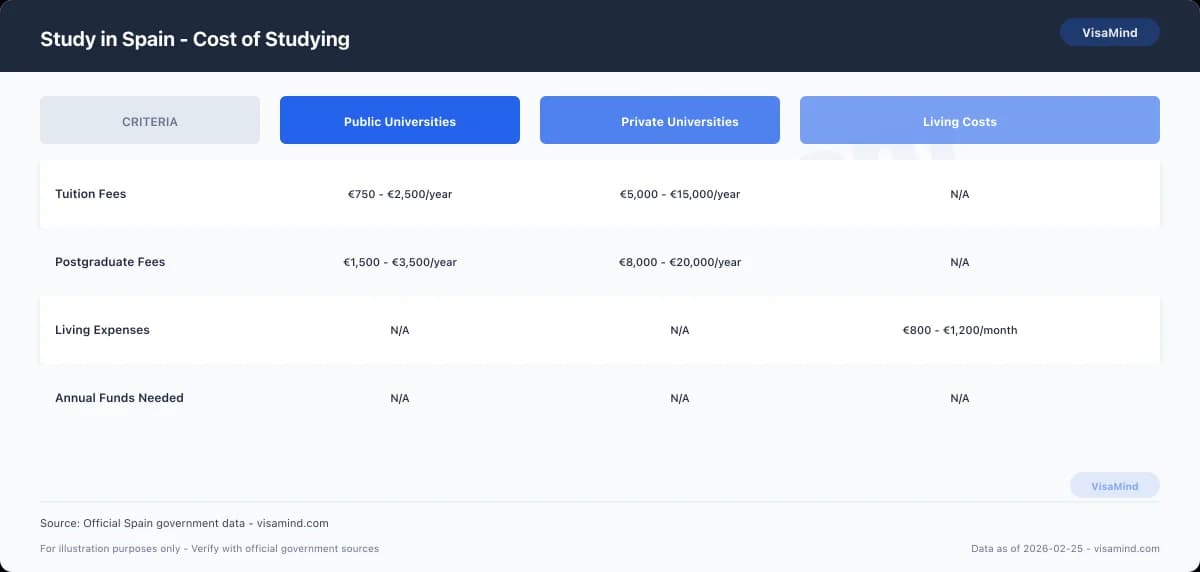
When considering studying in Spain, tuition fees play a significant role in planning your budget. The cost of tuition can vary greatly depending on the type of institution and the level of study. Public universities in Spain generally offer more affordable options, with tuition fees ranging from €750 to €2,500 per academic year for undergraduate programs as of 2023. Private universities tend to be more expensive, with fees that can go up to €20,000 annually. It’s advisable to verify the latest tuition fees directly with the chosen institution.
Living Costs
In addition to tuition, you should also budget for living expenses while studying in Spain. The cost of living can vary depending on the city. Major cities like Madrid and Barcelona might require a monthly budget between €900 and €1,500, covering accommodation, food, transport, and leisure activities. Smaller cities may offer a more economical lifestyle, with costs ranging from €600 to €1,000 monthly. For a detailed breakdown of costs, you can refer to our Financial Requirements guide.
Financial Requirements for Student Visas
To apply for a student visa, you need to demonstrate adequate financial means to support yourself during your stay. This is a crucial step in the application process. As of 2023, the State Secretariat for Migration requires proof of at least €7,000 annually. This amount is intended to ensure you can cover living costs without relying on employment. For more information on how to meet these requirements, consult our How To Apply guide.
Comparison Table
Here is a comparison of key financial aspects you need to consider when planning to study in Spain:
| Aspect | Public University | Private University | Major Cities (e.g., Madrid, Barcelona) | Smaller Cities |
|---|---|---|---|---|
| Tuition Fees | €750 - €2,500 | Up to €20,000 | - | - |
| Monthly Living Costs | - | - | €900 - €1,500 | €600 - €1,000 |
| Annual Financial Requirement | - | - | €7,000 | €7,000 |
Use this table as a guide for estimating your total costs while studying in Spain, but always verify the latest numbers through official channels. For more detailed insights into visa-related costs, you might find the Visa Extension Guide useful.
Working While Studying
#Working While Studying in Spain
As a student in Spain, balancing academics with part-time work can enhance your experience and help cover living expenses. However, there are certain restrictions to consider regarding working hours.
How Many Hours Can You Work?
Students on the National Student Visa are permitted to work part-time, which typically means up to 20 hours per week. This arrangement ensures that your primary focus remains on your studies. During academic breaks, such as the summer holidays, you may be allowed to work full-time, but it's essential to verify the specifics with the local authorities or your university.
Are There Any Restrictions?
When working as a student, the following restrictions apply:
- Type of Work: The job should not interfere with your studies. Typically, it should be related to your field of study, providing practical experience.
- Employer Authorization: Employers must obtain a work authorization for you from the local immigration office. This is a separate process from your student visa.
- Contract Duration: Your employment contract cannot exceed the duration of your student visa.
Employer Requirements
Before you can start working, your potential employer must:
- Obtain a work permit for you from the local immigration office.
- Ensure the job aligns with the requirements set by the State Secretariat for Migration (Secretaría de Estado de Migraciones).
Related Links
For more detailed procedures, explore our Visa Refusal Reasons guide to understand common pitfalls, or check the Visa Extension Guide if you're considering extending your stay. Additionally, if you're interested in long-term employment opportunities, the National Work visa might be an option post-graduation.
Student Life and Practical Matters
#Health Insurance
- Mandatory Health Coverage: As a student in Spain, you are required to have health insurance that provides comprehensive coverage. This is a crucial step when applying for your National Student Visa.
- Types of Insurance:
- Public Health System: Students from the EU may access the public health system with a European Health Insurance Card (EHIC).
- Private Insurance: Non-EU students typically need private health insurance, which should cover the entire duration of your stay.
Housing Options
- University Accommodation: Many universities offer dormitories or student residences. It's advisable to apply early, as spots fill up quickly.
- Private Rentals: Renting a private apartment or room is a common choice. Websites and local agencies can assist in finding suitable housing.
- Shared Apartments: Sharing an apartment with other students can be a cost-effective option and a great way to meet new people.
Banking for Students
- Opening a Bank Account: Having a local bank account can simplify financial transactions. Most banks in Spain offer accounts specifically for students, often with lower fees or special conditions.
- Required Documents:
- Passport: Your valid passport is usually required.
- Proof of Enrollment: A document from your educational institution verifying your student status.
- Spanish Address: Proof of your local address, such as a rental contract.
Additional Practical Considerations
- Cost of Living: Be prepared for expenses beyond tuition, such as housing, food, and transportation. As of 2023, the average monthly cost for a student in Spain is approximately €600-€1,000, but verify on the official website for the most current figures.
- Transportation: Public transport is widely available and often discounted for students. Consider purchasing a monthly pass for savings.
For further details on living and studying in Spain, you might find the Visa Refusal Reasons and Financial Requirements guides helpful.
After Graduation
#Post-Graduation Opportunities for International Students in Spain
After completing your studies in Spain, you may be interested in exploring options to remain in the country for work or further studies. Spain offers several pathways for international graduates to transition from a student role to a working professional.
What Are Your Options After Graduation?
Graduates holding a National Student Visa can consider the following options for staying in Spain:
-
National Work Visa: If you secure a job offer from a Spanish employer, you can apply for a National Work Visa. This visa allows you to work and reside in Spain legally. It's essential to ensure that your potential employer is aware of the requirements for hiring an international graduate.
-
Highly Qualified Professional Visa: If you have a job offer for a high-skilled position, this visa might be suitable. It is designed for individuals with specialized skills that are in demand in Spain.
-
Entrepreneur Visa: For those looking to start their own business in Spain, the Entrepreneur Visa provides an opportunity to establish and manage a business. This option is ideal if you have an innovative business idea and a solid business plan.
How Can You Transition to a Work Visa?
To transition from a student visa to a work visa, you must first secure employment or have a business plan approved. The process generally involves:
-
Securing a Job Offer: Before applying for a work visa, you need a confirmed job offer from a Spanish employer. The employer must demonstrate that the position cannot be filled by a local resident.
-
Gathering Required Documents: Prepare necessary documents such as your employment contract, academic credentials, and any certifications relevant to your new job.
-
Lodging Your Application: Submit your application to the appropriate Spanish authorities. For detailed guidance on this process, refer to How To Apply.
Can You Extend Your Stay for Job Searching?
Spain offers a Job Search Visa, which allows graduates to stay for an additional period while seeking employment. This visa is a temporary permit generally valid for up to 12 months. During this time, you can look for job opportunities and transition to a work visa once employed.
What If You Want to Pursue Further Studies?
If you wish to continue your studies, perhaps by enrolling in a higher-level program, you can apply to extend your student visa. Make sure to check the specific requirements for extending a student visa in Spain, which may involve proving your enrollment in a new academic program. For more information, refer to the Visa Extension Guide.
Conclusion
Exploring post-graduation options in Spain provides a pathway to continue your professional growth while enjoying all that Spain has to offer. Whether you're aiming to work, start a business, or further your education, there are multiple visa options available to support your goals. Always verify the most current information on visa types and requirements on official Spanish government websites.
Pathway to Permanent Residence
#Transition from Student to Permanent Resident
Studying in Spain offers a promising pathway to permanent residence for international students. After completing your studies, you may be eligible to apply for various visas that can eventually lead to permanent residency. The National Work Visa is a popular option for graduates seeking employment in Spain, allowing you to gain valuable work experience and integrate into the Spanish workforce.
Steps Towards Permanent Residency
-
Complete Your Studies: Ensure that you fulfill all academic requirements for your program under your National Student Visa.
-
Obtain Relevant Work Experience: After graduation, securing employment can set you on the path toward permanent residency. Consider applying for a National Work Visa to legally work in Spain.
-
Explore Long-term Visas: Depending on your circumstances, you might qualify for other long-term visas like the Long Term Residence Visa or the EU Blue Card, both of which are stepping stones to permanent residency.
Key Considerations for Permanent Residency
-
Work Contract: A stable job offer with a Spanish company can significantly strengthen your application for long-term residency.
-
Language Proficiency: While not always mandatory, proficiency in Spanish can enhance your integration into the community and improve your chances of obtaining permanent residency.
-
Time in Spain: Typically, you need to have resided legally in Spain for a certain period (check the latest requirements on the official website) before applying for permanent residency.
Visa Comparison
Below is a brief comparison of different visa options that can lead toward permanent residency:
| Visa Type | Purpose | Duration |
|---|---|---|
| National Work Visa | Employment | Typically 1-2 years (renewable) |
| EU Blue Card | Highly skilled employment | 1-4 years (renewable) |
| Long Term Residence Visa | Extended stay in Spain | Indefinite (after 5 years of residency) |
Useful Resources
For further assistance, explore these guides and situations:
- Processing Times for various visas
- Visa Refusal Reasons to understand potential pitfalls
- Long Term Residence for more details on permanent residency
Embarking on the journey from student to permanent resident requires careful planning and a clear understanding of Spain's immigration pathways. Ensure you stay informed by consulting the How To Apply guide and constantly verifying requirements on official resources.
Common Mistakes
#Insufficient Financial Resources
-
Failure to Prove Financial Sufficiency: When applying for a student visa, you must demonstrate that you have the financial resources to support yourself during your stay in Spain. This includes tuition fees, living expenses, and other costs. Not providing adequate proof of financial means can lead to a visa denial. Refer to the Financial Requirements guide for detailed information on what is required.
-
Inconsistent Financial Documentation: Submitting inconsistent or incomplete financial documents is another common error. Ensure that your bank statements, scholarship letters, or financial guarantees are up-to-date and consistent with other parts of your application.
Lack of Genuine Student Intent
-
Unclear Study Purpose: You should clearly articulate your study goals in Spain. This involves specifying the program you will attend and how it aligns with your career or academic objectives. An unclear or poorly elaborated study plan can suggest a lack of genuine intent to study, leading to a visa refusal.
-
Inadequate Enrollment Proof: Failure to provide an official enrollment letter from a recognized Spanish educational institution can be detrimental to your application. Ensure that this letter is official and clearly states your acceptance into the program.
Document and Application Errors
-
Missing or Incorrect Documents: One of the most common mistakes is submitting an incomplete application. Make sure you gather all necessary documents well in advance, as outlined in the Documents Checklist.
-
Errors in Personal Information: Any discrepancies in your personal information, such as name or date of birth, can delay processing times or result in application rejections. Double-check all entries for accuracy before submission.
Related Visa Types
If you are considering different options, you might also explore the Schengen Tourist or Schengen Business visas for short-term stays, or the National Work visa if you plan to work in Spain after your studies. Each visa type has distinct requirements and processes, so choose the one that aligns with your goals.
Real Scenarios
#Experiencing Student Life in Spain
Imagine you have just arrived in Spain to embark on your academic journey. As a student, Spain offers a vibrant culture, rich history, and diverse experiences that can enrich your education. You're not just here to attend classes; you're here to immerse yourself in the Spanish way of life. Whether you're taking a stroll through the historic streets of Salamanca or enjoying a traditional meal in Barcelona, every day brings a new adventure.
What If You Want to Stay Longer?
After completing your studies, you might decide that you'd like to extend your stay in Spain. Perhaps you've fallen in love with the country and want to explore further opportunities. In this scenario, you might consider transitioning from a student visa to another type of residence permit, such as the Long Term Residence or the National Work visa, if you secure employment. Each path requires careful planning and consideration of the necessary requirements and timelines. It's crucial to start this process well ahead of your current visa's expiration.
Balancing Work and Studies
While studying in Spain, you might want to gain some work experience or support yourself financially. As a student, you're generally allowed to work part-time, but there are specific regulations to be aware of. It's essential to ensure that any employment does not interfere with your studies. You can find more information on work-related options in situations like Digital Nomad and Work.
Overcoming Challenges: A Case Study
Consider the case of Maria, a student from Argentina who faced challenges when her visa was nearing expiration. She wanted to continue her studies and needed to extend her stay. By carefully reviewing the Visa Extension Guide and gathering the necessary documentation, Maria successfully applied for an extension. Her experience highlights the importance of early preparation and understanding of the visa procedures involved. Maria's proactive approach allowed her to continue enjoying her student life in Spain without interruption.
Navigating the intricacies of studying in Spain requires a good understanding of the opportunities and challenges you may face. With the right preparation and knowledge, your educational experience in Spain can be both rewarding and transformative.
FAQs
Can I work while studying in Spain?
What happens if my student visa application is rejected?
Can I switch from a student visa to a work visa in Spain?
How can I apply for permanent residence after studying in Spain?
Can I bring my family while studying in Spain?
What are common mistakes to avoid when applying for a student visa in Spain?
Can I study and work in Spain on a non-student visa?
Sources
Last reviewed: February 25, 2026
VisaMind provides informational guidance only and is not a government agency. This is not legal advice. Requirements can change and eligibility depends on your specific facts. If your case is complex or high-stakes, consult a licensed immigration attorney.
Next steps
Requirements vary by nationality, purpose, timeline, and case details. VisaMind turns uncertainty into a sequenced checklist with official source citations.
Find my visa