Do You Need a Visa?
#
Do You Need a Visa to Visit Spain?
Spain, a top destination for millions of travelers each year, offers a variety of entry options depending on your nationality and the purpose of your visit. Whether you can enter Spain without a visa or need to apply for one depends largely on your country of residence and the length and purpose of your stay.
Visa-Free Entry
For citizens of the European Union (EU), European Economic Area (EEA), and Switzerland, no visa is required to enter Spain. These travelers can enjoy the freedom of movement and stay for an unlimited period.
If you are from a country that has a visa-free agreement with the Schengen Area, such as the United States, Canada, Australia, or Japan, you can stay in Spain for up to 90 days within a 180-day period without a visa. This applies to tourism, business, short-term studies, or family visits.
Schengen Visa Requirements
If you are not from a visa-exempt country, you will need to apply for a Schengen Visa to enter Spain. The Schengen Visa allows you to travel across all 26 Schengen countries for up to 90 days within a 180-day period. There are different types of Schengen Visas depending on your travel purpose:
- Schengen Tourist Visa: For tourism and leisure.
- Schengen Business Visa: For attending business meetings, conferences, or other professional engagements.
For more detailed guidance on how to apply for a Schengen Visa, you can refer to our How To Apply guide.
When Is a Visa Required?
You will need to apply for a visa if:
- Your nationality is not eligible for visa-free entry.
- You plan to stay longer than 90 days.
- Your visit involves activities such as work, long-term study, or family reunification.
In these cases, you may need to apply for one of the following visas:
- National Work Visa: For employment purposes.
- National Student Visa: For pursuing academic courses.
- Family Reunification Visa: If you are joining family members residing in Spain.
To determine your specific visa requirements, it’s advisable to verify the details on the official website of the State Secretariat for Migration (Secretaría de Estado de Migraciones).
Summary Table of Entry Options
| Entry Option | Duration | Requires Visa |
|---|---|---|
| EU/EEA/Swiss Citizens | Unlimited | No |
| Visa-Free Countries | Up to 90 days | No |
| Non-Visa-Free Countries | Up to 90 days | Yes, Schengen Visa |
| Long-Stay/Work/Study/Family | More than 90 days | Yes, National Visa |
Before traveling, it's crucial to confirm the most current visa regulations applicable to your situation, as policies can change. For comprehensive information, consult our Documents Checklist to ensure you have all required documents before lodging your visa application.
Types of Visitor Visas
#Types of Visitor Visas to Spain
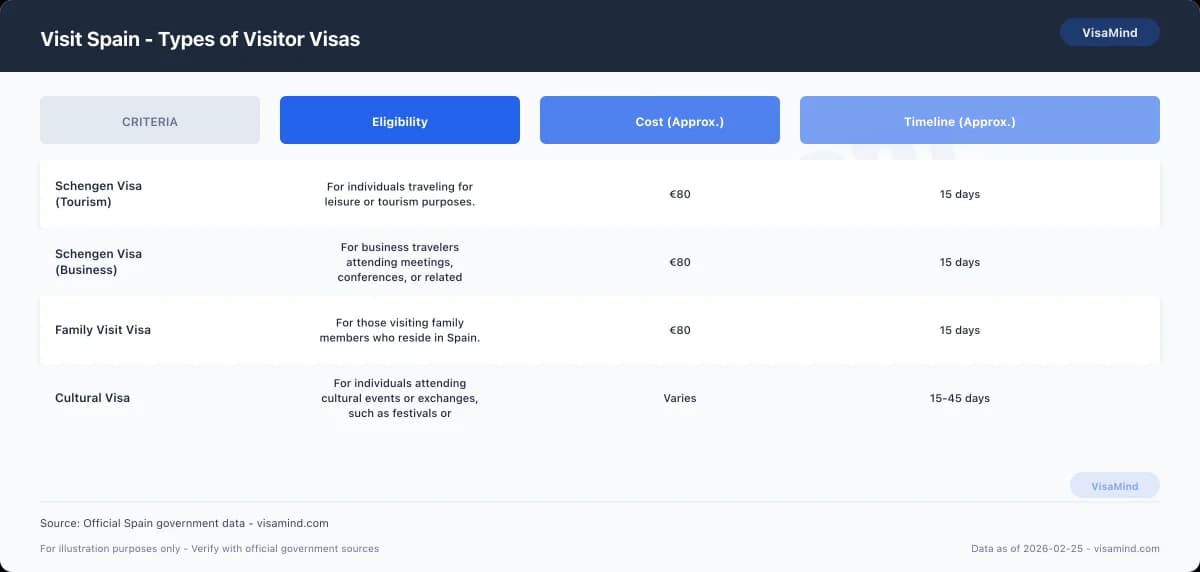
When planning a visit to Spain, understanding the types of visitor visas available is crucial. Spain offers a variety of visas depending on the purpose of your visit. Here, we'll focus on the visitor visas primarily used for tourism and business purposes.
| Visa Type | Eligibility | Cost | Timeline |
|---|---|---|---|
| Schengen Visa (Tourism) | For tourists traveling to Spain and other Schengen countries for up to 90 days. Must have travel insurance and sufficient funds. | Varies by country (approximately €80 as of 2023) | Typically 15 days; verify on the official website |
| Schengen Visa (Business) | For business-related activities such as meetings, conferences, or negotiations. Requires an invitation from a Spanish business. | Similar to the tourism visa, costs can vary (approximately €80 as of 2023) | Generally 15 days; verify on the official website |
What Are the Key Differences?
While both visas permit stays of up to 90 days within a 180-day period, their purposes differ:
-
Schengen Visa (Tourism): This visa is tailored for those looking to explore Spain's rich cultural heritage, indulge in its culinary delights, or simply enjoy a holiday. Applicants need to demonstrate they have the financial means to cover their stay and that they hold valid travel insurance.
-
Schengen Visa (Business): Designed for individuals attending business activities, this visa requires additional documentation, such as an invitation letter from a Spanish company or organization. It's important to show a clear purpose of visit related to business endeavors.
How Can You Prepare for Your Application?
To streamline your application process, you should:
- Use the Documents Checklist to gather necessary documentation.
- Visit the How To Apply guide for a step-by-step application process.
- Ensure you have sufficient financial means and valid travel insurance for the duration of your stay.
Additional Considerations
While the Schengen visa is common for short visits, if you're planning a longer stay or have specific circumstances such as studying, working, or family reunification, you might need to explore other visa types like the National Work Visa or National Student Visa.
Understanding the nuances of each visa type ensures you choose the right option for your visit to Spain. Always check the latest requirements and timelines on the State Secretariat for Migration's official website to ensure a smooth application process.
What You Need to Apply
#What Documents Are Required for a Visit to Spain?
When planning to visit Spain, whether for tourism or business, it's essential to prepare the necessary documents for your visa application. Below is a list of key requirements you need to consider.
Passport and Personal Identification
- Valid Passport: Your passport must be valid for at least three months beyond your planned departure date from the Schengen area and must have been issued within the last ten years. Ensure it has at least two blank pages.
- Passport Photos: Two recent passport-sized photographs that meet the Schengen guidelines for photo specifications.
Financial and Travel Documentation
- Proof of Financial Means: Demonstrating that you have sufficient funds to support yourself during your stay in Spain is crucial. This can include:
- Bank statements for the last three months
- Pay slips or proof of regular income
- A letter of sponsorship if someone else is financially supporting your visit
For more detailed guidance on financial requirements, consider reviewing the Financial Requirements guide.
- Travel Itinerary: A detailed plan of your travel within Spain, including flight reservations (not purchased tickets) and accommodation bookings.
Insurance and Additional Documents
- Travel Insurance: A travel insurance policy that covers medical emergencies with a minimum of €30,000, valid throughout the Schengen area.
- Invitation Letter: If applicable, an invitation letter from a host in Spain (for business visits or staying with family/friends), detailing the purpose and duration of your stay.
Visa-Specific Requirements
Depending on the type of Schengen visa you are applying for, additional documentation may be required. For instance:
- For Business Visits: An invitation from a Spanish business or organization, as well as details on the nature of the business relationship.
- For Tourism: Evidence of your travel plans, such as a day-by-day itinerary.
For more information on the types of visas and specific document requirements, you can refer to the Schengen Tourist Visa and Schengen Business Visa pages.
How to Proceed with Your Application
Once you have gathered all necessary documents, you will need to lodge your visa application at the Spanish consulate or visa application center in your country. Be sure to verify the specific requirements and current processing times on the How To Apply page.
By ensuring that all documentation is complete and accurate, you can facilitate a smoother application process for your visit to Spain.
The Application Process
#Applying to Visit Spain: Online vs. Embassy
When planning a visit to Spain, understanding the application process is crucial. Depending on your location and preference, you can apply online or through a local Spanish embassy or consulate. Here’s a step-by-step guide to navigate your options:
-
Determine Your Visa Type: First, identify the visa type you need based on your purpose of visit. For tourism or business, consider applying for a Schengen Tourist or Schengen Business visa.
-
Gather Necessary Documents: Compile the required documents, such as a valid passport, travel itinerary, and proof of accommodation. For a complete list, refer to the Documents Checklist.
-
Choose Your Application Method:
-
Online Application: Some Spanish embassies offer the option to apply online. This typically involves creating an account on their website, filling out the application, and uploading your documents.
-
Embassy or Consulate: If online application is unavailable, contact the nearest Spanish embassy or consulate to schedule an appointment. You will need to bring your documents and complete the application in person.
-
VFS Centers and Appointment Scheduling
VFS Global centers are authorized to accept visa applications for Spain in several countries. They facilitate the process, making it easier and often faster.
-
Locate a VFS Center: Visit the VFS Global website to find a center near you. Ensure they handle Spanish visa applications.
-
Book an Appointment: Schedule your appointment online through the VFS website. Be sure to book in advance, as slots can fill up quickly.
-
Attend Your Appointment: On the day of your appointment, bring all necessary documents and be prepared to provide biometric data, such as fingerprints.
What Happens After Application Submission?
Once you submit your application, whether online, at an embassy, or through a VFS center, processing times may vary. Here’s what to expect next:
-
Processing Times: Visa processing can take anywhere from a few days to several weeks. For specific timelines, consult the Processing Times.
-
Receive Your Visa Decision: You will be notified by the embassy, consulate, or VFS center when your application has been processed. If approved, you can then collect your visa or have it mailed to you.
For other visa options, such as the Digital Nomad or Golden Visa, specific application processes may apply. Always verify the latest requirements and procedures on the official website to ensure compliance with current immigration regulations.
At the Border
#What to Expect During Immigration Control
Upon arrival in Spain, you will go through immigration control, where several checks will be conducted. This is a critical step in ensuring the security and regulation of entry into the country. As you approach border control, be prepared for the following procedures:
-
Passport and Visa Check: Ensure you have your passport and, if required, a valid visa such as a Schengen Visa (Tourism) or Schengen Visa (Business). The immigration officers will verify these documents to confirm your eligibility to enter Spain.
-
Fingerprinting: If you are entering Spain for the first time with a visa, you may be required to provide biometric data such as fingerprints. This is a standard procedure to enhance security and verify identity.
-
Interview: Be ready for a possible brief interview with an immigration officer. They may ask about the purpose of your visit, your intended length of stay, and your accommodation arrangements. Having a clear itinerary or proof of accommodation can be helpful.
Use of E-Gates
Spain is gradually implementing e-gates at major airports to expedite the immigration process for eligible travelers. These automated systems can significantly reduce waiting times and are typically available for European Union (EU) citizens and travelers from specific countries.
Benefits of E-Gates:
- Efficiency: E-gates streamline the process, allowing passengers to cross borders faster.
- Reduced Human Interaction: For those eligible, using e-gates can mean less direct interaction with immigration officers.
Preparing for a Smooth Entry
To ensure your entry into Spain is as seamless as possible, consider these preparation tips:
-
Have All Required Documents Ready: This includes your passport, visa (if applicable), and any supporting documents like travel insurance or proof of accommodation.
-
Understand Your Visa Requirements: If you're visiting for tourism, business, or any other purpose, make sure you're aware of the specific requirements tied to your visa type. For instance, you can explore options like National Work or National Student visas if your visit involves work or study.
Each step at the border is designed to ensure a safe and orderly entry for all travelers. Familiarize yourself with the process, and you'll be well-prepared for your journey to Spain. For more detailed guidance on visa types and requirements, consult relevant sections such as the Visa Refusal Reasons guide.
Extending Your Stay
#Can You Extend Your Stay in Spain?
If you find yourself captivated by Spain's vibrant culture and wish to extend your stay beyond the duration initially granted by your visa, you may be able to apply for an extension. The possibility of extending your stay largely depends on the type of visa you hold. For those with a Schengen Visa, which typically allows you a stay of up to 90 days within a 180-day period, extensions are generally not possible unless there are exceptional circumstances, such as medical reasons or force majeure. However, for longer stays or different purposes, transitioning to another type of visa may be an option.
How to Apply for an Extension
To pursue an extension, it is essential to initiate the process before your current visa expires. You should contact the State Secretariat for Migration (Secretaría de Estado de Migraciones) to discuss your specific situation and verify eligibility. In many cases, you may need to gather additional documentation, such as proof of financial resources to support your extended stay, valid travel insurance, and a compelling reason for the extension. For a comprehensive list of necessary documents, you might find the Documents Checklist helpful.
Alternatives to Extending a Tourist Visa
If extending a tourist visa is not feasible, consider exploring other visa options that suit your needs for a longer stay in Spain. Depending on your situation, you might be eligible to apply for a National Work Visa if you have a job offer, or a National Student Visa if you plan to study. For those with remote work arrangements, the Digital Nomad Visa could be an attractive option. Each visa type has its own set of criteria and application process, so reviewing the Visa Extension Guide can provide valuable insights.
By understanding your options and preparing the necessary documentation, you can increase your chances of successfully extending your stay in Spain or transitioning to a more suitable visa category.
Common Mistakes Visitors Make
#Overstaying Your Visa
- Pay Attention to Your Visa Duration: One of the most common mistakes visitors make is overstaying their visa. For example, a Schengen Tourist Visa typically allows you to stay for up to 90 days within a 180-day period. Exceeding this limit can lead to fines, deportation, or future entry bans.
- Plan Your Departure: Always plan your travel itinerary to ensure you leave Spain before your visa expires. Misjudging the exit date can have severe consequences. If you need more time, consider the Visa Extension Guide to explore your options.
Working on a Tourist Visa
- Understand Your Visa's Limitations: A tourist visa does not permit you to work in Spain. Engaging in any form of employment, whether paid or unpaid, is a violation of your visa terms.
- Explore the Right Visa for Work: If you intend to work while in Spain, consider applying for a visa that caters to employment, such as the National Work Visa or the Digital Nomad Visa.
Insufficient Financial Resources
- Verify Financial Requirements: Visitors must demonstrate sufficient funds to cover their stay in Spain. The exact amount varies, but having enough financial resources is crucial to avoid visa refusal. Refer to the Financial Requirements Guide for detailed information.
- Maintain Access to Funds: Ensure you have access to your financial resources throughout your visit. This includes having credit cards, bank statements, or cash readily available.
By being aware of these common pitfalls and planning accordingly, you can enjoy your visit to Spain without encountering unnecessary legal issues. Always consult official resources and guides to ensure compliance with the latest regulations.
Real Scenarios
#What Are Some Real-Life Examples of Visiting Spain?
When planning a visit to Spain, understanding real-life scenarios can help you navigate the process smoothly. Take, for example, Maria, a Brazilian national who wishes to explore Spain's rich culture and history. She plans to visit Barcelona and Madrid for two weeks. In her case, Maria would need to apply for a Schengen Visa (Tourism), which allows short stays for tourism purposes. Before her trip, Maria ensures she gathers all necessary documents, such as proof of accommodation and a return flight ticket, and applies well in advance to avoid any last-minute issues. For more details, she refers to the Schengen Tourist Visa page.
Is a Business Visit to Spain Different?
Consider John, a Canadian entrepreneur interested in attending a business conference in Valencia. To enter Spain for this purpose, John needs a Schengen Visa (Business). This visa type is tailored for individuals attending business meetings, conferences, or related events within the Schengen Area. John prepares by securing an invitation letter from the conference organizers and compiling documents that verify his business activities. He also checks the Schengen Business Visa requirements to ensure a successful application process.
How Does Family Reunification Work?
For those looking to join family members in Spain, like Fatima, an Algerian mother whose son resides in Madrid, the Family Reunification process is relevant. Fatima can apply for a visa that allows her to live with her family in Spain longer-term. This process involves providing proof of family ties and meeting specific financial requirements. To understand the necessary steps and documents, Fatima consults the Family Reunification Visa guidelines.
Are There Special Considerations for Long Stays?
Individuals like Alex, an Australian writer planning to stay in Spain for an extended period to work on his novel, might explore options beyond standard visas. Alex could consider visas allowing long-term residence, such as the Non Lucrative Visa. This visa permits stays longer than 90 days without engaging in economic activities. Alex would need to demonstrate sufficient financial resources to support himself during his stay. For further guidance, Alex looks into the Long Term Residence options.
Each scenario highlights that the visa type and required documents can vary significantly based on the purpose of your visit. Be sure to verify on the official website for the most current requirements and timelines.
FAQs
What documents do I need to apply for a Spain visa?
Can I switch from a tourist visa to a business visa in Spain?
Can I extend my stay in Spain beyond 90 days?
What happens if I overstay my visa in Spain?
Can I work in Spain with a tourist visa?
What are common mistakes visitors make when applying for a Spain visa?
Can family members join me during my visit to Spain?
Sources
Last reviewed: February 25, 2026
VisaMind provides informational guidance only and is not a government agency. This is not legal advice. Requirements can change and eligibility depends on your specific facts. If your case is complex or high-stakes, consult a licensed immigration attorney.
Next steps
Requirements vary by nationality, purpose, timeline, and case details. VisaMind turns uncertainty into a sequenced checklist with official source citations.
Find my visa