On this page
- The Admission Step
- Student Visa Requirements
- The Application Process
- Working While Studying
- After Graduation
- Pathway to Permanent Residence
- Common Mistakes
- What It Actually Costs
- Day-to-Day Student Life
- Real Student Visa Stories
- Visa options for this goal
- Guides for United Kingdom
- Other goals for United Kingdom
The Admission Step
#- Receive an Offer from a Licensed Student Sponsor
Before applying for a Student visa in the UK, you must receive an offer of admission from a recognized educational institution, known as a licensed student sponsor. This is a critical step, as your chosen institution must be legally authorized to sponsor international students. Once you receive a conditional or unconditional offer, confirm your acceptance to proceed to the next steps.
- Obtain a Confirmation of Acceptance for Studies (CAS)
After accepting an offer, the university or college will provide you with a Confirmation of Acceptance for Studies (CAS). This essential document is issued electronically and includes a unique reference number. The CAS confirms your course details, sponsorship, and eligibility for a Student visa application. This reference number will need to be included in your visa application.
- Fulfill English Language Requirements
Demonstrating your proficiency in English is mandatory for obtaining a Student visa. Most universities require a certain level of English language skills, typically proven through standardized tests such as IELTS or TOEFL. Ensure you meet the specific requirements of your chosen institution and have the necessary documentation ready.
- Prepare Financial Evidence
You must show that you have sufficient funds to cover your tuition fees and living expenses while studying in the UK. This financial proof is necessary to satisfy UK Visas and Immigration (UKVI) requirements. The amount required varies depending on your course and location. Be prepared to provide bank statements or other financial documents to demonstrate your ability to support yourself.
- Gather Additional Documentation
In addition to your CAS and financial evidence, gather any other required documents, such as your passport, academic transcripts, and proof of parental consent if you are under 18. Ensure all documents are up-to-date and meet UKVI specifications.
Important: Ensure that all the information on your CAS matches your application details. Discrepancies can lead to delays or refusal of your visa application.
- Consider Your Visa Options
Once you have all the necessary documents and your CAS, consider which visa category is most appropriate for your study plans. If you are under 18 and attending an independent school, a Child Student Visa might be a more suitable option. For shorter courses, explore the Short-term Study Visa.
Tip: Check out the Student Vs Short Term Study guide to understand which visa best fits your needs.
By following these steps, you will be well-prepared to proceed with your UK Student visa application. Remember, the CAS is a pivotal part of your journey, so ensure all requirements are met to avoid unnecessary complications.
Student Visa Requirements
#To study in the United Kingdom, securing a Student visa is essential. This section outlines the financial, health, and language requirements necessary for this visa.
Financial Requirements
When applying for a Student visa through UK Visas and Immigration (UKVI), it's crucial to demonstrate that you have sufficient funds to support yourself and cover your course fees. The specific amounts depend on your location in the UK. As of 2023, verify these amounts on the official UKVI website:
| Location | Living Costs | Course Fees |
|---|---|---|
| London | £1,334 per month | Course-specific, check the institution's website |
| Outside London | £1,023 per month | Course-specific, check the institution's website |
Tip: Always keep updated with the latest financial requirements on the UKVI website to ensure compliance.
Health Insurance
Having health insurance is a crucial part of your stay in the UK. International students must pay the Immigration Health Surcharge (IHS) as part of their visa application, granting access to the National Health Service (NHS) during their stay. The IHS cost is typically around £470 per year for a student. However, it's advisable to verify the latest rates and conditions through official sources.
Important: Paying the IHS does not cover all medical expenses. Consider additional private health coverage for comprehensive protection.
Language Requirements
A key requirement for the Student visa is English language proficiency. You must prove that you can speak, read, write, and understand English to a certain level, typically by passing an approved English language test (SELT) like IELTS or by having an academic qualification taught in English. The required proficiency level varies depending on your course.
| Course Level | English Requirement |
|---|---|
| Degree Level or higher | Equivalent to CEFR level B2 |
| Below Degree Level | Equivalent to CEFR level B1 |
Tip: Confirm with your educational institution about the accepted English proficiency tests and required scores.
For more detailed comparisons between student visas, you might explore Student Vs Short Term Study to determine the most suitable option for your educational goals. Additionally, understanding the Visa Extension Guide can be valuable if you plan to extend your stay for further studies.
The Application Process
#Determine Eligibility
The first step in applying for a Student visa to study in the United Kingdom is ensuring that you meet all eligibility criteria. You must be at least 16 years old and have received an offer to study from a licensed student sponsor. Additionally, you must demonstrate your ability to speak, read, write, and understand English. Financially, you must prove that you have enough money to support yourself and pay for your course. If you are 16 or 17 years old, parental consent is required, and you must provide evidence of this as part of your application process.
Important: If you are 16 or 17 and plan to study at an independent school, you might qualify for a Child Student Visa instead.
Gather Required Documents
Once you confirm your eligibility, gather all necessary documentation. This includes proof of identity, such as a passport, evidence of financial support, and a Confirmation of Acceptance for Studies (CAS) from your educational institution. Applicants under 18 must provide parental consent. Additional personal information, like your National Insurance number or credit card details, may also be required.
Apply for Your Visa
You can apply for a Student visa from either outside or inside the UK. Ensure that you apply before your current visa expires if you are already in the UK. Your new course must start within 28 days of your current visa's expiration. Submit your application through the UK Visas and Immigration (UKVI) online portal. If successful, you will receive access to your e Visa.
Prepare for Arrival
Before traveling to the UK, check what items you can bring with you and what must be declared at the border. Make sure to travel only after the start date specified on your visa. Failure to adhere to these regulations may result in entry denial.
Tip: Review the Visa Extension Guide if you plan to extend your stay in the UK.
After Arrival in the UK
Once you arrive in the UK, check if you can extend your visa, especially if you plan to further your studies or transition to a Graduate Visa. This visa allows you to stay in the UK for at least 18 months after completing an eligible course, providing time to explore work opportunities or further education.
Important: Ensure that your travel document is linked to your UKVI account to avoid complications at the UK border.
Working While Studying
#As an international student in the United Kingdom on a Student Visa, you are permitted to work while studying, provided you adhere to specific guidelines set by UK Visas and Immigration (UKVI). These guidelines aim to ensure that your primary focus remains on your studies.
How Many Hours Can You Work?
The number of hours you can work during your studies depends on the level of your course and your visa conditions:
- During Term Time:
- Undergraduate and below: up to 20 hours per week
- Some foundation and pre-sessional courses: up to 10 hours per week
- During Holidays:
- Full-time work is permitted
Important: Always check your visa vignette or Biometric Residence Permit (BRP) for specific work conditions, as these may vary.
Restrictions on Employment
While you have the opportunity to work, there are certain restrictions you must adhere to:
- Type of Work: You cannot be self-employed, engage in business activities, or work as a professional sportsperson or entertainer.
- Placement or Internship: Any work placement or internship must be an integral part of your course.
Tips for Balancing Work and Study
Balancing work and study can be challenging. Here are some tips to help you manage:
- Prioritize your coursework and create a schedule that accommodates both study and work.
- Take advantage of university resources such as career services for job placement assistance.
- Stay informed about UKVI regulations to ensure compliance with your visa conditions.
For more specific details about your visa conditions or to explore other visa types such as the Graduate Visa for post-study work, you can refer to the Student Visa page on our site. Additionally, if you're considering other pathways, the Visa Extension Guide might be helpful.
After Graduation
#After completing your studies in the United Kingdom, you have several options to consider for post-study work and further opportunities in the country. The UK Visas and Immigration (UKVI) provides pathways to remain and work, enhancing your professional experience and potentially leading to permanent residence.
Graduate Visa
The Graduate Visa is an excellent option if you wish to stay in the UK after your studies. This visa allows you to remain in the UK for at least 18 months following the successful completion of an eligible course.
-
Eligibility Requirements:
- You must be in the UK to apply.
- Completion of a UK degree or other eligible qualification.
- Your current student visa must be valid when you apply.
-
Key Features:
- Work: You can work in most jobs or look for work.
- Study: Further study is allowed, but certain restrictions apply.
Tip: Consider applying for the Graduate Visa soon after completing your course to make the most of your post-study work rights.
Other Work Visa Options
While the Graduate Visa offers immediate post-study work opportunities, other visas might be more suitable depending on your career goals and circumstances.
Skilled Worker Visa
If you have a job offer from a UK employer, the Skilled Worker Visa might be a suitable option. This visa allows you to work in a qualifying role with an approved employer.
- Requirements:
- A job offer from a UK employer with a valid sponsorship licence.
- The role must meet skill level and salary requirements.
Innovator Founder Visa
For those interested in starting a business in the UK, the Innovator Founder Visa could be an appropriate choice. It requires endorsement by an approved body and a viable business idea.
- Requirements:
- Endorsement by an approved body.
- A detailed business plan.
Pathway to Permanent Residence
Staying in the UK on a work visa can eventually lead to permanent residence, known as Indefinite Leave to Remain (ILR). To qualify, you generally need to have lived in the UK for five years under a visa category that leads to settlement, such as the Skilled Worker Visa.
Important: Carefully plan your visa timeline to ensure continuous legal residence, which is crucial for ILR eligibility.
For further exploration of visa options and guidance on choosing the right path, refer to related visa and situation guides such as Skilled Worker Visa and Graduate Work. Each path offers unique opportunities and requirements, so assess which aligns best with your personal and professional objectives.
Pathway to Permanent Residence
#Studying in the United Kingdom can be a strategic step toward achieving permanent residence status. Here's how this pathway often unfolds.
Transitioning from a Student to a Graduate Visa
Upon successfully completing an eligible course in the UK, you can apply for a Graduate Visa. This visa allows you to stay in the UK for at least 18 months. It's an opportunity to gain work experience, which can be crucial for moving towards permanent residence.
- Eligibility: You must be in the UK when applying.
- Duration: At least 18 months, giving you time to find skilled employment.
Important: Ensure you apply for the Graduate Visa before your Student Visa expires.
Moving from Graduate Visa to Skilled Worker Visa
Once you have secured a job offer from a UK employer, you may be eligible for a Skilled Worker Visa. This visa is a stepping stone toward permanent residence, provided you meet certain conditions.
- Requirements: Job offer from an approved UK employer and a salary meeting the minimum threshold.
- Potential for Permanent Residence: After five years on a Skilled Worker Visa, you may be eligible to apply for Indefinite Leave to Remain.
Indefinite Leave to Remain and Beyond
Indefinite Leave to Remain (ILR) is a key milestone in settling permanently in the UK. After holding ILR status for a year, you may apply for British Citizenship.
- Requirements for ILR: Continuous residence in the UK, meeting income and employment criteria, and passing the Life in the UK test.
- Path to Citizenship: Hold ILR for at least one year before applying for citizenship.
Tip: Start preparing for the Life in the UK test well in advance to ensure a seamless transition to ILR.
By strategically navigating these visa categories, you can maximize your chances of transitioning from a student to a permanent resident in the UK.
Common Mistakes
#Avoiding common mistakes can significantly impact your application’s success. Consider the following frequent pitfalls:
Financial Requirements
-
Insufficient Funds: One of the most common errors is not providing adequate proof of financial means. You must demonstrate that you have enough money to support yourself and pay for your course. The required amount may vary depending on your circumstances, so ensure you have accurate and up-to-date financial documents. For more details on the financial criteria, refer to the Financial Requirements Guide.
-
Incorrect Documentation: Ensure that the financial documents you submit meet UKVI requirements. Bank statements, for instance, should clearly show your name and the amount available, covering the necessary duration.
Intent and Eligibility
-
Genuine Student Intent: UKVI scrutinizes applications to ensure that applicants are genuine students. Clearly outline your study plans, career goals, and how the course in the UK aligns with these objectives. Failing to convincingly demonstrate your intent can lead to refusal.
-
Parental Consent: If you are 16 or 17 years old, not providing evidence of parental consent can result in application delays or rejection. Ensure this documentation is included if applicable.
Timing and Procedures
-
Visa Timing Issues: Applying for your Student visa after your current visa has expired is a critical mistake. You must submit your application before your current visa expires and ensure your new course starts within 28 days of this expiry. For guidance on application timing, see the How To Apply Guide.
-
Traveling Before Visa Start Date: Entering the UK before the start date on your visa can lead to complications with your immigration status. Always check your visa for the correct travel dates.
Identification and Account Linking
-
Proof of Identity: Not proving your identity as part of your application can result in delays. This usually involves biometrics or identity document submissions.
-
Linking Travel Document to UKVI Account: Ensure your travel document is correctly linked to your UKVI account to avoid issues when entering the UK. This minor detail can cause significant entry problems if overlooked.
Important: Always verify the latest details and requirements on the official UKVI website, as immigration policies can change.
What It Actually Costs
#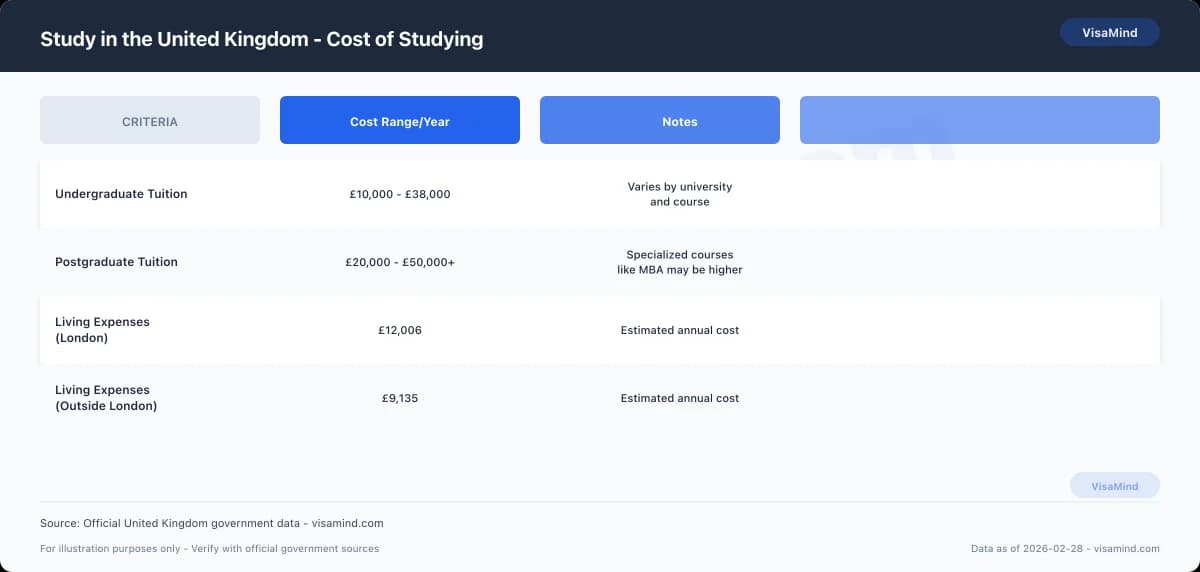
Understanding the costs associated with studying in the United Kingdom is essential for planning your educational journey. This section provides a detailed overview of tuition fees, living costs, and financial requirements for international students.
Tuition Fees
Tuition fees in the UK vary widely depending on the type of course, the level of education, and the university you choose. Below is a general guide:
| Level of Study | Annual Tuition Fees (Approximate) |
|---|---|
| Undergraduate | £10,000 - £38,000 |
| Postgraduate (Taught) | £11,000 - £32,000 |
| Postgraduate (Research) | £15,000 - £30,000 |
Important: Check the specific fees for your chosen course and university, as they can vary significantly. Always verify the most current rates on the official university website.
Living Costs
Living expenses are another crucial consideration. The UKVI requires international students to demonstrate they have sufficient funds to support themselves. Estimated living costs are as follows:
| Location | Monthly Living Costs (Approximate) |
|---|---|
| London | £1,334 |
| Outside London | £1,023 |
These figures cover accommodation, food, travel, and personal expenses. Keep in mind that lifestyle choices and spending habits can affect your actual costs.
Financial Requirements
To successfully apply for a Student Visa, you must prove you have enough financial resources. This includes:
- Course Fees: Proof of the first year's tuition fees or the total course fees if the course duration is less than a year.
- Living Costs: Evidence of sufficient funds to cover living costs as outlined above.
- Additional Costs: Depending on your situation, you may also need to account for additional expenses, such as health insurance.
Tip: Use the Financial Requirements Guide to understand what documents you need to submit to demonstrate your financial capability.
These financial preparations are crucial for securing your place at a UK university and ensuring a smooth visa application process. For more information on applying for a visa, check the How To Apply Guide.
Day-to-Day Student Life
#Tip: Arriving in the UK on a Student visa unlocks a wealth of resources and facilities aimed at enhancing your academic and personal experience.
Health Insurance
- NHS Access: As an international student, you'll typically have access to the UK's National Health Service (NHS) once you’ve paid the Immigration Health Surcharge as part of your visa application. This entitles you to most healthcare services at no additional cost.
- Private Health Insurance: While NHS covers many services, consider private health insurance for quicker access to specialists and additional coverage for dental and optical care.
Student Housing
- University Accommodation: Many universities offer dedicated student housing which can be a convenient and community-oriented option. Apply early, as spaces fill up quickly.
- Private Rentals: Alternatively, you can rent privately. Websites like Rightmove or Zoopla can be useful for finding accommodation. Ensure you understand the terms of your tenancy agreement and any associated costs.
- Costs: Depending on location, expect monthly rent to range from £300 to £1,500. Verify current costs on reputable websites.
Banking for Students
- Opening a Bank Account: Having a UK bank account is essential for managing finances. Most banks offer student accounts with benefits like free overdrafts. You’ll typically need your passport, proof of address, and university enrollment confirmation to open an account.
- Banks to Consider: Major banks like Barclays, HSBC, and Lloyds offer student-friendly services. Compare their offerings to find what best suits your needs.
Important: Be sure to inform your bank of your student status to access specific benefits and avoid unnecessary fees.
For more information on living in the UK as a student, explore our guide on Student vs Short Term Study to understand your options better. Additionally, after your studies, you might look into options like the Graduate Visa for extending your stay.
Real Student Visa Stories
#A recent graduate from India, Priya, aspired to pursue a Master's degree in Biomedical Science at a prestigious university in the UK. Having received an offer from a licensed student sponsor, she needed to secure a Student Visa to make her academic dreams a reality. Priya meticulously gathered her required documents, including proof of financial support and evidence of her English language proficiency. She applied through the UK Visas and Immigration (UKVI) portal, ensuring all her documentation was in order. After applying, Priya received her visa approval within three weeks, allowing her to start her course on schedule. Her journey illustrates the importance of thorough preparation and understanding the specific requirements set by UKVI for international students. Upon completing her studies, Priya plans to explore options under the Graduate Visa to gain work experience in the UK.
Scenario: Transitioning from a Short-term Study Visa
Carlos, a Brazilian student, initially entered the UK on a Short-term Study Visa to attend a summer language program. During his stay, he was offered a place in a full-time undergraduate program at a UK university. Realizing he needed a Student Visa to continue his studies, Carlos began the process of switching his visa status. He applied for his Student Visa from within the UK, a process facilitated by the UKVI's online system. Carlos needed to provide proof of his new course offer and demonstrate his financial means to support his extended stay. Within four weeks, he received his visa approval, allowing him to seamlessly transition to his undergraduate studies without having to leave the UK. Carlos's experience highlights the flexibility within the UK immigration system for students looking to extend their academic journey.
FAQs
What are the financial requirements for a Student Visa in the United Kingdom?
Can I extend my Student Visa while in the United Kingdom?
What is the process for applying for a Student Visa with UK Visas and Immigration?
Is parental consent required for a 17-year-old applying for a Student Visa in the United Kingdom?
Can I work while studying on a Student Visa in the United Kingdom?
What is the maximum age to apply for a Student Visa to study in the United Kingdom?
Can I apply for a Student Visa from within the United Kingdom?
Sources
Last reviewed: March 1, 2026
VisaMind provides informational guidance only and is not a government agency. This is not legal advice. Requirements can change and eligibility depends on your specific facts. If your case is complex or high-stakes, consult a licensed immigration attorney.
Next steps
Requirements vary by nationality, purpose, timeline, and case details. Use Find My Visa to get a personalized checklist for United Kingdom with official sources and deadlines.
Find my visa