On this page
- Family Sponsorship Eligibility
- Proving Your Relationship
- Sponsor Income and Savings
- The Application Process
- Processing Times and Waiting
- Common Refusal Reasons
- What You Can Do While Waiting
- Rights and Restrictions After the Visa
- Path to Permanent Residence
- What Other Families Experienced
- Other goals for Canada
Family Sponsorship Eligibility
#You may be eligible to sponsor your parents or grandparents to become permanent residents of Canada through the Parent and Grandparent Sponsorship program managed by Immigration, Refugees and Citizenship Canada (IRCC). This program allows your loved ones to live, study, and work in Canada as permanent residents. To begin this process, it is crucial to understand the eligibility requirements and the relationships that qualify for sponsorship.
Eligibility Criteria for Family Sponsorship
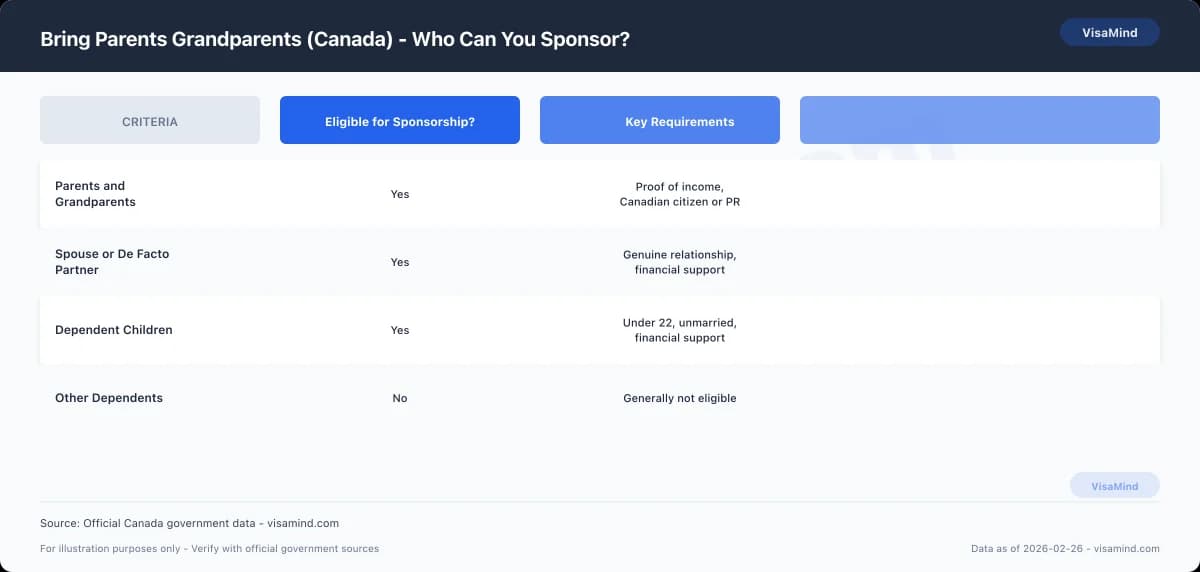
To sponsor a family member, you must meet specific eligibility criteria set by IRCC. These criteria include being at least 18 years old and a Canadian citizen or a permanent resident of Canada. Here is a brief overview of the eligible relationships that can be sponsored:
| Family Member | Eligibility Detail |
|---|---|
| Parents | Biological or adoptive parents can be sponsored if you meet the financial requirements to support them. |
| Grandparents | Biological or adoptive grandparents can also be sponsored under similar conditions as parents. |
| Spouse or Partner | Includes legally married partners, common-law partners, and conjugal partners. |
| Dependent Children | Children under 22 years old, or over if they have a physical or mental condition that makes them dependent. |
| Other Dependents | In exceptional cases, siblings or other relatives can be sponsored if they meet specific criteria. |
Important Considerations
Important: To sponsor your parents or grandparents, you need to demonstrate a sufficient income level to support them financially. This requirement is known as the Minimum Necessary Income (MNI) and varies depending on the number of family members you are supporting.
Before applying, ensure you have all necessary documentation, such as proof of relationship and personal information, to substantiate the sponsorship claim. Missing documents can delay the process or lead to a refusal. For those exploring alternatives, the Super Visa is another option that allows parents and grandparents to visit Canada for extended periods.
Related Sponsorship Options
If you are interested in sponsoring other family members, the Family Sponsorship Guide provides detailed information on eligibility and application processes. Additionally, the Spousal Sponsorship and Parent Grandparent Sponsorship pages offer insights into specific family sponsorship categories.
Understanding the eligibility criteria and requirements is fundamental to successfully sponsoring your parents or grandparents to become permanent residents in Canada. Always verify the latest requirements and guidelines on the official IRCC website to ensure compliance with current immigration laws and regulations.
Proving Your Relationship
#Proving your relationship is a critical step in sponsoring your parents or grandparents to become permanent residents in Canada. The Immigration, Refugees and Citizenship Canada (IRCC) requires comprehensive documentation to demonstrate the legitimacy of your familial connection.
Documents for Proof of Relationship
To successfully establish your relationship with your parents or grandparents, you may need to provide a combination of the following documents:
-
Birth Certificates and Adoption Papers: These documents are primary evidence of your biological or legally recognized relationship. Ensure they are certified copies.
-
Marriage Certificates: If applicable, provide marriage certificates to verify the marital status of your parents or grandparents. This is essential if you are sponsoring both parents or if they are accompanied by a spouse.
-
Family Book or Family Register: Some countries issue a family book or register that lists family members. This can serve as additional proof of familial ties.
Evidence of Cohabitation and Financial Interdependence
In some cases, demonstrating a shared life or financial interdependence can strengthen your application:
-
Joint Bank Statements: Providing copies of joint bank account statements can illustrate financial interdependence between you and your parents or grandparents.
-
Shared Utility Bills: Utility bills in both your names are useful to prove cohabitation. This is especially relevant if your parents or grandparents have been living with you.
-
Lease Agreements or Property Deeds: Documents showing shared ownership or rental of a residence can help establish cohabitation.
Additional Supporting Evidence
Beyond official documents, supplementary materials can further solidify your application:
-
Photographs: A collection of family photographs depicting you with your parents or grandparents over the years can provide visual evidence of your relationship.
-
Communication Records: Copies of phone bills, emails, or letters exchanged between you and your parents or grandparents can demonstrate ongoing communication and connection.
-
Affidavits from Friends or Family: Consider submitting affidavits from people who can attest to your relationship. These should be sworn statements that provide context and detail on your familial bond.
Important: Ensure that all documents are in English or French. If they are not, you must provide official translations. Missing or inadequate proof of relationship can lead to delays or denial of your sponsorship application.
For more detailed guidance on family sponsorship, refer to the Family Sponsorship Guide and explore options like the Parent Grandparent Sponsorship.
Sponsor Income and Savings
#When sponsoring parents or grandparents to become permanent residents in Canada, it's crucial to meet specific income thresholds and savings requirements. These criteria ensure that the sponsor can financially support the sponsored individuals adequately.
Income Requirements for Sponsorship
The Canadian government requires sponsors to demonstrate that they have a stable income to support the family members they wish to bring to Canada. The income threshold is determined by the Low Income Cut-Off (LICO) plus 30%. This ensures that sponsors can meet the essential needs of their household, including the sponsored individuals.
The income criteria are based on the number of people in the sponsor's family unit, including the sponsored parents or grandparents. Sponsors must show proof of income for the past three taxation years, typically through Notices of Assessment from the Canada Revenue Agency.
Savings and Maintenance Funds
In addition to income, having a certain level of savings can strengthen an application. While there isn't a specific savings requirement for sponsoring parents and grandparents, demonstrating a healthy savings account can indicate financial stability and preparedness for unforeseen expenses.
Income and Savings: A Comparison
Below is a concise table to help you understand the requirements better:
| Requirement | Description |
|---|---|
| Income Threshold | Must meet LICO plus 30% for the family unit size. |
| Proof of Income | Required for the past three taxation years, typically using CRA Notices of Assessment. |
| Savings | No specific requirement, but beneficial to demonstrate financial security. |
Important: Failing to meet the income requirements can result in application refusal. It’s crucial to verify the current income thresholds on the official IRCC website.
To further explore related visa options, you might consider the Parent Grandparent Sponsorship or the Super Visa, which offers an alternative route for parents and grandparents to visit Canada on long-term visas.
Understanding these financial requirements is a critical step in successfully sponsoring your parents or grandparents. For more detailed guidance, you can refer to the Family Sponsorship Guide, which provides comprehensive information on the application process and necessary documentation.
The Application Process
#-
Verify Eligibility and Gather Documents
Before starting the application process to bring your parents or grandparents to Canada, ensure you meet the eligibility criteria for sponsorship. As a sponsor, you must be a Canadian citizen or permanent resident and meet specific income requirements.
Gather all necessary documents, including proof of relationship to the individuals you wish to sponsor. This proof can include birth certificates or other legal documents that establish the familial connection. Additionally, prepare personal information such as your Social Insurance Number (SIN), financial details, and any relevant medical or work information.
Tip: Review the Parent Grandparent Sponsorship guidelines for detailed eligibility requirements and documentation checklists.
-
Submit an Interest to Sponsor Form
The next step is to express your interest in sponsoring your parents or grandparents. This is typically done through an online form made available by IRCC during specific periods each year. Once the form is submitted, IRCC randomly selects potential sponsors and invites them to submit a full application.
-
Receive an Invitation and Apply
If selected, you'll receive an invitation to apply. It's important to carefully follow the instructions provided by IRCC, which will guide you through completing the necessary forms and submitting the application. At this stage, you'll need to provide all required supporting documents and pay the necessary fees.
Important: Not submitting a complete application package, including all supporting documents and fees, can result in delays or refusal.
-
Biometrics and Medical Exams
As part of the application process, your parents or grandparents may be required to provide biometrics, including fingerprints and a photo. IRCC will inform you if this is necessary. Additionally, they may need to undergo medical examinations to ensure they meet health requirements. For more information, refer to the Biometrics Guide and Medicals And Police Certificates.
-
Attend Interviews if Required
In some cases, IRCC may request an interview with the applicants. This could be conducted in person or virtually, depending on the circumstances. It's essential to prepare for these interviews by reviewing potential questions and ensuring that all details provided in the application are consistent and accurate. You can find helpful tips in the Interview Prep guide.
Completing these steps carefully and thoroughly will facilitate the process of bringing your parents or grandparents to Canada. Always check for the most current information and application periods on the official IRCC website.
Processing Times and Waiting
#
Processing times for the Parent and Grandparent Sponsorship Program can vary significantly based on several factors. Understanding these timelines and what affects them can help you plan more effectively.
What Are the Processing Times?
The processing times for the Parent and Grandparent Sponsorship can fluctuate depending on the volume of applications and other considerations. As of the latest data, the average processing time ranges from 20 to 24 months. Always verify the current timelines on the official IRCC website to ensure you have the most up-to-date information.
Factors Affecting Processing Speed
Various elements can influence how quickly your application is processed. Here are key factors:
- Completeness of Application: Ensure all required documents, such as proof of relationship and personal information, are submitted. Missing documents can lead to delays.
- Volume of Applications: High submission volumes can extend processing times.
- Verification Needs: Additional scrutiny may be required for complex cases, which can add to the timeline.
Priority Categories
Certain applications might receive faster processing under specific circumstances. While there are no formal priority categories for the Parent and Grandparent Sponsorship, ensuring that your application is complete and accurate can aid in a smoother process.
Processing Times Comparison
To give you a clearer picture, here’s a comparison with other related visa and sponsorship categories:
| Program Type | Average Processing Time | Influencing Factors | Notes |
|---|---|---|---|
| Parent and Grandparent Sponsorship | 20-24 months | Application volume, completeness | Permanent residency path |
| Super Visa | A few weeks to months | Medical exam results, document accuracy | Temporary stay up to 2 years per visit |
| Spousal Sponsorship | 12 months | Relationship proof, completeness | Permanent residency path |
Tip: Use the Processing Times Explained guide to understand how IRCC calculates processing times.
Staying informed about the processing timelines and factors impacting them will help you manage expectations and prepare for your family's future in Canada. Always keep an eye on the official IRCC updates for the most current information.
Common Refusal Reasons
#When sponsoring parents or grandparents to become permanent residents in Canada, several common reasons can lead to application refusals. Understanding these can help you better prepare your application.
Insufficient Evidence
-
Proof of Relationship: One of the main reasons for refusal is the failure to provide sufficient proof of your relationship with the sponsored individuals. Ensure you gather documents such as birth certificates or family registries that clearly demonstrate your familial connection.
-
Inadequate Documentation: Missing or incomplete documents can also result in refusals. It's crucial to follow the guidelines provided by IRCC closely and ensure all required documents are included with your application.
Financial Shortfalls
-
Minimum Necessary Income (MNI): As a sponsor, you must demonstrate that you meet the Minimum Necessary Income requirements for three consecutive tax years prior to the application. If your financial documentation does not meet these thresholds, your application may be refused. You can find further details in the Proof Of Funds guide.
-
Inaccurate Financial Information: Providing incorrect or inconsistent financial information can lead to refusal. Be sure your financial statements and tax documents are accurate and up-to-date.
Medical and Character Issues
-
Medical Inadmissibility: If the medical examination reveals that the sponsored individuals have health conditions that could pose excessive demand on Canada’s health or social services, the application may be refused. For more information, refer to the Medicals And Police Certificates guide.
-
Criminal Record: Any criminal history can negatively impact the application. It is important to declare all past convictions and provide necessary documentation.
Sham Marriage Concerns
- Genuine Intent: Although this section focuses on parents and grandparents, it's worth mentioning that concerns about sham marriages can affect family sponsorship applications. Ensure that all aspects of your application genuinely reflect your intent and relationship.
Important: Comprehensive and honest documentation is key to avoiding refusals. If you face complexities or uncertainties, consider consulting with an immigration professional to enhance your application’s chances of success.
What You Can Do While Waiting
#While waiting for your application to sponsor your parents or grandparents to become permanent residents in Canada, there are several important factors to consider. These include work rights, travel restrictions, and maintaining legal status in Canada.
Work Rights in Canada
If you are waiting on a sponsorship application, you may still be eligible to work in Canada. This is particularly relevant if you are on a temporary status and have applied for a Bridging Open Work Permit (BOWP). The BOWP allows you to remain in Canada and continue working while your permanent residence application is being processed. For more detailed information, you can explore our Bridging Open Work Permit guide.
Tip: Applying for a Bridging Open Work Permit can help prevent employment disruptions while your application is pending.
Can You Travel While Waiting?
Traveling outside Canada while your sponsorship application is being processed can be risky. If you leave Canada, you might face challenges re-entering the country, particularly if your current visa status does not guarantee re-entry. If you must travel, ensure that your travel documents and status allow for re-entry into Canada. For those in Canada on a Temporary Resident Visa, the Temporary Resident Permit might provide an alternative option if your current visa does not support multiple entries.
Maintaining Status: Implied and Bridging
In Canada, maintaining your legal status is crucial while your application is pending. If your current status is about to expire, you should apply for an extension to maintain implied status. Implied status allows you to remain in Canada under the conditions of your initial permit until a decision is made on your extension application. For those eligible, applying for a Bridging Open Work Permit can also provide a seamless transition while waiting for permanent residence approval.
Important: Ensure that you apply for any extensions before your current status expires to maintain implied status.
Additional Considerations
While waiting, staying informed about your application status and any required next steps is vital. You can track your application through the IRCC's online portal and consult guides on Processing Times Explained to understand typical timelines. Additionally, keeping your contact information updated with IRCC ensures you receive all notifications promptly.
By understanding your rights and responsibilities during this period, you can better navigate the waiting process while ensuring that your legal status in Canada remains uninterrupted.
Rights and Restrictions After the Visa
#Once your parents or grandparents become permanent residents in Canada, they gain several rights, along with certain responsibilities and restrictions. Here's what you need to know about their status and what it entails.
Rights of Permanent Residents
As permanent residents, your parents or grandparents will have the right to:
- Live, work, and study anywhere in Canada: They can choose any province or territory to reside in and are free to pursue employment or educational opportunities without additional permits.
- Access most social benefits: This includes health care coverage, which is a significant advantage for elderly family members.
- Apply for Canadian citizenship: After fulfilling residency requirements, they may be eligible to apply for citizenship, gaining the full rights of Canadian citizens.
- Protection under Canadian law and the Canadian Charter of Rights and Freedoms: They enjoy the same legal protections as Canadian citizens.
Important: Permanent residents must carry and present their valid PR card or permanent resident travel document (PRTD) when traveling to Canada.
Residency Requirements and Conditions
To maintain permanent resident status, your parents or grandparents must comply with certain residency requirements:
- Physical Presence: They must live in Canada for at least 730 days within any five-year period. This period does not need to be continuous.
- Compliance with Canadian laws: Permanent residents must abide by all Canadian laws at the federal, provincial, and municipal levels.
Failing to meet these conditions can lead to the loss of permanent resident status.
Restrictions on Permanent Residents
While permanent residents enjoy many rights, they also face specific restrictions:
- Voting and Political Office: They cannot vote in Canadian elections or run for political office until they become Canadian citizens.
- Certain High-Security Jobs: Some jobs requiring a high level of security clearance are only available to Canadian citizens.
For more detailed guidance on maintaining permanent residency and potential pathways to citizenship, explore resources like the Permanent Residence guide or the PR Pathways Overview. These resources provide valuable insights into the responsibilities and opportunities for permanent residents in Canada.
Path to Permanent Residence
#When sponsoring parents or grandparents to become permanent residents of Canada, understanding the path from sponsorship to permanent residency and eventually citizenship is key. This journey involves several stages, each with its own timeline and requirements.
Transition to Permanent Residency
Once your sponsorship application is approved, your parents or grandparents will receive confirmation allowing them to become permanent residents. This status grants them the right to live, work, and study in Canada. The transition from sponsorship approval to permanent residency can vary, but it generally takes several months. For up-to-date processing details, visit the Processing Times Explained guide.
Benefits of Permanent Residency
Upon receiving permanent residency, your parents or grandparents will have access to several benefits, including:
- Health Care: Access to Canada's public health care system.
- Education: Eligibility for subsidized education at Canadian institutions.
- Work Opportunities: The ability to work for any employer without a need for a separate work permit.
Tip: Encourage your family members to apply for a Bridging Open Work Permit if they wish to work while waiting for their permanent residency application to be finalized.
Path to Canadian Citizenship
After maintaining permanent residency status for a set period, your family members may be eligible to apply for Canadian citizenship. Generally, this requires residing in Canada for three out of the last five years and demonstrating adequate knowledge of English or French. The citizenship application process typically includes a test on Canadian history, values, and symbols.
Key Considerations
- Residency Obligation: Permanent residents must physically reside in Canada for at least 730 days within a five-year period to maintain their status.
- Citizenship Application: Additional documentation, such as proof of language skills and a clean criminal record, will be required when applying for citizenship.
Important: Failure to meet the residency obligation could result in the loss of permanent residency status.
For further details on the steps to becoming a permanent resident or citizen, explore our Permanent Residence overview.
What Other Families Experienced
#A Canadian permanent resident, Maria, wanted to sponsor her elderly parents to join her in Canada. She was concerned about meeting the required financial criteria for sponsorship, as her job situation had recently changed. To address this, Maria reviewed the detailed eligibility guidelines provided by the Immigration, Refugees and Citizenship Canada (IRCC) and consulted the Family Sponsorship Guide. She diligently gathered all necessary financial documents, including her employment history and proof of income over the past three years. After submitting her application, Maria received a positive response within eight months, allowing her parents to start the process of becoming permanent residents.
Scenario: Proving Relationship Documentation
Raj, a software engineer living in Toronto, faced the challenge of proving his relationship with his grandparents for sponsorship. Aware of the potential pitfalls, he meticulously collected various documents, including birth certificates and family photographs, to establish a clear lineage. Raj used the Visa Application Steps as a guide and ensured all documents were complete and accurate before submission. Thanks to his thorough preparation and attention to detail, Raj's application was approved within nine months, and his grandparents were able to relocate to Canada permanently.
Scenario: Medical Requirements
Samantha, a nurse in Vancouver, aimed to sponsor her parents. However, her mother had a pre-existing medical condition that she feared might complicate the application. Samantha consulted the Medicals And Police Certificates guide to understand the medical examination requirements. She arranged for her mother to undergo a medical examination with an IRCC-approved panel physician. By following the guidelines and submitting detailed medical records, Samantha was able to reassure the authorities of her mother’s health stability. Within a year, her parents received approval to move to Canada, thanks to Samantha's proactive approach and thorough documentation.
FAQs
How do I check the processing time for a Bring Parents Grandparents (Canada) sponsorship application?
Can I switch from a visitor visa to a sponsored parent visa in Canada?
How can I prove my income for sponsoring parents and grandparents to Canada?
What are the common reasons for refusal in the Bring Parents Grandparents (Canada) program?
Is it possible to combine a Super Visa with a Bring Parents Grandparents (Canada) application?
What is the purpose of the Bring Parents Grandparents (Canada) form?
What are the rights of parents after receiving a visa through the Bring Parents Grandparents (Canada) program?
Sources
Last reviewed: March 1, 2026
VisaMind provides informational guidance only and is not a government agency. This is not legal advice. Requirements can change and eligibility depends on your specific facts. If your case is complex or high-stakes, consult a licensed immigration attorney.
Next steps
Requirements vary by nationality, purpose, timeline, and case details. Use Find My Visa to get a personalized checklist for Canada with official sources and deadlines.
Find my visa