How Financial Proof Works
#In Vietnam, financial proof is a critical component of the visa application process, ensuring that applicants possess the necessary funds to support their stay in the country. While the exact financial requirements can vary depending on the type of visa you are applying for, the principle remains the same: demonstrating sufficient financial means to cover expenses like accommodation, travel, and daily living costs. This is particularly relevant for visas such as the Tourist Visa (DL Symbol), Business Visa (DN Symbol), and Student Visa (DH Symbol).
What Constitutes Financial Proof?
For most visa categories, financial proof involves submitting documents that clearly indicate your financial stability. Common forms of acceptable proof include recent bank statements, pay slips, tax returns, or sponsorship letters. The Immigration Department of Vietnam evaluates these documents to ensure applicants have access to funds that are not only adequate but also readily available throughout their stay.
Why Is Financial Proof Required?
The requirement for financial proof is part of Vietnam's immigration policy to prevent over-reliance on public resources and to ensure that visitors can sustain themselves independently. This measure helps in maintaining national economic stability and reduces the risk of illegal employment or overstaying. For visas like the Investor Visa (DT Symbol), additional documentation might be required to demonstrate the financial investment capacity in Vietnam.
Tip: Ensure all financial documents are up-to-date and reflect accurate information to avoid delays or rejections.
How Is Financial Proof Evaluated?
The Immigration Department of Vietnam typically looks for consistency and authenticity in your financial documents. This involves verifying the source of your funds, checking for any discrepancies, and ensuring that the financial standing aligns with the duration and purpose of your visit. For instance, a student applying for a Student Visa (DH Symbol) might need to show proof of tuition payment and additional funds for living expenses.
Important: Submitting incomplete or inaccurate financial documents can result in application denial. Always double-check your submissions for accuracy.
Understanding how financial proof works within Vietnam's visa application process is essential for a successful application. By ensuring your financial documentation meets the Immigration Department's standards, you can significantly enhance your chances of obtaining the desired visa and enjoying a smooth entry into Vietnam.
Financial Thresholds by Category
#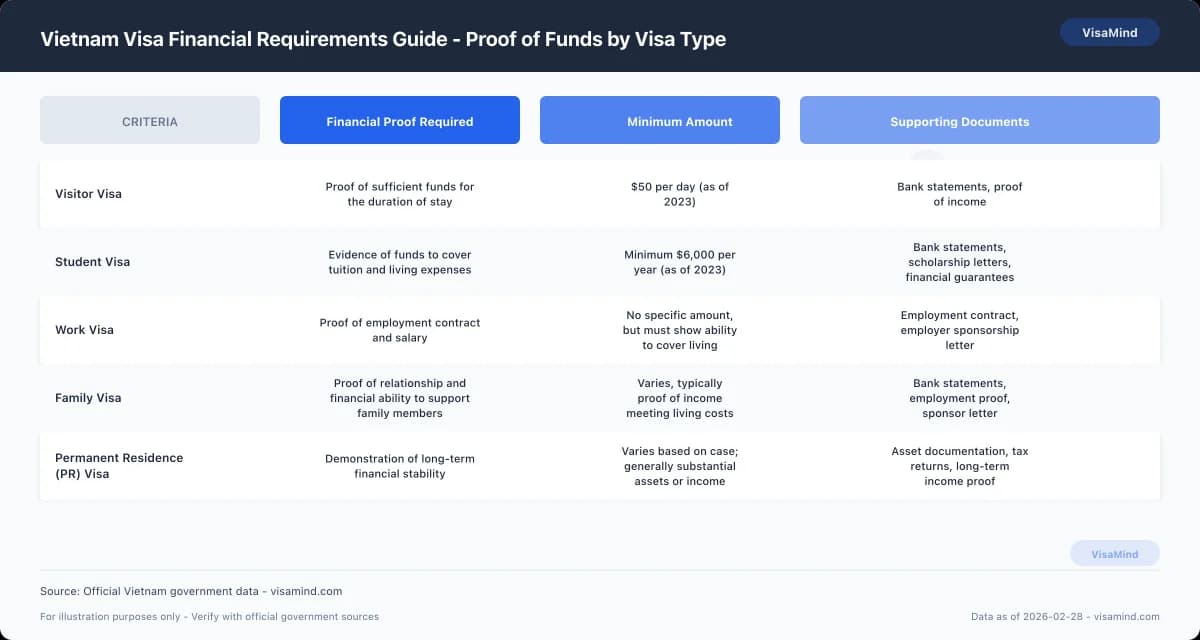
The Immigration Department of Vietnam requires applicants to demonstrate sufficient financial means. This ensures that applicants can support themselves while in the country. Below, we outline the financial thresholds and evidence required for different categories of visas, including visitor, student, work, family, and permanent residence visas.
Financial Thresholds by Visa Category
| Visa Type | Financial Evidence Required | Minimum Financial Threshold |
|---|---|---|
| Visitor Visa | Bank statements, proof of income, or sponsor letter | Typically around $1,000 USD per month as of early 2026 — always verify current amounts with the official authority, verify on the official website |
| Student Visa | Proof of scholarship, bank statements, or sponsor letter | Minimum balance of $3,000 USD in a bank account as of early 2026 — always verify current amounts with the official authority, verify on the official website |
| Work Visa | Employment contract and/or proof of income | Must show ability to cover living costs, generally $1,500 USD per month as of early 2026 — always verify current amounts with the official authority, verify on the official website |
| Family Visa | Proof of relationship, financial support affidavit | Varies based on family's income, no fixed threshold but must demonstrate financial capability |
| Permanent Residence | Proof of sustained financial means, such as income statements or assets | Typically requires proof of long-term financial stability, consult Permanent Residence Card guidelines |
What Documents Can Prove Your Financial Means?
For each visa type, you are required to submit specific documents that prove your financial capability:
- Bank Statements: These should be recent and cover the last three to six months. They must clearly show your account balance and transaction history.
- Proof of Income: This can be in the form of salary slips, tax returns, or any official document that indicates regular income.
- Sponsorship Letter: If you have a sponsor, they must provide a letter stating their relationship to you and their commitment to support you financially. This should be accompanied by their financial documents.
Important: Ensure all financial documents are translated into Vietnamese or English and certified if originals are in another language.
Tips for a Successful Application
- Ensure Accuracy: Double-check all financial documents for accuracy and completeness. Any discrepancies might lead to delays or denial of your visa.
- Consult Official Sources: Requirements might change, so always verify the latest financial thresholds and document requirements on the official website.
- Use Internal Resources: For guidance, consider consulting the How To Apply and Documents Checklist pages for Vietnam visas.
By understanding and preparing the necessary financial documentation, you enhance your chances of a successful visa application process. Always stay informed of the latest requirements and consult the Immigration Department of Vietnam for any clarifications.
What Your Bank Statements Must Show
#Providing bank statements as proof of financial capability is a crucial step. The Immigration Department of Vietnam requires applicants to submit detailed financial documentation to demonstrate that they have sufficient funds for their stay.
Bank Statement Duration
- Minimum Months Required: You must provide bank statements covering at least three months prior to your visa application. This period allows the Immigration Department to assess your financial stability over time.
Balance Requirements
- Minimum Balance: While there isn't a universally fixed amount for all visa types, applicants should ensure that their account balance is adequate to cover their anticipated expenses in Vietnam. As a general guide, a balance that covers living expenses for your intended stay is recommended.
- Average Balance: Besides the minimum balance, some visa categories may require evidence of a consistent average balance over the three-month period. This ensures that the funds are not just recent deposits but represent sustained financial capability.
Tip: It's advisable to maintain a stable balance well in advance of your application to avoid any suspicion of last-minute deposits.
Eligible Accounts
- Types of Accounts: Savings accounts, checking accounts, and fixed deposit accounts are typically acceptable. Ensure that the account is under your name as per the identification documents submitted.
- Joint Accounts: Joint accounts may also be considered, provided you can demonstrate your access and rights to the funds. Documentation proving your relationship with the co-holder and your ability to access the funds may be required.
Important Considerations
- Currency and Conversion: If your bank statements are in a foreign currency, it is recommended to present a conversion to Vietnamese Dong (VND) or US Dollars (USD) for clarity.
- Official Translations: Bank statements not originally in Vietnamese or English should be accompanied by an official translation. This ensures that the Immigration Department can accurately assess your financial situation.
For more details on visa types and their specific financial requirements, consider reviewing the Tourist Visa (DL Symbol) and Business Visa (DN Symbol) pages. Also, check out the How To Apply guide for comprehensive application steps.
Important: Providing inaccurate or misleading financial information can lead to visa denial. Ensure all documents are complete and verifiable by the Vietnamese authorities.
What Counts as Acceptable Funds
#Important: Ensure that all financial documents you provide are genuine and verifiable; discrepancies can lead to visa denial by the Immigration Department of Vietnam.
When applying for a visa to Vietnam, demonstrating adequate financial resources is essential. The Immigration Department of Vietnam requires specific types of financial documentation to establish the financial stability of applicants. Below is a detailed explanation of what constitutes acceptable funds for visa applications.
Cash Savings and Bank Accounts
- Personal Savings: A bank statement from a recognized financial institution showing your personal savings is considered acceptable. Ensure the account is in your name and reflects a stable balance over time.
- Fixed Deposits: Certificates of fixed deposits can also be used, provided they are in your name and are readily accessible.
Investments and Property
- Investment Portfolios: Documentation proving ownership of stocks, bonds, or mutual funds can demonstrate financial stability. Ensure these are liquid or easily convertible to cash.
- Property Assets: Ownership documents of real estate properties can be used as proof of financial capability. This includes property deeds or valuation reports.
Scholarships and Financial Aid
- Scholarships: Official letters confirming a scholarship from a recognized institution, detailing the amount and duration, are acceptable.
- Educational Grants: Letters of grant approval from government or educational bodies can be used to support your application.
Unacceptable Sources of Funds
While various financial assets can support your visa application, some sources are not considered valid by the Immigration Department of Vietnam.
- Unsecured Loans: Loans without collateral or those that are not from recognized financial institutions are typically not accepted.
- Informal Borrowing: Personal loans or financial gifts from friends or family without formal documentation are not valid.
- Non-liquid Assets: Assets that cannot be readily converted into cash, such as personal belongings or collectibles, do not count as acceptable funds.
Tip: Ensure all financial documents are translated into Vietnamese or English, as required, to facilitate the application process.
For more information on visa types and application procedures, you can explore the E Visa and Student Visa sections, which provide further insights into the specific requirements for different visa categories.
Common Financial Mistakes
#When you're applying for a visa to Vietnam, it's crucial to provide accurate and complete financial documentation. Many applicants encounter issues due to common financial mistakes. Here's how to avoid them:
Last-Minute Deposits
- Avoid Sudden Large Deposits: A sudden influx of funds in your bank account can raise suspicions. Ensure that your bank statements reflect a consistent balance over a period of time. This demonstrates financial stability and reliability.
Insufficient Financial History
-
Provide a Comprehensive Financial Record: It's important to submit bank statements that cover a significant period, generally three to six months. This provides the Immigration Department with a clear view of your financial habits and stability.
-
Maintain Adequate Funds: Ensure your account consistently holds sufficient funds to cover your stay in Vietnam. The exact amount can vary based on the visa type, so verify the latest requirements on the official website.
Wrong Currency
- Use the Correct Currency: Ensure that your financial documents are in a currency that is widely accepted and easily convertible. While Vietnamese Dong (VND) is ideal, major currencies like USD or EUR are usually acceptable. Convert your funds to a recognized currency to avoid complications.
Missing Explanations for Transactions
- Clarify Unusual Transactions: If your bank statements include any large or irregular transactions, provide an explanation. This can prevent any assumptions of financial instability or misconduct. Include supporting documents if necessary.
Tip: Providing a clear and consistent financial history can significantly increase your chances of a successful visa application. If any part of your financial documentation is unclear, it might be helpful to include a letter of explanation.
For more insights into the visa process, consider checking our resources on How To Apply and the Documents Checklist. These guides can help you navigate the application process more effectively.
When Someone Else Pays
#Financial proof can come from a sponsor or guarantor. This section examines what is required from sponsors to satisfy the Immigration Department of Vietnam's financial requirements.
What is Required from a Sponsor?
When a sponsor or guarantor provides financial support for a visa application, they must furnish several documents to demonstrate their ability and commitment to financially support the applicant. The key documents typically include:
- Income Statements: Proof of income, such as salary slips or bank statements, showing consistent earnings that are sufficient to support the applicant during their stay in Vietnam.
- Affidavit of Support: A formal statement confirming the sponsor's intention and ability to support the visa applicant. This should clearly outline the nature of the relationship and the level of financial support being provided.
- Tax Returns: Copies of recent tax filings can further validate the sponsor's financial capacity. These documents help establish a clear picture of the sponsor's financial health.
Important: Ensure all documents are translated into Vietnamese and certified by the appropriate authorities to avoid delays.
How to Demonstrate Financial Capability?
To adequately demonstrate financial capability, sponsors must ensure that their documentation is thorough and meets the standards set by the Immigration Department. Here's a breakdown of what to include:
1. Detailed Financial Statements:
These should cover at least the past six months and include all relevant income and expenses. 2.
Legal Residency Proof:
Documents confirming the sponsor's legal residency status, such as a residence card or visa, are required. 3.
Relationship Documentation:
Evidence of the relationship between the sponsor and the applicant, like family registers or notarized letters.
Tips for a Smooth Process
Tip: Compile all financial documents in advance and cross-check them with Documents Checklist to ensure nothing is missing.
For those applying for specific visa types, such as a Tourist Visa (DL Symbol) or Business Visa (DN Symbol), the sponsor's financial proof can often expedite the process by providing additional assurance to the authorities.
Common Pitfalls to Avoid
Sponsors often make mistakes that can lead to application delays or rejections. Here are some common pitfalls:
- Incomplete Documentation: Missing any required document could result in application rejection.
- Inaccurate Information: Providing incorrect or inconsistent information across documents can raise red flags.
- Non-Verified Translations: Documents not translated by certified professionals may not be accepted.
For more detailed guidance on the application process, consider visiting How To Apply and familiarize yourself with the necessary steps to ensure a successful visa application.
A Practical Financial Checklist
#1. Begin Early and Maintain Consistent Records
Starting your financial documentation process early is essential when applying for a visa to Vietnam. Begin by gathering all necessary financial documents, such as bank statements, proof of income, and any additional financial certifications that demonstrate your ability to support yourself during your stay. Ensure that these records are consistent and cover a sufficiently long period to show financial stability. Regularly updating and organizing these documents will help you avoid last-minute rushes.
Tip: Consistent financial documentation over six months is often recommended to demonstrate stability. Verify current requirements on the Immigration Department of Vietnam's official website.
2. Prepare Cover Letters for Unusual Patterns
If there are any unusual patterns in your financial records, such as large deposits or withdrawals, it is advisable to include a cover letter with your application. This letter should clearly explain these transactions to avoid any misunderstandings during the review process. Providing context helps the Immigration Department understand your financial situation better and speeds up your application processing.
3. Compile All Required Documents Thoroughly
Make sure to compile all necessary documents before lodging your visa application. This typically includes a passport data page image, a recent photograph, and any documents proving legal residence. Depending on your visa type, like an Investor Visa or Work Visa, additional documents such as a labor contract or ID card from a representative agency may be required.
Important: Submitting incomplete or non-compliant documents will lead to delays or rejection. Check the Documents Checklist to ensure completeness.
4. Utilize Digital Tools and Online Portals
Consider using the online application portals provided by the Immigration Department to lodge your application. These portals often provide step-by-step guidance and immediate feedback on the completeness of your documents. They also allow for electronic submission of financial documents, making the process more efficient and traceable.
Tip: Using the online system helps you avoid mail delays and provides a receipt number for tracking your application status.