Can You Extend Your Visa?
#Foreigners holding certain types of visas in Vietnam can extend their stay through the Immigration Department of Vietnam (Cục Quản lý xuất nhập cảnh), provided they meet specific eligibility criteria. The options for extension differ based on the visa type. Here's a detailed look:
| Visa Type | Eligibility for Extension | Notes |
|---|---|---|
| Tourist Visa (DL) | Eligible | Typically extends for 1-3 months. |
| Business Visa (DN) | Eligible | Can be extended for 1-3 months, often needing sponsorship. |
| Investor Visa (DT) | Eligible | Extensions can be longer, up to 12 months. |
| Work Visa (LD) | Eligible | Requires employer sponsorship and a valid work permit. |
| Student Visa (DH) | Eligible | Needs confirmation from educational institution. |
| E-Visa | Not eligible directly | Must exit and reapply, no direct extensions. |
| Visa on Arrival | Eligible | Similar to tourist or business visas, conditions apply. |
Key Points About Visa Extensions
Foreigners on a Tourist Visa (DL) or a Business Visa (DN) can apply for extensions ranging from one to three months. The application typically involves submitting a document request from a sponsor in Vietnam. If you hold a Business Visa, having a local sponsor is often necessary.
Important: Ensure your sponsor and documentation are legitimate to avoid complications.
Special Visa Types
For those on an Investor Visa (DT), the process is more favorable. As an investor, you can typically extend your visa for longer periods, potentially up to 12 months. This is contingent on your investment activities and legal compliance in Vietnam.
Work Visas (LD) also allow for extensions, but they require a valid work permit and sponsorship from your employer. The extension period aligns with your employment contract duration.
Non-Extendable Visas
Certain visa types, like the E-Visa, do not offer direct extension options. If you're on an E-Visa and wish to stay longer, you must exit Vietnam and reapply for a new visa. Similarly, while Visa on Arrival holders can seek extensions, it follows the same pathway as tourist or business visas.
Tip: For those on non-extendable visas, consider Visa On Arrival options for a longer stay in Vietnam.
For further details on the extension process, visit the How To Apply and Documents Checklist guides. Always verify the latest requirements and procedures on the official website or through trusted local agents.
Submitting Your Extension Request
#1. Determine the Application Method
You have two options for submitting your Vietnam visa extension request: online or in-person. For those comfortable with digital processes, the online method is convenient and allows for efficient tracking. However, if you prefer face-to-face interaction or require assistance, visiting an Immigration Department of Vietnam office may be more suitable.
2. Gather Required Documents
Before submitting your extension request, ensure you have all necessary documents prepared. Common requirements include:
- A completed application form.
- A declaration form and any relevant papers proving legal residence.
- A passport data page image and a recent photograph (4x6 cm in JPG or JPEG format, file size less than 2MB).
- For specific visa categories like Business Visa (DN Symbol) or Work Visa (LD Symbol), additional documents such as an ID card or labor contract may be required.
Tip: Double-check your documents against the Documents Checklist to ensure nothing is missing.
3. Prepare and Submit Your Application
-
Online Submission: Access the public service portal to upload your documents. Ensure you fulfill required information fields and upload necessary documents, including a portrait and biometric passport photo. Confirm the declaration information and proceed by entering the verification code. Once satisfied, agree to the terms and proceed to payment.
-
In-Person Submission: Visit the competent domestic agency, usually the Immigration Department of Vietnam or the Commune Police, to submit your documents. You may also need to provide a document of notice/request to invite or sponsor foreigners from agencies, organizations, or individuals in Vietnam.
4. Pay Applicable Fees
Regardless of the submission method, payment of the extension fee is required. For online applications, payment can be made through the portal. For in-person submissions, fees are typically paid directly at the office.
Important: Ensure all information is declared in English. Failure to do so may result in application denial.
5. Track Your Application Status
After submission, monitor your application status. If applying online, enter your registration code, email, and date of birth on the portal to check the result. For in-person applications, inquire directly with the Immigration Department or Commune Police.
By following these steps, you can navigate the process of extending your Vietnam visa with confidence. For more details on application procedures, refer to resources like How To Apply for comprehensive guidance.
Extension Document Checklist
#It's essential to prepare the necessary documents as specified by the Immigration Department of Vietnam. Ensure that you have all required documentation to avoid any delays in processing your application. Below is a checklist of essential documents needed for a successful visa extension application.
Personal Documents
- Passport: A valid passport with a minimum of six months validity remaining. Include the data page and any pages with current Vietnam visa stamps.
- Passport Photo: A recent 4x6 cm photograph in JPG or JPEG format, with a file size of less than 2MB. The photo should be a straight-on portrait without glasses.
Application and Declaration Forms
- Visa Extension Application: Obtain and complete the appropriate application form. This is crucial for processing your request.
- Declaration of Residence: Include a declaration of your current residence status. Use Form CT01, as issued with Circular No. 56/2021/TT-BCA, to declare any changes in residence information.
Sponsorship and Employment Documents
- Invitation or Sponsorship Document: A formal notice or request from your inviting or sponsoring agency, organization, or individual in Vietnam.
- Employment Verification: For those on a Work Visa (LD Symbol), provide a valid labor contract if applicable.
Additional Requirements for Specific Visa Types
- ID Card Copy: Required for those visiting foreign representative agencies in Vietnam.
- Proof of Temporary Residence: Include details such as your surname, middle name, first name, date of birth, gender, personal identification number, and temporary residence period.
Important: Incomplete or incorrect documentation can lead to application rejection. Ensure all information is accurate and up-to-date.
Submission and Verification
Once all documents are gathered, submit them directly to the competent domestic agency of the Ministry of Foreign Affairs or the local Commune Police, as required. You may also have the option to submit your documents online through public service portals. After submission, it is essential to verify your application status using your registration code, registration email, and date of birth.
For more detailed steps on how to apply and what to expect during the processing period, you can refer to our How To Apply guide for comprehensive information. Additionally, understanding Visa Refusal Reasons could help avoid common pitfalls during your application process.
Fees and Processing Times
#When extending your Vietnam visa through the Immigration Department of Vietnam, understanding the fees and processing times is crucial. Here’s a breakdown of the costs, timelines, and expedited options available for different visa types.
Fees and Processing Times
| Visa Type | Extension Fee (USD) | Standard Processing Time | Expedited Processing Option |
|---|---|---|---|
| Tourist Visa (DL) | $25 | 5-7 working days | Available for additional fee |
| Business Visa (DN) | $30 | 7-10 working days | Available for additional fee |
| Work Visa (LD) | $35 | 10-15 working days | Available for additional fee |
| Investor Visa (DT) | $40 | 15-20 working days | Available for additional fee |
Important: Ensure your documents are complete and accurate. Incomplete submissions can lead to delays or rejection of your application.
Expedited Processing
If you require a faster processing time, the Immigration Department offers expedited services for an additional fee. The specific cost and time reduction depend on the visa type and urgency. Contact the Immigration Department of Vietnam for precise details on expedited processing options.
Payment and Submission
You can submit your application either in person at the local immigration office or online through the public service portal. Payment of the extension fee is typically done at the time of submission. It's essential to confirm the payment methods accepted by the Immigration Department, as options may vary.
Tip: Submitting your application online can save time and provide you with immediate confirmation of receipt. For guidance, refer to the How To Apply section.
For more information on processing times and any potential updates, you can refer to the Processing Times guide. Always verify the latest fees and timelines on the official website as they are subject to change.
What If You Overstay
#Overstaying your visa in Vietnam can lead to significant consequences. It's important to be aware of the penalties and how they might impact future visa applications.
Consequences of Overstaying
If you overstay your visa in Vietnam, you could face fines, deportation, and even bans from re-entering the country. The fines are calculated based on the number of days you have overstayed, and they can increase quickly.
- 1-3 days over: Typically incurs a fine of around 500,000 VND per day.
- 4-10 days over: The fine can range from 1,250,000 VND to 4,000,000 VND.
- Over 10 days: You may face higher fines, potential deportation, and a possible re-entry ban.
Important: Failing to settle fines or resolve your immigration status can lead to further legal actions, including detention.
Impact on Future Visa Applications
Overstaying your visa can severely impact your ability to apply for future visas. When you attempt to apply for another visa type, such as a Tourist Visa (DL Symbol) or a Work Visa (LD Symbol), the record of your overstay may cause your application to be scrutinized more closely or even rejected.
- Visa Rejection: Overstaying can be noted in your immigration record, leading to increased scrutiny or automatic rejection of future visa applications.
- Application Delays: Processing times for future applications may be extended as the Immigration Department conducts thorough reviews.
- Limited Visa Options: Certain visa types may become unavailable, affecting your ability to choose how you visit or stay in Vietnam.
Preventive Measures and Solutions
To avoid the complications of overstaying, it's crucial to monitor your visa's expiration date and take proactive steps to extend your stay if needed. Consider these options:
-
Apply for a Visa Extension: Before your visa expires, consider extending your stay through the Immigration Department of Vietnam. Ensure you have all necessary documents ready, such as the application form and proof of legal residence.
-
Explore Alternatives: If extending your visa is not feasible, consider other options such as applying for a Temporary Residence Card or a Visa On Arrival, if eligible.
-
Plan Your Departure: If an extension or alternative visa is not possible, plan your departure from Vietnam well before the expiration date to avoid overstay penalties.
Tip: Keep a digital and physical copy of your visa expiration date and set reminders to review your options well in advance.
By understanding the implications of overstaying and taking timely action, you can protect your future travel opportunities in Vietnam. Always verify the most current regulations and processes with the Immigration Department of Vietnam for the latest updates.
Which Visas Are Extendable
#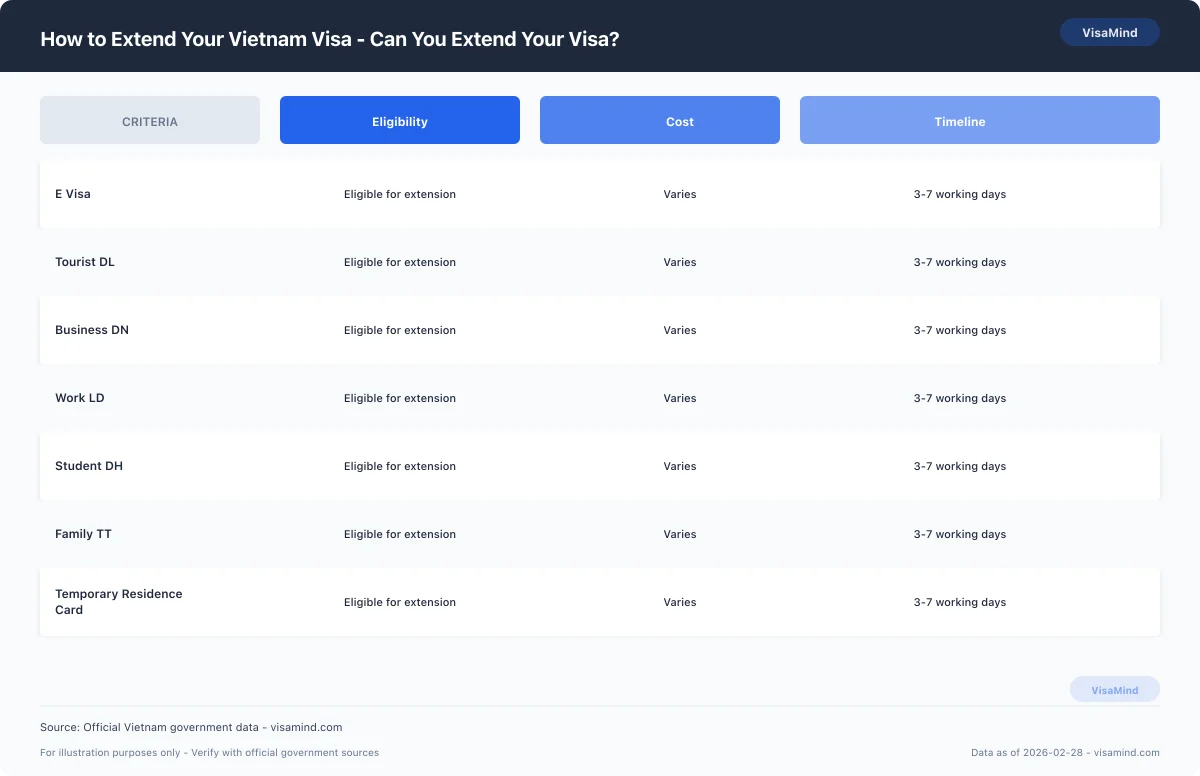
Important: Certain visa categories are not eligible for extension in Vietnam. Ensure your visa type is extendable before proceeding with the application process.
Which Visas Are Extendable?
Extending your stay in Vietnam requires understanding the eligibility and conditions for different visa types. Below is a detailed breakdown of which visas can be extended, the eligibility criteria, associated costs, and typical processing timelines.
| Visa Type | Eligibility | Cost (USD) | Timeline |
|---|---|---|---|
| Tourist Visa (DL Symbol) | Tourists with ongoing travel plans in Vietnam. Must not have violated visa conditions. | $10 - $45 (as of early 2026 — always verify current amounts with the official authority; verify on the official website) | 5-10 working days |
| Student Visa (DH Symbol) | Students enrolled in recognized educational institutions in Vietnam. Requires confirmation from the institution. | $30 - $60 (as of early 2026 — always verify current amounts with the official authority; verify on the official website) | 5-7 working days |
| Work Visa (LD Symbol) | Foreigners with valid work permits. Employer sponsorship is required. | $70 - $100 (as of early 2026 — always verify current amounts with the official authority; verify on the official website) | 5-10 working days |
| Family Visa (TT Symbol) | Family members of Vietnamese citizens or foreigners residing in Vietnam. Proof of relationship is necessary. | $40 - $80 (as of early 2026 — always verify current amounts with the official authority; verify on the official website) | 5-7 working days |
Tourist Visa
Tourist visas, or DL visas, are extendable for those wishing to explore Vietnam further. Ensure you apply for an extension before your current visa expires to avoid overstaying penalties.
Student Visa
For students on a Student Visa (DH Symbol), extensions are generally straightforward but require documentation from your educational institution. It's crucial to maintain your student status to remain eligible.
Work Visa
Holders of Work Visa (LD Symbol) must ensure their work permits are valid. Coordination with your employer is essential as they must sponsor the extension. You may also need to provide an updated employment contract or a letter from your employer.
Family Visa
A Family Visa (TT Symbol) is extendable for individuals with close family ties in Vietnam. Prepare to submit proof of relationship, such as marriage certificates or birth certificates, to substantiate your application.
Tip: Always check the latest fee structure and processing timelines on the official Immigration Department website to avoid unexpected delays or costs.
Understanding these nuances helps ensure a smoother extension process. For more detailed guidance, you can refer to our Documents Checklist or explore the differences between E Visa Vs Visa On Arrival.
Alternatives to Extension
#If you're unable to extend your Vietnam visa through the Immigration Department of Vietnam, there are several alternatives to consider. Each option requires careful planning and adherence to specific regulations.
Switching to a Different Visa Type
Switching to a different visa category might be a viable option if your circumstances have changed. For instance, if you're currently on a Tourist Visa (DL Symbol), you might consider moving to a Work Visa (LD Symbol) or a Business Visa (DN Symbol) if you have secured employment or business opportunities in Vietnam. To do this, you'll need:
- A valid job offer or business invitation.
- Relevant documentation such as a labor contract or business registration.
- Submission of the necessary documents to the Immigration Department.
Important: Ensure you meet the specific eligibility criteria for the new visa type before applying.
Leaving and Re-entering Vietnam
Another option is to leave Vietnam and re-enter with a new visa. This method is often used by travelers who need more time in Vietnam but cannot extend their current visa. Here’s what you need to do:
-
Exit Vietnam before your current visa expires.
-
Apply for a new visa, such as an E Visa or Visa On Arrival, while abroad.
-
Re-enter Vietnam with the new visa.
This approach can be time-consuming and may involve additional costs, such as visa fees and travel expenses.
Voluntary Departure
If extending your stay or switching visa types isn't feasible, voluntary departure is the last alternative. Departing Vietnam on or before your visa expiration date ensures you avoid penalties associated with overstaying. You can then plan to return at a later date if desired, using a new visa application.
Tip: Leaving voluntarily before your visa expires helps maintain a clean immigration record, making future visa applications smoother.
Changing Your Status
In some cases, you may qualify for a status change, such as obtaining a Temporary Residence Card. This option is generally available to those with long-term work contracts or family ties in Vietnam. Required documents typically include:
- Proof of family relationship or employment.
- A valid passport and current visa.
- Application submissions to the Immigration Department.
Each alternative has its own set of requirements and timelines, so it's crucial to review your options and prepare accordingly. For the most accurate and up-to-date information, always verify details on the official Immigration Department website.