On this page
- Family Sponsorship Eligibility
- Proving Your Relationship
- Sponsor Income and Savings
- The Application Process
- Processing Times and Waiting
- Common Refusal Reasons
- What You Can Do While Waiting
- Rights and Restrictions After the Visa
- Path to Permanent Residence
- What Other Families Experienced
- Visa options for this goal
- Guides for Canada
- Other goals for Canada
Family Sponsorship Eligibility
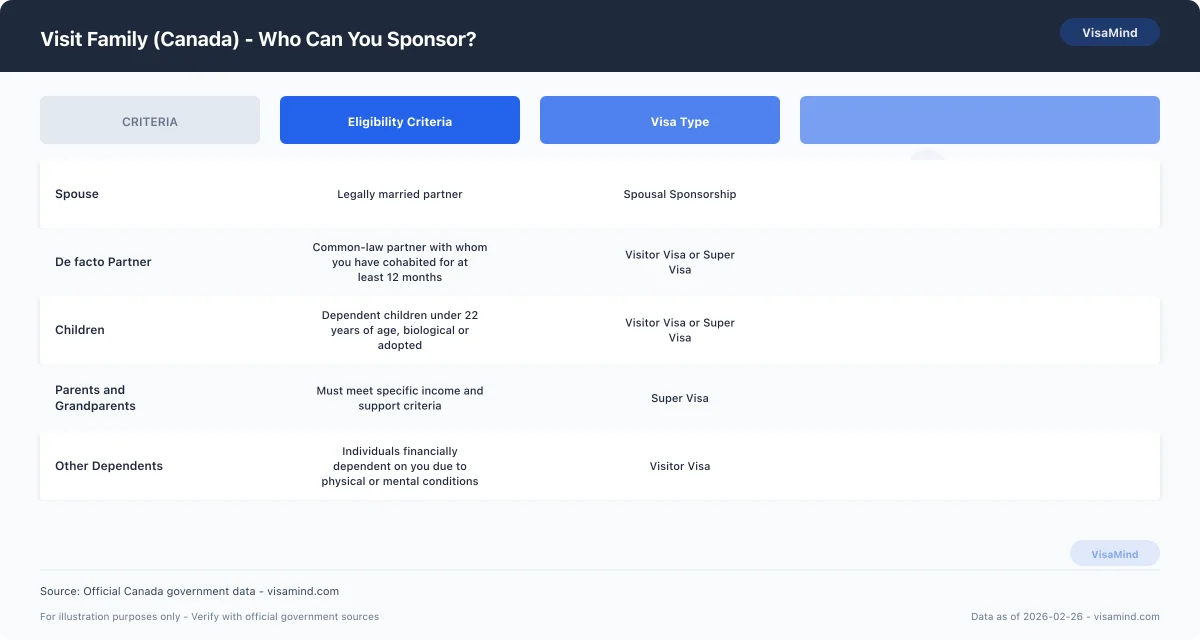
#To visit family in Canada, you need to understand the eligibility criteria for family sponsorship. This entails knowing which relationships qualify and the processes involved. Here is a breakdown of eligible family relationships and their requirements:
Eligible Family Relationships
To apply for a family visit to Canada, you need to have a qualifying relationship with a Canadian citizen or permanent resident. Here are the eligible family relationships:
| Relationship Type | Eligibility Requirements |
|---|---|
| Spouse | Must be legally married to a Canadian citizen or permanent resident. |
| De Facto Partner | Must have lived together in a conjugal relationship for at least 12 months. |
| Children | Must be under 22 years old and not married or in a common-law relationship. |
| Parents and Grandparents | May be eligible for a Super Visa for extended stays. |
| Other Dependents | Includes children over 22 with a disability or other qualifying dependents. |
Understanding the Sponsorship Process
When visiting family in Canada, the sponsorship process is crucial for eligibility. Here's what you need to know:
-
Sponsorship Application: A Canadian citizen or permanent resident must sponsor you. They need to demonstrate their commitment and the genuine nature of the relationship.
-
Financial Support: The sponsor must prove they can support you financially during your stay in Canada. This is essential for dependents and parents applying for a Super Visa.
-
Authorization of Representatives: If using an immigration representative, ensure they are licensed. You can verify their status through IRCC to avoid complications.
Important Considerations
Important: Missing mandatory biometric submissions can delay or invalidate your application. Always check the latest biometric requirements.
To learn more about family sponsorship and other visa options, consider exploring the Family Sponsorship Guide and related visa types such as the Temporary Resident Visa (Visitor Visa) and Electronic Travel Authorization (eTA).
Understanding your eligibility is the first step in visiting family in Canada. Ensure you meet the criteria and gather all necessary documentation to support your application.
Proving Your Relationship
#Proving your relationship with the family member you intend to visit is a crucial part of the application process. This section outlines the types of evidence you can provide to demonstrate your relationship.
Official Documents
- Marriage Certificates: If you are visiting a spouse or partner, a marriage certificate serves as official proof of your relationship.
- Birth Certificates: These are useful for showing parent-child relationships, whether you are visiting a child or a parent.
- Adoption Papers: When visiting an adopted child or parent, provide official adoption documentation to establish the relationship.
Cohabitation and Financial Interdependence
- Joint Lease or Mortgage Documents: If you have lived together with your family member, providing a lease or mortgage in both names can establish cohabitation.
- Shared Utility Bills: Documents like utility bills with both names and a shared address can further substantiate cohabitation claims.
- Joint Bank Account Statements: Statements showing shared financial responsibilities or financial interdependence can be essential.
Personal Evidence
- Photographs: A collection of dated photos depicting family gatherings, holidays, or other events can visually demonstrate your ongoing relationship.
- Communication Records: Emails, letters, or messages showing regular communication with your family member can help verify the relationship.
Additional Documentation
- Affidavits from Third Parties: Statements from friends or community leaders who can vouch for the authenticity of your relationship may support your application.
- Medical Records: If applicable, documents showing shared medical insurance or treatment may be relevant, especially for dependents.
Tip: Always provide translations for documents that are not in English or French. Certified translations should be included to ensure the documents are understood by the case officer.
When preparing your application to visit family in Canada, make sure that the documentation you provide is comprehensive and well-organized. Each piece of evidence contributes to a clearer understanding of your relationship with the family member you wish to visit. For more detailed guidance, consider reviewing the Visitor Invitation Letter and Visitor Visa Financial Proof guides to strengthen your application.
Sponsor Income and Savings
#
When sponsoring a family member to visit Canada, understanding the financial obligations is essential. Sponsors often need to demonstrate sufficient income and savings to support their visiting relatives. This section outlines the financial requirements for sponsors, focusing on income thresholds, savings, and necessary maintenance funds.
Sponsor Income and Savings Requirements
To ensure that your family member's visit is well-supported, you must meet specific financial criteria. Here's a breakdown of the requirements:
| Criteria | Description |
|---|---|
| Income Thresholds | Sponsors may need to prove they meet minimum income levels, often linked to the Low-Income Cut-Off (LICO) values published annually by the Canadian government. Verify the latest LICO values on the IRCC website. |
| Savings | Having a certain amount of savings can be beneficial, especially if your income is close to the threshold. This helps demonstrate your ability to financially support your family member during their stay. |
| Maintenance Funds | You must show you can cover the cost of living and any unforeseen expenses for your family member during their visit. This includes accommodation, food, and health insurance if applicable. |
Tip: It's wise to have financial documents ready, such as bank statements and recent tax returns, to prove your income and savings when requested by the IRCC.
Demonstrating Financial Capacity
Financial documentation plays a crucial role in the application process. Here are the steps you can take to demonstrate your financial capacity:
- Gather Financial Documents: Collect recent pay stubs, tax returns, and bank statements.
- Calculate Total Income: Include all sources of income such as employment earnings, rental income, and any other taxable income.
- Prepare a Budget: Outline anticipated expenses for your family member’s stay, including housing, food, and travel costs within Canada.
- Compile Savings Evidence: If relying on savings, include documentation showing sufficient funds are readily available.
Additional Considerations
Being prepared financially is just one part of the sponsorship process. Other factors, like providing a Visitor Invitation Letter, are essential to strengthen your family member's application. Furthermore, if you are considering a longer visit, exploring options like the Super Visa might be beneficial.
Important: Ensure all financial documents are up-to-date and reflect your current financial situation accurately. Inaccuracies or outdated information can lead to delays or refusals.
Understanding and meeting these financial requirements will help facilitate a smoother process for bringing your family to visit Canada. Be sure to verify all information on the official IRCC website, as requirements can change annually.
The Application Process
#-
Determine Your Eligibility
Before starting the application process to visit family in Canada, it's crucial to determine if you need a visitor visa or an Electronic Travel Authorization (eTA). Citizens of certain countries, like Qatar, will be eligible to apply for an eTA starting November 25, 2025, for air travel. For others, a Visitor Visa (Temporary Resident Visa) may be required. Check the Temporary Resident Visa (Visitor Visa) section for more details.
-
Gather Required Documents
Collect the necessary documents to support your application. This typically includes:
- A valid passport
- Proof of financial support during your stay
- A letter of invitation from your family in Canada, if applicable
- Recent photographs that meet the specifications
- Any additional documents requested by IRCC based on your country of residence
Ensure all documents are complete and accurate to avoid delays.
-
Complete the Application
You can apply online or on paper. For online applications, visit the official IRCC website to access the application forms and instructions. If you choose to use an immigration representative, verify that they are authorized by checking the Visitor Visa ETA Guide.
Tip: Applying online can expedite the process and allows you to track your application status.
-
Pay the Required Fees
The application fee for a visitor visa starts at $CAN 100. Fees vary based on the type of visa and additional services like biometrics. Confirm the exact amount on the IRCC website before making payment.
-
Submit Biometrics, if Required
Depending on your nationality, you may be required to provide biometrics (fingerprints and a photo) as part of your application. This step is crucial and missing it can result in delays or denials. Consult the Biometrics Guide for detailed instructions.
-
Attend an Interview, if Requested
In some cases, IRCC may request an interview to further assess your application. Prepare for this by reviewing common questions and ensuring all your documents are in order. The Interview Prep guide can be a helpful resource.
-
Monitor Application Status
After submission, regularly check the status of your application through your online account. Processing times can vary depending on the applicant's country of residence, so refer to the Processing Times Explained guide for more insights.
Important: Keep all correspondence from IRCC and ensure your contact information is up to date throughout the process.
Processing Times and Waiting
#Understanding the processing times and waiting periods for your application is crucial. This section outlines the current timelines, factors affecting processing speed, and tips for managing your application journey.
Current Processing Times
The processing time for a Temporary Resident Visa (Visitor Visa) to visit family in Canada varies depending on the applicant's country of residence. Processing times are subject to change and can be influenced by several factors, including the volume of applications received and the time of year.
| Visa Type | Processing Time (Estimated) |
|---|---|
| Visitor Visa | Check country-specific processing times on the IRCC website |
| eTA | A few minutes to several days |
Tip: It's advisable to apply well in advance of your planned travel date to account for any unforeseen delays.
Priority Categories and Factors Affecting Speed
Certain categories may receive priority processing, such as applications involving family reunification under specific circumstances. However, in general, the following factors can affect the speed of processing:
- Completeness of Application: Ensure all required documents and information are provided.
- Volume of Applications: High demand periods can slow down processing times.
- Biometrics Requirement: If applicable, the time taken to provide biometrics can affect the overall processing duration.
How Can You Expedite Processing?
While you cannot directly expedite processing, you can take steps to potentially avoid delays:
- Ensure Completeness: Double-check your application for accuracy and completeness before submission.
- Biometrics: Provide biometrics promptly if required. Refer to the Biometrics Guide for more details.
- Authorized Representatives: If using a representative, verify that they are licensed. This ensures that your application is handled by a qualified professional and reduces the risk of errors.
Important: Failing to provide biometrics when required can lead to application delays or refusal.
Checking Status and Updates
After submitting your application, you can check the status online through the IRCC portal. You will need your application number and personal details to log in. Regularly checking your status can help you stay informed about any updates or additional requirements.
For further guidance on understanding processing timelines, visit the Processing Times Explained guide. Additionally, explore options like the Super Visa if applicable, for extended visits with family members in Canada.
Common Refusal Reasons
#Several common reasons can lead to a refusal. Understanding these can help strengthen your application and increase your chance of success.
Insufficient Evidence
- Purpose of Visit: Failing to clearly demonstrate the purpose of your visit can result in a refusal. Ensure you provide detailed information about your family ties in Canada and the reason for your visit.
- Proof of Ties to Home Country: It's crucial to demonstrate strong ties to your home country, such as employment, family, or property, to convince the IRCC that you will return after your visit.
Sham Marriage Concerns
- Relationship Authenticity: If visiting a spouse or partner, you must provide evidence that the relationship is genuine. This includes shared financial responsibilities, communication records, and photos together. For more information on proving relationship authenticity, refer to the Spousal Sponsorship Guide.
Financial Shortfalls
- Lack of Financial Support: You must prove you have enough funds to support your stay in Canada. This includes bank statements, employment letters, or proof of financial support from your family in Canada. Check the Visitor Visa Financial Proof guide for detailed requirements.
Medical and Character Concerns
- Health Issues: Medical inadmissibility can occur if you have a health condition that poses a public health risk or would place excessive demand on Canadian health services. You may need to undergo a medical examination, as outlined in the Medicals and Police Certificates guide.
- Criminal Record: A criminal record can lead to a refusal. It's essential to provide police certificates and any documentation that explains your criminal history and rehabilitation efforts.
Tip: Always keep copies of all documents submitted in your application to address any questions or concerns from the IRCC promptly.
Understanding these common refusal reasons and addressing them in your application can help you avoid pitfalls and increase your chances of obtaining a visitor visa to visit family in Canada. For further insights on refusal reasons, you can explore the Visitor Visa Refusal Reasons guide.
What You Can Do While Waiting
#While you wait for your visitor visa application to be processed, there are important considerations to keep in mind regarding your rights and status.
Work Rights and Limitations
While your application is under review by Immigration, Refugees and Citizenship Canada (IRCC), you cannot work in Canada unless you have an appropriate work permit. If you wish to work while visiting family, consider applying for a Work Permit separately.
Important: Engaging in unauthorized work can affect your current and future visa applications negatively.
Travel Restrictions and Advice
While waiting for your visitor visa decision, it is advisable to limit international travel. Frequent travel can complicate your application process since IRCC may require your passport for visa stamping. If travel is unavoidable, ensure your contact details are updated with IRCC to receive any important notifications promptly.
Implied Status and Bridging Options
If you are already in Canada on a valid visa and have applied for a different visa or an extension before the current one expires, you may have what is known as "implied status." This allows you to remain in Canada under the same conditions as your original permit until a decision is made.
- Bridging Open Work Permit: If transitioning between permits, consider applying for a Bridging Open Work Permit to maintain your work rights while awaiting a decision on a new permit application.
Monitoring Application Status
Regularly check your application status online through your IRCC account. Processing times vary, so staying informed helps in planning your stay or travel efficiently. For more detailed insights, consult the Processing Times Explained guide.
Tip: Opt for online applications to receive immediate confirmation and tracking capabilities, reducing the risk of mail delays.
By understanding these aspects, you can better navigate the waiting period while your visitor visa application is being processed.
Rights and Restrictions After the Visa
#Once you have successfully obtained a Temporary Resident Visa (Visitor Visa) to visit family in Canada, it's important to understand the rights and restrictions associated with this type of visa. While it allows you to enter Canada temporarily, there are specific conditions you must adhere to during your stay.
Temporary vs. Permanent Status
A visitor visa grants you temporary resident status, which means your stay in Canada is limited to a specific period, typically up to six months. This visa does not provide permanent residency rights or allow you to work or study in Canada without additional permits. If you're considering a longer-term stay or permanent residency, you may want to explore other pathways, such as the Express Entry system or the Parent Grandparent Sponsorship.
Residence Requirements
While in Canada on a visitor visa, you are expected to maintain a valid status throughout your stay. If you wish to extend your visit, you must apply for an extension before your current status expires. You can learn more about the process on the Extend Stay page. It's crucial to comply with all conditions outlined by the Immigration, Refugees and Citizenship Canada (IRCC) to avoid any issues with future travel to Canada.
Restrictions on Activities
While visiting family in Canada, there are several restrictions you should be aware of:
- Work and Study: You are not permitted to work or enroll in a study program without obtaining the appropriate work or study permits. For work opportunities, consider applying for a Work Permit if eligible.
- Health Care: As a visitor, you are not covered by Canada's public health insurance system. Ensure you have adequate travel health insurance for the duration of your stay.
- Legal Compliance: You must abide by all Canadian laws and regulations. Any legal infractions could affect your current and future visa eligibility.
Important: Overstaying your visa may result in removal from Canada and could jeopardize future travel plans. Always keep track of your visa expiration date and plan accordingly.
Understanding these rights and restrictions is crucial in ensuring a smooth and enjoyable visit with your family in Canada. Always verify specific details on the official IRCC website and consult with authorized representatives if you have any questions or require assistance.
Path to Permanent Residence
#If you're visiting family in Canada and considering a longer-term stay, there is a pathway you can follow to transition from a temporary resident visa to permanent residence (PR). While a visitor visa, such as the Temporary Resident Visa (Visitor Visa), allows you to enter Canada for a short period, certain programs can facilitate your move to PR status.
Pathways to Permanent Residence
-
Express Entry System:
If you have skills that are in demand in Canada, you might qualify for PR through the Express Entry system. This is a points-based system that assesses candidates on factors like age, education, language proficiency, and work experience. -
Provincial Nominee Program (PNP):
Each province in Canada has its own criteria for nominating candidates for PR. If you have experience or a job offer in a particular province, you might be eligible for the Provincial Nominee Program. -
Spousal or Family Sponsorship:
If you have family members who are Canadian citizens or PR holders, they might be able to sponsor you. This includes options like Spousal Sponsorship and Parent Grandparent Sponsorship.
Timeline to Permanent Residence
The timeline to transition from a temporary resident to a permanent resident can vary significantly based on the pathway you choose. Here's a general overview:
| Pathway | Estimated Time to PR |
|---|---|
| Express Entry | 6 to 12 months |
| Provincial Nominee Program | 1 to 2 years |
| Family Sponsorship | 1 to 3 years |
Important: These timelines are estimates and can change based on the volume of applications and specific program requirements. Always check the latest processing times on the IRCC website.
From Permanent Residence to Citizenship
Once you become a permanent resident, you may be eligible for Canadian citizenship after several years. Generally, you must have been physically present in Canada for at least 1,095 days (3 years) out of the last five years before applying for citizenship. Additionally, you must meet other requirements such as language proficiency and knowledge of Canada.
For more detailed guidance on transitioning from a visitor visa to permanent residence, consult resources like the PR Pathways Overview and explore specific programs that align with your qualifications and aspirations.
What Other Families Experienced
#A software engineer from India wanted to visit his sister in Canada for an important family gathering. His main concern was the complexity of the visitor visa application process. He started by gathering all the required documents, including proof of his employment and financial capacity to cover his stay in Canada. Using the guidance available on the official IRCC website, he ensured that his application was complete before lodging it through the IRCC portal. Despite initial anxiety over the processing time, which can vary by country, he received his visa approval within eight weeks. This allowed him to attend the family event as planned, emphasizing the importance of thorough preparation and timely application submission.
Scenario: Transitioning to an eTA for Qatari Citizens
A business consultant from Qatar frequently visited Canada to meet family and attend professional conferences. Previously, he had to apply for a visitor visa for each trip, which was time-consuming. However, as of November 25, 2025, citizens of Qatar became eligible for an Electronic Travel Authorization (eTA) instead of a visitor visa. Upon learning this, he visited the Visitor Visa ETA Guide to understand the new requirements. By applying online, he was able to quickly secure his eTA, which streamlined his travel plans. This change significantly reduced his application processing time, allowing for more spontaneous visits to Canada.
FAQs
How long does IRCC take to process a Visit Family (Canada) visa?
What are the common refusal reasons for a Visit Family (Canada) visa?
Can I switch from a Visit Family (Canada) visa to a Super Visa for parents?
Can I work in Canada on a Visit Family (Canada) visa?
What can I do while waiting for my Visit Family (Canada) visa approval?
What rights do I have after receiving a Visit Family (Canada) visa?
Can I apply for permanent residence while on a Visit Family (Canada) visa?
Sources
Last reviewed: March 1, 2026
VisaMind provides informational guidance only and is not a government agency. This is not legal advice. Requirements can change and eligibility depends on your specific facts. If your case is complex or high-stakes, consult a licensed immigration attorney.
Next steps
Requirements vary by nationality, purpose, timeline, and case details. Use Find My Visa to get a personalized checklist for Canada with official sources and deadlines.
Find my visa