On this page
- Your Work Visa Options
- Employer Sponsorship Requirements
- How to Apply for a Work Visa
- What You Can and Cannot Do
- From Work Visa to PR
- What Goes Wrong
- Credential Requirements
- Salary Thresholds and Fees
- Tax Rules for Foreign Workers
- Real Scenarios
- Visa options for this goal
- Guides for Germany
- Other goals for Germany
Your Work Visa Options
#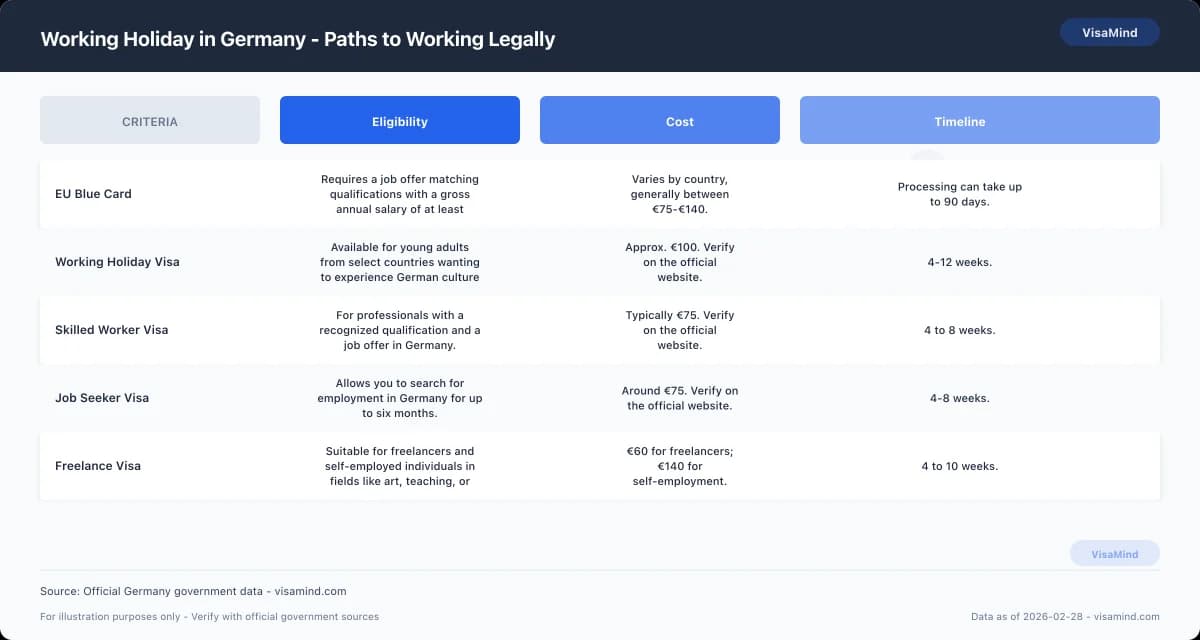
Germany offers several work visa options for those interested in working and living in the country. Each visa type is tailored to different needs, eligibility criteria, and career goals. Below is a comparison of the main work visa categories available, including their eligibility requirements, costs, and timelines.
| Visa Type | Eligibility | Cost | Timeline |
|---|---|---|---|
| Working Holiday Visa | Valid passport from a country with a Working Holiday agreement, age 18-30, first-time participant in Germany | Approx. €75 | 4-6 weeks |
| EU Blue Card | German or comparable foreign academic qualification, job offer with a minimum annual gross salary of €56,800 (as of 2023) | Approx. €100 | 4-12 weeks |
| Skilled Worker Visa | Recognized qualification, job offer in a shortage occupation | Approx. €75 | 4-12 weeks |
| Job Seeker Visa | University degree, sufficient funds, intent to find employment in Germany | Approx. €75 | Up to 6 months to find a job |
| Freelance Visa | Proof of freelance work, sufficient funds, health insurance | Approx. €100 | Varies |
What is the Working Holiday Visa?
The Working Holiday Visa is designed for young travelers who want to explore Germany while working to support their stay. It provides an opportunity to experience the German culture and lifestyle while working temporarily. This visa is available to citizens of countries that have a Working Holiday agreement with Germany and is ideal for those aged 18-30 who have not previously participated in the program.
How Does the EU Blue Card Work?
The EU Blue Card is aimed at highly skilled professionals with a higher education degree and a job offer in Germany. This visa facilitates entry for workers with specialized skills, especially in fields experiencing labor shortages. The required minimum salary threshold is an important criterion, and you can find more about these requirements on the Blue Card EU page.
Are There Other Work Visa Options?
Yes, Germany also offers a Skilled Worker Visa for applicants with vocational qualifications recognized in Germany. This visa targets professions with labor shortages, such as health, engineering, and IT sectors. Additionally, the Job Seeker Visa allows individuals to enter Germany and search for employment for up to six months.
Tip: For those interested in freelance work, the Freelance Visa might be an attractive option, allowing you to work independently in Germany.
What Should You Consider?
When deciding on a visa, consider the eligibility requirements, costs, and processing timelines. Additionally, it's important to have a comprehensive understanding of the financial requirements associated with each visa category. For more information on these aspects, you can refer to the Financial Requirements guide.
To ensure you meet all necessary criteria, gather all required documents and verify current details on the Federal Foreign Office website, particularly if you plan to apply at a consulate abroad. For residence permits and other inquiries within Germany, consult the local Ausländerbehörde (foreigners' authority).
Employer Sponsorship Requirements
#Understanding the requirements for employer sponsorship is crucial for a seamless application process. While the Working Holiday visa primarily allows individuals to explore work and travel opportunities without needing a specific employer sponsor, there are still important considerations for those planning to engage in employment while in Germany.
Do Employers Need to Sponsor Working Holiday Participants?
For the Working Holiday visa in Germany, there is generally no requirement for employers to formally sponsor participants. This means you can work with various employers during your stay without the need for them to provide sponsorship documentation typically required for other work visas, such as the Skilled Worker Visa.
However, employers must still adhere to German labor laws and ensure that your employment complies with the terms of your Working Holiday visa. This includes restrictions such as the duration of employment with a single employer and the type of work that can be performed.
What Are the Employment Conditions?
While on a Working Holiday visa, you are allowed to work in Germany, but there are several conditions to keep in mind:
- Duration Limitations: Generally, you can only work for each employer for a limited period, often up to six months. This encourages a variety of work experiences during your stay.
- Job Type: The work should align with temporary or casual employment typically associated with working holidays, such as hospitality or seasonal work.
- Compliance with Labor Laws: Employers must ensure that your working conditions meet German labor standards, including working hours and minimum wage requirements.
Key Responsibilities for Employers
Even though formal sponsorship isn't needed, employers have certain responsibilities when hiring Working Holiday participants:
- Verify Visa Status: Employers should confirm the validity of your Working Holiday visa and ensure it permits employment.
- Adhere to Legal Obligations: Compliance with employment contracts, remuneration, and working conditions as per German regulations is mandatory.
- Report to Authorities: In some cases, employers may need to report your employment to local authorities, such as the local foreigners' authority, especially if your employment status changes.
Tip: Keep a copy of your employment contract and any related documents, as they might be required for administrative purposes or in case of an employment dispute.
In summary, while employer sponsorship is not a requirement for the Working Holiday visa, both employers and participants must adhere to specific conditions related to employment. By understanding these requirements, you can ensure a productive and enjoyable work experience during your stay in Germany. For more detailed information on other visa options or employment conditions, consider exploring our Working Holiday Guide.
How to Apply for a Work Visa
#Determine Your Eligibility
To apply for a Working Holiday visa in Germany, you must meet specific eligibility criteria. Ensure that you have a valid passport from a country with a Working Holiday agreement with Germany and that you are between the ages of 18 and 30. Additionally, you should not have previously participated in the Working Holiday program in Germany. For more detailed information about eligibility and related visa options, consider checking out the Opportunity Card eligibility requirements.
Gather Required Documents
Before lodging your application, gather all necessary documents. You will need:
- A valid passport with at least two blank pages
- Proof of sufficient funds to support yourself during your stay
- Completed Working Holiday visa application form
- Any additional documents specified by the German consulate handling your application
Ensuring you have these documents ready will streamline your application process and prevent any unnecessary delays.
Submit Your Application
Once you've collected all required documents, you can submit your application to the German consulate in your home country. The Federal Foreign Office (Auswärtiges Amt) is responsible for handling consular visa applications. It's essential to review any specific instructions provided by the consulate, as requirements may vary slightly between locations.
Important: Ensure your passport is valid and not expired before applying. Using an expired passport will result in application rejection.
Pay the Application Fee
As part of the process, you will need to pay a visa application fee. The amount may vary, so verify the current fee on the official website of the German consulate in your country. This fee is non-refundable, even if your application is unsuccessful.
Await Processing
After submitting your application and paying the fee, you will need to wait for the processing to be completed. Processing times can vary based on the consulate's workload and other factors. To get a better understanding of typical timelines, you might find the Processing Times guide useful.
Attend an Interview (If Required)
In some cases, the consulate may request an interview to further discuss your application and intentions in Germany. If this is the case, make sure to prepare thoroughly. Reviewing the Interview Prep guide can help you get ready for this step.
By following these steps and ensuring you meet all the requirements, you increase your chances of a successful application for a Working Holiday visa in Germany. For a comprehensive overview of the Working Holiday program, visit the Working Holiday Guide.
What You Can and Cannot Do
#When participating in the Working Holiday program in Germany, you have the flexibility to work for different employers during your stay. This is one of the key benefits of the program, allowing you to explore various job opportunities across the country. However, it's important to note that you cannot remain with a single employer for more than six months. This limitation is designed to ensure that your experience remains varied and aligns with the temporary nature of the visa.
Can Family Join You?
The Working Holiday visa is intended for individual applicants and does not provide provisions for accompanying family members. If you wish for your family to join you in Germany, they would need to apply for their own visas. Depending on their situation, they might consider options such as the Family Reunion Visa or Spouse Visa to stay in Germany legally.
Important: Family members cannot automatically join you on a Working Holiday visa; each member must apply for a separate visa if they wish to accompany you.
Can You Study?
Studying while on a Working Holiday visa is permitted, but there are restrictions to keep in mind. You can enroll in language courses or other short-term educational programs. However, if you intend to pursue a full academic course or degree, you might need to apply for a Student Visa instead. This specific visa will provide a more appropriate framework for long-term studies in Germany.
Tip: Consider using your time in Germany to take part in language courses, which can enhance your cultural experience and improve your integration into local life.
From Work Visa to PR
#To transition from a Working Holiday Visa to Permanent Residency (PR) in Germany, understanding the pathways and timelines is essential. The process requires strategic planning, especially if you aim to establish a long-term life in Germany. Here’s how a work visa can lead to PR and what you need to know about the timeline.
Transition Pathways to Permanent Residency
After your Working Holiday Visa expires, consider applying for another type of visa that aligns with your career goals. Common options include:
- Skilled Worker Visa: For those with qualifications in demand in Germany’s labor market.
- Blue Card EU: Suitable if you have a high skill level and a job offer with a minimum salary requirement.
- Self-Employed: If you plan to start your own business in Germany.
Each of these visas has specific eligibility requirements and provides a pathway to long-term residency. For more details on visa options, check the Skilled Worker Visa and Self Employed Visa pages.
Timeline to Permanent Residency
The timeline for obtaining PR varies based on the type of visa you hold and your personal circumstances. Typically, it involves the following stages:
- Work Visa Duration: Most work visas are valid for one to four years, depending on the type and terms of employment.
- Residence Requirement: To qualify for PR, you generally need to have lived in Germany for a continuous period, often 33 to 60 months. The exact duration depends on your visa type and whether you meet integration criteria, such as language proficiency.
- Application for PR: Once you meet the residency requirement, you can apply for a Settlement Permit. This involves proving stable income, adequate housing, and sufficient pension provision if applicable.
| Visa Type | Typical Duration | PR Eligibility After |
|---|---|---|
| Skilled Worker Visa | Up to 4 years | 33 months (21 months with B1 German) |
| Blue Card EU | Up to 4 years | 33 months (21 months with B1 German) |
| Self-Employed | Varies | 3 years (if business is successful) |
Tip: Enhance your chances for PR by improving your German language skills and integrating into the local community. This can significantly reduce the waiting period for a settlement permit.
Key Considerations
- Language Proficiency: Demonstrating proficiency in German can accelerate your PR application process.
- Financial Stability: You must show proof of consistent income and financial independence.
- Integration Courses: Completing integration courses may be mandatory or beneficial, depending on your visa type.
For a detailed guide on transitioning to PR, consult the PR Pathway Guide for comprehensive information.
By planning your visa transitions and meeting the necessary requirements, you can set yourself on a successful path to permanent residency in Germany. Always verify the latest requirements and procedures on the official websites to stay informed.
What Goes Wrong
#It's essential to navigate potential pitfalls that could lead to a refusal. Understanding common reasons for rejection will help you avoid mistakes and improve your chances of a successful application.
Eligibility Issues
- Age Limit: You must be between 18 and 30 years old. If you are outside this range, your application will likely be rejected.
- Previous Participation: If you have already participated in the Working Holiday program in Germany, you cannot apply again.
- Passport Requirements: You need a valid passport from a country with a Working Holiday agreement with Germany. Ensure your passport is valid and has at least two blank pages.
Financial Missteps
- Proof of Funds: Failing to provide adequate proof of sufficient funds to support yourself during your stay is a common reason for rejection. Make sure your financial documents are up-to-date and clearly demonstrate your ability to support yourself.
Tip: It's advisable to maintain a bank account balance that comfortably exceeds the minimum required amount before applying.
Documentation Errors
- Incomplete Applications: Submitting an incomplete application is one of the primary causes of rejection. Double-check that all sections of your application are filled out and that you have included all necessary documents.
- Expired Documents: Using expired documents, such as an out-of-date passport, can lead to immediate rejection. Verify the expiry dates of all your documents before submission.
Additional Considerations
- Incorrect Visa Type: Make sure you are applying for the correct visa. If your intentions or qualifications align more closely with another type, such as the Skilled Worker Visa or Opportunity Card, explore those options instead.
For further guidance on avoiding these pitfalls and to ensure your application is complete, refer to the Documents Checklist and Visa Refusal Reasons available on our website.
Credential Requirements
#It's important to understand the credential requirements needed to successfully apply for the visa. This section outlines the necessary skills assessments, qualification recognition, and degree requirements to ensure your application aligns with Germany's immigration standards.
Skills Assessments and Qualification Recognition
- Foreign Qualification Recognition: If you hold a foreign academic qualification, it may need to be recognized in Germany to be considered comparable to a German qualification. You can use the Qualification Recognition process to verify the status of your credentials.
- Tertiary-Level Qualifications: For those without traditional academic degrees, demonstrating a tertiary-level qualification that took at least three years to complete may be required, especially if you're considering transitioning to other work visas like the Blue Card EU.
Important: Ensure your qualifications are recognized before lodging your application to avoid potential delays in the visa process.
Degree Requirements
- Academic Qualifications: While the Working Holiday visa does not specifically require a degree, having a German academic qualification or a recognized foreign equivalent can open up more opportunities, such as applying for an EU Blue Card or other skilled work visas.
- Proof of Education: Even if a degree is not mandatory, providing proof of your educational background can strengthen your application and demonstrate your preparedness for the German job market.
Financial Proof and Age Requirements
- Proof of Sufficient Funds: You must demonstrate that you have enough financial resources to support yourself during your stay. This is a critical component of the Working Holiday visa application process. Refer to the Financial Requirements guide for more details.
- Age Limitations: Applicants must be between 18 and 30 years old and should not have previously participated in the Working Holiday program in Germany.
Tip: Consider opening a German bank account upon arrival to manage finances easily and meet any ongoing requirements for financial sufficiency.
Navigating the credential requirements for a Working Holiday in Germany involves ensuring that your qualifications are recognized and that you meet the necessary financial and age criteria. By preparing these elements in advance, you can enhance your application and broaden your opportunities during your stay.
Salary Thresholds and Fees
#It's crucial to understand the financial requirements that ensure you can support yourself during your stay. While Germany does not set a specific salary threshold for the Working Holiday visa, applicants must demonstrate they have sufficient funds to cover their living expenses. Typically, this means having at least €2,000 readily available in your bank account, though the exact amount may vary. Always check the Financial Requirements for the most current figures.
Application Fees
Applying for a Working Holiday visa involves several costs. Below is a table summarizing the fees associated with the application process:
| Item | Description | Cost (as of 2023) |
|---|---|---|
| Visa Application | Fee for processing the Working Holiday visa application | €75 |
| Additional Fees | Possible costs for document verification or translations | Varies |
Important: Application fees are non-refundable even if your application is denied. Verify fees on the official Federal Foreign Office website.
Minimum Income Requirements
While the Working Holiday visa does not require a formal job offer, you must prove financial independence. As mentioned, having at least €2,000 in savings is a general guideline. Additionally, you may be asked to provide proof of accommodation and travel insurance for the duration of your stay.
Timeline for Application
The processing time for a Working Holiday visa can vary, but typically it takes about 4 to 6 weeks from the time you submit your application at a German consulate. To avoid delays, ensure all documents are complete and adhere to How To Apply guidelines.
Tip: Begin your application process early, especially during peak travel seasons, to accommodate any unforeseen delays.
For more details on the Working Holiday program and other visa options like the Opportunity Card or Job Seeker Visa, explore our comprehensive guides and resources.
Tax Rules for Foreign Workers
#When participating in the Working Holiday in Germany program, understanding your tax obligations and social security contributions is crucial. Here's a breakdown of what you need to know to stay compliant with German regulations.
Income Tax Obligations
In Germany, foreign workers are generally subject to income tax on their earnings. The tax rate can vary depending on your income level, with progressive rates starting at 14% and going up to 45% for higher earners. As a working holiday visa holder, you'll need to register with the local tax office (Finanzamt) to obtain a tax identification number (Steueridentifikationsnummer).
Important: Ensure you register with the Finanzamt shortly after arriving in Germany to avoid any tax-related complications.
Social Security Contributions
Germany has a robust social security system, and as a foreign worker, you'll likely be required to contribute. Contributions typically cover health insurance, pension, unemployment, and long-term care insurance. However, there are exceptions based on the duration of your stay and the nature of your employment.
- Health Insurance: Mandatory for all workers, including those on working holiday visas.
- Pension Insurance: Usually required unless you can prove coverage in your home country.
- Unemployment Insurance: Generally not applicable for short-term stays.
- Long-term Care Insurance: Required if you are covered by statutory health insurance.
Double Taxation Treaties
Germany has agreements with many countries to avoid double taxation, which means you won't be taxed on the same income in both Germany and your home country. It's advisable to check whether your home country has such an agreement with Germany.
| Agreement Type | Purpose |
|---|---|
| Income Tax Treaty | Prevents double taxation on income earned abroad |
| Social Security Treaty | May exempt you from certain contributions |
Tips for Managing Your Taxes
- Keep Records: Maintain detailed records of your income and any taxes paid.
- Consult a Tax Advisor: Consider seeking advice from a tax professional familiar with German laws.
- Check Treaty Benefits: Verify if your country has a treaty with Germany to benefit from reduced tax rates or exemptions.
For more detailed guidance on financial obligations and how they might affect your working holiday experience, you can refer to resources like the Working Holiday Guide or explore other visa options such as the Schengen Visa for short-term stays.
Real Scenarios
#A 25-year-old graphic designer from Australia, Alex, wanted to explore the vibrant art scene in Berlin while gaining international work experience. Alex was eligible for the Working Holiday Visa as Australia has an agreement with Germany, and they met the age requirement and had not previously participated in the program. Before applying, Alex ensured they had a valid passport and proof of sufficient funds for the stay. The application process involved submitting the necessary documents to the German consulate in Australia. Once the visa was approved, Alex moved to Berlin and secured a temporary job at a local design studio. This experience allowed Alex to immerse in the local culture while building a diverse portfolio. The whole process from application to receiving the visa took about two months.
Scenario: Canadian Student Extending a Stay Post-Graduation
After completing a semester abroad in Germany, Emily, a 22-year-old Canadian student, wanted to extend her stay to work and travel in the country. She learned that the Working Holiday Visa was an ideal option for her situation, given her nationality and age. Emily visited the Federal Office for Migration and Refugees (BAMF) website to gather the necessary information and ensure she met all the requirements. After preparing her documents, including proof of funds and health insurance, Emily submitted her application through the German consulate in Toronto. Upon approval, Emily was able to work part-time at a local café in Munich while exploring the surrounding regions. The application process took about six weeks, allowing her to transition smoothly from student life to a working holiday.
Scenario: New Zealander Navigating Financial Proof Challenges
Liam, a 29-year-old from New Zealand, faced a challenge proving sufficient funds for his Working Holiday Visa to Germany. Despite having savings, Liam's bank statements did not initially meet the consulate's requirements. To address this, Liam consulted the Documents Checklist provided by BAMF and adjusted his financial documentation accordingly, including a letter from his bank verifying his account balance. After resubmitting the updated financial proof, his visa was approved, allowing him to work in Hamburg in a tech startup. This realigned his career trajectory while enjoying the rich cultural experiences Germany offers. The revised application process took an additional month, but the outcome was successful, leading to a rewarding working holiday experience.
FAQs
Is proof of funds required for the Working Holiday in Germany visa?
How do I apply for the Working Holiday in Germany visa through BAMF?
Can you switch from a Working Holiday visa to an EU Blue Card in Germany?
What happens if my Working Holiday in Germany application is incomplete?
Can I apply for permanent residency after a Working Holiday in Germany?
What can disqualify you from obtaining a Working Holiday in Germany visa?
Can I work for an employer sponsoring me on a Working Holiday in Germany?
VisaMind provides informational guidance only and is not a government agency. This is not legal advice. Requirements can change and eligibility depends on your specific facts. If your case is complex or high-stakes, consult a licensed immigration attorney.
Next steps
Requirements vary by nationality, purpose, timeline, and case details. Use Find My Visa to get a personalized checklist for Germany with official sources and deadlines.
Find my visa