On this page
- Family Sponsorship Eligibility
- Proving Your Relationship
- Sponsor Income and Savings
- The Application Process
- Processing Times and Waiting
- Common Refusal Reasons
- What You Can Do While Waiting
- Rights and Restrictions After the Visa
- Path to Permanent Residence
- What Other Families Experienced
- Visa options for this goal
- Other goals for Canada
Family Sponsorship Eligibility
#
Understanding the eligibility criteria for family sponsorship is essential. As of 2023, Canada allows citizens and permanent residents to sponsor certain family members for immigration, including spouses, common-law partners, dependent children, and sometimes parents and grandparents. Here, we’ll focus on the eligibility requirements for sponsoring a spouse or common-law partner.
Sponsorship Eligibility
To sponsor a family member to Canada, you must meet specific criteria set by Immigration, Refugees and Citizenship Canada (IRCC). Here's a breakdown of eligibility requirements for different relationships:
| Relationship Type | Eligibility Requirements |
|---|---|
| Spouse | Legal marriage recognized in Canada |
| Common-law Partner | Cohabitation for at least 12 months |
| Dependent Children | Under 22 years old, not married or in a common-law relationship |
| Parents/Grandparents | Must meet income requirements and sign an undertaking |
Key Requirements for Spousal Sponsorship
-
Age and Status: You must be at least 18 years old and either a Canadian citizen, permanent resident living in Canada, or a Canadian citizen planning to return to Canada once your spouse becomes a permanent resident.
-
Financial Support: You must demonstrate the ability to financially support your spouse or partner for three years after they become a permanent resident. This includes providing for basic needs like food, clothing, and shelter without relying on social assistance.
-
Genuine Relationship: You need to provide evidence that your relationship is genuine and not primarily for immigration benefits. This can include photographs, joint financial accounts, and other documents showing a shared life.
-
No Criminal Record: Both you and your spouse should have a clean criminal record. Any past convictions may require additional documentation or could affect the application outcome.
Important: Failing to provide sufficient evidence of a genuine relationship is a common reason for application refusal.
Documentation and Process
Gathering the correct documents is crucial for a successful application. Here are the steps involved:
-
Collect Documentation: Gather proof of your relationship, financial ability, and personal information such as identification documents and police certificates.
-
Submit Application: Once you've compiled your documents, submit them to IRCC along with the required sponsorship application forms. Ensure all forms are complete and accurate.
-
Processing Time: The processing time can vary, but as of 2023, it typically takes about 12 months. Check the Processing Times Explained for the most current estimates.
For more detailed guidance, you may refer to the Family Sponsorship Guide which provides comprehensive information on preparing your application.
Related Sponsorship Options
If you’re interested in sponsoring other family members, consider exploring the Parent and Grandparent Sponsorship program. Additionally, if you're looking for work opportunities, the Spousal Open Work Permit might be available to you.
Tip: Applying online can help avoid mail delays and ensures receipt of your application by IRCC.
For further assistance with the application process, you may want to explore our Visa Application Steps guide.
Proving Your Relationship
#When sponsoring your spouse to move to Canada, one of the critical elements is demonstrating the genuineness of your relationship. Immigration, Refugees and Citizenship Canada (IRCC) requires various forms of evidence to ensure that your relationship is legitimate and not solely for immigration purposes. Here’s a guide on what counts as proof of your relationship:
Legal Documentation
- Marriage Certificate: If you are legally married, a certified copy of your marriage certificate is required.
- Common-Law Partner Documentation: For common-law partners, proof of cohabitation is necessary. This can include a statutory declaration of common-law union.
Proof of Cohabitation
- Joint Lease or Mortgage: Documents showing shared tenancy or ownership of property.
- Utility Bills: Bills in both names at the same address (e.g., electricity, water).
Financial Interdependence
- Joint Bank Accounts: Statements showing shared bank accounts or financial responsibilities.
- Shared Financial Responsibilities: Proof of shared expenses, such as credit card accounts, loans, or insurance policies.
Personal and Social Evidence
- Photographs: A collection of photographs from different occasions, demonstrating the evolution and continuity of your relationship over time.
- Communications: Records of communication between you and your spouse, such as emails, text messages, or phone call logs.
Important: Ensure that all documents are translated into English or French if they are in another language. Also, maintaining a variety of evidence strengthens your application.
Social Ties and Recognition
- Affidavits from Friends and Family: Written statements from friends and family attesting to the authenticity of your relationship.
- Social Media Posts: Screenshots or printouts of social media interactions that demonstrate your relationship.
In addition to gathering these documents, it's beneficial to familiarize yourself with the Family Sponsorship Guide for comprehensive details on the process. You may also want to explore how a Spousal Open Work Permit can enable your spouse to work while the sponsorship application is being processed.
Tip: Keep copies of all documents you submit. This will be valuable in case the IRCC requests additional information or if you need to provide further proof during the application process.
Sponsor Income and Savings
#When sponsoring a spouse under the Canadian immigration system, it is crucial to understand the income and savings requirements that must be met. The Immigration, Refugees and Citizenship Canada (IRCC) sets specific criteria for sponsors to ensure that they can financially support the person they are sponsoring.
Sponsor Income Requirements
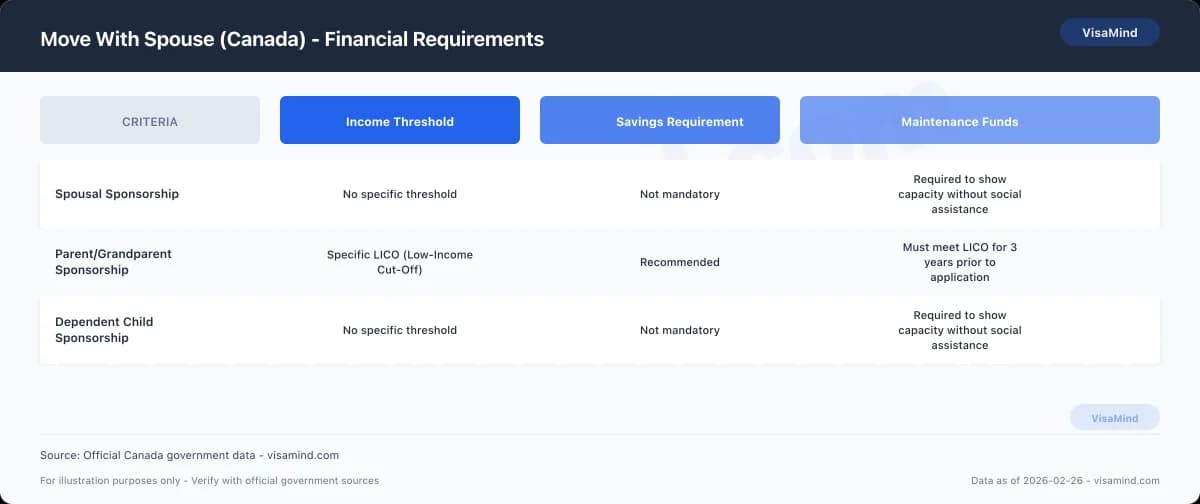
In general, sponsors do not need to meet a minimum income requirement to sponsor a spouse or common-law partner. However, they must demonstrate the ability to provide for their family, including the sponsored person. It's essential to provide evidence of your financial ability, which can include employment letters, pay stubs, and bank statements.
Important: While there is no minimum income requirement for sponsoring a spouse, demonstrating financial stability can strengthen your application.
Savings and Maintenance Funds
While there are no specific savings requirements for sponsoring a spouse, having additional funds can be beneficial. Sponsors should be prepared to provide proof of their savings if requested by IRCC. This may include bank statements or other documentation showing available funds that can be used to support the sponsored spouse.
Understanding the Financial Responsibilities
Sponsoring a spouse involves a significant commitment. As a sponsor, you are financially responsible for your spouse for a period of three years after they become a permanent resident. This means you must be able to support them if they cannot support themselves.
| Criteria | Requirement |
|---|---|
| Income Requirement | No specific minimum, but must show financial capability |
| Savings Requirement | Not mandatory, but proof of savings may be beneficial |
| Financial Responsibility | Responsible for spouse for 3 years post-permanent residency |
For more detailed guidance on financial requirements and the sponsorship process, consult the Family Sponsorship Guide or explore related visas like the Spousal Sponsorship. Understanding these aspects will help ensure a smoother application process.
Tip: Keep thorough records of all financial documents submitted as part of your application to avoid delays or refusals.
If you want to learn more about the path to permanent residence or other family sponsorship options, check out our Permanent Residence section for valuable insights.
The Application Process
#Moving to Canada with your spouse involves several key steps to ensure that the application for sponsorship is correctly lodged and processed. Below is a detailed guide on how to navigate the process with Immigration, Refugees and Citizenship Canada (IRCC).
-
Review Eligibility and Gather Documentation
Before starting your application, ensure that you meet the eligibility criteria for sponsoring your spouse. This includes being a Canadian citizen or permanent resident. You'll need to gather personal information such as your financial, medical, and work details, as well as evidence of your relationship, like marriage certificates or joint financial records.
Important: Providing insufficient evidence of your relationship is a common pitfall. Ensure all documentation is thorough and clear.
-
Complete the Sponsorship and Permanent Residence Applications
Begin by completing the relevant sponsorship application forms provided by IRCC. Make sure to include all required sections and signatures. The forms typically require detailed information about both the sponsor and the person being sponsored. It's crucial to follow the instructions specific to your eligibility category.
-
Submit Your Application
Once your forms are complete and all necessary documents are gathered, submit your application to the appropriate IRCC office. Ensure that your package is complete to avoid delays due to missing information. Remember, any incomplete submissions can lead to processing setbacks or even refusals.
Tip: Consider submitting your application online. It can speed up the process and provides a receipt number for tracking.
-
Biometrics and Interviews
After submitting your application, you may be required to provide biometrics and attend an interview. IRCC will inform you if these steps are necessary. Biometrics typically include fingerprinting and a photograph, which help confirm your identity.
-
Await Decision
Once IRCC receives your complete application, they will assess it. Processing times can vary, so it's important to check the latest timelines on the IRCC website. During this period, you can visit family in Canada under certain conditions if you meet the requirements for a Temporary Resident Permit.
Tip: Keep a copy of all submitted documents and correspondence with IRCC for your records.
Understanding each step of the application process is crucial in ensuring that your move with your spouse to Canada is successful. For more detailed guidance, you may explore the Spousal Sponsorship visa type or consult the Visa Application Steps guide.
Processing Times and Waiting
#Processing times for sponsoring a spouse or partner to become a permanent resident in Canada can vary significantly. The time it takes to process an application depends on several factors, including the specific category of the application and the completeness of the submitted documents. Here is a breakdown of the processing times and what can affect them:
Processing Times and Influencing Factors
| Application Type | Processing Time | Priority | Factors Affecting Speed |
|---|---|---|---|
| Spousal Sponsorship (Inland) | Approximately 12 months | Standard | Completeness of application, biometrics submission, criminal and medical checks |
| Spousal Sponsorship (Outland) | Approximately 12 months | Standard | Country of origin, application completeness, additional document requests |
| Priority Cases | Varies (expedited) | High | Humanitarian grounds, urgent family needs |
Factors Influencing Processing Times
-
Completeness of Application: Ensure that your application is thorough and includes all necessary documents. Missing information or documents can lead to delays.
-
Biometrics and Background Checks: Timely submission of biometrics and completion of background checks are crucial. Delays in these areas can extend processing times. More details can be found in the Biometrics Guide.
-
Country of Origin: Applications from certain countries may require additional processing time due to specific security or procedural requirements.
-
Priority Categories: Some cases may qualify for expedited processing based on humanitarian grounds or urgent family needs. However, these are assessed on a case-by-case basis by the IRCC.
Tip: Submit your application online to expedite initial processing and receive a quicker confirmation of receipt.
How to Monitor Your Application Status
Once you have submitted your sponsorship application, you can check its status online through the IRCC website. Keeping track of your application status can help you prepare for any additional documentation requests or interviews that may arise.
For more detailed insights into processing times and what each stage entails, you may refer to the Processing Times Explained guide. This can provide you with a clearer understanding of the various stages involved in the application process.
Tips for Avoiding Delays
-
Gather All Necessary Documents: Before applying, collect all required documents, including evidence of relationship, personal details, and any other necessary paperwork. Refer to the Visa Application Steps to ensure you have everything needed.
-
Respond Promptly to Requests: If the IRCC requests additional information or documents, respond as quickly as possible to avoid further delays.
-
Understand the Requirements: Familiarize yourself with the specific requirements and instructions for your application category. This can significantly reduce the chances of errors or omissions.
By understanding these factors and preparing your application carefully, you can help ensure a smoother process as you navigate the path to permanent residence for your spouse.
Common Refusal Reasons
#It's essential to be aware of common reasons for application refusals. Understanding these can help you prepare a stronger application.
Insufficient Evidence
-
Proof of Relationship: One of the most common reasons for refusal is inadequate evidence of a genuine relationship. You need to provide comprehensive documentation such as marriage certificates, photographs, communication records, and joint financial statements.
-
Incomplete Documentation: Submitting incomplete documents or missing pages can lead to delays or refusals. Ensure all required documents are properly gathered and submitted.
Tip: Carefully review the Spousal Sponsorship Guide to understand the necessary documentation.
Sham Marriage Concerns
-
Authenticity Doubts: If IRCC suspects the marriage is not genuine and was entered into primarily for immigration purposes, the application may be denied. It's important to provide ample evidence that demonstrates the authenticity of your relationship.
-
Interviews: In some cases, you may be required to attend an interview to further verify the legitimacy of your marriage. Be prepared to answer questions about your relationship history and future plans.
Financial Shortfalls
-
Minimum Income Requirements: As a sponsor, you must meet minimum income levels to support your spouse or partner. Failing to meet these financial requirements can result in refusal.
-
Proof of Financial Support: You should provide tax documents, employment letters, and bank statements to demonstrate your ability to financially support your spouse or partner.
Important: Verify the current financial requirements and thresholds on the official IRCC website to ensure compliance.
Medical and Character Issues
-
Medical Examinations: Your spouse or partner must undergo a medical examination to ensure they do not pose a health risk to Canadians. Failure to pass this examination can lead to refusal.
-
Criminal Record: A criminal record can be a significant hurdle. If applicable, consider seeking legal advice to address any potential issues.
For more on avoiding these pitfalls and ensuring a successful application, explore related topics like Visa Refusal Reasons and Medicals and Police Certificates.
What You Can Do While Waiting
#While waiting for your spouse’s application to be processed by Immigration, Refugees and Citizenship Canada (IRCC), there are several important aspects to consider regarding your rights and status in Canada.
Work Rights
If you are already in Canada, you may be eligible to apply for a Spousal Open Work Permit. This permit allows you to work for almost any employer in Canada while your sponsorship application is being processed. Having the ability to work not only provides financial benefits but can also help integrate you into Canadian society.
Implied Status and Bridging Options
If you are applying from within Canada and your current visa or permit is about to expire, you may benefit from implied status. This means you can legally remain in Canada under the conditions of your original permit until a decision is made. Alternatively, if you are transitioning from a temporary status, consider applying for a Bridging Open Work Permit to maintain your work status.
Tip: Ensure you apply for the Bridging Open Work Permit before your current status expires to avoid any legal complications.
Travel Restrictions
While awaiting a decision, consider the implications of travel. Leaving Canada might affect your application or your ability to return, especially if your visa or permit expires while you are outside the country. If traveling is necessary, ensure you have a valid Temporary Resident Visa to re-enter Canada.
Key Considerations
- Maintain Communication: Regularly check your email and any official IRCC correspondence for updates or requests for additional information.
- Document Updates: Keep all documentation current, including health checks and police certificates, as they may be requested during the processing period.
- Monitor Processing Times: Stay informed about typical processing times by consulting resources like the Processing Times Explained.
By understanding and managing these aspects, you can better navigate the waiting period and prepare for a smooth transition to permanent residency.
Rights and Restrictions After the Visa
#Once your spouse or partner is approved for permanent residence in Canada through the spousal sponsorship process, they will gain certain rights and face specific restrictions. Here's what to expect after the visa is granted:
Rights After Receiving Permanent Residence
Upon approval, your spouse or partner will enjoy many benefits as a permanent resident of Canada:
- Live, Work, and Study: They can live anywhere in Canada and have the right to work or study without the need for additional permits.
- Access to Social Benefits: They will be eligible for most social benefits that Canadian citizens receive, including healthcare coverage.
- Path to Citizenship: After residing in Canada for a certain period, they may apply for Canadian citizenship. The general requirement is physical presence in Canada for at least 1,095 days (three years) out of the five years preceding the application.
Restrictions and Conditions
Despite these rights, there are certain conditions and restrictions that apply to new permanent residents:
- Residency Obligation: To maintain permanent resident status, they must meet residency requirements by being physically present in Canada for at least 730 days (two years) within a five-year period.
- Criminal Convictions: Engaging in serious criminal activity can lead to loss of permanent resident status and removal from Canada.
- Sponsorship Conditions: If the sponsorship includes financial support conditions, the sponsor must fulfill these obligations, typically for three years.
Important Considerations
Important: Failing to meet the residency obligation can result in the loss of permanent resident status. Keep records of time spent in Canada to easily demonstrate compliance if needed.
If your spouse or partner needs to work while waiting for their permanent residence application to be processed, they might be eligible for a Bridging Open Work Permit. This can help maintain financial stability during the waiting period.
For more details on transitioning from a work permit to permanent residency, you can explore the PGWP to PR Roadmap. This guide offers insights into making a seamless transition from studying or working in Canada to becoming a permanent resident.
Path to Permanent Residence
#The journey from being sponsored as a spouse to becoming a permanent resident of Canada involves several important steps. Initially, you and your spouse must ensure eligibility to apply under the Spousal Sponsorship category, which facilitates family reunification. Once the application is lodged with Immigration, Refugees and Citizenship Canada (IRCC), the application processing time can vary, typically ranging from 12 to 18 months. Accurate and complete documentation is crucial to avoid delays or refusals.
Tip: Always verify current processing times on the official IRCC website to ensure you have the most accurate timeline.
How Can You Transition to Permanent Residency?
Once the spousal sponsorship is approved, the sponsored spouse will receive permanent resident status. This status allows you to live, work, and study anywhere in Canada. Additionally, it provides access to most social benefits Canadian citizens receive, including health care coverage.
Steps to Transition:
- Receive confirmation of spousal sponsorship approval.
- Obtain your Confirmation of Permanent Residence (COPR) document.
- Land in Canada and complete the final immigration interview with a Canada Border Services Agency (CBSA) officer.
- Receive your Permanent Resident Card by mail.
How Long Until You Can Apply for Citizenship?
After becoming a permanent resident, you may be eligible to apply for Canadian citizenship. As of 2023, you must have been physically present in Canada for at least 1,095 days (three years) within the five years before your application. This period must include time spent as a permanent resident. Additionally, applicants must meet language and knowledge requirements unless exempted.
Eligibility Criteria for Citizenship:
- Physical Presence: At least 1,095 days in Canada.
- Language Proficiency: Proof of language skills in English or French.
- Knowledge of Canada: Pass a test on Canadian history, values, institutions, and symbols if you are between 18 and 54 years old.
Important: Ensure all residency days are accurately tracked and documented to avoid discrepancies during the citizenship application process.
Resources for Further Guidance
For more detailed information on transitioning from a temporary status to permanent residency, you can refer to related guides such as the PR Pathways Overview and Permanent Residence Situation. It is also advisable to stay informed through official IRCC updates and resources available through their website.
What Other Families Experienced
#A software developer from India, recently married to a Canadian citizen, was anxious about proving the legitimacy of their relationship to Immigration, Refugees and Citizenship Canada (IRCC). Given the recency of their marriage, they knew they had to provide compelling evidence to support their application. They gathered photographs, travel itineraries, and communications spanning their courtship and wedding, and submitted them with their sponsorship application. The couple also provided affidavits from family and friends affirming the authenticity of their relationship. Utilizing the IRCC's Spousal Sponsorship pathway, they successfully demonstrated their genuine commitment. Within nine months, IRCC approved their application, allowing the spouse to join their partner in Canada as a permanent resident.
Scenario: Long-Distance Relationship Documentation
A nurse from the Philippines faced the challenge of documenting a long-distance relationship for spousal sponsorship. They had been in a relationship with their Canadian partner for over three years but had only met in person twice. To address this, they provided a comprehensive timeline of their relationship, including digital communication logs, call records, and detailed descriptions of shared interests and future plans. They followed the guidelines outlined in the Family Sponsorship Guide to ensure comprehensive documentation. Despite the physical distance, their diligent preparation paid off. After 12 months of processing, IRCC granted the nurse permanent residency, reuniting them with their partner in Canada.
Scenario: Overcoming Missing Document Challenges
An engineer from Brazil encountered a hurdle when IRCC requested additional documentation to verify financial support from their Canadian spouse. Initially, they had submitted the sponsorship application without complete financial records due to unforeseen delays. They promptly responded to the IRCC request by gathering and submitting the necessary financial documents, including pay stubs and bank statements. Thanks to the structured guidance from the Visa Refusal Reasons, they avoided potential pitfalls that could have led to a refusal. Within six months of addressing the request, their application was approved, and they moved to Canada to start their new life together.
FAQs
What financial requirements must be met for the Move With Spouse (Canada) application?
Can my spouse work in Canada while waiting for the Move With Spouse (Canada) application to be processed?
What are common refusal reasons for the Move With Spouse (Canada) application by IRCC?
How can I combine a Move With Spouse (Canada) application with studying in Canada?
What rights do I have after obtaining a visa through Move With Spouse (Canada)?
What should I do if my Move With Spouse (Canada) application is delayed?
What experiences have other families shared about the Move With Spouse (Canada) application?
Sources
Last reviewed: March 1, 2026
VisaMind provides informational guidance only and is not a government agency. This is not legal advice. Requirements can change and eligibility depends on your specific facts. If your case is complex or high-stakes, consult a licensed immigration attorney.
Next steps
Requirements vary by nationality, purpose, timeline, and case details. Use Find My Visa to get a personalized checklist for Canada with official sources and deadlines.
Find my visa